Googlebot 2 MB Limit, Commerce Protocols and Core Update
Measure Googlebot limits per uncompressed response, verify commerce availability in the actual flow, and diagnose the March update separately from Search Console logging changes.

Googlebot's download limit, agentic commerce availability and the March core update require different checks. Measure each critical response, verify the actual purchase flow and use first-party search evidence before assigning a traffic cause.
Googlebot's per-resource download limit
Googlebot documentation describes the first 2 MB of supported HTML or other files, with a separate 64 MB limit for PDFs. It counts response headers and uncompressed content. The technical explanation says the downloaded portion is passed onward as a complete file, while bytes beyond the limit are ignored.
Linked resources are fetched separately. An HTML file, external stylesheet and script do not become one combined response for this rule. Total page weight still matters for user performance, but it is a different measurement.
Google documents a separate 64 MB PDF limit. Response headers count toward the uncompressed measurement. Large inline scripts, serialized data or CSS can push necessary content beyond the downloaded portion. Check representative product, category, search and article templates. Measure actual uncompressed responses rather than using the compressed transfer total or a screenshot as a substitute.
Save response headers and body, measure their sizes and inspect what appears before the documented limit. Check title, canonical, robots directives, important links and primary content. After a correction, fetch the deployed response again and record date, size and hash. Moving code to an external file does not remove the need to fetch that resource successfully.

Agentic commerce with verified availability
Google introduced Universal Commerce Protocol on January 11, 2026, describing development with companies including Shopify, Etsy, Wayfair, Target and Walmart. The announcement concerns an open protocol and specific commerce integrations, rather than proving every merchant can use every checkout feature.
OpenAI's initial checkout announcement described a distinct initiative using Agentic Commerce Protocol. It distinguished organic product results from sponsored placement and retained the merchant as seller of record. Availability and checkout behavior have changed since that announcement. Verify the current merchant documentation and actual flow before describing an in-chat purchase as generally available.
For a merchant audit, record country, plan, interface and date. Test discovery, product selection, checkout handoff and purchase as separate states. A displayed product or supported protocol does not prove a paid order. Agentic interfaces still depend on accurate product pages, feeds and order operations.

Merchant data and transaction checks
Keep title, description, price, availability, variants, images and policies synchronized. Stable identifiers help avoid mixing incompatible variants. Product structured data must match visible information and cannot repair inaccurate inventory.
Test shipping, tax, returns and out-of-stock behavior through the real flow. Record failures and the system responsible. A product discovery test can pass while checkout fails, so measure each stage independently. Do not apply an unsupported universal protocol penalty or assume that a site becomes unnecessary.

March core update evidence
Google's status history records the March 27 rollout with a duration of 12 days and 4 hours. It does not publish sector loss percentages or establish a new sitewide Core Web Vitals scoring rule. Separate third-party observations from documented system guidance.
For an affected site, compare clicks by page and query under comparable filters. Review competing results and technical changes during the same interval. Use people-first content questions to evaluate purpose and evidence. They cannot guarantee recovery or identify one metric as the cause of a domain's result.

Search Console's logging correction
Google's anomaly log documents inaccurate impressions from May 13, 2025 through April 27, 2026. CTR and average position were also affected, while clicks were not. Annotate that interval rather than treating its reporting as a stable comparison series.
Use click patterns and first-party outcomes to investigate real performance, keeping their measurement limits. A changed impression denominator does not by itself establish changed demand. Do not apply a single invented adjustment factor to historical rows.

Separate crawl size from user performance
A heavy image or video can harm loading without occupying the HTML response. Inline data can create download-limit risk even on a page that seems fast after loading. Maintain separate response-size checks and user-performance measurements.
Place necessary metadata and primary content early, remove unused serialized data and externalize resources when appropriate. Verify that rendering and accessibility still work afterward. Performance thresholds and per-resource download limits should each retain their documented meaning.
Start this week's work with the largest critical HTML responses, then validate product information and the available commerce flow. Annotate the core rollout and logging correction in the search report. The agent-readiness review provides task-level acceptance checks, while the ecommerce agent review distinguishes discovery from a completed transaction.

Measure response bytes with a repeatable procedure
Choose representative URLs from templates likely to contain large inline data: product families, categories, search results and long articles. Save final response headers and the uncompressed body. Use the same public response path that the investigation concerns, and record whether a cache or security layer returned a different body.
Measure headers and body separately, then assess their combined uncompressed size against the applicable resource limit. A compressed transfer figure cannot substitute for that measurement. Linked images, JavaScript and stylesheets are separate resources. Their total weight belongs in a loading-performance analysis.
Inspect the location of the main content, canonical, robots directives and useful links in the response. A large serialized state block before the main explanation can consume the available portion. A page below the limit can still fail through missing content, an error response or a rendering dependency. The byte check is one test, not a certification of indexability.
A worked distinction between two heavy pages
Consider one product page with modest HTML and large external images. Its user loading performance may need work even though the HTML is comfortably within the download limit. Another page can contain oversized inline catalog data while showing a visually simple design. Its response-size issue may be invisible in a screenshot.
For the first, investigate media delivery and actual user performance. For the second, inspect serialized data and response construction. Externalizing unused code or data can help, but the remaining resources must still load and the page must preserve accurate content. These are illustrative cases, not measurements of a named site.
Separate the commerce specification from the launch receipt
UCP and ACP are distinct initiatives with their own specifications, partners and implementation routes. An announcement establishes what its publisher described at that time. It does not establish current availability for a particular country, merchant or account. Preserve the date and scope when discussing an initial launch.
Build a merchant worksheet with interface, market, eligible offers, integration status and transaction stage. A visible product is discovery. A cart operation is a separate event. Checkout completion and a paid order require their own records. Keep the merchant's seller and fulfillment responsibilities clear rather than describing conversational checkout as the disappearance of the store.
Follow one offer from catalog to order
Start with a stable product and variant identifier. Compare title, selected variant, price, currency and stock in the feed, public page, applicable structured data and checkout. Then check delivery cost, return policy and payment failure. An accurate discovery result can still lead to an unavailable or mismatched offer.
Assign discrepancies to the system that owns the data. After correction, repeat the same sample and retain timestamps. Reconcile order identifiers and handle cancellations or refunds in outcome reporting. A protocol profile or valid Product object is insufficient evidence of a completed sale.
Restore the update analysis without invented system changes
The official core-update window provides a calendar for comparison. It does not identify sector winners or a hidden sitewide Core Web Vitals rule. Analyze actual clicks by query, page, device and market. Review template releases, indexing and changed result layouts as competing explanations.
Keep the content review concrete: purpose, original evidence, accuracy and the task served. A page can need improvement without the update being proved as the cause of its loss. Likewise, a loading issue warrants a performance fix without requiring a claim that Google changed its scoring architecture.
A weekly action list with distinct receipts
The technical work should leave saved responses, size measurements and a verified corrected version. Commerce work should leave consistent offer data and the observed transaction state. Search reporting should leave comparable click exports and annotations for rollout and the impression anomaly.
Keep owners and follow-up conditions for each queue. If the byte check passes but a purchase fails, continue with commerce operations. If traffic reporting changes while clicks remain stable, inspect measurement. Completing one queue does not automatically complete the others, and a short review schedule does not promise search recovery.
Frequently Asked Questions
How should response size be verified?
Save final headers and uncompressed body, measure both and inspect the location of important content. Keep linked resources and loading-performance analysis separate.
Can an accurate product result still fail commercially?
Yes. Variant mismatch, stock, delivery, payment or order-state failures can occur later. Reconcile the final order independently of discovery and cart creation.
Does the limit apply to the combined page weight?
No. Google documents a per-resource uncompressed download limit, with linked resources fetched separately.
Does protocol support prove a completed purchase?
No. Discovery, checkout initiation, handoff and a paid order require separate verification.
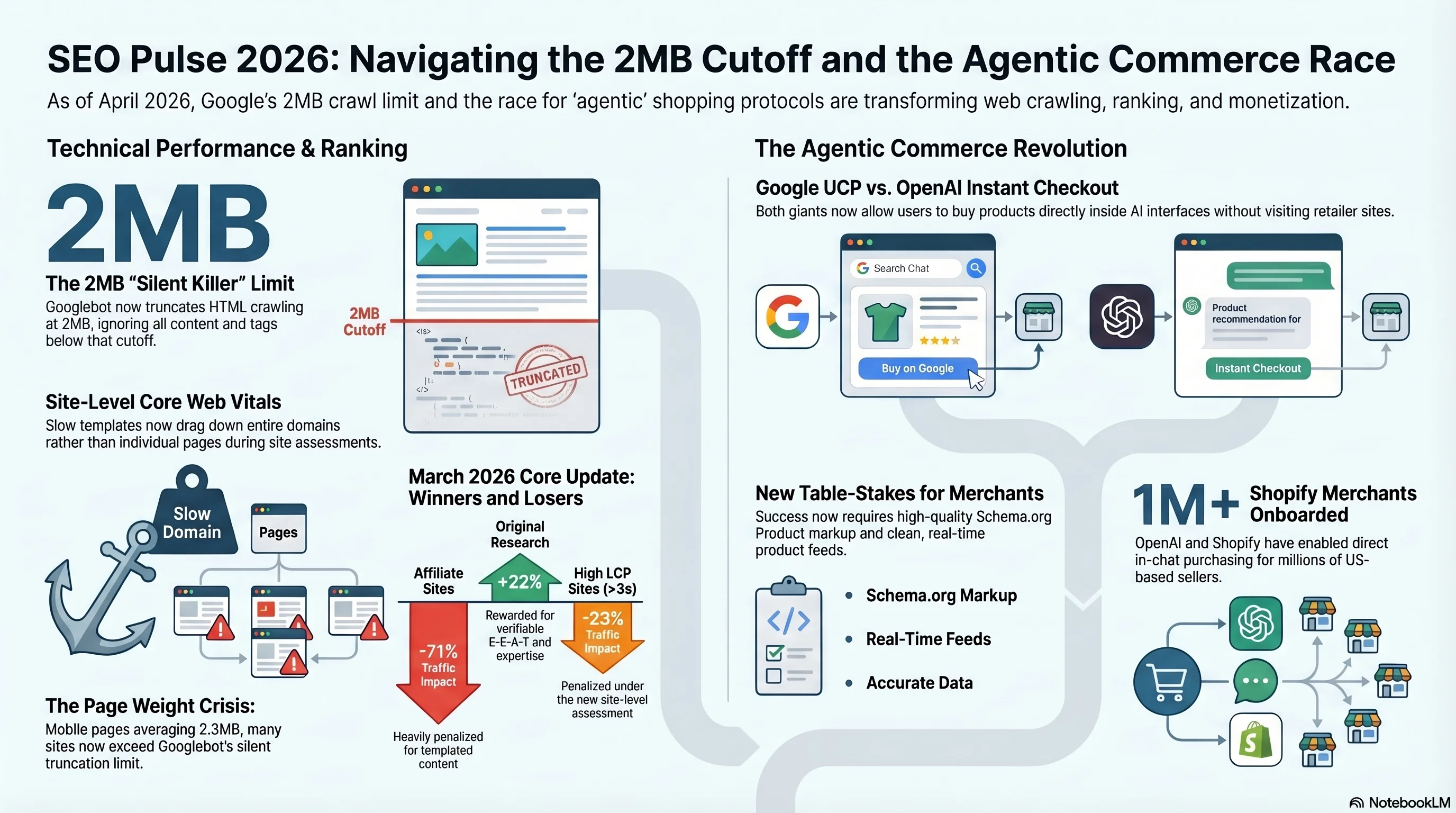
Watch the video page: SEO Pulse: 2MB Cutoff, Agentic Commerce, Core Update (60s recap)
About the Author