Comparison and Alternatives Pages With Evidence Behind the Verdict
Build comparison pages around distinct purchase decisions and retain evidence for each material claim. Repair unsupported recommendations before expanding. Useful research reduces avoidable risk without guaranteeing rankings or AI citations.

A buyer replacing software because an export is missing can make the wrong purchase from an accurate comparison table. The replacement may advertise the export while reserving it for a more expensive plan. If the page compares headline prices without checking that detail, its verdict fails the buyer even though the feature names are correct.
That is the research problem to solve before expanding a comparison library. Before approving another comparison page, I would ask which purchase decision it answers and which evidence supports the recommendation. A template supplies structure, while the recommendation still needs its own justification. Useful research reduces avoidable editorial and policy risk, without making a page immune to Google updates or guaranteeing an AI citation.
TLDR. Build around a buyer's decision and make the verdict traceable to dated evidence. Distinguish hands-on findings from vendor specifications. Review overlapping pages before adding more, and choose improvements or exclusions by purpose. Keep Google Search reporting separate from a repeated sample of AI answers.
Buyer decisions and comparison scope
An “X vs Y” page can evaluate two named candidates. An “X alternatives” page has to explain the reason for replacing X. A category shortlist needs a basis for including and excluding products. These distinctions help set the research task. They are editorial planning choices rather than Google's required URL taxonomy.
In the hypothetical export example, the useful comparison checks the required format on the recommended subscription. It also examines the constraint that could prevent switching. A different buyer choosing an initial subscription may need a different answer, even when the candidate products overlap.
Google's reviews system explicitly includes comparisons and ranked recommendations within its scope. Its high-quality reviews guidance favors evidence, meaningful distinctions and reasons for a recommendation. Those documents recognize the format without establishing a ranking advantage for every comparison page.
Before commissioning one, review actual customer questions and relevant search evidence. Search Console can expose queries already associated with a property, though missing rows cannot prove there is no demand. Check the decision and expected answer for the intended market. No keyword volumes or product-pair opportunities have been measured here.
Scaled-content risk and Lily Ray's observation
Lily Ray described an unnamed site in a November 23, 2026 X post, after reading someone's LinkedIn account of scaling AI-made comparison, alternatives and listicle pages for GEO. She checked its trajectory and associated its decline with what she called that year's January 20 Google update.
That is her observation of one site, using third-party estimates. It cannot establish that comparison pages caused the decline, and it is not a controlled test. The retrieved Google Ranking history did not confirm a January 20, 2026 update. Contemporary reporting described unconfirmed volatility around January 20-21. The date should retain that qualification rather than become an official core or spam update name.
The firmer basis for evaluating a publishing program is Google's scaled content abuse policy. It addresses many pages created primarily to manipulate rankings without helping users, regardless of production method. AI use, a shared template or a particular page count alone does not establish a violation.
Doorway pages and site reputation abuse require separate assessments. Similar intermediary pages with little distinct utility can warrant a doorway review. Reputation abuse depends on the specified third-party-content and host-signal conditions. Publishing a comparison of the company's own product does not automatically meet those conditions.
Keep weak research distinct from prompt injection and listicle manipulation. A comparison can mislead buyers through an unsupported verdict without containing any instruction aimed at an assistant.
Evidence requirements for a defensible verdict
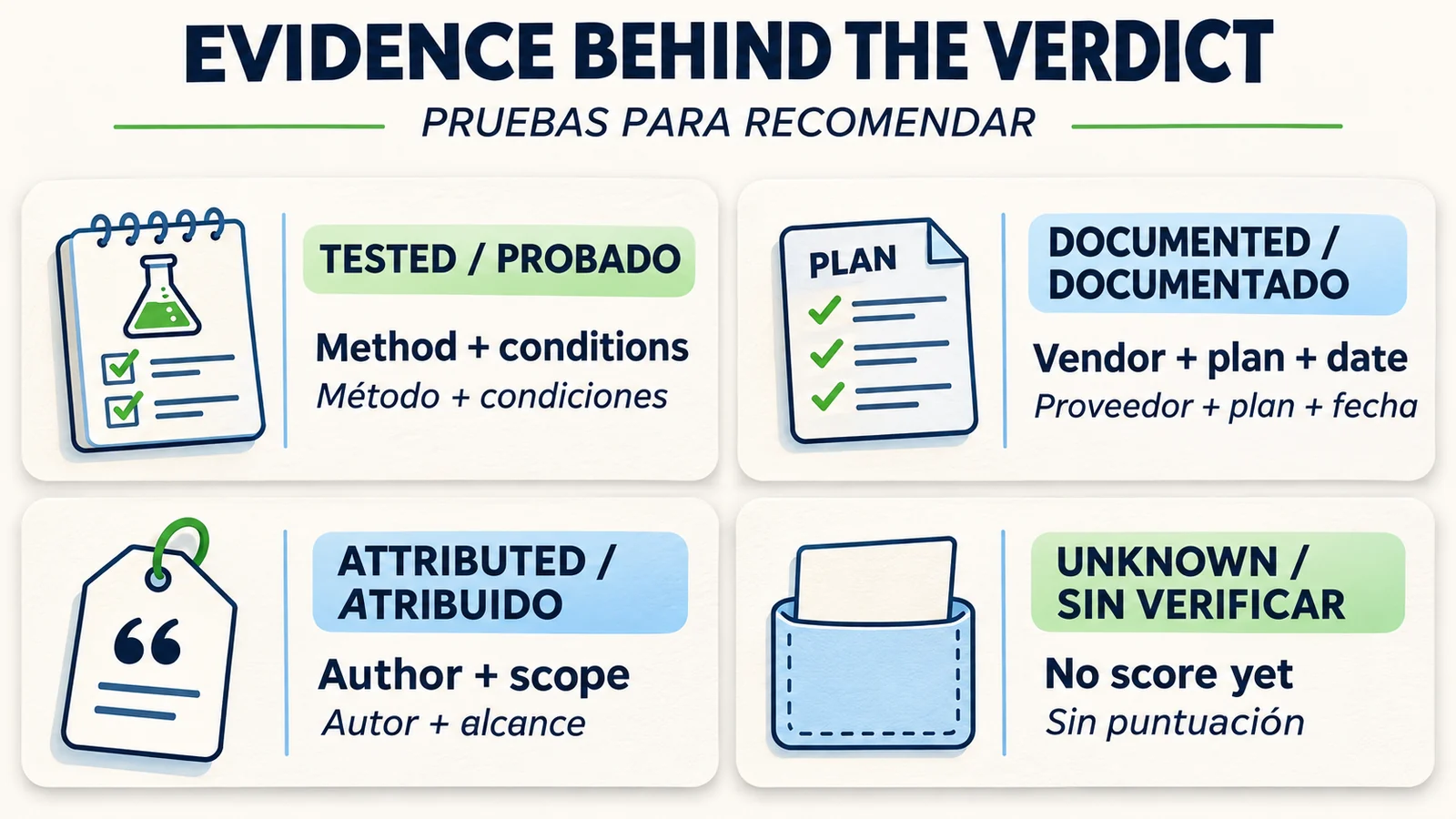
A dated product-page capture supports what the vendor advertised. It does not show how the product behaved during use. The method should let a reader distinguish a documented specification comparison from a hands-on review before accepting the recommendation.
Retain an evidence note beside each claim that could change the purchase decision. Record the plan and date, then identify what was tested or documented. Google's people-first content questions ask about original information and substantial value beyond rewriting sources. Reformatting vendor copy into a table leaves that question unresolved.
| Evidence type | Record to retain | Limit on the claim |
|---|---|---|
| Hands-on finding | Method, conditions and captured result | Applies to the tested setup |
| Vendor specification | Dated documentation and relevant plan | Advertised capability, not a test result |
| Third-party observation | Original attribution and scope | Remains that author's observation |
| Unknown | Missing evidence and the question to resolve | Excluded from a scored verdict |
This record is an editorial recommendation, not a Google scoring formula. No minimum number of screenshots, table rows or words is implied. Its purpose is to make a verdict checkable and changing facts easier to maintain.
Compare prices on equivalent terms. A monthly equivalent billed annually needs that condition, along with currency and any limit relevant to the buyer's task. If the required capability is available only after an upgrade, compare the applicable plan. A cheaper entry price cannot support a cheaper-solution verdict when it excludes the job being evaluated.
Explain a condition where the preferred option fits less well. That may be a migration constraint or a feature available on a competing plan. Give the reason and its evidence instead of adding a token drawback for apparent balance. Disclose the publisher's commercial relationship and identify the scope of any testing. Google's generative AI guidance permits useful assistance, but generating more prose cannot replace missing product research.
The jewelry-brand AI comparisons case offers related context in an account attributed to Growing Search. Its published account is not a controlled test of comparison-page formats, and no numerical preference rate is established here.
Publication checks before library expansion
Reversing “X vs Y” into “Y vs X” does not by itself create another buyer decision. Nor does adding an industry label establish that the evidence or recommendation changes. If two briefs produce the same answer for the same circumstances, review them together before assigning separate URLs.
Use this pre-publish check to decide if research is complete enough for the proposed page:
- Decision and scope. The brief names the purchase problem and explains why existing coverage is insufficient.
- Comparable conditions. The verdict uses the relevant plans and billing basis. Criteria relate to the task.
- Evidence and uncertainty. Material claims have dated sources, while unknowns remain visible. Claimed use has supporting test records.
- Recommendation and ownership. The preferred option follows from the findings. Commercial relationships are disclosed, and a named owner has a review trigger for changing facts.
These are editorial checks derived from the guidance, without a promised ranking outcome. If the evidence is incomplete, narrow the claim or finish the research before publishing. A qualification that makes the verdict more accurate is useful to the buyer.
Audit actions for existing comparison pages
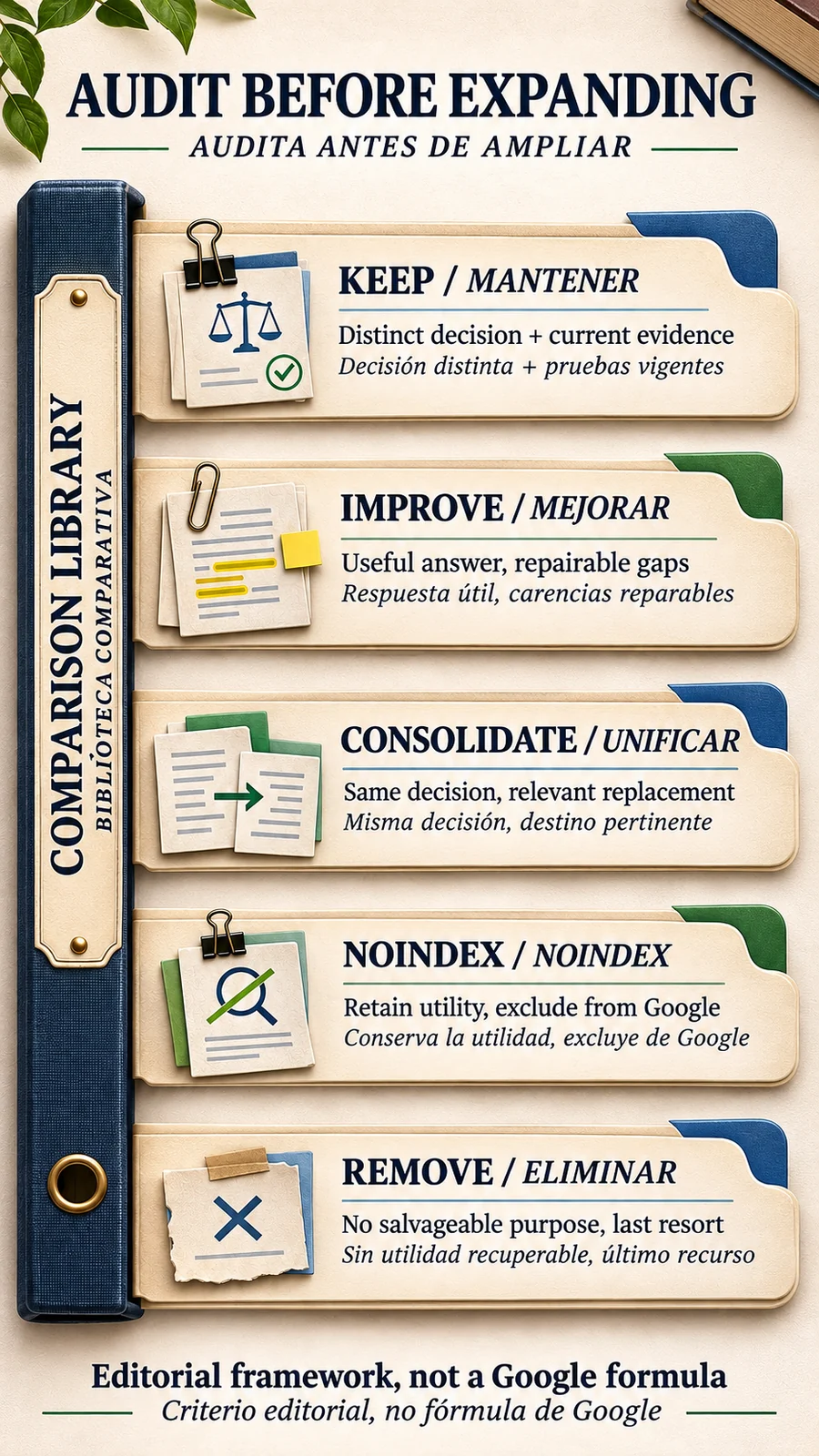
Inventory each URL by intended decision before choosing a technical action. Add the evidence available and overlap with neighboring pages. Search performance can prioritize the review, but low traffic alone cannot establish that a page has no useful purpose.
| Finding | Suggested action | Reason to record |
|---|---|---|
| Distinct answer with current evidence | Keep and maintain | Its buyer question remains useful |
| Useful question with repairable gaps | Improve | Missing evidence can be obtained |
| Several answers to the same decision | Consolidate | A relevant destination can preserve the useful material |
| Retained user utility without a search purpose | Consider noindex | Exclusion from Google is intentional |
| No salvageable content or remaining use | Consider removal | Less destructive options were reviewed |
The matrix is an editorial interpretation of the documentation. Google's core-update guidance favors substantive improvements and treats deletion as a last resort. An index-bloat audit by page purpose supports those decisions without imposing a deletion quota.
Consolidation needs a relevant replacement. Follow Google's permanent redirect guidance for a lasting move, while preserving the useful answer at the destination. Redirecting unrelated pages to a homepage does not repair their unsupported recommendations.
For a retained page excluded from results, noindex must be crawlable for Google to process it. A robots.txt block can prevent that processing. Exclusion also removes the indexing prerequisite for Google's AI supporting links. Choose it because the page should be excluded, with that consequence understood. Neither consolidation nor removal supplies a recovery deadline.
Search Console cohorts and separate AI observations
Define a fixed list of comparison URLs in Search Console, then review explicit comparison queries separately. The URL group measures page performance, while a query group describes selected wording. Neither can identify a query as an AI prompt.
Google's Performance report filters support custom regex. This illustrative expression selects explicit English comparison wording.
\b(vs|versus|alternatives?|compare|comparisons?)\b
For Spanish wording, an example is the following expression.
\b(vs|versus|alternativas?|comparar|comparativas?|comparaci[oó]n|comparaciones)\b
These have not been applied to a property here. Review false matches and questions they miss before using them for a report.
Keep the country and device filters consistent across equivalent date ranges, and record changes to the URL list. The Search Console regex guide explains query selection in more detail. Query-filtered totals omit anonymized queries and can exclude truncated data, so they cannot represent all demand. For core-update analysis, Google's guidance advises confirming rollout completion and waiting at least a full week before comparing performance.
Google's AI-feature guidance places that activity within Search Console's Web reporting. Indexed, snippet-eligible pages can be supporting links, with no guarantee of selection. A regex report is therefore insufficient evidence of AI citation growth. The distinction between Google SEO foundations and assistant measurement applies here too.
For a manual AI citation sample, keep the prompt list fixed and record the engine/model label with its interface and browsing state. Save language, market context and date/time. Use fresh chats under declared conditions and preserve the complete response with visible source links.
Code a brand mention separately from a citation to a specific owned URL. Record an explicit recommendation as another observation. If calculating sample citation frequency, count each cited owned URL once per answered run, disclose the answered-run denominator and show all attempted runs with failures or unavailable answers. Repeat on a declared schedule while retaining earlier captures.
That record describes the sampled conditions. It cannot establish global market share or the proportion of all buyers who receive a citation. An assistant can cite a page while recommending a competitor. Identifiable referrals and business outcomes require separate evidence, and one screenshot cannot establish a trend or an update effect.
At the next planning review, I would start with a comparison whose verdict cannot be defended from its retained sources. Repair the decision criteria and assign a review trigger before commissioning related pages. That gives the editor a concrete research requirement for the next brief.
Frequently asked questions
Does Google ban comparison and alternatives pages?
No format-wide ban is established. Google's reviews guidance includes comparisons and ranked recommendations. Spam assessment depends on purpose and value, including scaled low-value production primarily intended to manipulate rankings.
Can AI be used to write product comparisons?
AI use alone does not establish a policy violation. The publisher still needs evidence for material claims and an accurate account of what was tested. Generated wording cannot turn vendor documentation into hands-on findings.
Does a useful comparison guarantee an AI citation?
No. Google requires indexing and snippet eligibility for supporting links without guaranteeing selection. Manual citation checks describe only the sampled responses under their recorded conditions.
Should low-traffic alternatives pages be deleted?
Review purpose, evidence and overlap first. Improve or consolidate useful answers where justified. Google treats deletion as a last resort, and low traffic alone is insufficient reason for removal.
Was January 20, 2026 a confirmed Google update?
The retrieved official Ranking history did not confirm that label. Lily Ray used it in her observation, while contemporary reporting described unconfirmed volatility around January 20-21. The observation does not establish the cause of a particular site's decline.
About the Author