
AI Industry SEO: The $200 Billion Search Battleground
Artificial intelligence is the fastest-growing vertical in search history. This is the complete organic growth playbook for AI companies competing in 2026.
1. The AI Market Scene
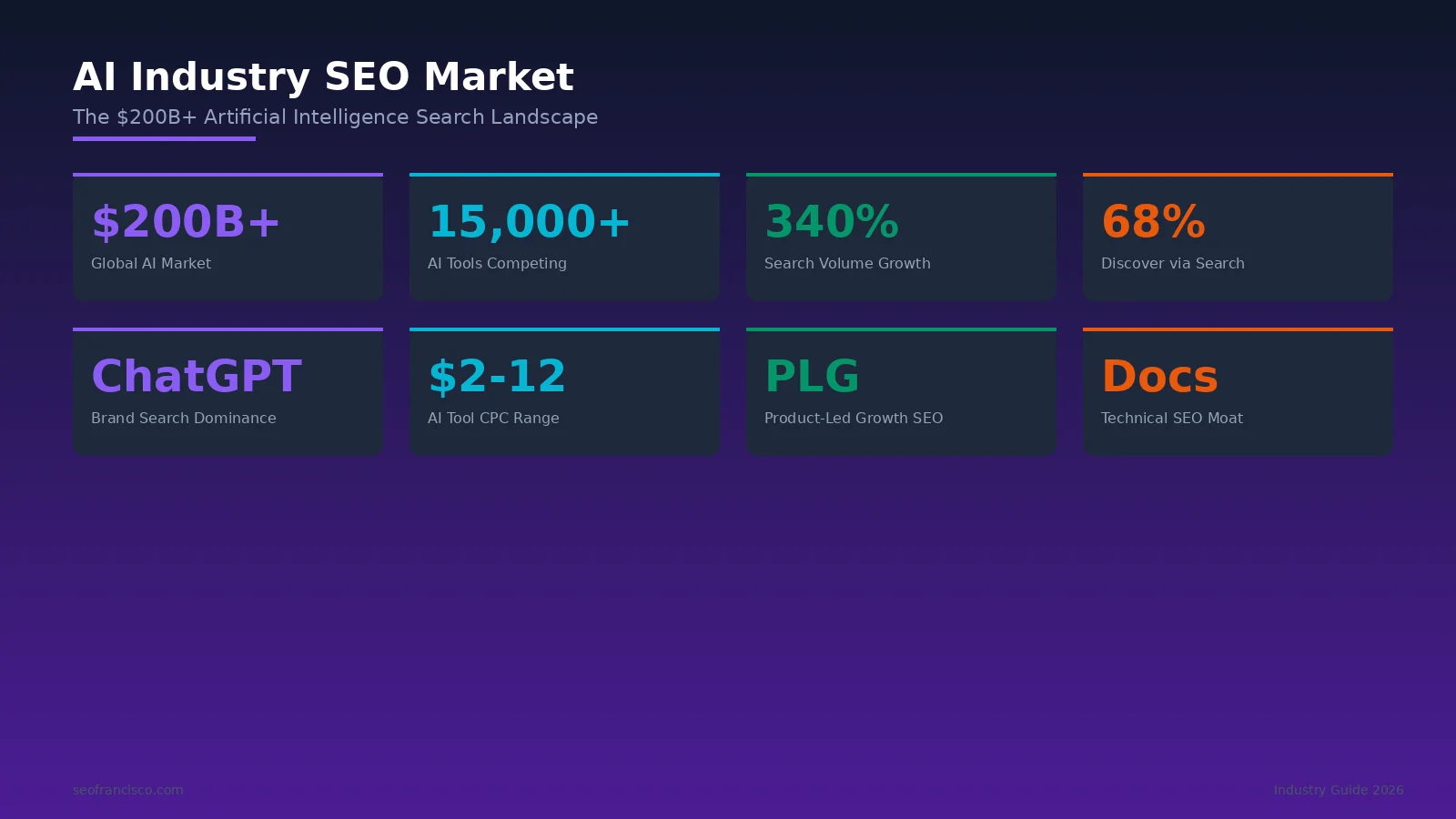
The artificial intelligence market crossed $200 billion in global revenue in 2025 and is projected to surpass $300 billion by the end of 2026, driven by enterprise adoption, consumer tool proliferation, and the infrastructure buildout powering both. What was a niche machine learning market five years ago has become the dominant technology investment category, reshaping every adjacent industry from cloud computing to professional services.
The competitive density is staggering. Product Hunt alone has indexed over 15,000 AI tools since January 2024. The directory scene reflects this: sites like There's An AI For That, Futurepedia, and AI Tool Directory have become de facto category pages, ranking for thousands of long-tail AI queries that individual tool makers struggle to capture. For SEO strategists, this means the AI vertical combines the tool-discovery dynamics of SaaS with the information-overload challenges of early-era app stores.
AI Market Revenue by Category (2026)
The funding scene shapes who can compete for organic visibility. OpenAI ($13B raised), Anthropic ($7.3B), and Mistral ($1.1B) have resources to staff dedicated SEO and content teams. But the long tail of 14,000+ bootstrapped and seed-stage AI tools depends almost entirely on organic search as their primary discovery channel. For these companies, SEO is not a marketing tactic; it is the business model.
2. How People Search for AI Tools
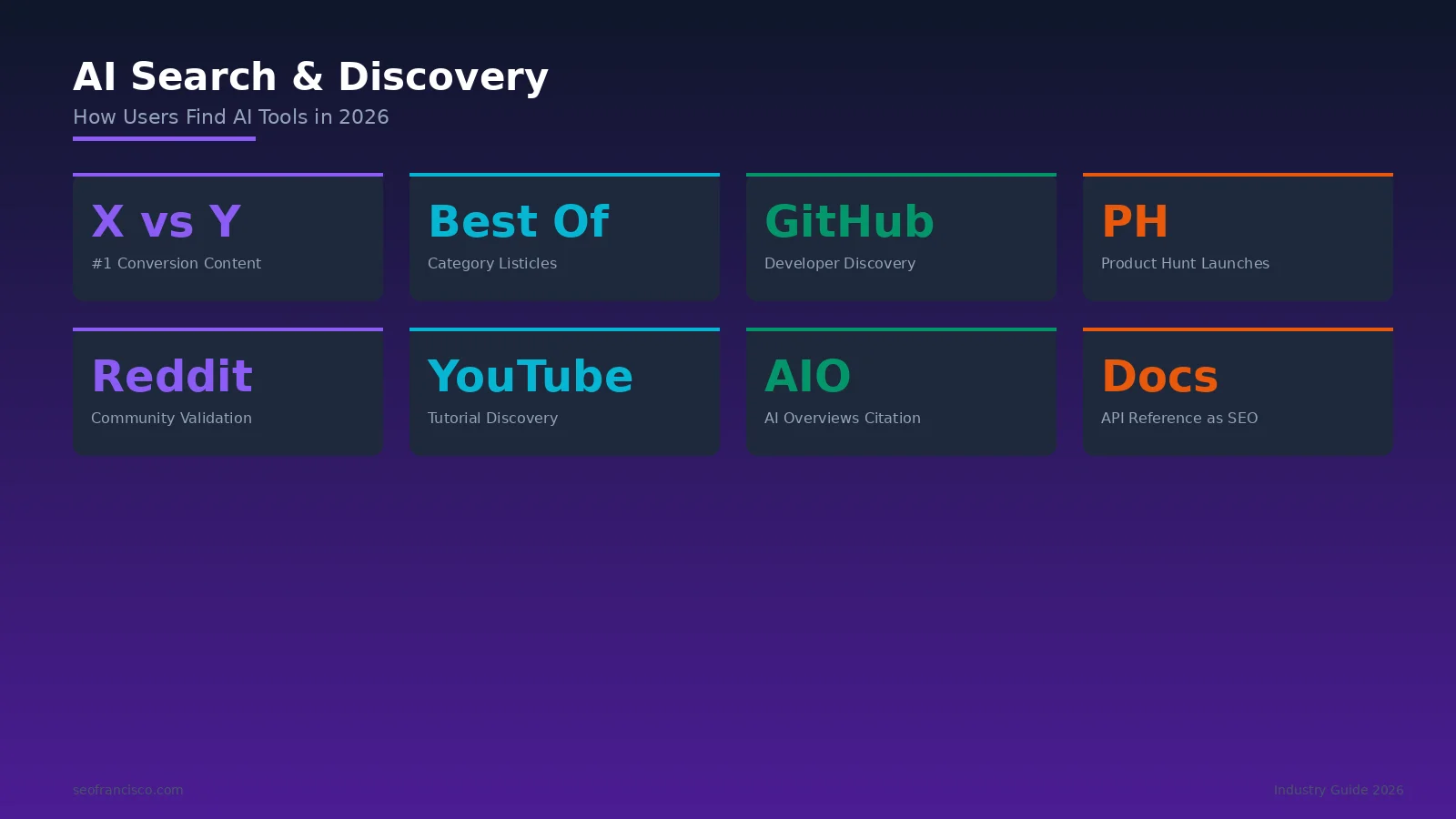
AI search behavior is different from any previous software category. The "best AI for X" query pattern has become the dominant discovery mechanism, generating more aggregate search volume than any single AI brand name except ChatGPT. Users have internalized that there is an AI tool for everything, and they search accordingly: "best AI for writing emails," "best AI for removing backgrounds," "best AI for coding Python." This pattern creates a massive opportunity for comparison content and use-case-specific landing pages.
How Users Discover AI Tools
Brand Searches vs. Category Searches
ChatGPT dominates branded search with over 180 million monthly searches globally, making it one of the most-searched product terms in history. But aggregate category searches — "AI writer," "AI image generator," "AI chatbot" — collectively exceed 400 million monthly searches. This means the non-branded opportunity is larger than any single brand, and it is growing faster. For every person searching "ChatGPT," two more are searching for what ChatGPT does without naming it.
The Alternatives Gold Rush
"ChatGPT alternative" generates 1.4 million monthly searches alone. "Midjourney alternative" pulls 320K. "GitHub Copilot alternative" drives 180K. These "alternative" queries represent the highest-intent organic opportunity in the AI vertical because they signal users who are actively dissatisfied with the market leader and ready to switch. Ranking for your competitor's "[brand] alternative" query is the single most cost-effective acquisition strategy in AI SaaS.
Developer vs. End-User Intent Split
AI search queries split into two different audience segments. End users search for outcomes: "AI that writes essays," "AI headshot generator," "AI meeting summarizer." Developers search for infrastructure: "LLM API pricing comparison," "fine-tuning Llama 3," "vector database benchmark." These audiences require entirely separate content architectures, keyword strategies, and conversion funnels. A developer searching "embedding model benchmark" and a marketer searching "best AI writing tool" will never convert on the same page.
3. Comparison & Alternative Content Strategy
If there is a single dominant SEO strategy in the AI vertical, it is comparison content. "X vs Y" pages, "best AI tools for [use case]" listicles, and "[competitor] alternatives" roundups collectively drive more converting organic traffic than any other content type in AI SaaS. The math is straightforward: users who search comparisons are at the bottom of the decision funnel, and the conversion rates reflect it , 3-8x higher than top-of-funnel educational content.
Comparison Content ROI by Type
The "X vs Y" Page Plan
Effective AI comparison pages follow a specific formula that Google rewards. They need to demonstrate first-hand experience (actual screenshots, real test outputs, genuine workflow comparisons), structured data with feature matrices, transparent methodology disclosure, and a clear recommendation with reasoning. Pages that simply list features from each product's marketing page get outranked by pages that show the reviewer's actual ChatGPT and Claude conversation side-by-side on the same prompt.
"Best AI for X" Listicles
Target use-case queries: "best AI for resume writing," "best AI for logo design." Include 8-12 tools with real screenshots, pricing tables, and a clear winner recommendation. These pages rank for dozens of long-tail variants simultaneously.
Head-to-Head Comparisons
"ChatGPT vs Claude," "Midjourney vs DALL-E 3." Feature-by-feature breakdown with real output samples. Include a structured comparison table with FAQ schema. Top-performing comparison pages generate 50K+ monthly visits.
Alternative Roundups
"ChatGPT alternatives," "Jasper AI alternatives." Frame your product as the first or second recommendation. These pages convert at 4-6x the rate of educational blog posts because users are actively looking to switch.
G2 & Capterra Competition
Review platforms dominate branded comparison SERPs. Combat this by building product-led comparison hubs on your own domain with richer data, real benchmarks, and fresher content than aggregators can provide.
4. Technical Documentation SEO
Technical documentation is the most undervalued SEO asset in the AI industry. Stripe proved the model a decade ago: developer docs that rank in Google become the primary acquisition channel for technical products. In 2026, the AI companies winning the documentation SEO game , OpenAI, Anthropic, Hugging Face, LangChain , capture developer traffic that converts at 5-12x the rate of top-of-funnel blog content because users arriving via documentation queries have active implementation intent.
API Reference as SEO Moat
Every public API endpoint generates a long-tail keyword opportunity. OpenAI's API documentation ranks for over 42,000 unique keywords, from "openai chat completions api" to "gpt-4 vision api parameters." Each documentation page serves as both a product manual and an organic landing page. The compounding effect is significant: well-indexed API docs attract developers who then build products on your platform, creating a lock-in flywheel that competitors cannot easily replicate.
Code Snippet Optimization
Google increasingly surfaces code snippets in featured snippets for developer queries. AI companies that format their documentation with language-tagged code blocks, descriptive headings above each snippet, and copy-paste-ready examples capture these positions. The key detail most miss: Google heavily favors code snippets that include inline comments explaining what each line does. Uncommented code rarely wins the featured snippet.
The Docs-to-Blog Pipeline
The smartest AI companies treat documentation as a content feedstock. Every new API feature, SDK update, or model release generates a documentation page (bottom-funnel, implementation intent) plus a companion blog post (mid-funnel, discovery intent) plus a tutorial (top-funnel, education intent). LangChain executes this strategy systematically: a single new chain type produces a reference page, a cookbook tutorial, and a "how to build X with LangChain" blog post. This three-layer approach captures the full search funnel from a single product event.
Changelog SEO
AI products ship updates weekly or daily. Each update is a keyword opportunity that most companies waste. Anthropic's Claude changelog, OpenAI's model release notes, and Stability AI's version histories all rank for time-sensitive queries like "Claude 3.5 Sonnet new features" and "GPT-4o release date." A well-structured, regularly updated changelog with semantic HTML headings and a dedicated sitemap serves as an evergreen SEO asset that compounds traffic with every product release.
5. Content Strategy for AI Companies
AI content strategy operates across five distinct content types, each targeting a different segment of the search funnel. The companies that dominate organic in this vertical , Hugging Face, Zapier AI, Copy.ai, Notion AI , execute across all five simultaneously rather than concentrating on a single type.
Use Case Pages
Programmatic pages targeting "[tool] for [use case]" at scale. Zapier's AI features page generates 140+ individual use case URLs.
- "AI for email marketing"
- "AI for financial analysis"
- "AI for customer support"
- 50-200 pages per product
Tutorial Content
Step-by-step guides showing how to accomplish specific tasks. Tutorial content converts at 2.4x the rate of listicles.
- "How to fine-tune GPT-4"
- "Build a chatbot with LangChain"
- "Automate reports with AI"
- Video + text hybrid format
Benchmark & Evaluation
Model comparison data, speed tests, accuracy evaluations. High link-earning potential from researchers and journalists.
- "LLM benchmark 2026"
- "AI writing tool accuracy test"
- "Image gen quality comparison"
- Update quarterly for freshness
AI Glossary Strategy
Glossary pages targeting AI terminology represent a high-volume, low-competition opportunity that most AI companies overlook. Queries like "what is RAG," "transformer architecture explained," "what are embeddings," and "LLM vs foundation model" each generate 50K-500K monthly searches. A full AI glossary , 100+ terms with clear definitions, diagrams, and internal links to product pages , serves as a topical authority signal while capturing thousands of informational keywords.
Thought Leadership vs. Product Content Balance
The AI vertical has a unique content challenge: thought leadership about AI capabilities attracts massive traffic but converts poorly, while product-focused content converts well but attracts limited organic traffic. The solution is a 60/40 split , 60% product-anchored content (tutorials, use cases, comparisons) and 40% thought leadership (industry analysis, trend reports, research summaries). The thought leadership builds domain authority and backlinks; the product content captures demand.
Community Content as SEO Signal
Discord servers, Reddit communities, and GitHub Discussions generate organic search signals that feed back into traditional SEO. Hugging Face's community forums rank for thousands of model-specific queries. LangChain's Discord-generated content surfaces in Google. AI companies should treat community platforms as indexed content surfaces, ensuring that common questions are answered with SEO-aware formatting and that high-value community threads are synthesized into formal documentation or blog posts.
6. Technical SEO for AI Platforms
AI platforms present a unique set of technical SEO challenges that stem from their product architecture. Most AI tools are built as JavaScript single-page applications (React, Next.js, Vue) with active content that changes based on user input, authenticated states, and real-time model outputs. This creates fundamental indexability challenges that require deliberate architectural decisions to solve.
SPA Rendering Challenges
Google's rendering engine (Chromium-based WRS) can execute JavaScript, but with latency. Pages that rely entirely on client-side rendering experience delayed indexing , often 2-4 weeks vs hours for server-rendered HTML. For AI tools shipping weekly updates, this delay means new feature pages miss their initial traffic window entirely. The fix: server-side rendering (SSR) or static site generation (SSG) for all pages that need to rank, reserving client-side rendering for authenticated app experiences that do not need organic visibility.
Active Content and Indexation
AI playground pages, demo outputs, and interactive tools create a crawl budget paradox. A single AI playground page can generate infinite URL variations based on user inputs, potentially consuming crawl budget without providing indexable content. The strategic approach: create a static showcase page for each major capability (with pre-generated example outputs, screenshots, and descriptive text) while keeping the actual interactive tool behind a noindex or parameter-excluded URL structure.
Pricing Page Optimization
AI tool pricing pages are among the highest-converting organic landing pages in the vertical. "ChatGPT pricing," "Claude API pricing," "Midjourney plans" generate millions of aggregate monthly searches. These pages need structured pricing data (using Product schema with Offer markup), comparison tables between tiers, clear feature differentiation, and an FAQ section addressing the most common pricing objections. The pricing page is often the #2 organic landing page for AI tools after the homepage, yet most companies treat it as a simple table rather than a conversion-optimized SEO asset.
Free Tier as SEO Strategy
Offering a free tier is not just a product-led growth tactic , it is an SEO strategy. Free-tier users generate user-generated content (shared outputs, embedded widgets, public projects) that creates natural backlinks and social signals. Canva's AI features, ChatGPT's free tier, and Notion AI's freemium model all generate organic signals from millions of free users sharing outputs across the web. The free tier turns your user base into an unpaid link building team.
7. Link Building for AI Companies
The AI vertical enjoys a structural link building advantage that no other industry matches: every AI launch is inherently newsworthy. Technology media, mainstream press, and the broader creator economy treat AI product releases as major news events. This means AI companies can earn editorial backlinks at a pace that would be impossible in more established verticals like finance or healthcare.
| Link Strategy | Avg. DR of Linking Domains | Links per Campaign | Difficulty |
|---|---|---|---|
| Product Hunt Launch | 90+ | 50-200 | Low |
| Tech Media Coverage | 80-95 | 20-80 | Medium |
| Research Paper Citation | 70-90 | 30-500 | High |
| Open Source Repository | 95+ (GitHub) | 100-5,000 | High |
| AI Directory Submissions | 40-70 | 30-80 | Low |
| Developer Community Posts | 60-85 | 10-40 | Medium |
Product Hunt as a Link Engine
A Product Hunt launch is the most efficient link building event available to AI companies. A single successful launch (top 5 of the day) generates 50-200 backlinks from Product Hunt itself (DR 90+), recap sites, newsletter roundups, and social mentions that Google can associate with your domain. The key is timing: launch on Tuesday-Thursday for maximum visibility, prepare a network of supporters for the initial upvote surge, and have a press kit ready for journalists who discover you via the Product Hunt trending page.
Open Source as Link Strategy
Open-sourcing a model, dataset, or tool is the highest-ROI link building strategy in AI. Hugging Face's open model system generates thousands of backlinks from researchers, developers, and educators who reference models in papers, tutorials, and course materials. Meta's Llama release generated an estimated 12,000+ unique referring domains within six months. Even smaller companies can open-source peripheral tools (evaluation frameworks, dataset preprocessing scripts, prompt libraries) to earn developer community links at scale.
Research Papers and Technical Blog Posts
Publishing original research , even lightweight benchmarks, evaluation reports, or capability analyses , earns links from academic and technical communities. Anthropic's Constitutional AI paper, Google DeepMind's Gemini technical report, and smaller companies like Cohere and Together AI regularly publish technical content that earns high-authority citations. You do not need a world-class research lab. A rigorous benchmark comparing LLM performance on your specific use case generates citable data that researchers and journalists link to.
8. AI Overviews & the Meta-Irony
Here is the existential irony of AI industry SEO in 2026: AI companies are competing for visibility in search results generated by AI. Google's AI Overviews now appear for 47% of AI-related queries, synthesizing information from multiple sources into a direct answer that often reduces click-through rates by 40-60%. The companies building the technology that powers these overviews are simultaneously being disrupted by them.
How Google AIO Cites AI Tools
AI Overviews heavily favor three content types when citing AI tool information: official documentation (pricing, features, API specs), authoritative reviews (from sites with established E-E-A-T in technology), and benchmark data (quantitative comparisons with methodology). Content that provides vague qualitative assessments ("ChatGPT is great for writing") gets passed over in favor of content with specific, verifiable claims ("ChatGPT-4o processes 128K context windows at 30 tokens/second"). Factual density is the single strongest predictor of AIO citation.
Brand Queries vs. Category Queries in AIO
AI Overviews behave differently for brand queries and category queries. For brand queries ("what is Claude"), AIO typically cites the company's own website and 1-2 authoritative third-party sources. For category queries ("best AI coding assistant"), AIO synthesizes from 4-8 sources and your own site may not be cited at all. The strategic implication: invest heavily in brand-building so users search your product name directly (where AIO helps you) rather than relying solely on category queries (where AIO may bypass you entirely).
The Irony Layer
AI companies are in a unique philosophical position. They are building the technology that reduces their own organic visibility. Anthropic publishes research on AI capabilities; Google's AI Overview uses that research to generate answers that keep users on Google. OpenAI optimizes for search traffic; Google's AI uses OpenAI's documentation as training data and citation sources for overviews that suppress clicks to OpenAI. This recursive active means AI companies must simultaneously tune for traditional search, AI-generated search, and the emerging agentic search patterns where AI agents browse the web on behalf of users.
9. The Economics of AI SEO
The economics of organic acquisition in the AI vertical are favorable relative to paid channels, but the cost structure varies dramatically by segment. Enterprise AI platforms face CPCs of $8-12 for bottom-funnel keywords, making organic the only viable scaling channel. Consumer AI tools face lower CPCs ($2-5) but compensate with massive volume requirements to justify the unit economics of freemium conversion.
Average CPC by AI Tool Category
| AI Category | Avg. CPC | Monthly Volume | Organic Opportunity |
|---|---|---|---|
| AI Writing Tools | $3.20 | 2.8M | High |
| AI Image Generation | $2.10 | 4.1M | High |
| AI Coding Assistants | $5.80 | 1.6M | Medium |
| Enterprise AI / MLOps | $11.40 | 420K | Premium |
| AI Customer Support | $8.60 | 890K | Premium |
| AI Video Generation | $2.80 | 1.9M | High |
| AI Agents & Automation | $7.20 | 680K | Medium |
Customer Acquisition Cost by Channel
Customer Acquisition Cost by Channel
Organic search delivers the lowest CAC across both freemium consumer AI ($5-15 per activated user) and enterprise AI ($500-3,000 per qualified lead). Paid search CAC runs 3-5x higher, and outbound sales CAC for enterprise AI can exceed $8,000 per qualified opportunity. The implication is clear: SEO is not optional for AI companies , it is the primary economics lever that determines whether unit economics work at scale.
VC-Funded vs. Bootstrapped Growth Patterns
VC-funded AI companies (OpenAI, Anthropic, Jasper) can afford to run paid acquisition at negative ROI while building organic traffic. They treat paid search as a market-entry accelerant and organic as the long-term margin protector. Bootstrapped AI companies (Perplexity pre-Series A, many open-source tools) depend on organic from day one. For bootstrapped AI, the first 90 days of SEO strategy , targeting low-competition long-tail keywords, building comparison content, and earning Product Hunt and directory links , often determines whether the company survives.
AI-Related Search Volume Growth (2020-2026)
The growth curve tells the story. AI-related search volume was relatively flat from 2020-2022, oscillating between 15-25 million monthly queries globally. ChatGPT's launch in November 2022 triggered an inflection point. By mid-2023, volume had tripled. By early 2025, it had increased 8x from pre-ChatGPT levels. The 2026 trajectory shows no deceleration , monthly volume for AI tool queries now exceeds 200 million globally, and new subcategories (AI agents, AI video, AI music) are opening fresh keyword frontiers monthly.
Frequently Asked Questions
What makes SEO for AI companies different from regular SaaS SEO?
How important is technical documentation for AI SEO?
Should AI companies block AI crawlers like GPTBot and ClaudeBot?
What is the ROI of comparison content for AI tools?
How do AI Overviews affect AI company SEO strategies?
What is the best SEO strategy for a bootstrapped AI startup?
How should AI companies handle pricing page SEO?
Is open-sourcing AI models or tools worth it for SEO?
Related Industry Guides
Need SEO Strategy for Your AI Product?
Francisco has 15+ years of SEO expertise including AI-era search strategy. Get a growth plan designed to compete in the fastest-moving vertical in search.
Book a Strategy Call →