
Industrial & B2B Manufacturing SEO: The Complete Guide for 2026
How manufacturers, industrial suppliers, and B2B companies win high-value contracts through search — backed by data from a $10.1 trillion market and 62-touchpoint buyer journeys.
The B2B Manufacturing Digital Scene
The U.S. B2B e-commerce market has crossed the $10.1 trillion threshold, and manufacturing accounts for 41.2% of all B2B e-commerce transactions. This is not a future projection , it is the current state of industrial commerce. Digital channels now generate 56% of total B2B revenue, a figure that would have seemed impossible a decade ago when most manufacturers relied almost exclusively on trade shows, catalogs, and direct sales teams.
What makes this shift irreversible is the budget commitment behind it. Manufacturers now allocate 3-7% of total revenue to marketing, and 87% are planning to increase that allocation in the next fiscal year. The companies that recognized organic search as a compounding investment , rather than a line item to justify quarterly , are the ones now dominating their verticals in search visibility.
The competitive scene in B2B search is paradoxically both fierce and wide open. While enterprise players have invested heavily in paid search and ABM platforms, the majority of mid-market manufacturers still treat their website as a digital brochure rather than a demand generation engine. Their product catalogs are locked inside PDFs. Their spec sheets require form fills to access. Their blog consists of press releases from 2021. This creates an enormous opportunity for companies willing to invest in structured, search-optimized content that meets buyers where they actually research.
The B2B Buyer Process: 62 Touchpoints to a Sale
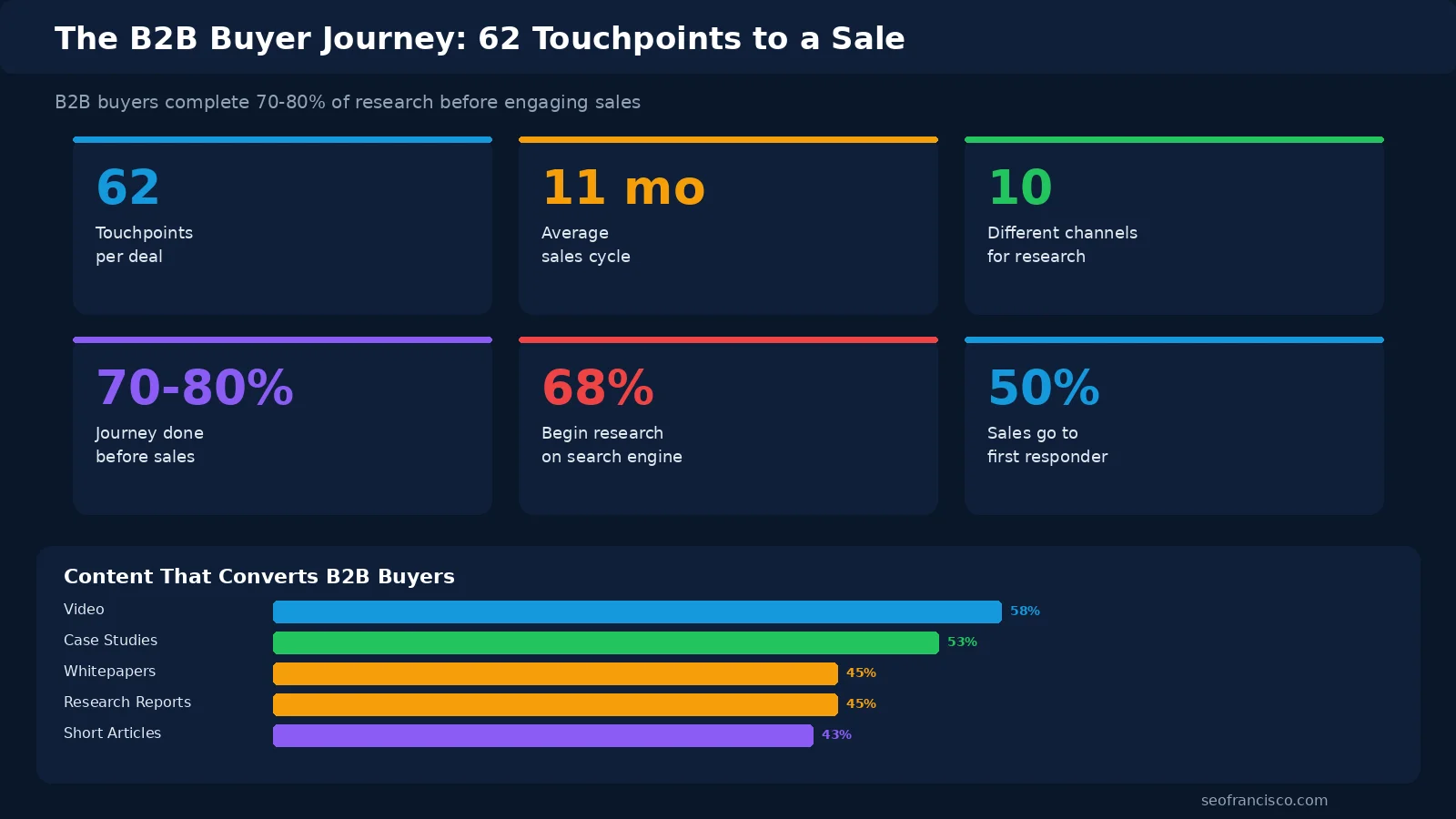
68% of B2B buyers begin their purchase process on a search engine , not at a trade show, not through a sales call, and not from a catalog mailing. The modern B2B buyer completes 70-80% of the purchase process before ever engaging with a sales representative. By the time your sales team gets a phone call, the buyer has already researched solutions, compared vendors, read case studies, and likely has a shortlist of two or three finalists.
The average B2B manufacturing deal involves 62 discrete touchpoints across 10 different channels over an 11-month sales cycle. Buyers consume whitepapers, watch product demo videos, read third-party reviews, attend webinars, compare spec sheets, and circle back to search results multiple times before making a purchase decision. Crucially, 50% of all B2B sales go to the first vendor to respond , which means the company that shows up earliest and most consistently in the buyer's research wins the deal.
B2B Buyer Process: Touchpoints by Stage
This buying behavior has profound implications for SEO strategy. You cannot tune for a single conversion keyword the way a B2C brand targets "buy running shoes." Instead, you need content that captures the buyer at every stage: problem-aware ("how to reduce CNC machining tolerance errors"), solution-aware ("CNC vs EDM for precision parts"), vendor-aware ("best precision machining companies USA"), and decision-ready ("precision machining RFQ"). Each stage has different intent patterns and different content requirements.
Technical SEO for Industrial Catalogs
Industrial and manufacturing websites face a unique set of technical SEO challenges that simply do not exist in other verticals. The most common: product catalogs with tens of thousands of SKUs locked inside PDF spec sheets, CAD file libraries that search engines cannot parse, and faceted navigation systems that generate millions of crawlable URL permutations without adding meaningful content.
PDF and CAD Indexation
The average industrial manufacturer has between 500 and 5,000 product PDFs on their website , spec sheets, installation guides, compliance certificates, material safety data sheets (MSDS), and engineering drawings. Google can index PDFs, but it treats them as secondary content and rarely ranks them above well-structured HTML pages. The strategic move is to extract key specifications from each PDF and create structured HTML product pages that link to the PDF as a downloadable resource. This gives Google parseable content while preserving the detailed technical documents that engineers expect.
Faceted Navigation for Product Catalogs
A manufacturer with 10,000 products, 8 filter categories, and 5 options per category can generate over 390,000 unique URL combinations from faceted navigation alone. Without proper canonicalization and crawl budget management, Googlebot will spend its entire crawl budget on filter permutations while ignoring your highest-value product and category pages. Implement rel="canonical" on all filtered pages pointing back to the primary category, use robots.txt to block low-value filter combinations, and deploy the Product schema markup that gives Google structured data about each product's specifications, pricing, and availability.
Content Gating Strategy
The gated-vs-ungated debate is especially acute in B2B manufacturing. Gating whitepapers and spec sheets generates leads, but it also prevents search engines from indexing that content. The recommended approach: ungate the first 30-40% of every asset (enough for Google to understand topical relevance and rank the page), then gate the detailed specifications, pricing tables, and CAD files behind a form. This balances lead generation with search visibility.
| Technical Challenge | Impact | Priority |
|---|---|---|
| PDF-only product catalogs | 70-90% of specs invisible to search | Critical |
| Faceted nav index bloat | Crawl budget waste, thin content signals | Critical |
| Content gating (100% gated) | Zero organic visibility for gated assets | High |
| Missing Product schema | No rich results, lower CTR | High |
| Core Web Vitals (catalog pages) | LCP failures on image-heavy pages | Medium |
| CAD files not linked to HTML | Engineering audience unreachable via search | Medium |
@type: Product with manufacturer, material, weight, width, height, and additionalProperty fields for custom specifications (tolerance, hardness, certifications). Google's product rich results now surface in B2B searches, and manufacturers with structured data see measurably higher click-through rates for specification-heavy queries.
Content Strategy: From Whitepapers to Video
Content marketing in B2B manufacturing delivers a measurable $3 return for every $1 invested, making it one of the highest-ROI activities available to industrial marketers. But the content mix that works for B2B looks nothing like B2C content strategy. Manufacturing buyers want depth, specificity, and evidence , not listicles and infographics.
The most effective B2B content types, ranked by buyer influence: video leads at 58%, followed by case studies at 53%, whitepapers at 45%, blog posts at 42%, and webinars at 38%. The dominance of video is a relatively recent development , as recently as 2023, whitepapers held the top position. The shift reflects a broader trend: even highly technical B2B buyers prefer to watch a 3-minute product demonstration before reading a 20-page spec sheet.
B2B Content Type Effectiveness
The key to manufacturing content strategy is matching content format to buying stage. Engineers researching a problem want technical blog posts with data and diagrams. Procurement managers comparing vendors want case studies with hard ROI metrics. C-suite executives approving a six-figure purchase want a 90-second video showing the business impact. Every piece of content should be optimized for a specific buyer persona at a specific process stage , and every piece should be indexable by search engines.
AI Overviews: B2B's Bigger Challenge
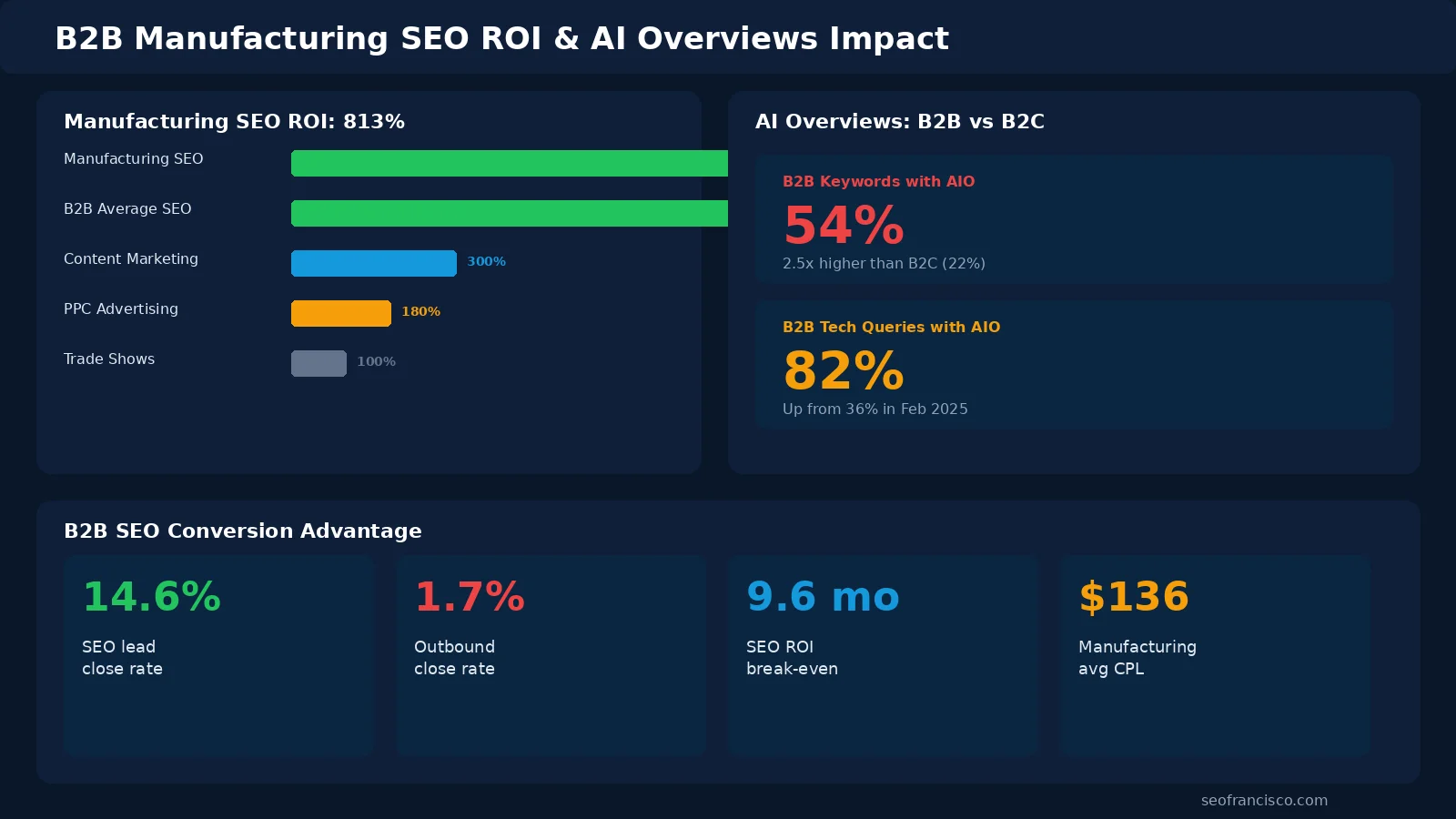
AI Overviews present a significantly larger disruption to B2B search than to B2C. While only 22% of consumer keywords trigger AI Overview boxes, 54% of B2B keywords now trigger AI Overviews , and in the technology vertical, that number rises to 82%. This is because B2B queries tend to be informational and comparison-oriented, exactly the query types Google's AI is most aggressive about answering directly.
The impact on click-through rates is severe: pages that appear below an AI Overview box experience a 58% reduction in organic CTR. However, the data also reveals a clear opportunity. Pages that are cited within the AI Overview receive 35% more clicks than they did before AI Overviews existed. The algorithm is not eliminating organic traffic , it is redistributing it heavily toward authoritative, well-structured sources that Google's AI trusts enough to cite.
AI Overview Trigger Rates: B2B vs B2C
For B2B manufacturers, the path to AI Overview citation requires three structural investments. First, Author schema markup , pages with identifiable, credentialed authors are 3x more likely to be cited in AI answers. Second, FAQPage structured data , pages using FAQPage schema have a 67% citation rate in AI Overviews versus 23% for pages without it. Third, high factual density , AI systems prefer content with specific numbers, named sources, and verifiable claims over generic marketing copy.
CPC and the Economics of B2B Search
B2B search economics differ from consumer verticals. Industrial keywords carry CPCs of $2-8, while broader B2B terms run $8-15 per click. These numbers look manageable until you factor in conversion rates and the cost-per-lead math. The average B2B manufacturing cost per lead across all channels is $819 , compared to $358 for B2C. Google Ads delivers CPL of $160-300, while LinkedIn advertising runs $120-250 per lead.
Organic search inverts this equation entirely. SEO-generated leads convert at 2.6% (versus 1.5% for PPC) and close at 14.6% (versus 1.7% for outbound prospecting). When you combine the higher conversion rate, the higher close rate, and the zero marginal cost of organic traffic, manufacturing SEO delivers an 813% ROI , making it the single most efficient demand generation channel available to industrial companies.
Cost Per Lead by Channel: B2B Manufacturing
| Channel | Avg CPC/CPM | CPL Range | Close Rate |
|---|---|---|---|
| Organic SEO | $0 (earned) | $31-65 | 14.6% |
| Google Ads (industrial) | $2-8 CPC | $160-300 | 1.5% |
| Google Ads (broader B2B) | $8-15 CPC | $200-350 | 1.5% |
| LinkedIn Ads | $5-12 CPC | $120-250 | 2.1% |
| Outbound (cold) | Variable | $300-500 | 1.7% |
| Trade Shows | $15K-50K/event | $500-1,200 | 4.2% |
The B2B Manufacturing SEO Strategy Plan
A complete B2B manufacturing SEO strategy requires eight coordinated phases. Most companies fail not because they skip a phase, but because they execute phases out of order , building content before fixing technical infrastructure, or launching link building before establishing topical authority.
Technical Foundation Audit
Crawl the full product catalog. Identify PDF-only pages, faceted nav bloat, missing schema, and Core Web Vitals failures. Prioritize by revenue impact.
Buyer Persona Keyword Mapping
Map keywords to each buying committee role (engineer, procurement, plant manager, C-suite) and each process stage (problem → solution → vendor → decision).
Catalog Restructuring
Convert top-revenue PDF spec sheets into structured HTML product pages with Product schema. Keep PDFs as downloadable resources linked from the HTML page.
Content Hub Architecture
Build topic clusters around core manufacturing capabilities. Each cluster: 1 pillar page + 8-12 supporting articles + 2-3 video assets + 1 gated whitepaper.
AI Overview Optimization
Add Author schema, FAQPage structured data, and front-load factual density in the first 200 words of every page. Target citation rather than just ranking.
ABM-SEO Integration
Align SEO content with target account lists. Create industry-specific landing pages that address the exact pain points of your highest-value prospects.
Technical Link Acquisition
Earn links from trade publications, industry directories, engineering forums, and OEM partner sites. Manufacturing-specific link building requires domain expertise.
Pipeline Attribution & Measurement
Connect organic traffic to CRM pipeline data. Track first-touch and multi-touch attribution through the full 62-touchpoint process to prove SEO revenue impact.
B2B SEO ROI vs Other Channels
B2B SEO by Vertical
While the strategic plan applies across all B2B verticals, each industry sub-sector has unique keyword landscapes, buyer behaviors, and technical requirements. Here is how the approach adapts across the four largest B2B verticals.
Discrete Manufacturing
Automotive parts, aerospace components, machinery OEMs. Long tail dominates , 78% of traffic comes from specification-level queries.
- Tune for material + tolerance + process queries
- CAD file libraries as link magnets
- Certification pages (ISO, AS9100) as trust signals
- Average deal value: $80K-500K
Industrial Supply & Distribution
MRO suppliers, fastener distributors, safety equipment. Catalog depth is the moat , top distributors index 100K+ product pages.
- Faceted navigation with canonical strategy
- Cross-sell/comparison content between products
- Local SEO for distribution centers
- Average order value: $2K-15K
B2B SaaS & Technology
ERP, MES, PLM, IoT platforms. The most competitive B2B vertical in search , 82% of keywords trigger AI Overviews.
- Comparison and "vs" pages are critical
- Integration partner pages for long-tail capture
- Developer documentation as SEO asset
- Average contract: $50K-250K ARR
Professional Services (B2B)
Engineering firms, testing labs, consulting. Expertise demonstration through content is the primary ranking factor.
- Author-attributed thought leadership
- Case study pages with quantified outcomes
- Service area pages for local + national coverage
- Average engagement: $25K-150K
ABM + SEO Integration: The Compounding Advantage
72% of B2B companies now use account-based marketing (ABM), allocating an average of 29% of their total marketing budget to ABM programs. When ABM and SEO operate in silos, both underperform. When they are integrated , using SEO data to inform ABM targeting and ABM account lists to guide SEO content priorities , the results compound dramatically.
Companies with integrated ABM-SEO programs report a 208% increase in marketing-attributed revenue, 28% faster sales cycles, and 35% higher close rates. The mechanism is straightforward: SEO ensures your content appears when target accounts research problems you solve, while ABM ensures you are tracking engagement from those specific accounts and accelerating them through the pipeline with personalized follow-up.
ABM + SEO Integration Impact
How ABM and SEO Work Together
The integration operates on three levels. First, intent data alignment: ABM platforms like Demandbase and 6sense detect when target accounts are researching specific topics , SEO ensures you have authoritative content ranking for those exact topics. Second, content personalization: create industry-specific landing pages optimized for organic search that also serve as personalized ABM destinations when target accounts visit. Third, attribution unification: connect first-touch organic data with ABM engagement data in the CRM to see the complete picture from anonymous search visit to closed deal.
Frequently Asked Questions
How long does it take to see results from B2B manufacturing SEO?
The average break-even point for a B2B manufacturing SEO program is 9.6 months. Initial rankings improvements typically appear within 3-4 months, measurable lead generation begins around month 5-6, and the compounding traffic effect that produces 813% ROI materializes over 12-36 months. B2B SEO requires patience because the sales cycle itself averages 11 months , a lead generated in month 4 may not close until month 15.
Should we ungate our whitepapers and technical content?
Partially. The recommended approach is to ungate the first 30-40% of each asset , enough for search engines to index the content and rank the page , while gating the detailed specifications, pricing, and downloadable files. This preserves lead generation while dramatically increasing organic visibility. Companies that fully ungate typically see 3-5x more organic traffic but 40% fewer form fills; however, the net pipeline value almost always increases because of higher traffic volume.
How do we handle product catalogs with thousands of SKUs?
Prioritize by revenue. Start with your top 100-200 products by revenue or margin and create structured HTML pages for each. Add Product schema with manufacturer, material, dimensions, tolerances, and certifications. Use canonical tags on all faceted navigation pages to prevent index bloat. Deploy a programmatic template that can scale to thousands of SKUs once the structure is validated. Most manufacturers find that 20% of their catalog generates 80% of search demand.
What is the most important technical SEO fix for manufacturers?
Converting PDF-only product information into indexable HTML pages. The majority of manufacturing websites have 70-90% of their product specifications locked inside PDFs that Google deprioritizes in rankings. Creating structured HTML pages that surface key specs (dimensions, materials, tolerances, certifications) and link to the PDF as a downloadable resource is consistently the highest-impact technical fix, often producing measurable ranking improvements within 60-90 days.
How does AI Overview impact B2B keywords?
B2B keywords trigger AI Overviews at a 54% rate , more than double the 22% rate for B2C keywords. Technology-sector queries hit 82%. This disproportionate impact exists because B2B queries tend to be informational and comparison-oriented, which is exactly the query type Google's AI targets. The defense strategy is to tune for citation within AI Overviews rather than just traditional ranking: use Author schema, FAQPage markup, and front-load factual density in your content.
How should we integrate ABM with our SEO strategy?
Start by aligning your keyword strategy with your target account list. Use ABM intent data to identify which topics your target accounts are researching, then ensure you have authoritative SEO content ranking for those queries. Create industry-specific landing pages that serve dual purpose , organic search landing pages and ABM personalized destinations. Connect your analytics to track when target accounts visit organic pages, and feed that engagement data into your ABM platform for sales follow-up. Companies with integrated ABM-SEO report 208% more marketing-attributed revenue.
What budget should a manufacturer allocate to SEO?
Manufacturers typically allocate 3-7% of total revenue to marketing, with SEO representing 15-25% of the marketing budget for companies serious about organic growth. For a $50M manufacturer, that translates to roughly $225K-875K annually in SEO investment. Given the 813% average ROI and 9.6-month break-even, the investment payback is substantial. Start with a technical audit and catalog restructuring (months 1-3), layer in content production (months 3-6), then scale with link building and ABM integration (months 6-12).
Explore More Industry Guides
Ready to Build Your B2B Manufacturing SEO Strategy?
From technical catalog audits to ABM-SEO integration, I bring 15+ years of enterprise SEO experience to complex B2B environments. Let's discuss how to turn your product catalog into a demand generation engine.
Book a Strategy Session