
Legal SEO: The Definitive Industry Guide for 2026
How law firms win clients through search in the highest-CPC industry on the internet — backed by data across 7 practice areas, $3B+ in annual legal ad spend, and the most aggressive YMYL scrutiny Google applies.
The Legal Digital Marketing Scene
The US legal services market reached $426.7 billion in 2026, making it one of the largest professional services sectors in the economy. Law firm advertising spend now exceeds $3 billion annually, with digital channels absorbing an increasing share. Firms allocate between 2% and 10% of gross revenue to marketing, and within that budget, 45% goes directly to SEO and organic search , more than any other single channel.
The average mid-market law firm now spends roughly $150,000 per year on SEO, a figure that has risen 40% since 2023 as competition intensifies across every practice area. This investment reflects a fundamental shift: the referral-driven model that sustained law firms for decades is eroding. Today, organic search is the primary client acquisition channel for the majority of firms outside the AmLaw 200.
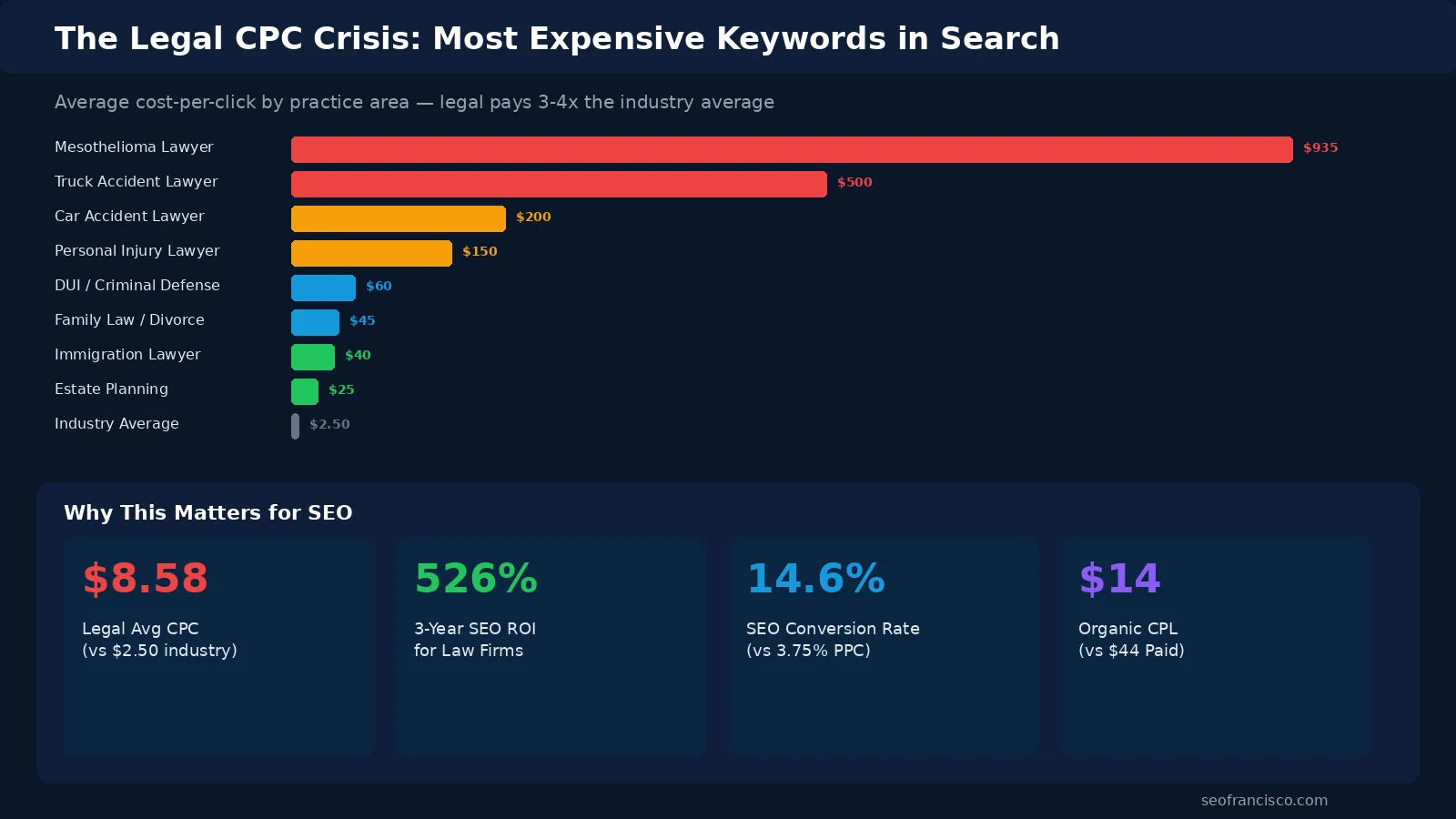
What makes legal SEO uniquely important , and uniquely difficult , is the convergence of three factors: the highest cost-per-click rates of any industry (mesothelioma keywords reach $935), Google's strictest content quality standards (YMYL classification), and extreme local competition where dozens of firms fight for visibility in the same metro area Map Pack. Understanding these dynamics is essential before investing a single dollar in legal search marketing.
How Clients Search for Legal Services in 2026
87% of people looking for a lawyer start on Google. This makes search the dominant intake channel, surpassing referrals, directories, and every other source by a wide margin. But the search scene is shifting rapidly. ChatGPT usage for legal queries has tripled from 9% to 28.1% in under 18 months, signaling the beginning of a channel diversification that every firm needs to track.
How Clients Find Lawyers in 2026
Device behavior in legal search is atypical: 67% of legal searches happen on desktop, compared to just 23% mobile-only. This reflects the high-stakes nature of legal decisions , people research lawyers from their office or home computer, not on the subway. However, "near me" legal searches have surged 500% since 2019, and those are predominantly mobile.
The Intent Funnel: From Problem to Phone Call
Legal search intent follows a distinct pattern. A potential client first searches their problem ("landlord won't return deposit"), then searches for a solution type ("tenant rights lawyer"), then evaluates specific firms ("best tenant lawyer in [city]"), and finally converts via phone call or intake form. The firms that capture traffic at the problem-awareness stage , before a client even knows they need a lawyer , build pipeline at a fraction of the cost of competing on high-intent keywords.
The CPC Crisis: Why Legal Pays More Per Click Than Any Industry
Legal advertising is the most expensive pay-per-click market on the internet. The average legal CPC is $8.58 , roughly 3-4x the cross-industry average of $2-3. But that average obscures the real story. In high-value practice areas, CPCs are staggering: mesothelioma keywords reach $935 per click, truck accident terms exceed $500, and personal injury phrases routinely cost $70-250 per click.
Cost Per Click by Legal Practice Area
These CPCs are not arbitrary , they are a direct function of case value. A single mesothelioma case can be worth $1-10 million in fees, which means even at $935 per click with a 3% conversion rate, the math still works for well-funded firms. But for smaller practices, these economics are devastating. A personal injury firm burning $20,000/month on PPC at $150/click acquires 133 clicks, converts roughly 5 clients, and must hope those cases settle for enough to justify the spend.
This CPC crisis is why 45% of law firm marketing budgets now flow to SEO. Organic rankings provide the same high-intent traffic without the per-click tax. Every position gained organically for "personal injury lawyer [city]" is worth thousands of dollars per month in avoided PPC spend , indefinitely.
YMYL & E-E-A-T: Why Google Scrutinizes Legal Content
Google classifies legal content as "Your Money or Your Life" (YMYL) , content that can directly impact a person's legal rights, financial stability, or safety. This means legal pages are held to the highest possible quality standards in Google's ranking systems. The December 2025 core update made this especially clear, hitting law firm websites that relied on AI-generated or thin content harder than almost any other vertical.
December 2025 Core Update: Impact on Legal Content
The data is stark: 85-95% of law firms that relied on copy/paste AI content lost significant organic traffic after the December 2025 update. Generic legal blog posts generated by ChatGPT without attorney review, real case analysis, or jurisdiction-specific nuance were systematically devalued. Meanwhile, firms with attorney-authored content, real case references, and strong trust signals gained ground.
The Four Pillars of Legal E-E-A-T
Experience
Content written by attorneys who have litigated the specific case types discussed. Real case outcomes (anonymized), courtroom experience, and jurisdiction-specific insights that only practicing lawyers can provide.
Expertise
Bar admissions, practice area focus, years of experience, notable verdicts, and continuing legal education credentials , all visible on every content page, not just the "About" page.
Authoritativeness
Citations to statutes, case law, bar association guidelines, and legal scholarship. Backlinks from legal publications, bar associations, law schools, and court websites. Attorney schema markup.
Trustworthiness
Clear attorney-client privilege disclaimers, transparent fee structures, real client testimonials, bar association membership verification, and honest case outcome disclosures.
What Google Requires From Legal Content in 2026
| Requirement | What It Means | Impact |
|---|---|---|
| Attorney author attribution | Bar number, practice area, years of experience , visible at top of every page | Critical |
| Jurisdiction specificity | Content must reference specific state/federal laws, not generic legal overviews | Critical |
| Direct answer in first 120 words | Address the user's legal question clearly before expanding into detail | Critical |
| Case law citations | Reference actual statutes, court decisions, and regulatory guidance | High |
| Attorney/LegalService schema | Structured data for practice areas, attorney profiles, and office locations | High |
| Editorial disclaimer | Attorney-client privilege notice, not-legal-advice disclaimers, last-reviewed dates | Medium |
| Content freshness | Legal content must be reviewed when statutes change , stale legal advice is dangerous | Medium |
Local SEO: Where Legal Clients Convert
For the vast majority of law firms, local SEO is the highest-converting channel available. When someone searches "divorce lawyer near me" or "DUI attorney [city]," they are deep in the decision funnel and ready to call. The Google Map Pack , the three local business listings that appear below the map , captures a disproportionate share of these clicks, and Google Business Profile signals account for 32% of Map Pack ranking factors.
Reviews Are the Decision Layer
92% of potential clients read online reviews before contacting a law firm. 84% will not even consider a firm with fewer than 4 stars. The average law firm rating is 4.78 out of 5, which means anything below 4.5 puts a firm at a severe competitive disadvantage. Firms with perfect 5-star ratings receive 25% more clicks than firms with 4-star ratings , a gap that translates directly into phone calls and signed retainers.
The Local SEO Checklist for Law Firms
- Foundation Google Business Profile Optimization Complete every field: practice areas as categories, service area, attorney photos, office photos, business description with city and practice area keywords. Post weekly updates about case wins, legal news, or community involvement.
- Trust Signals Review Acquisition System Systematically request reviews from every resolved case. Respond to every review within 48 hours , positive and negative. Target 10+ new reviews per month for competitive markets. Never incentivize or fabricate reviews (bar ethics violation).
- Citations Legal Directory Presence Consistent NAP (name, address, phone) across Avvo, Justia, FindLaw, Martindale-Hubbell, Super Lawyers, and general directories (Yelp, BBB). Inconsistent citations suppress Map Pack visibility.
- Content Location-Specific Practice Area Pages Create individual pages for every practice area + city combination you serve: "personal injury lawyer in Austin," "DUI attorney in Austin," etc. Each page must contain unique, jurisdiction-specific content , not templated copy with city names swapped.
AI Overviews: The Zero-Click Legal Search Scene
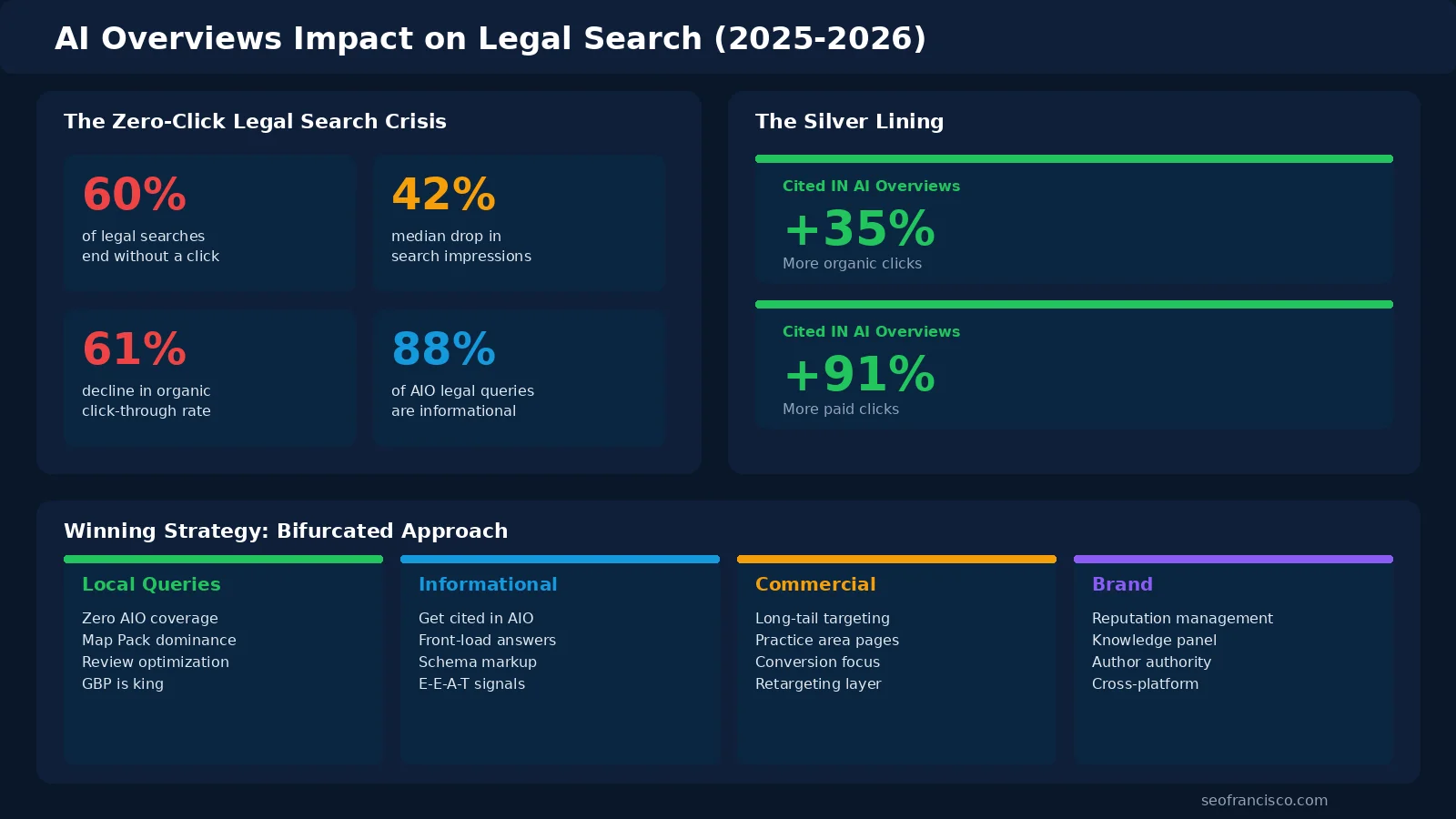
AI Overviews have changed how legal information surfaces in search results. Currently, 60% of legal searches end without a click to any website , users get their answer directly from Google's AI-generated summary. For law firms, this creates both a threat and an opportunity.
AI Overview Impact on Legal Search
The data shows a 42% median impression drop and 61% CTR decline for legal queries where AI Overviews appear. 88% of AI Overview legal queries are informational ("what is a restraining order," "how to file for bankruptcy"). However, the firms that are cited inside AI Overviews experience a dramatically different outcome: they receive 35% more clicks than firms that appear in traditional organic results below the AI summary.
The Bifurcated Strategy
Winning in the AI Overview era requires a two-track approach. For informational queries (conditions, processes, legal definitions), tune for AI Overview citation , structured answers, schema markup, high factual density. For high-intent local queries ("personal injury lawyer near me"), invest aggressively in local SEO and Google Business Profile. Local queries receive far fewer AI Overviews, making the Map Pack the primary battleground for client acquisition.
The Legal SEO Strategy Plan
A full legal SEO program operates across eight phases, each building on the previous one. Firms that skip phases , especially the technical and E-E-A-T foundations , consistently underperform firms that invest in systematic, sequential execution.
Technical Audit & Cleanup
Site speed, Core Web Vitals, crawlability, mobile experience, HTTPS, XML sitemap, robots.txt. Fix the foundation before building content.
E-E-A-T Architecture
Attorney profiles with schema markup, bar credentials, editorial policies, disclaimer pages, medical/legal review workflows.
Practice Area Hub Pages
One full pillar page per practice area (2,500-4,000 words) targeting the highest-value keywords. Interlink to supporting content.
Local SEO Buildout
Google Business Profile optimization, citation cleanup, review generation system, location-specific landing pages for every practice area + city.
Content Engine
4-8 attorney-reviewed articles per month targeting long-tail informational queries. Each article links to a practice area hub and includes real case analysis.
Link Authority Building
Legal publication outreach, bar association profiles, law school alumni networks, local business partnerships, HARO/legal journalist relationships.
AI & GEO Optimization
Structured data for AI Overview citation, FAQ schema, direct-answer formatting, entity optimization for LLM visibility (ChatGPT, Perplexity, Gemini).
Conversion Rate Optimization
Intake form testing, click-to-call placement, live chat integration, consultation booking flow, call tracking attribution.
Legal SEO by Practice Area
Not all legal verticals are created equal. CPC, competition intensity, local vs. national intent, and content requirements vary dramatically across practice areas. Firms that apply a one-size-fits-all SEO approach consistently underperform those that tailor strategy to their specific vertical.
Monthly SEO Investment by Practice Area
| Practice Area | Monthly SEO Budget | CPC Range | Key Differentiator |
|---|---|---|---|
| Personal Injury | $8,000 - $15,000 | $70 - $250 | Highest competition |
| Criminal Defense | $4,000 - $8,000 | $20 - $100 | Urgency-driven intent |
| Family Law | $3,000 - $6,000 | $15 - $80 | High local volume |
| Immigration | $3,000 - $6,000 | $20 - $60 | Multilingual SEO |
| Corporate / B2B | $5,000 - $10,000 | $30 - $90 | Thought leadership |
| Bankruptcy | $2,000 - $5,000 | $15 - $60 | Counter-cyclical demand |
| Estate Planning | $2,000 - $4,000 | Sub-$30 | Educational content |
Personal Injury: The Apex Predator Vertical
Personal injury is the most competitive and most expensive legal SEO vertical. Monthly budgets of $8,000-$15,000 are the minimum for competitive metro areas, and large firms in cities like Los Angeles, Houston, and Chicago spend $30,000-$50,000/month. The economics justify it: a single catastrophic injury case can generate $500K-$5M in contingency fees. CPCs range from $70-$250, with truck accident and mesothelioma terms far exceeding that range.
Criminal Defense: Urgency as a Strategy
Criminal defense search behavior is uniquely urgent , someone arrested for DUI at 2 AM needs a lawyer by morning. This creates a window where mobile-optimized local SEO and Google Business Profile visibility are disproportionately valuable. CPCs are more moderate ($20-$100), but the conversion window is extremely narrow. Firms that rank in the Map Pack and have click-to-call enabled capture these high-intent, time-sensitive clients.
Immigration: The Multilingual Advantage
Immigration law is one of the few legal verticals where multilingual SEO provides a genuine competitive advantage. Spanish-language content alone can capture 30-40% additional search volume in major metros. CPCs are relatively moderate ($20-$60), but the volume of informational queries around visa categories, green card processes, and asylum procedures creates an enormous content opportunity.
ROI: Making the Business Case for Legal SEO
The ROI argument for legal SEO is built on one central fact: organic search converts at 14.6%, while PPC converts at just 3.75% , a 4x gap. This conversion rate difference compounds when you factor in cost per lead: organic SEO generates legal leads at approximately $14 per lead vs. $44 per lead through PPC. In personal injury, the gap is even wider: $183 organic CPL vs. $442 PPC CPL.
SEO vs. PPC: Conversion Rates and Cost Per Lead
Over a three-year horizon, the compounding nature of organic traffic produces a 526% return on investment. Unlike PPC , where traffic drops to zero the moment you stop paying , organic rankings continue generating leads month after month. A well-built practice area page that reaches page one can produce leads for 3-5 years with only periodic content updates, representing a durable asset on the firm's balance sheet.
Why SEO and PPC Work Together
The optimal strategy is not SEO or PPC , it is sequential. PPC provides immediate intake volume for firms that need clients now, while SEO builds the long-term asset that eventually reduces PPC dependency. Our legal PPC case study demonstrates this complementary approach: running targeted PPC campaigns on the highest-value keywords while simultaneously building organic authority, then gradually shifting budget from paid to organic as rankings improve.
Legal SEO Case Study
How a mid-market law firm built organic authority across 4 practice areas, achieving 526% ROI through systematic SEO strategy.
Read the full case study →Legal PPC Case Study
Targeted paid search campaigns that delivered immediate intake volume while organic SEO built long-term client acquisition.
Read the full case study →Legal SEO: Frequently Asked Questions
How long does legal SEO take to produce results?
How much should a law firm spend on SEO per month?
Can law firms use AI to write SEO content?
Is local SEO or national SEO more important for law firms?
How do AI Overviews affect law firm SEO?
What makes legal SEO different from healthcare SEO?
What is the most important ranking factor for law firm websites?
Explore More Industry Guides
Ready to Build Your Law Firm's Search Visibility?
We build YMYL-compliant, E-E-A-T-first SEO programs for law firms , from solo practitioners to multi-office firms across every practice area.
Get a Legal SEO Audit →