
Automotive SEO: The $2.7 Trillion Opportunity
The global automotive market is the highest-value consumer purchase vertical in search. 92% of car buyers start online, yet most dealerships still run SEO from the 2015 playbook. This is the complete guide to automotive search marketing in 2026.
1. The Automotive Market Scene
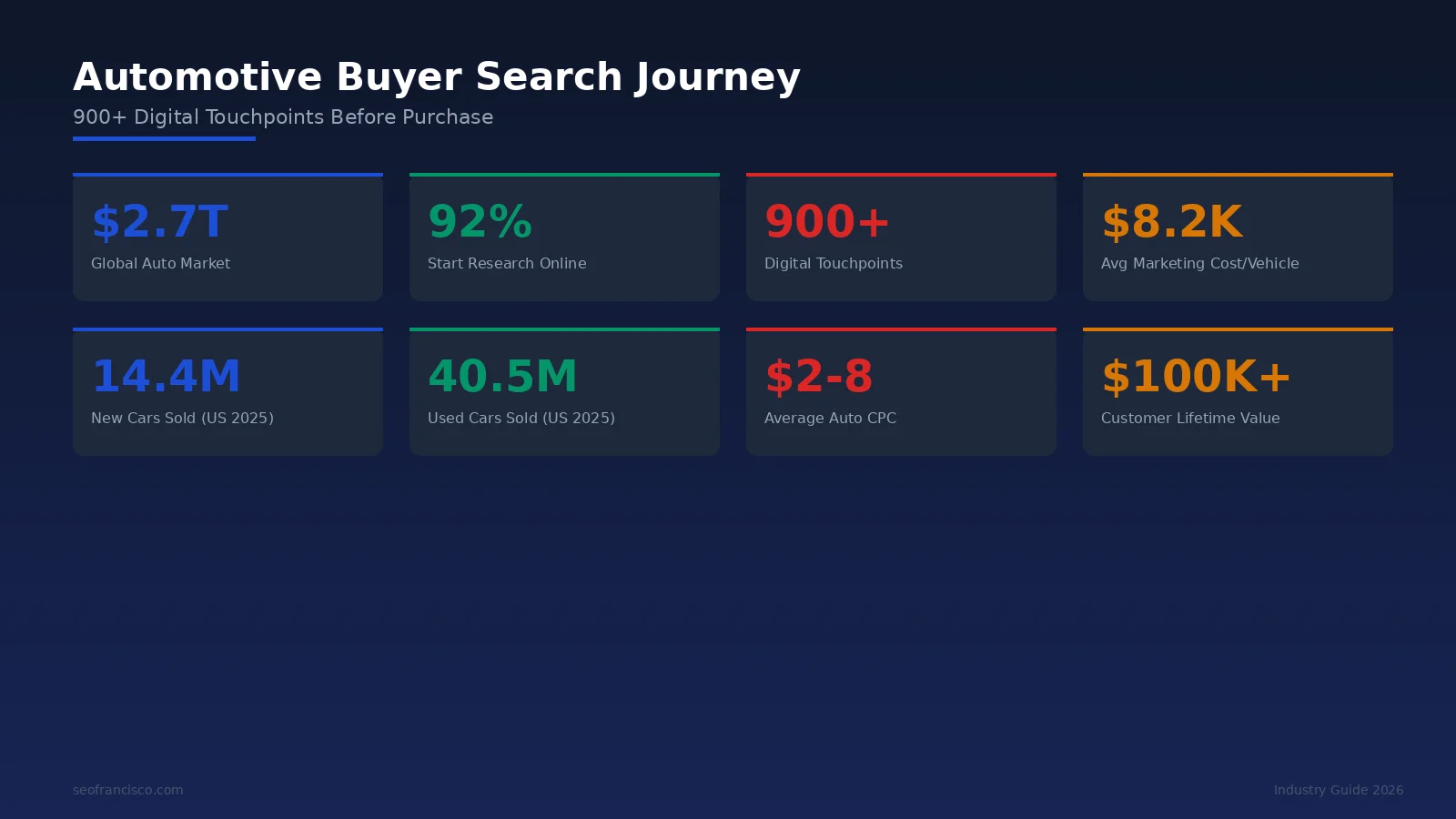
The global automotive industry generates $2.7 trillion in annual revenue, making it the single largest consumer purchase category on the planet. In the United States alone, roughly 15.5 million new vehicles and 40 million used vehicles change hands each year. Every one of those transactions begins with a search query, and the dealerships and brands that dominate organic visibility capture a disproportionate share of that demand.
The competitive scene splits into three distinct tiers with different SEO dynamics. First, OEMs (Toyota, Ford, GM, Hyundai) operate massive brand-authority domains with six-figure page counts. Second, third-party aggregators (Cars.com, AutoTrader, CarGurus, Edmunds, KBB) dominate informational and comparison queries through sheer content volume and domain authority in the DR 80+ range. Third, individual dealerships and dealer groups fight for local visibility in a radius-based battle where proximity, reviews, and inventory freshness determine who appears in the Map Pack.
Automotive Revenue by Segment (2026)
The tension between OEMs and dealers creates a unique SEO active. Manufacturers invest heavily in brand-level SEO for model pages, configurators, and national campaigns. But the actual transaction happens at the dealer level, which means local SEO for the dealership is what in the end converts demand into revenue. Smart dealer groups have learned to build content strategies that complement rather than compete with their OEM partners, targeting long-tail inventory queries and local modifiers that the manufacturer sites ignore.
2. How Car Buyers Search
The modern car buyer completes an average of 900+ digital interactions over a 2-3 month purchase cycle before setting foot in a dealership. That figure, documented by Google and Cox Automotive research, represents one of the longest and most complex consumer journeys in any industry. Every search, video view, review read, and configurator session is a touchpoint where SEO visibility translates directly into consideration.
Car Buyer Research Channels (2026)
Query Intent Patterns
Automotive search queries fall into five distinct intent clusters. Research queries ("best midsize SUV 2026," "Toyota RAV4 vs Honda CR-V") dominate the early funnel and are almost entirely owned by aggregators and OEMs. Pricing queries ("Honda Civic price," "average cost of oil change") trigger AI Overviews and Knowledge Panels. Inventory queries ("used Toyota Camry near me," "red Ford F-150 for sale") signal purchase-ready intent. Dealer queries ("Toyota dealership open Sunday," "best rated Honda dealer") indicate in-market shoppers. Service queries ("brake replacement cost," "check engine light meaning") drive fixed-operations revenue.
The "Near Me" Dominance
Automotive is among the most location-dependent search verticals. "Car dealership near me" searches have grown 150%+ over the past five years, and local intent modifiers appear in roughly 46% of all automotive queries. Google's local pack now appears for nearly every transactional auto query, which means dealerships that fail to tune their Google Business Profile, manage reviews, and build local citations are invisible at the exact moment a buyer is ready to visit.
Zero-Click Auto Answers
Google now provides direct answers for an expanding range of automotive queries. Vehicle pricing, MPG ratings, safety scores, recall information, and basic specifications all appear in Knowledge Panels or AI Overviews without requiring a click. For dealerships, this means informational traffic on specification queries is declining, and the strategic response is to target queries where Google cannot provide a complete answer: inventory availability, local pricing, trade-in valuations, and financing scenarios.
3. Local SEO for Dealerships
For the vast majority of automotive businesses, local SEO is the highest-ROI channel available. A single dealership location can generate $50-150 million in annual revenue, and the difference between appearing in the Google Map Pack and not appearing at all can represent hundreds of monthly walk-ins. The local algorithm for automotive is proximity-weighted, but reviews, completeness, and activity signals all influence ranking within the competitive radius.
Local Search Ranking Factors for Auto Dealers
Google Business Profile Optimization
The GBP is the single most important digital asset for a dealership. Every field matters: primary category (Car Dealer), secondary categories (Used Car Dealer, Auto Repair Shop, Auto Parts Store), attributes (women-led, veteran-led, EV charging), service areas, business description with keyword integration, and regular Google Posts. Dealerships that post weekly inventory highlights, service specials, and event announcements to their GBP see measurably higher engagement rates and Map Pack visibility compared to dormant profiles.
Review Management
The automotive vertical has one of the highest review-sensitivity thresholds in local search. Buyers making a $30,000-70,000 purchase decision read an average of 12-18 reviews before selecting a dealership. The minimum viable review profile is 4.5 stars with 200+ reviews. Below 4.0 stars, conversion rates drop by roughly 70%. Proactive review generation through post-sale follow-ups, service appointment completions, and QR code prompts in the showroom is non-negotiable for competitive dealers.
Multi-Location Dealer Groups
Large dealer groups like AutoNation, Lithia Motors, and Penske Automotive operate hundreds of locations. Their local SEO challenge is unique: each location needs an individualized GBP, unique landing pages with location-specific inventory and staff information, and a review generation strategy that does not cannibalize sibling locations. The most sophisticated groups use active location pages that pull real-time inventory feeds, local staff bios, and community event information to create genuinely unique content at each URL.
4. Inventory-Based SEO
Automotive is the only major consumer vertical where the product catalog changes daily. New vehicles arrive on the lot, used trade-ins get listed, and sold inventory must be removed. This creates a unique technical SEO challenge: generating and managing thousands of Vehicle Detail Pages (VDPs) that are individually optimized, properly indexed, and removed cleanly when inventory sells. The dealerships that solve this problem at scale dominate organic traffic for high-intent, bottom-funnel queries.
Vehicle Detail Page Optimization
A well-optimized VDP targets the specific query a buyer types when they know what they want: "2024 Toyota Camry SE red for sale [city]." Each VDP should include the full vehicle title (year, make, model, trim, color), VIN, pricing (MSRP and dealer price), 15-30 high-resolution photos, a unique vehicle description (not manufacturer boilerplate), feature highlights, financing estimates, and structured data markup. The title tag pattern that performs best: [Year] [Make] [Model] [Trim] for Sale in [City] | [Dealer Name].
| VDP Element | SEO Impact | Priority |
|---|---|---|
| Unique title tag with year/make/model/city | Direct ranking factor for inventory queries | Critical |
| Vehicle schema markup (Auto/Car) | Rich results with price, mileage, availability | Critical |
| 15-30 photos with descriptive alt text | Image search traffic + engagement signals | High |
| Unique vehicle description (150+ words) | Avoids thin content penalties across thousands of VDPs | High |
| Financing calculator widget | Time-on-page, conversion assist, featured snippet eligibility | Medium |
| Similar vehicles module | Internal linking + reduces bounce to competitors | Medium |
Structured Data for Vehicles
Google supports the Vehicle and Car schema types for automotive inventory. Implementing JSON-LD with properties like vehicleIdentificationNumber, mileageFromOdometer, fuelType, driveWheelConfiguration, vehicleInteriorColor, and offers (with price and availability) enables rich results that display pricing and key specs directly in the SERP. Dealers with proper vehicle schema see 15-25% higher click-through rates compared to plain blue-link listings.
New vs. Used Inventory Strategy
New vehicle VDPs compete against the OEM's own model pages and aggregator listings. The dealer's advantage is local specificity and actual availability. Used vehicle VDPs have less competition but require more unique content since each vehicle is one-of-a-kind. The highest-performing dealers create unique descriptions for every used vehicle that highlight condition, history, and local relevance rather than duplicating manufacturer spec sheets.
5. Technical SEO for Automotive
Dealer websites operate under constraints that most other industries never encounter. The dominant dealer website platforms (CDK Global, Dealer.com/Cox Automotive, DealerSocket/Solera, DealerInspire) control the underlying technology stack, which means individual dealers have limited control over rendering, URL structure, page speed, and structured data implementation. Understanding what you can and cannot change on each platform is the first step in any automotive technical SEO audit.
CDK Global
Largest dealer platform by market share. Known for heavy JavaScript rendering and limited URL customization.
- JavaScript-dependent VDP rendering
- Limited title tag control on inventory pages
- Template-locked page structures
- Slow adoption of Core Web Vitals fixes
Dealer.com (Cox)
Second largest platform with better SEO flexibility but still template-constrained.
- Better schema markup support
- Custom landing page builder available
- Moderate page speed performance
- Inventory feed integration with VLA
DealerInspire
Newer entrant favored by progressive dealers. More SEO-friendly architecture.
- Server-side rendered VDPs
- Full title/meta control
- Built-in schema for vehicles
- Faster Core Web Vitals scores
JavaScript Rendering Issues
The biggest technical SEO problem in automotive is JavaScript-dependent rendering. Several major dealer platforms load inventory content, pricing, and even navigation via client-side JavaScript. Googlebot can render JavaScript, but it does so on a delayed schedule (sometimes days), which means new inventory may not be indexed for 48-72 hours after listing. For a dealership that receives 20-50 new vehicles per week, that delay represents lost organic visibility during the critical first days on the lot.
Pagination and Crawl Budget
A mid-size dealership might have 300-600 vehicles in active inventory, each generating a VDP. A large dealer group with 50 locations could have 20,000+ VDPs across their network. Managing crawl budget across this volume requires careful pagination (prefer infinite scroll alternatives or load-more patterns over traditional page-2, page-3 pagination), proper use of canonical tags on filtered inventory views, and aggressive cleanup of sold-vehicle URLs. The crawl budget waste from stale VDPs is the number-one technical SEO issue found in automotive audits.
Site Speed on Image-Heavy Pages
Vehicle pages carry 15-30 high-resolution photographs, a 360-degree interior viewer, and often an embedded video walkaround. Without aggressive image optimization (WebP/AVIF format, responsive srcset, lazy loading below the fold), a single VDP can exceed 8MB in page weight. The target: under 2.5 seconds LCP on mobile. Achieving this requires next-gen image formats, CDN delivery, and deferring non-critical media until user interaction.
6. Content Strategy for Automotive SEO
Content strategy in automotive must address the full purchase funnel across a 2-3 month buyer process. The most effective dealer content programs produce three categories: comparison and research content (top funnel), inventory and pricing content (mid funnel), and service and maintenance content (retention and fixed-ops revenue). Each category targets different intent clusters, and together they build topical authority that lifts the entire domain.
Model Comparison Pages
"Toyota RAV4 vs Honda CR-V vs Mazda CX-5" pages capture high-volume research queries. Include specs tables, pricing breakdowns, and a clear CTA to view local inventory for the winning model.
Buying Guides
"Best SUVs Under $35K in 2026" and "First-Time Car Buyer Guide [City]" pages build topical authority. Localize with regional pricing, tax information, and dealer-specific incentives.
EV Education Content
EV buyers have unique questions: charging infrastructure, range anxiety, tax credits, home charger installation. This is the fastest-growing content category in automotive and still has low competition at the local level.
Service & Maintenance Hub
"How often to change oil on a 2022 Honda Civic," "brake pad replacement cost [city]," and recall information pages drive fixed-ops revenue. Service content has 4x the conversion rate of sales content for returning customers.
Video Walkarounds
Video is the second most influential content format in automotive after photos. YouTube walkaround videos for specific vehicles in inventory serve dual purposes: they rank independently in YouTube and Google video carousels, and they increase time-on-page and conversion rates when embedded on VDPs. Dealerships producing 2-3 minute walkaround videos for every vehicle over $30K see measurable increases in lead submission rates. The production cost is minimal since a smartphone and a consistent format are sufficient.
YMYL Considerations
Automotive content intersects with YMYL (Your Money or Your Life) criteria in several areas: vehicle safety ratings, recall information, financing advice, and insurance guidance. Google applies elevated quality standards to this content. Demonstrating E-E-A-T (Experience, Expertise, Authoritativeness, Trustworthiness) through author bylines from certified technicians, citations from NHTSA and IIHS, and transparent financing disclosures is not optional. It is a ranking factor.
7. The EV Revolution and Its SEO Impact
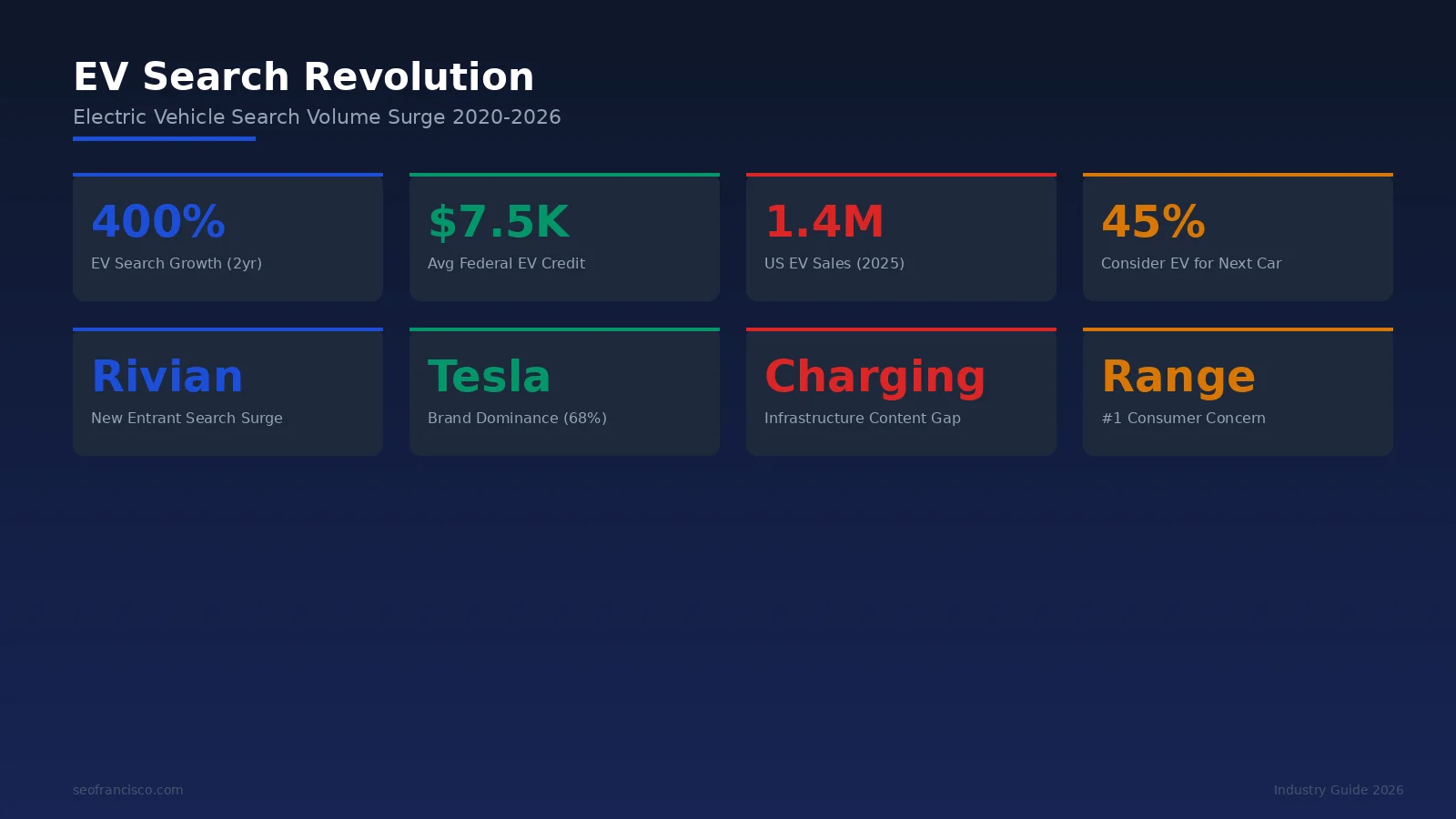
Electric vehicles have reshaped the automotive search scene more dramatically than any shift since the rise of mobile. EV-related search volume has grown over 400% since 2020, and the queries themselves are different from traditional automotive searches. Buyers are not just comparing models; they are researching charging networks, government incentives, battery degradation, home installation requirements, and total cost of ownership calculations that do not exist for ICE vehicles.
EV Search Volume Growth (2020-2026)
New Entrants Disrupting Search
Tesla, Rivian, Lucid, Polestar, VinFast, and Chinese manufacturers like BYD and NIO have created entirely new query spaces. Traditional dealerships that sell legacy brands must now compete for attention against direct-to-consumer EV brands with massive content marketing budgets. The SEO implication: every dealership that carries EVs needs dedicated landing pages for each EV model, a charging infrastructure content hub, and comparison content that directly addresses the EV-vs-ICE decision plan.
Charging Infrastructure Content
One of the highest-opportunity content categories in automotive SEO is local charging infrastructure. Queries like "EV charging stations near [city]," "how long to charge [model] at home," and "Level 2 vs Level 3 charging cost" are growing at 50%+ annually with relatively low competition. Dealerships that install on-site chargers and create local charging guide content capture both the informational traffic and the implicit trust signal of being an EV-ready facility.
Government Incentive Pages
Federal and state EV tax credits change frequently, creating a perpetual content refresh opportunity. The $7,500 federal tax credit, state-level rebates (up to $7,500 additional in states like California and Colorado), and manufacturer-specific incentive stacking create complex scenarios that buyers actively search for. Dealers who maintain current, accurate incentive calculators rank for high-intent queries that directly precede purchase decisions.
8. AI Overviews in Automotive Search
Google's AI Overviews have altered the automotive search results page. For queries like "best family SUV 2026" or "how much does a new Honda Civic cost," AI Overviews now synthesize answers from multiple sources and present them above organic results. This has compressed click-through rates for traditional organic listings, but it has also created new optimization opportunities for sites that understand how to be cited within the AI-generated response.
Structured Data Advantage
Sites with full structured data (Vehicle schema, FAQ schema, Review schema, LocalBusiness schema) are disproportionately cited in AI Overviews. Google's AI synthesis relies heavily on structured, machine-readable data when assembling responses about vehicle specifications, pricing, availability, and dealer information. The dealers and aggregators that have invested in schema markup over the past three years are now reaping outsized visibility benefits in the AI Overview era.
Content Strategies for AI Citation
To be cited in AI Overviews, automotive content must follow specific structural patterns: lead with a direct answer in the first sentence, provide specific data points (exact pricing, exact specifications), use comparison tables that the AI can parse, and demonstrate clear E-E-A-T signals. Content that buries the answer under three paragraphs of preamble is systematically excluded from AI citations. The format that works: fact-first paragraphs with supporting context.
Google Vehicle Ads Evolution
Google Vehicle Listing Ads are merging with organic vehicle results in ways that blur the line between paid and organic. The Vehicle Ads carousel now appears for inventory-specific queries, and Google Shopping's automotive vertical is expanding to include financing comparisons and trade-in estimates. Dealers need to treat their Google Merchant Center vehicle feed as an SEO asset, not just a paid advertising channel. The quality of the feed data (accurate pricing, complete descriptions, high-res images) affects both paid performance and organic rich result eligibility.
9. The Economics of Automotive SEO
Automotive SEO operates at economic scales that dwarf most other verticals. The average dealership spends $500,000-1.2 million per year on advertising, with digital channels now claiming 60-70% of that budget. Understanding the unit economics of organic search relative to paid channels is what separates strategic SEO investment from wasted spend.
Average CPC by Automotive Keyword Category
| Metric | Value | Implication |
|---|---|---|
| Average new car profit margin | $1,800-3,200 | Justifies $200+ CPA for qualified leads |
| Average used car profit margin | $2,500-4,500 | Higher margin = more aggressive SEO spend |
| Lifetime customer value (sales + service) | $100,000+ | Single organic conversion can generate 6-figure LTV |
| Average service visit revenue | $350-500 | Service SEO has fastest payback period |
| Organic traffic share for top dealers | 35-45% | Top performers derive nearly half of leads from organic |
Customer Acquisition Cost by Channel
Organic vs. Paid Attribution
The biggest challenge in automotive SEO is attribution. A buyer who searches "best midsize SUV 2026" (organic click), then searches "Toyota Camry price" (paid click), then searches "Smith Toyota hours" (local/Maps) before walking in often gets attributed entirely to the last paid click. Dealerships that implement multi-touch attribution models consistently find that organic search influences 65-80% of all sales, even when it does not receive last-click credit. This reframing of attribution is what justifies sustained SEO investment in a vertical where paid advertising pressure is relentless.
Frequently Asked Questions
How long does it take for automotive SEO to show results?
What is the most important SEO factor for car dealerships?
How should dealerships handle SEO for sold inventory?
Is EV content worth investing in for traditional dealerships?
How much should a dealership budget for SEO?
What structured data should automotive websites implement?
How do AI Overviews affect automotive SEO strategy?
What are the biggest technical SEO challenges for dealer websites?
Related Industry Guides
Need Expert Automotive SEO Strategy?
Francisco has 15+ years of SEO expertise across enterprise verticals. Get a customized strategy for your dealership or automotive brand.
Book a Strategy Call →