
Healthcare SEO: The Definitive Industry Guide for 2026
How hospitals, clinics, pharma brands, health tech companies, and wellness brands win patients through search — backed by data from 1 billion daily health queries and 6 real client engagements.
The Healthcare Digital Marketing Scene
Healthcare is one of the largest and fastest-growing verticals in digital marketing. The global healthcare marketing and communications market grew from $24.55 billion in 2025 to $26.52 billion in 2026, and is projected to reach $43.26 billion by 2032 at an 8.43% CAGR. Digital now accounts for 72% of all media spend in healthcare and pharmaceutical marketing, with 88% of U.S. healthcare marketers planning to increase digital ad spending in 2026.
The broader digital health market tells an even more dramatic story: valued at $491.62 billion in 2026, it is projected to reach $2.35 trillion by 2034. Telehealth alone grew from a niche offering to a $36.1 billion U.S. industry, creating entirely new keyword categories , "online doctor," "virtual therapy," "telehealth appointment" , that barely existed before 2020.
For healthcare organizations, this means organic search is no longer optional , it is the primary channel patients use to find providers, research conditions, compare treatments, and make care decisions. Yet most healthcare websites are poorly optimized, leaving billions of dollars in patient lifetime value on the table.
How Patients Search for Healthcare in 2026
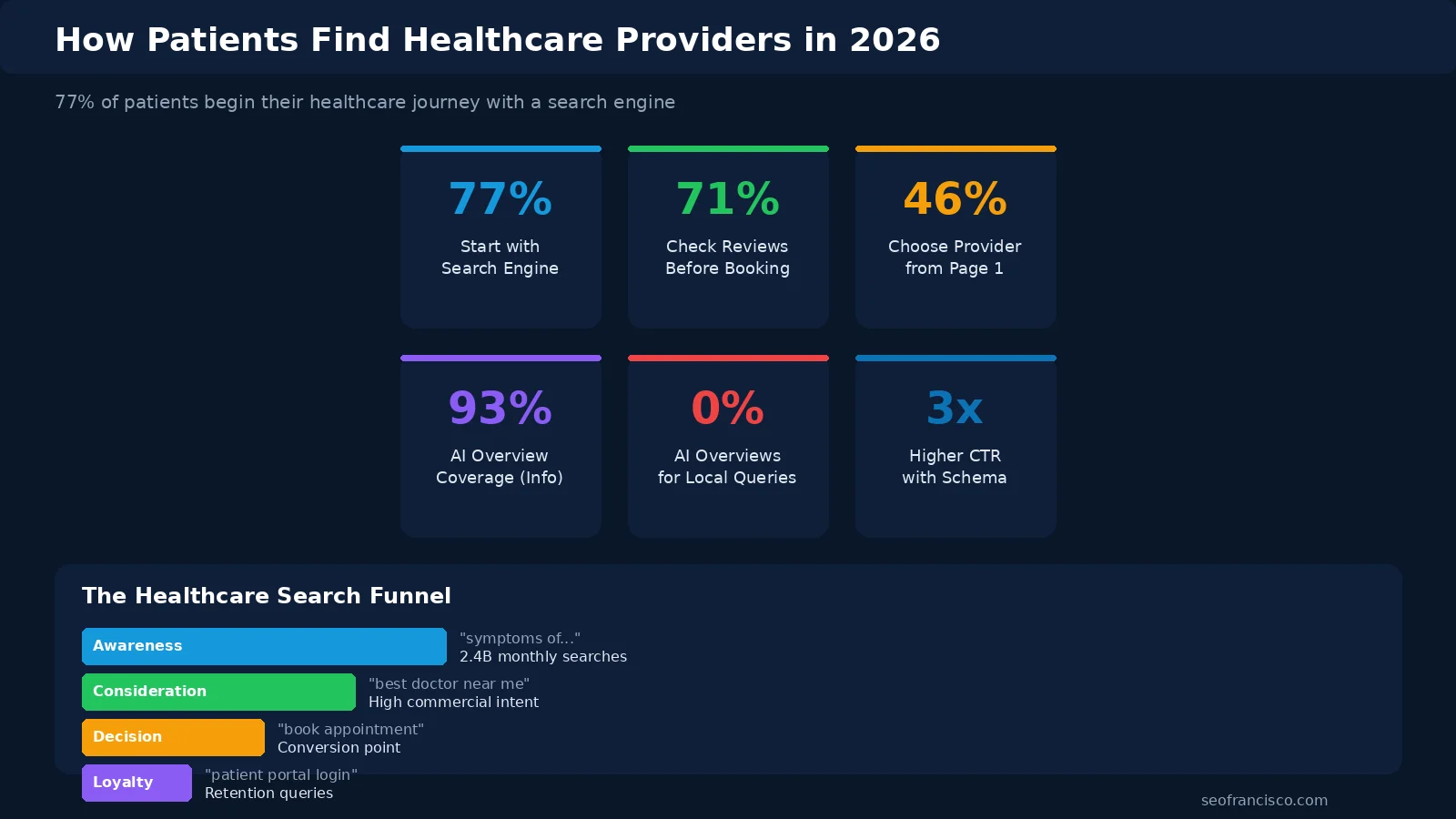
Google processes over 1 billion health-related queries every day , approximately 70,000 per minute. This was confirmed directly by Hema Budaraju, Google's Search AI lead, at The Check Up 2026 conference in March 2026. Health searches now represent roughly 5% of all Google queries globally, making healthcare one of the highest-volume search verticals.
The patient search process has changed. In 2023, online search officially surpassed physician referrals as the leading way Americans find new doctors. Today, 77% of patients begin their healthcare process on Google, with 46% using Google Search to identify a new doctor. Another 46% cross-reference their insurance plan's online directory.
Patient Provider Discovery Methods (2026)
Reviews Drive the Decision
Finding a provider is only the first step. The evaluation phase is where reviews become critical: 84% of patients check online reviews before choosing a provider, 51% read a minimum of 6 reviews, and 40% have actually canceled an appointment or changed providers because of what they read in reviews. Practices with higher ratings earn 37% more revenue annually, and a one-star improvement can boost hospital revenue by 5-9%.
The Mobile-First Healthcare Searcher
Over 60% of healthcare searches happen on mobile devices, though healthcare maintains a more balanced split (51% mobile vs. 47% desktop) compared to other industries where mobile dominates at 66%+. This is because patients often switch to desktop for detailed research , reading treatment options, comparing providers, and completing intake forms. However, mobile dominates for appointment bookings, and clinics that optimized their mobile experience saw a 50% increase in organic traffic from mobile devices in 2025.
Health search queries have also grown 3x longer on average, shifting from simple keywords like "back pain" to conversational queries like "what causes lower back pain that gets worse when sitting at a desk." This shift toward long-tail, natural language queries mirrors the rise of voice search , 25% of patients now use voice search to find physicians , and has massive implications for content strategy.
YMYL, E-E-A-T, and Why Most Healthcare Sites Fail
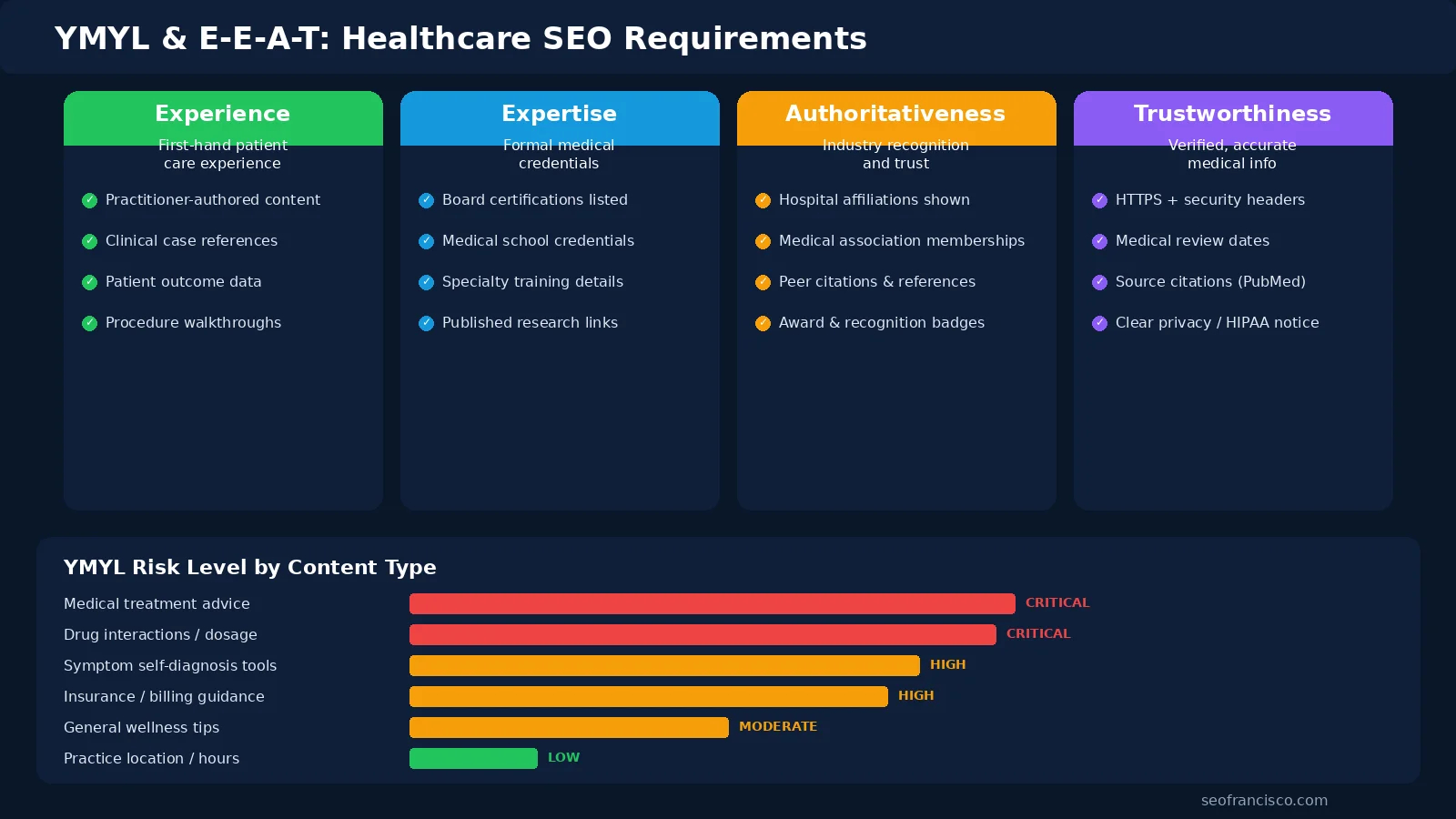
Google classifies healthcare content as "Your Money or Your Life" (YMYL) , content that could directly impact a person's health, safety, or financial stability. This means healthcare pages are held to the highest possible quality standards in Google's ranking systems. Since the introduction of the E-E-A-T plan and subsequent Helpful Content Updates, the gap between well-optimized and poorly-optimized healthcare sites has widened dramatically.
Impact of Google Core Updates on Healthcare Sites
The December 2025 core update hit YMYL websites especially hard. Generic health portals , sites that covered broad topics without demonstrable expertise , lost an average of 45% of their visibility. Meanwhile, specialized medical websites with strong E-E-A-T signals gained 30% visibility. The data makes it clear: Google is actively rewarding genuine medical expertise and punishing thin or generic health content.
The Four Pillars of Healthcare E-E-A-T
Experience
Content from practitioners who have direct clinical experience with the conditions and treatments discussed. Patient testimonials, case studies, and practice-specific insights demonstrate lived experience that generic content farms cannot replicate.
Expertise
Author credentials visible near the top of every page , board certification, specialty training, years of practice, hospital affiliations. Google now evaluates expertise on a topic-by-topic basis, not as a blanket sitewide assessment.
Authoritativeness
Citations to peer-reviewed sources (PubMed, ClinicalTrials.gov), medical society guidelines, and institutional research. Backlinks from medical institutions, health publications, and.edu domains. MedicalWebPage schema markup.
Trustworthiness
Transparent editorial policies, fact-checking methodology pages, medical disclaimers, clear author attribution, and HIPAA-compliant data handling. Trust is the foundation , without it, expertise and authority signals are discounted.
What Google Requires From Healthcare Content in 2026
| Requirement | What It Means | Impact |
|---|---|---|
| Author credentials block | Board certification, specialty, years of experience , near the top of page, not buried in footer | Critical |
| Direct answer in first 120 words | Provide a clear, concise answer to the user's query before expanding into detail | Critical |
| Clinical citations | Link to PubMed, medical society guidelines, ClinicalTrials.gov , not just other blog posts | Critical |
| MedicalWebPage schema | Structured data identifying the content type, medical specialty, and review status | High |
| Medical reviewer sign-off | Content reviewed by a licensed healthcare professional with visible reviewer attribution | High |
| Editorial policy page | Transparent methodology explaining how content is created, reviewed, and updated | Medium |
| Regular content freshness | Medical content must be reviewed and updated at least annually to maintain rankings | Medium |
Local SEO: Where Healthcare Patients Convert
"Doctor near me" searches have grown 185% since 2020. The Google Map Pack drives 40-44% of all local search clicks, and 88% of mobile local searchers either call or visit a business within 24 hours. For healthcare providers, local SEO is not an optional add-on , it is the single highest-converting channel.
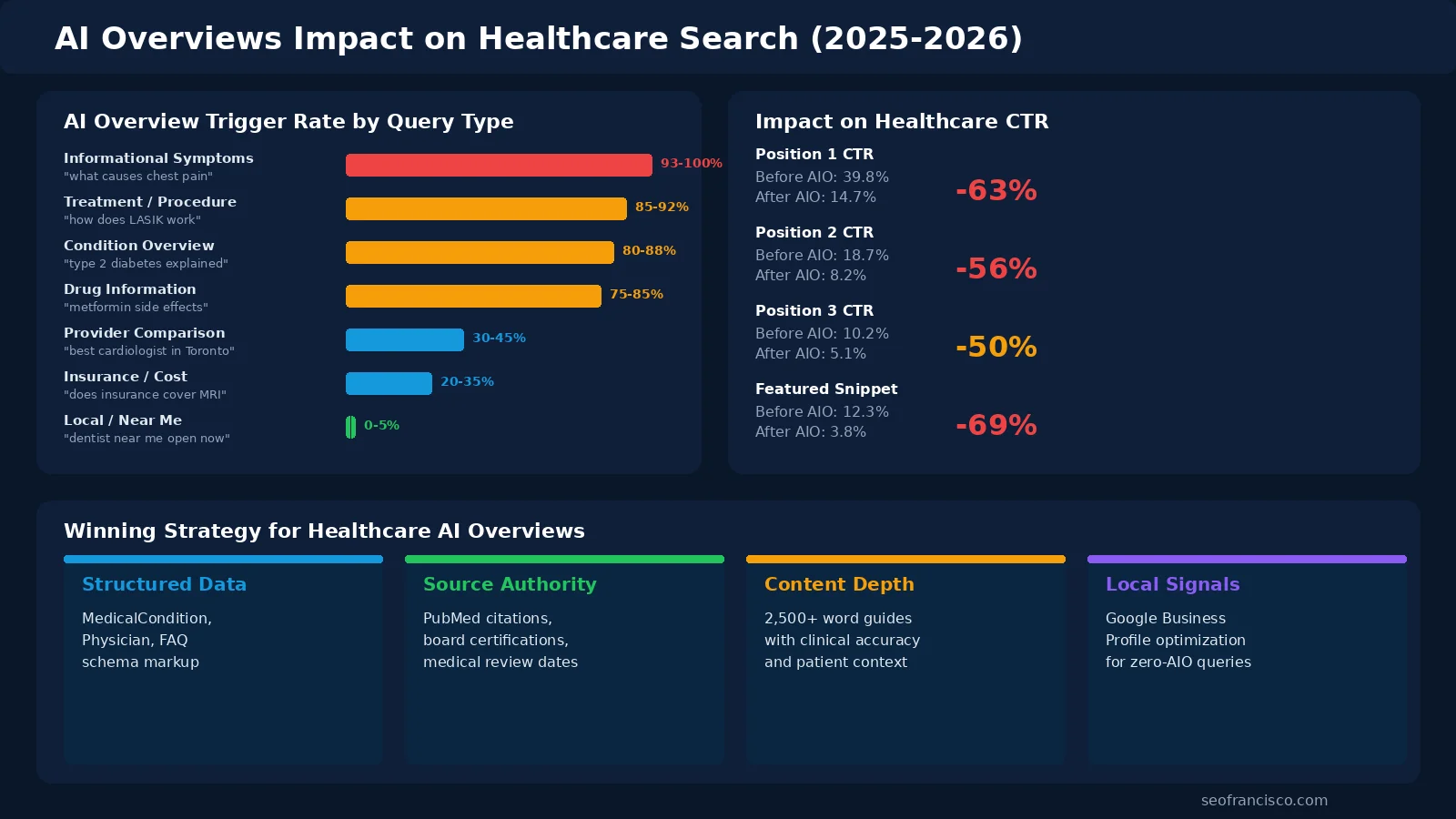
A critical factor that makes local SEO even more important for healthcare in 2026: Google has confirmed that local healthcare provider queries receive zero AI Overviews. When someone searches "dentist near me" or "urgent care [city name]," they see traditional local results , Map Pack, organic listings, and ads. This means local SEO for healthcare operates as pure traditional ranking territory, unaffected by the AI Overview disruption hitting informational health queries.
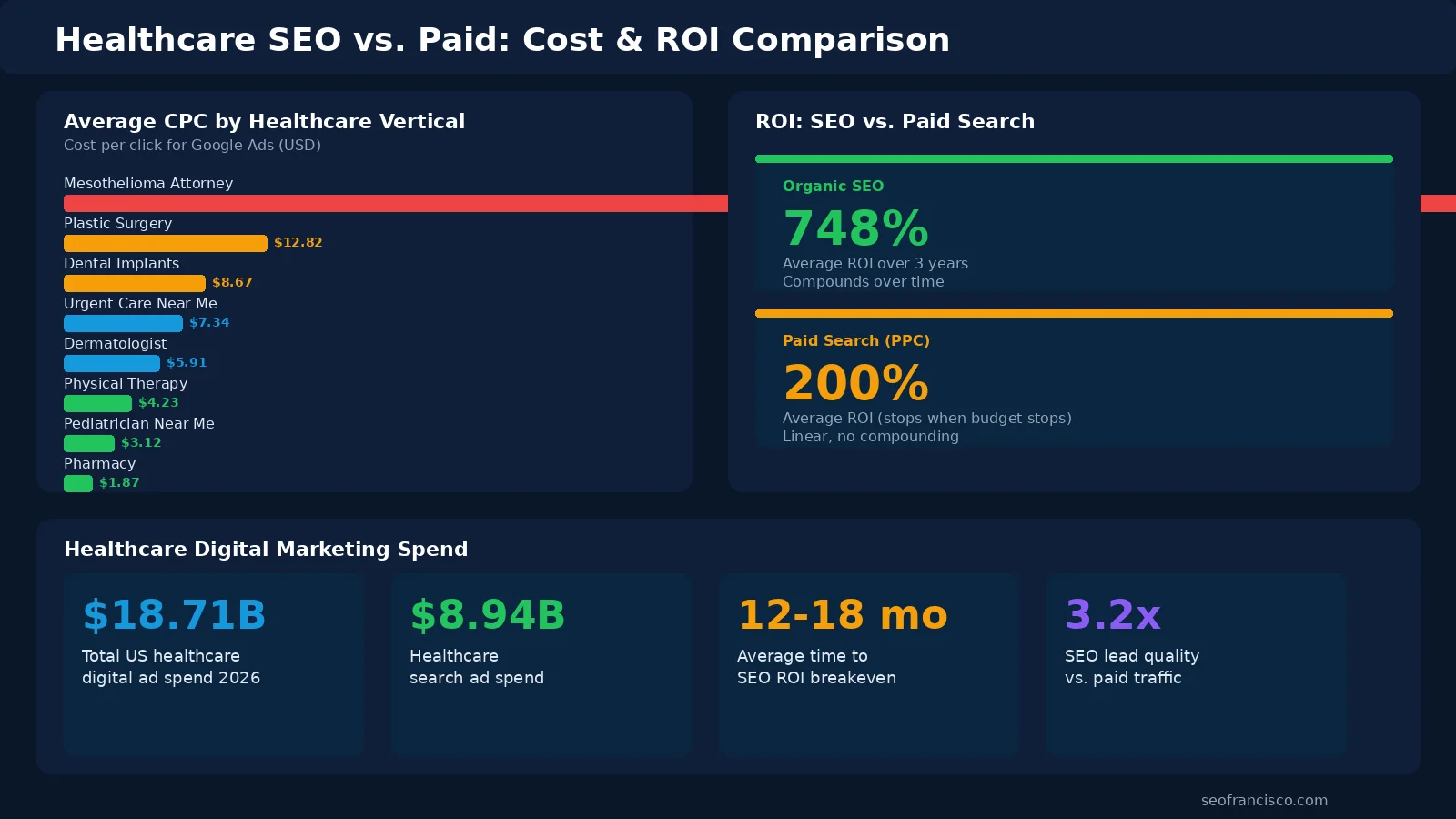
Healthcare CPC by Specialty
Google Business Profile: The Healthcare Local SEO Engine
Healthcare facilities with optimized Google Business Profiles have 838% more action clicks (calls, directions, website visits) than those without. Over 34% of all Google reviews are for healthcare services, making reviews both the most important and the most competitive element of healthcare local SEO.
Our dental clinic case study demonstrates the compound effect: by optimizing GBP across 3 locations, building review velocity from 47 to 280+ reviews (4.8 star average), and creating location-specific content, the practice achieved 340% more patient inquiries and 28 keywords ranking in the Map Pack top 3.
AI Overviews: The New Healthcare Search Reality
AI Overviews have transformed healthcare search in ways no other industry has experienced. According to BrightEdge's research, treatment and procedure queries now show AI Overviews 100% of the time , up from 45% in 2023. Symptom and condition queries show AI Overviews 93% of the time. The coverage by medical specialty is equally full: genetic/genomic content at 97%, cardiology at 96%, urology at 96%.
AI Overview Coverage in Healthcare by Query Type
For healthcare SEO, this creates a bifurcated strategy requirement. Informational health queries (symptoms, conditions, treatments) are heavily covered by AI Overviews, meaning traditional organic click-through rates for these queries are declining. But local provider queries receive zero AI Overviews, making them the highest-opportunity channel for patient acquisition.
Patient Trust in AI-Generated Health Information
Only 8% of patients rate AI Overviews for health as "very reliable", while 55% say "somewhat reliable." Google itself removed AI Overviews for certain medical queries in January 2026 after investigations found misleading health information , liver blood tests that didn't account for patient differences, and incorrect cancer screening recommendations. This trust gap creates an opportunity for healthcare brands that demonstrate genuine expertise: patients see the AI summary, then click through to authoritative sources they trust.
Our AI Overviews optimization case study shows how to structure content for both the AI Overview citation and the click-through: achieving 92% AI Overview inclusion by front-loading concise, factual answers while maintaining depth that compels the click.
HIPAA Compliance: The SEO Advantage Most Miss
HIPAA compliance in digital marketing is a minefield that most healthcare organizations handle poorly , and most SEO agencies ignore entirely. Standard marketing tools like Google Analytics, Meta Pixel, and many email platforms can violate HIPAA when used on healthcare websites because they associate a user's device with a specific medical concern.
For example: if a patient visits your "diabetes treatment" page and you have a Google remarketing tag installed, that tag creates an association between the patient's device and a health condition. That is technically a HIPAA violation.
HIPAA-Compliant Healthcare Marketing Stack
| Tool Category | Non-Compliant (Avoid) | Compliant Alternative |
|---|---|---|
| Analytics | Standard Google Analytics (client-side) | Server-side GA4 with BAA, or HIPAA-compliant platforms (Freshpaint, Piwik PRO) |
| Remarketing | Meta Pixel, Google Ads remarketing on condition pages | Contextual targeting (topic-based, not behavior-based) |
| Standard Mailchimp, HubSpot (without BAA) | Platforms with signed BAA (Paubox, LuxSci, configured HubSpot Enterprise) | |
| Forms | Standard web forms transmitting PHI | HIPAA-compliant form processors with encryption at rest and in transit |
| Call Tracking | Standard call tracking without BAA | HIPAA-compliant call tracking (CallRail with BAA, Invoca) |
The Healthcare SEO Strategy Plan
Based on our work across 6 healthcare verticals , generating combined organic traffic of 300,000+ monthly sessions and millions in attributable revenue , we have identified a repeatable 8-phase plan that works across healthcare sub-verticals.
- Phase 1 , Month 1 Technical Audit & Toxic Link Cleanup Crawl the site for technical issues: thin/duplicate pages, crawl budget waste, Core Web Vitals problems, missing structured data. Audit backlink profile for toxic links , common in healthcare due to legacy EMD link networks and directory spam. Our healthcare client had a 54.85 penalty risk score from 320+ toxic backlinks.
- Phase 2 , Month 1-2 E-E-A-T Infrastructure Build author profiles with medical credentials, implement MedicalWebPage and MedicalOrganization schema, create editorial policy and fact-checking methodology pages, add medical reviewer attribution to all clinical content. This is non-negotiable , without E-E-A-T infrastructure, no amount of content will rank in healthcare YMYL.
- Phase 3 , Month 2-3 Content Architecture & Funnel Mapping Map the patient process from awareness (symptom searches) to consideration (treatment comparisons) to conversion (provider selection). Build pillar-cluster content hubs per condition or service line. Separate HCP content from patient content if serving both audiences. Our pharmaceutical client built condition-based hubs that drove 420% visibility growth.
- Phase 4 , Month 2-4 Local SEO & GBP Optimization For multi-location practices: complete GBP optimization per location, build location-specific landing pages, implement review velocity programs, tune for "near me" and city-specific queries. For single locations: hyper-local content strategy targeting neighborhood and service-area terms.
- Phase 5 , Month 3-6 Content Production at Scale Deploy expert-authored content with clinical citations: condition guides, treatment explainers, cost transparency pages, comparison content, FAQ expansions. Every piece reviewed by a licensed healthcare professional. Target: 15-25 high-quality pages per month. Our natural health client published 240+ expert-authored articles.
- Phase 6 , Month 4-8 AI Overview & Featured Snippet Optimization Structure content to earn AI Overview citations (front-loaded answers, structured data, high factual density) while optimizing for featured snippets on condition and treatment queries. Our AI Overviews case study achieved 92% inclusion rate.
- Phase 7 , Month 6-10 Conversion Rate Optimization Tune appointment booking flows, reduce form friction (healthcare forms average 11+ fields , cut to 4-5), implement click-to-call on mobile, add live chat for patient questions. Healthcare sites converting above 5% outperform 75% of competitors; top performers reach 20%+. See our CRO case study for the methodology.
- Phase 8 , Ongoing Authority Building & Content Freshness Earn backlinks from medical institutions, health publications, and.edu domains. Refresh clinical content annually (Google monitors medical content freshness closely). Build digital PR around original research, patient outcome data, and provider expertise. Monitor for algorithm updates , healthcare sites are disproportionately affected by every core update.
Healthcare SEO by Vertical
Healthcare is not one industry , it is dozens of verticals, each with unique search patterns, compliance requirements, competitive dynamics, and patient journeys. Below is how SEO strategy differs across the 6 healthcare verticals we have served, with links to the full case studies.
Healthcare & Medical Services
Organic sessions grew 5x and lead volume 10x for a medical services provider after toxic link cleanup, content funnel architecture, and E-E-A-T signal building.
Read full case study →Pharmaceutical SEO
Visibility grew 420% for a pharmaceutical brand through condition-based content hubs, PharmD review workflows, and HCP vs. patient content segmentation , all FDA-compliant.
Read full case study →Dental Clinic Local SEO
Patient inquiries grew 340% across 3 locations through GBP optimization, review velocity (47 to 280+ reviews), and service-specific authority pages.
Read full case study →Elder Care & Senior Services
Qualified leads grew 4.6x by targeting family decision-makers (not residents), building local authority across 6 locations, and eliminating $200-400/lead aggregator dependency.
Read full case study →Health Tech & SaaS
$1.8M ARR from organic through competitor alternative pages (8.2% MQL conversion), compliance thought leadership, and product-led content hubs.
Read full case study →Natural Health & Wellness
Recovered from a 45% Helpful Content Update loss and grew 320% by rebuilding with 8 credentialed authors, increasing citations from 0.3 to 14.2 per article.
Read full case study →Key Differences by Healthcare Vertical
| Vertical | Primary SEO Challenge | Top Strategy Lever | Avg CPC Savings |
|---|---|---|---|
| Hospitals & Clinics | Multi-location local SEO at scale | GBP optimization + review velocity | $8-15/click |
| Pharmaceutical | FDA compliance + YMYL | PharmD-reviewed content hubs | $6-12/click |
| Dental | Hyperlocal competition | Map Pack dominance + service authority | $12-18/click |
| Elder Care | Surrogate searcher (family, not patient) | Decision-maker content + cost transparency | $5-10/click |
| Health Tech / SaaS | B2B buying committee (CIO, CMO) | Comparison pages + compliance authority | $15-40/click |
| Wellness / Supplements | Post-HCU E-E-A-T requirements | Expert author network + clinical citations | $3-8/click |
Healthcare SEO ROI: The Numbers
A well-executed healthcare SEO campaign yields a median ROI of 748% , $7.48 back for every $1 invested. Healthcare SEO ROI frequently ranges between 500% and 1,000% over time, benefiting from the industry's high patient lifetime value. Organic search leads in healthcare close at 14.6%, compared to 1.7% for outbound marketing (direct mail, print advertising).
Healthcare SEO ROI vs. Other Marketing Channels
Consider the math for a single optimized page: a well-built "dental implants in [city]" page might cost $2,000-$5,000 to create. It generates 30-80 visits per month. At a 5% conversion rate and $3,000-$5,000 average case value, that single page produces $4,500-$20,000 per month in revenue , indefinitely. The page pays for itself within the first month and continues generating returns for years.
Combined Client Organic Traffic Growth
Healthcare SEO: Frequently Asked Questions
How long does healthcare SEO take to show results?
Is healthcare SEO HIPAA compliant?
How much should a healthcare organization invest in SEO?
What is the biggest SEO mistake healthcare organizations make?
How do AI Overviews affect healthcare SEO strategy?
Should healthcare organizations invest in SEO or PPC first?
What structured data should healthcare websites implement?
Explore More Industry Guides
Ready to Grow Your Healthcare Practice Through Search?
We build YMYL-compliant, E-E-A-T-first SEO programs for healthcare organizations , from single-location practices to multi-state health systems.
Get a Healthcare SEO Audit →