How to Audit Index Bloat Before Scaled Content Costs You a Core Update
Audit index bloat by page purpose. Compare indexing evidence, choose a justified action and preserve the baseline before assessing a core update.

Before setting a cleanup target for a site that has expanded publishing, ask which page types justify their own search results. An indexed URL may offer little original value, while a page missing from Search may answer an important reader question. The audit should explain that difference before anyone starts deleting content.
Use index bloat as a practical label for reviewing unnecessary indexed pages. The sources below provide no safe ratio or deletion quota, and they do not establish that a larger indexed count causes core-update losses. The useful outcome is a reasoned decision for each page type, followed by verification of the affected URLs.
TLDR. Join your intended search inventory with a crawl and dated Search Console evidence, keeping gaps explicit. Assess the reader purpose before choosing keep, improve, merge, noindex or remove. Preserve the publishing history for a later comparison. Fewer indexed pages do not guarantee recovery, and AI-assisted production alone does not establish the cause of a loss.
November's early signals and the official boundary
The November 2026 core update began November 10 at 10:06 US/Pacific. Google said it applies globally and to all languages, with a rollout estimate of up to 2 weeks. At the November 17 source check, the incident page contained no completion entry. That estimate cannot supply a confirmed end date.
Google's core-update guidance describes broad changes that do not target particular sites or individual pages. Read the early visibility charts within that limit. Malte Landwehr reported ranking losses for 2 unnamed domains previously associated with scaled AI-content publishing. Glenn Gabe quoted Malte's observation, describing the picture as clearer after the weekend. His commentary concerns the same examples, rather than an independent dataset.
Lily Ray shared an unnamed AI-content company's visibility chart. Much of the visible decline precedes November, and her post does not explicitly attribute it to this update. Treating that graph as a November loss would give it a meaning the post does not establish.
These are early practitioner observations, without the page-level evidence needed to diagnose your site. The current generative-AI guidance says generating many pages without adding value for users may violate scaled-content-abuse policy. It also describes useful AI applications in research and structuring original material. Review the published result instead of treating the production tool as a diagnosis. A thin-content manual action needs its own evidence and response.
Intended pages versus observed indexing
I would start the intended inventory with the CMS and an editorial review. For each page type, write down the reader task and why individual pages need separate search results. A city-name substitution or a different filter parameter is a reason to inspect the distinction, rather than proof that the page should be removed. Check what useful information changes for the visitor.
Compare that inventory with the sitemap URLs and a crawl. A sitemap declares pages considered important. A crawl reports what it can reach within its configured scope and can miss orphan pages. Neither source certifies indexing, and the sitemap itself may need correction. Keep CMS URLs missing from the crawl in the audit.
Attach dated evidence from the Page indexing report. Google limits indexed-page examples to 1,000 URLs and warns that examples need not be complete even below the limit. An omitted URL belongs in an unknown state until another check supplies evidence. Google points to URL Inspection for individual URL status.
For the audit worksheet, use these recommended groups of fields:
- Purpose and history. URL, page type, distinct reader task, publication date and last substantive edit.
- Discovery and implementation. CMS presence, sitemap membership, crawl discovery, HTTP status, indexability and canonical destination.
- Evidence and decision. Observed indexing state with its source and date, relevant performance window, intended action and the reason for it.
These are worksheet recommendations, not fields promised together in one Google report. For a useful page missing from Search, investigate crawled, currently not indexed before classifying it as unwanted content. If only the homepage is indexed, establish the wider technical scope first. A site disappearing from Google also requires diagnosis beyond a page-count comparison.
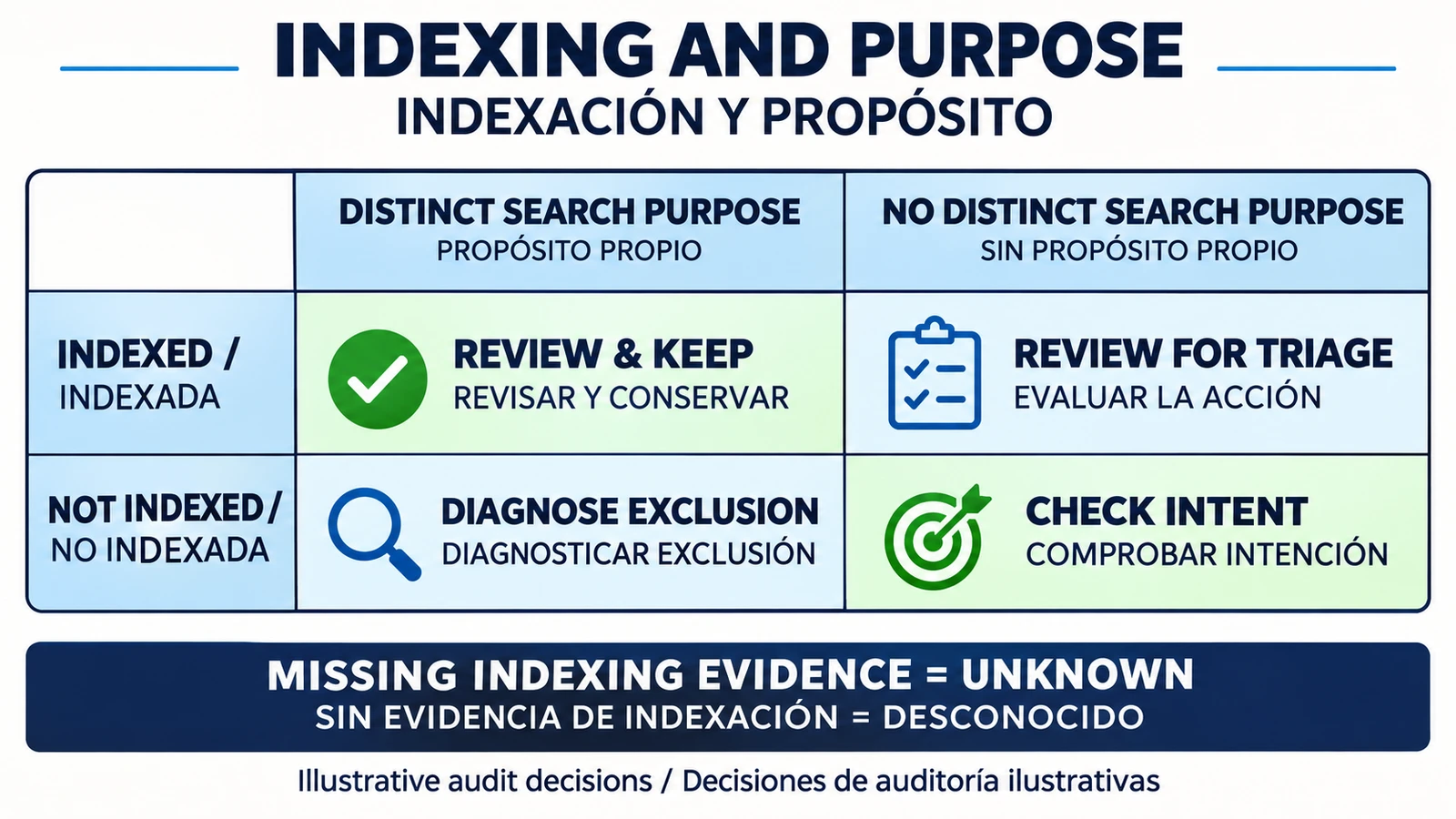
Page-type triage with a reason for each action
Review page types to locate repeated weaknesses, then inspect the individual URLs before implementing changes. Google's helpful-content assessment asks about originality, completeness and care in production. Apply those questions to the answer a visitor receives. A common template can support useful pages, while adding paragraphs can leave the reader's problem unresolved.
Keep
Retain a page with a distinct, useful search purpose. A recent window without clicks does not establish that it is disposable. I would check the reporting scope and the page's role before using performance to make the decision. A valuable page that is accidentally excluded needs repair, rather than a cleanup label.
Improve
Keep the intended purpose and name what is missing from the answer. That might be verification of a claim, a useful comparison or an explanation needed to make a decision. Assign the editorial work against that gap. A request to make every page longer would give the writer no evidence of what needs to improve.
Merge
Combine overlapping material when a suitable surviving page can preserve its useful contribution. For a retired duplicate, Google's canonicalization guidance supports permanent redirects. Check that the destination serves the visitor's task, then update internal links. A shared keyword does not make an unrelated page a suitable replacement.
Noindex
Keep a page accessible when it helps people using the site but does not need a search result. Google must be able to crawl it to see a noindex meta tag or HTTP header. A robots.txt block can prevent that observation. Excluding a URL also does not demonstrate that the remaining content has improved.
Remove
Consider removal only when the content cannot be salvaged and has no continuing purpose. Google's core-update guidance makes deletion a last resort. If there is no suitable replacement, return an appropriate 404 or 410 response. Avoid sending visitors to an unrelated homepage simply to make the old URL redirect.
This five-action method is a recommended audit framework. Its job is to connect a reason to the implementation, without promising a ranking treatment.
Publishing changes and the core-update comparison
Save the publishing history before cleanup begins. A template release or batch of rewritten pages can supply another explanation for later movement. Record the affected section and deployment date beside the performance evidence. Repair demonstrated technical faults when needed, with those repairs separately dated.
Google recommends confirming rollout completion, waiting at least a full week, then comparing that week with one before rollout started. It also recommends analyzing search types separately. The November core-update baseline guide covers that assessment. Preserve matching filters so a changed reporting scope does not become another explanation for the difference.
As a diagnostic recommendation, compare edited and unchanged page groups with similar reader tasks. An unchanged group adds context, but differences in demand or page mix prevent it from becoming a controlled experiment. I would leave attribution unresolved if the timing cannot distinguish the edits from the update. A dated audit is still useful when it cannot prove the cause of a traffic change.
An index-bloat audit checklist
Use the checklist to produce a reviewable action record before implementation:
- Preserve the reference. Save the relevant Search Console scope and publishing history, with dates.
- Join the inventories. Compare intended pages with sitemap URLs and a crawl. Include known CMS URLs outside the crawl.
- Mark the gaps. Keep missing indexing evidence unknown, with a specific check assigned where the decision needs it.
- Review the purpose. Inspect representative pages from each type and verify the individual URLs selected for action.
- Specify the action. Record the reason and intended destination or exclusion behavior. Consider improvement before deletion.
- Verify and revisit. Check implementation first, then later Google observations and comparable performance windows.
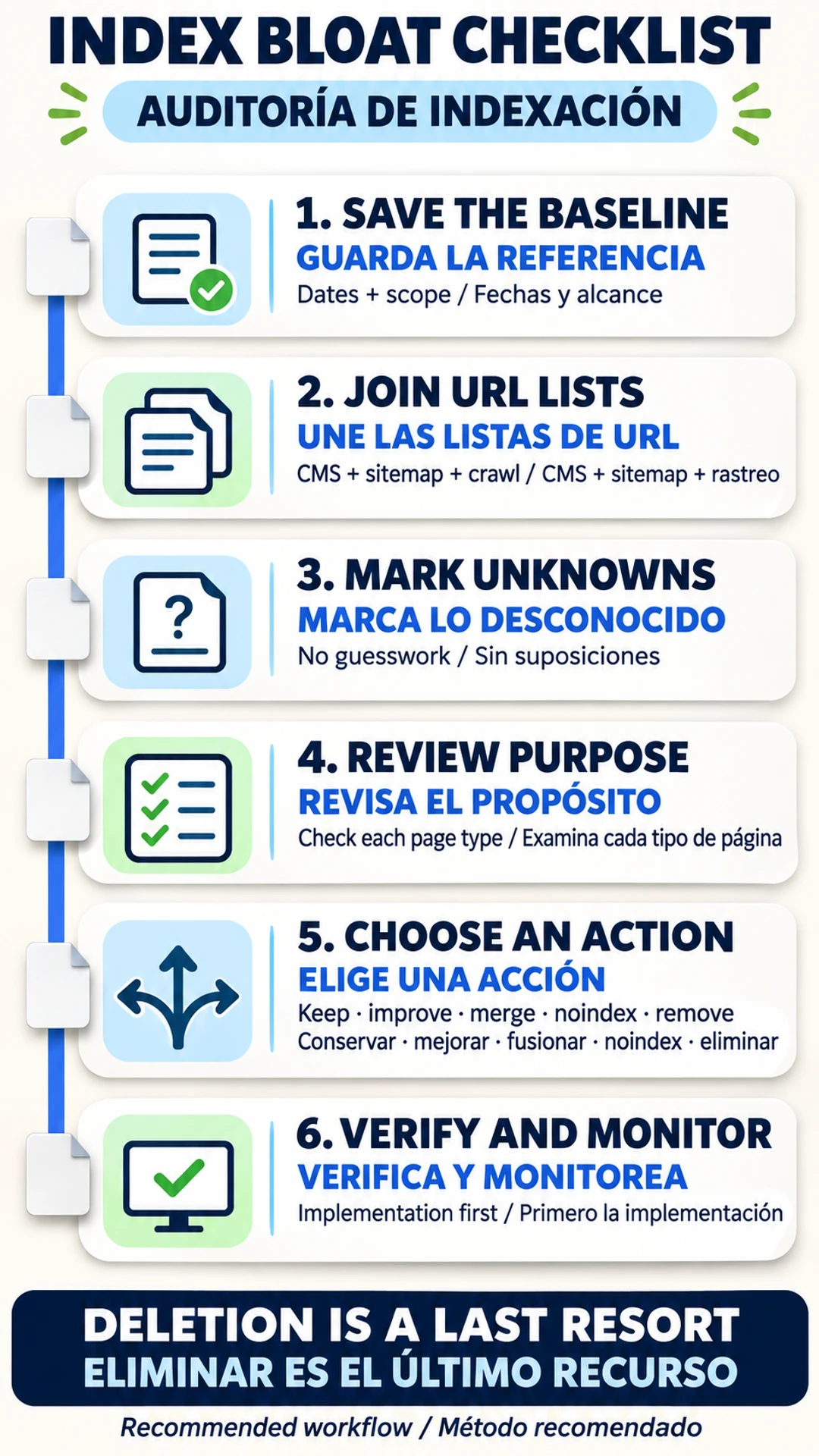
Implementation evidence and later search effects
After the changes, test the HTTP responses and redirect destinations. Check that retained pages remain eligible for indexing and that noindex pages remain crawlable. Review internal links and sitemap entries against the intended surviving inventory. Save those checks separately from Google's later observations.
The noindex guidance warns that a revisit may take months, depending on the page's importance. The core-update guidance describes possible effects from improvements in days to months. These refer to different processes and provide no recovery deadline. A smaller indexed count may be expected after intentional exclusions, but it cannot, by itself, show that the site's useful pages perform better.
Keep each page type attached to its reason for change and a follow-up date. That gives the next reviewer something more useful than a count of deleted URLs.
Frequently asked questions
Does a large indexed count prove index bloat?
No. Review the purpose of the pages and keep inventory limits visible. The sources used here provide no safe indexed-page ratio or deletion quota.
Should every page without recent clicks be removed?
No. Assess its usefulness and intended search role first. Google frames deletion as a last resort when content cannot be salvaged.
Does an AI-content visibility chart prove an AI penalty?
No. The early observations cited here do not establish a cause. Google's current guidance says generating many pages without user value may violate scaled-content-abuse policy.
Can noindex guarantee recovery after a core update?
No. Google must observe the instruction before excluding the page. Exclusion does not establish improvement in the remaining content or promise higher rankings.
When should the core-update comparison begin?
Google recommends waiting at least a full week after confirmed completion, then comparing that week with one before rollout began. The November 17 source check found no completion entry.
About the Author