Google AI Content and Thin Content: What We Know
WindowsForum’s manual action does not prove Google penalized AI content. See the evidence, two automation systems, audit steps, and recovery plan.

6-Minute AI Content and Thin Content Evidence Review
Watch what the WindowsForum case proves, and what it does not
A source-backed walkthrough of the reported manual action, two separate automation systems, Google's published policy, and a URL-level recovery plan.
Google has not confirmed that AI content caused the WindowsForum manual action. That is the first fact to keep straight.
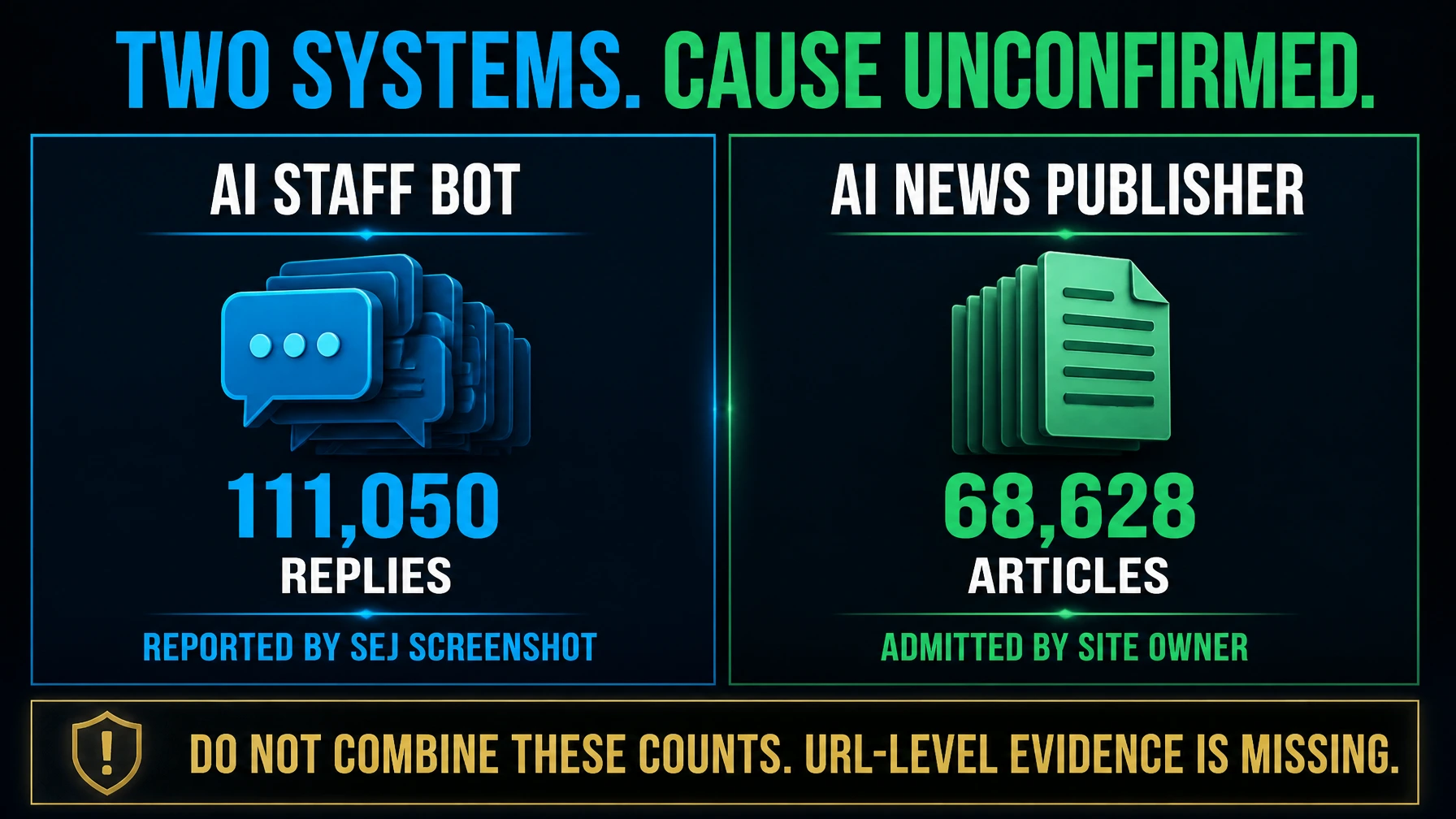
The case is still useful because it exposes what happens when automated publishing grows faster than its controls. WindowsForum reported a partial manual action for “Thin content with little or no added value.” Search Engine Journal then highlighted a staff account with 111,050 AI-generated replies. Days later, a WindowsForum administrator disclosed a different problem: an automated news system had published thousands of irrelevant or promotional articles that the site says should never have gone live.
Those are two separate automation systems. Neither can be named as the cause without URL-level evidence from Google.
TLDR
- WindowsForum says Google applied a partial manual action to its
/threads/URL pattern for thin content. - Google has not said that AI generation caused the action.
- The often-cited 111,050 figure belongs to an AI staff account that posted replies. It is not a count of affected or low-quality URLs.
- WindowsForum separately audited 68,628 automated news articles. It says 3,157 failed review and 3,139 were removed.
- The removals equal 4.57% of the news corpus. This confirms a publishing-quality failure, not the cause of Google’s action.
- The practical response is a URL-level audit, independent reviews of every automation system, and a reconsideration request backed by exact fixes.
What happened at WindowsForum
Search Engine Journal reported that WindowsForum received a partial manual action. A screenshot shared with the report showed the label “Thin content with little or no added value” and a pattern covering /threads/.
That label matters. The word “AI” was not in the reported notice.
An outside observer connected the action to a WindowsForum staff account whose public profile showed 111,050 replies since March 2023. That is a reasonable lead for an audit. It is not proof. A profile total tells us nothing about how many replies were indexed, how many were repetitive, whether they contained unsupported claims, or which pages a reviewer examined.
WindowsForum then published its own response, “Improving our news articles, and what we are doing about it”. The administrator described another system that gathered and published automated AI news articles.
The site says it reviewed 68,628 of those articles. It found 3,157 that failed its quality review, removed 3,139, and retained 18 because members had replied. It also says the deleted pages had zero replies. The cleanup blocked 124 source websites and added 48 filters.
This disclosure changes the evidentiary picture. It confirms that WindowsForum found irrelevant press releases, cryptocurrency material, stock content, and other items that did not belong on the site. It does not tell us which pages Google judged or whether Google focused on news articles, AI replies, old forum threads, or a combination.
The evidence, without the headline leap
| Claim | Evidence status | What it means |
|---|---|---|
| WindowsForum received a partial manual action for thin content | Reported by the site owner and SEJ | Treat the action and affected pattern as reported facts |
| Google penalized the site for using AI | Unsupported | Google has not identified AI use as the cause |
| The 111,050 bot replies caused the action | Hypothesis | The scale warrants an audit, but the profile count is not URL evidence |
| The automated news system published low-value material | First-party admission | WindowsForum’s own audit found content it says should not have been published |
| WindowsForum removed 3,139 news articles | First-party report | The site addressed a confirmed governance failure |
| Those 3,139 articles caused the manual action | Unproven | Google did not identify them as the trigger |
The calculation is also worth putting in context. The 3,157 failed articles represented about 4.60% of the 68,628-article news corpus. The 3,139 removals represented 4.57% of the corpus and 99.43% of the failed set. Eighteen failed articles, or 0.57% of that set, were retained.
A 4.57% failure rate might sound small. At this scale it still produced more than three thousand pages that the publisher judged unfit. Automation turns a modest error rate into a large cleanup.
What Google’s policies actually say
Google’s guidance on AI-generated content does not ban AI assistance. It says the appropriate use of AI or automation is not against its guidelines. The concern is using automation primarily to manipulate search rankings.
The spam policies define scaled content abuse around producing many pages primarily to manipulate rankings rather than help users. The policy can apply whether pages are produced by AI, humans, or a mixture.
Google’s helpful content guidance asks publishers to evaluate originality, completeness, expertise, and whether the page serves an existing audience. None of those tests can be reduced to “AI or not AI.”
A manual action also needs to stay separate from an algorithmic update. Google’s documentation describes it as a decision by a human reviewer, while a partial action on a URL pattern does not necessarily mean every matching URL was affected. WindowsForum reported the notice after Google’s June 2026 spam update began rolling out. That timing does not turn update volatility into evidence about the manual review.
Older indexation offers no safe harbor. A thread indexed since 2008 proves only that it remained eligible before the current review. It does not certify the page under current policies.
That distinction matches what I see in technical and content audits. The production tool is rarely the decisive fact. The harder questions are:
- Why does this page exist?
- What does it add that the source or competing pages do not?
- Who checked its claims?
- Does it solve the query better than a template filled with different nouns?
- Can the publisher explain how the page was selected, reviewed, updated, and retired?
If those questions have weak answers, replacing an AI writer with a human freelancer does not repair the system.
My position: automation needs to be treated as a publisher
Many teams treat an automated account as one more contributor. That understates the risk. A bot with a staff badge and six figures of replies functions as part of the site’s editorial voice, whatever the org chart calls it.
A person can write a poor article. An automated system can repeat the same editorial mistake across thousands of URLs before anyone notices. The relevant control is therefore not a prompt. It is a publishing policy with measurable limits.
Every automated system should have an owner, an allowed topic set, approved sources, factual review rules, publication caps, sampling requirements, rollback procedures, and a searchable log. Replies and standalone articles need different policies. A forum reply sits inside a conversation and may inherit context from human participants. An automated news article creates its own indexable page and must earn that page’s existence.
WindowsForum’s decision to preserve 18 failed articles because members replied illustrates the difference. Community discussion may add value that the original automated article lacked. Still, a reply count should not act as an automatic quality certificate. The retained page needs its own review.
This is closely related to the risks covered in our analysis of Google’s AI spam-detection research and the AI slop feedback loop. Detection is only one layer. Publishing discipline has to exist before content reaches the index.
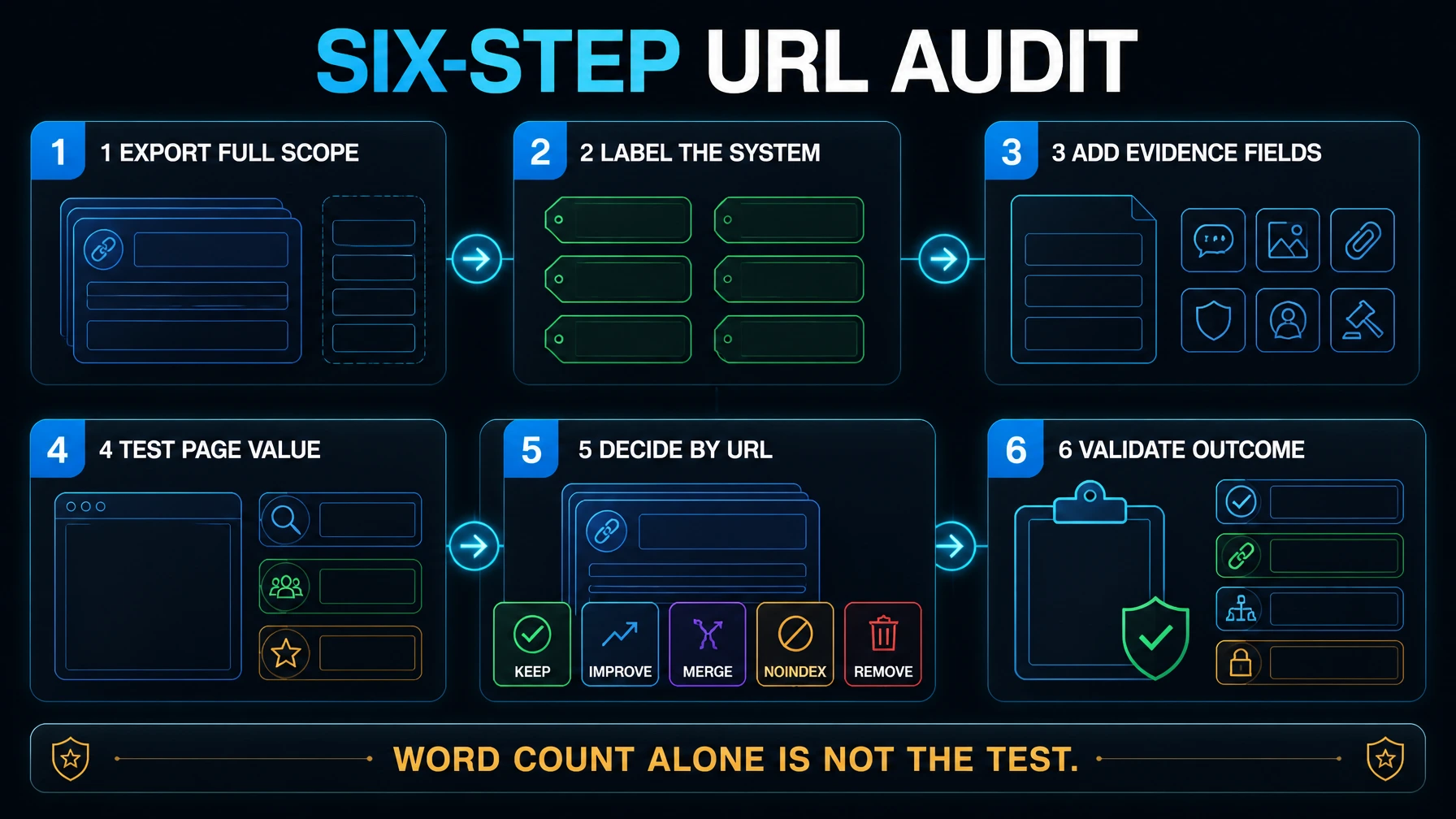
How to audit automation before it becomes a search problem
Do not begin by searching for a few embarrassing AI phrases. Build an inventory.
1. Export the full URL scope
Combine the CMS export, XML sitemaps, Search Console data, server logs, and a fresh crawl. Include URLs with zero clicks. Manual actions and quality problems are not limited to pages that still receive traffic.
2. Label the production system
For each URL, record whether it began as a human thread, AI reply, automated news article, imported page, or mixed page. WindowsForum’s two systems show why a single “AI content” label is too crude.
3. Add evidence fields
Capture publication date, index status, clicks, impressions, backlinks, meaningful replies, author type, source URL, last update, and factual-review status. Store the prompt or transformation rule when available, but do not mistake it for proof of quality.
4. Test page value
Review representative samples for duplication, unsupported claims, outdated advice, irrelevant topics, templated wording, absent firsthand experience, and weak answers. Increase the sample when a pattern fails. For high-risk sections, review every URL.
5. Decide at the URL level
Use five outcomes:
- Keep pages that are useful, accurate, and distinct.
- Improve pages with recoverable value.
- Merge pages that split one useful answer across duplicates.
- Noindex pages that serve members but do not belong in search.
- Remove pages with no defensible purpose.
6. Validate the outcome
Confirm status codes, canonicals, noindex directives, sitemap removal, internal-link cleanup, and crawl access. A spreadsheet marked “deleted” is not evidence that the URL now returns the intended response.
For sites already struggling with discovery and quality signals, our technical SEO advisory can connect this inventory to crawl behavior, templates, and indexation.
What a reconsideration request should contain
Google’s manual-action documentation says site owners should fix all affected pages before requesting review. A persuasive request is an audit record, not an apology letter.
For a case like this, I would include:
- The exact affected scope. Preserve the notice and list every matching URL group.
- A candid failure description. State what the automated system published and why the controls failed.
- Disposition counts. Report how many URLs were kept, improved, merged, noindexed, and removed.
- Representative examples. Show before and after URLs for each failure pattern.
- System changes. Document blocked sources, topic filters, human-review gates, publication limits, and monitoring.
- A separate reply-bot audit. If the notice does not exclude that system, document its quality and moderation controls too.
- Technical verification. Provide crawl evidence showing that removals and directives work.
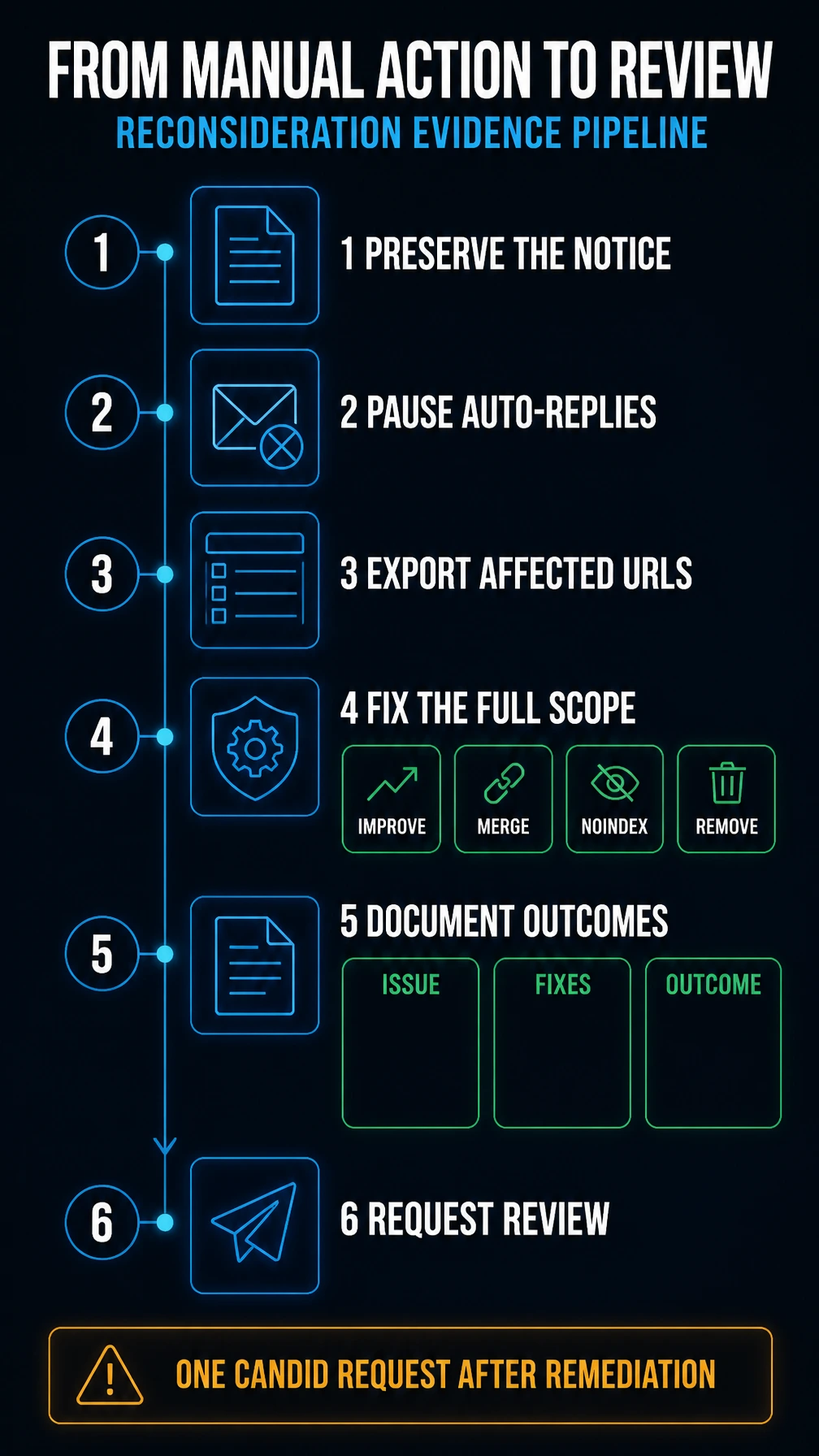
Submit one request after the full scope is fixed. Do not send repeated requests while a review is pending. A request that only argues the reviewer was wrong is an appeal. A request that documents the audit, corrections, counts, and changed controls demonstrates a fix.
What publishers should change now
You do not need to delete every AI-assisted page because of this case. You do need to know where automation can publish without a person making a page-level decision.
Start with three questions:
- Which systems can create indexable URLs?
- What percentage of their output receives meaningful human review before publication?
- How quickly can you identify and reverse a failed pattern?
If the answers are unclear, pause expansion. Audit the existing corpus first.
Our guide to Google’s AI search guidance explains why useful, attributable content remains the safer target. If your concern is writing quality rather than system governance, the AI writing tells audit offers a separate editorial check. Neither replaces the URL-level work described here.
The WindowsForum case should not become another slogan about Google “hating AI.” Its value is more practical. It shows that a site can operate multiple automation systems, discover quality failures in one, attract speculation about another, and still lack the URL evidence needed to explain a manual action with confidence.
That uncertainty is a reason to audit more carefully, not a license to make the headline louder.
Frequently Asked Questions
Did Google confirm that AI content caused the WindowsForum manual action?
No. The reported notice referred to thin content with little or no added value. Google has not publicly said that AI generation caused the action.
What does the 111,050 figure represent?
It is the public reply count associated with a separate AI staff account. It does not represent 111,050 affected URLs, indexed pages, or confirmed low-quality replies.
What did WindowsForum remove?
The site says it reviewed 68,628 automated news articles, found 3,157 that failed its quality review, and removed 3,139. It retained 18 because members had replied.
Does Google allow AI-generated content?
Google says appropriate AI or automation use is not inherently against its guidelines. Using automation primarily to manipulate rankings can violate its spam policies.
Should a site remove all AI-assisted pages after a manual action?
No blanket deletion rule follows from this case. Audit the full affected scope, judge each page’s value and accuracy, and fix every pattern covered by the action before requesting reconsideration.
Is human engagement enough to make an automated page valuable?
It can add real value, especially in a forum, but engagement alone is not proof. The page still needs to be accurate, useful, distinct, and appropriate for search.
About the Author