Is Your Rank Tracker Wrong? How to Tell a Real Ranking Drop From Bad SERP Data
Rank tracker wrong after a sudden drop? Learn how poisoned SERPs fake ranking losses, how to check Search Console, and when a Google ranking drop is real.
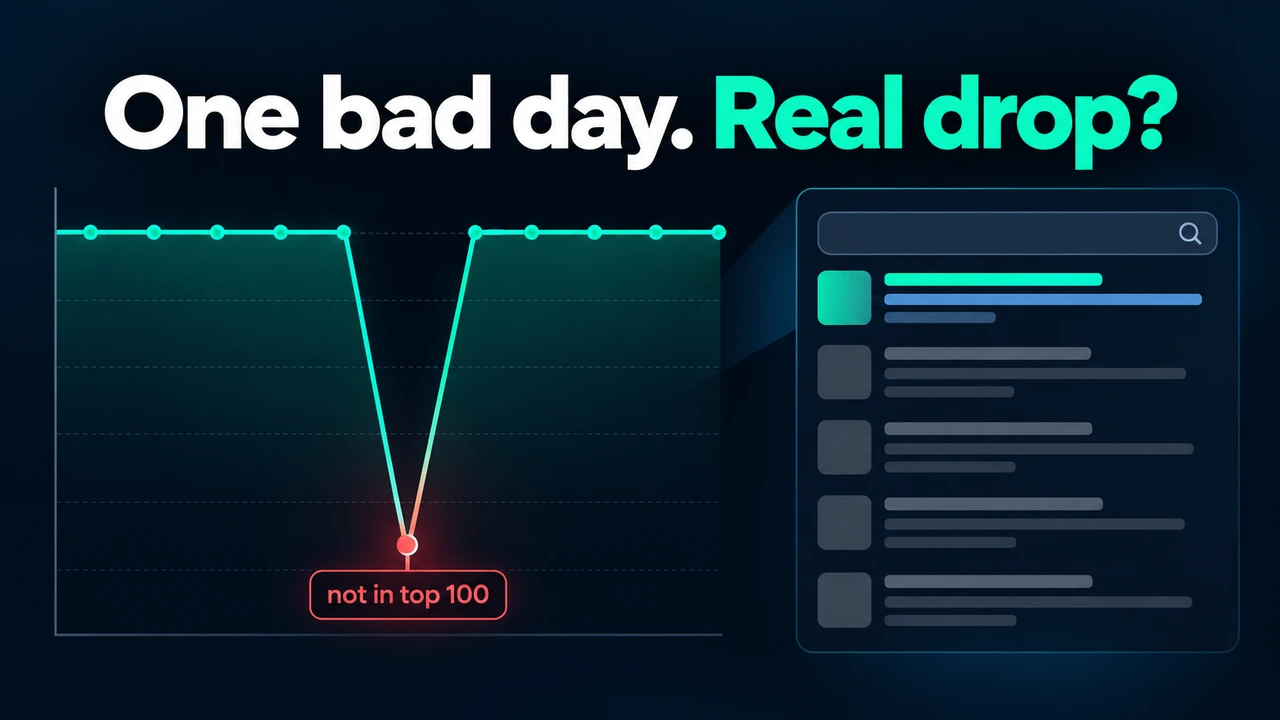
You open your rank tracker on Monday and a keyword you've held at #3 for months shows "not in top 100" for Saturday. Your first instinct is to check for a Google update and start rewriting the page.
Before you touch anything, check whether the data is real. Since late September 2026, Google has been serving some scrapers results pages that look normal but list a different set of sites, and rank trackers rely on scraping. AccuRanker reports that on October 24, 2026, Google poisoned 40% of its first desktop fetches. After its own checks, 3.2% of desktop keywords in its sample still had a swapped page 1. A drop that reverses the next day, where most of your usual competitors also vanished, is more likely bad SERP data than a real loss. Search Console for the same query and date is the tiebreaker.
That doesn't mean every drop is fake. October 24 was also a day of heavy ranking volatility that Google hasn't confirmed. You need to tell the two apart.
| What you see | What it can mean | What to verify next |
|---|---|---|
| A keyword drops sharply for one day, then returns | Likely a poisoned or swapped results page | Search Console position and clicks for that query and date |
| Most of your usual competitors also disappear from page 1 | The tracker probably saw a different results page | Whether the next day's page looks normal again |
| Local results show businesses from another city | A known sign of poisoned local results | Re-check from the right location |
| Many keywords fall together and stay down for days | Possibly real volatility or an update | Search Console trends, affected pages, update trackers |
| Search Console shows the same fall in position and clicks | The drop is probably real | Which pages and queries lost, and since when |
1. What poisoned and truncated SERPs are
AccuRanker uses "poisoned SERPs" for results pages that look normal but list a different set of organic results. Peter Emil Tybirk explains it in AccuRanker's write-up, first published October 19, 2026 and updated since. The decision appears to be made per browser session. Google hasn't commented. AccuRanker mentions anti-scraping aimed at AI answer engines as one possible explanation, not a confirmed one.
The timeline, per AccuRanker:
- Late September 24, 2026: onset. More than a quarter of keywords were affected on the first day. Smaller rounds had appeared since late January 2026.
- October 20 and October 23: Google tightened detection again, desktop hardest on the 20th and both devices on the 23rd.
- October 24: the worst day. 40% of first desktop fetches were poisoned. After AccuRanker's checks, 3.23% of desktop and 2.83% of mobile keywords in its sample still had a swapped page 1.
- October 25: desktop was back under 1%, at 0.6%, with mobile at 1.0%.
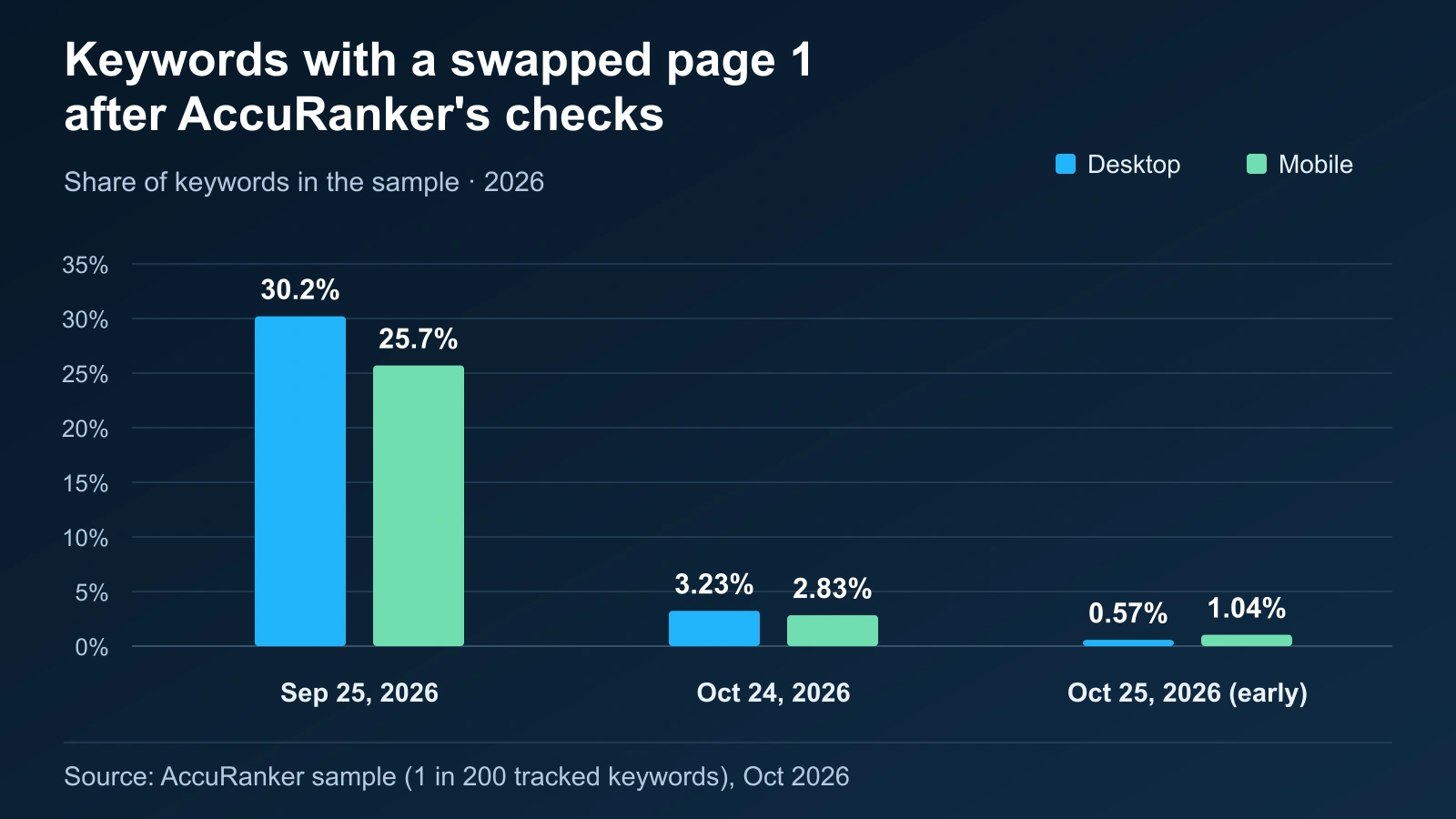
For scale, AccuRanker says whole-page flips were about 1 in 1,000 daily checks or fewer in 2025. Google still poisons 4–6.5% of first fetches, compared with 1.6–3.3% before the latest changes.
There's a second problem: truncated, or cut-down, pages. These are results pages with fewer results than normal. AccuRanker says they doubled to 4.0% of desktop requests and 2.1% of mobile, up from about 2% and 1% in mid-October. Google can keep a search cut down for hours.
What this doesn't prove: AccuRanker's figures come from its own sample of 1 in every 200 tracked keywords. Other tools collect differently and may have been hit more or less. It also doesn't tell you anything about your site's real visibility.
2. What a fake ranking drop looks like
A fake drop usually has two signatures. It reverses the next day, and the page your tracker saw doesn't look like your usual results page.
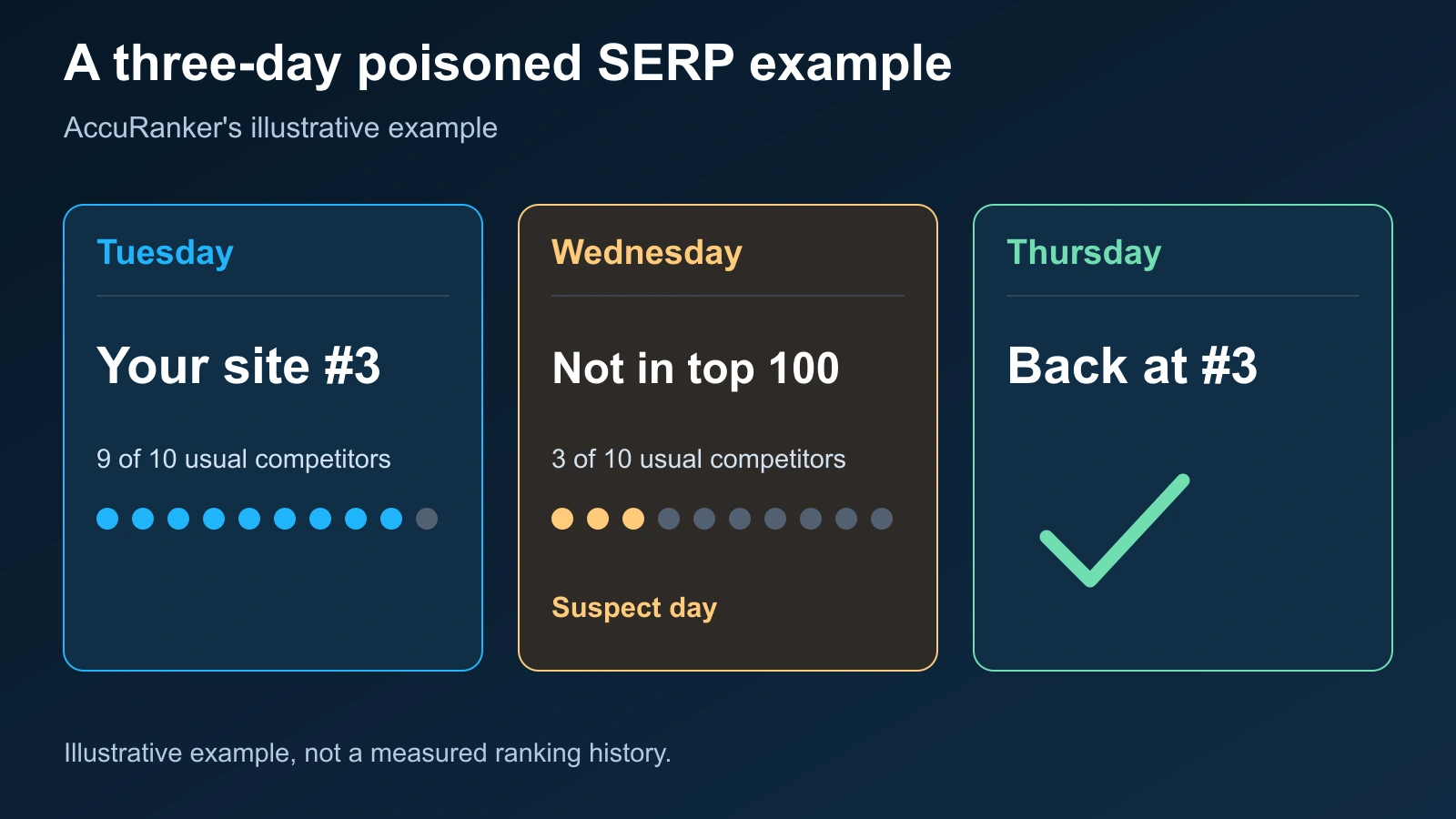
AccuRanker's illustrative example: a site sits at #3 with 9 of its 10 usual competitors around it. On Wednesday the tracker shows it outside the top 100, and only 3 of the 10 usual competitors remain. On Thursday it's back. The site didn't lose and regain its ranking overnight. The tracker saw a different page.
Signs to look for:
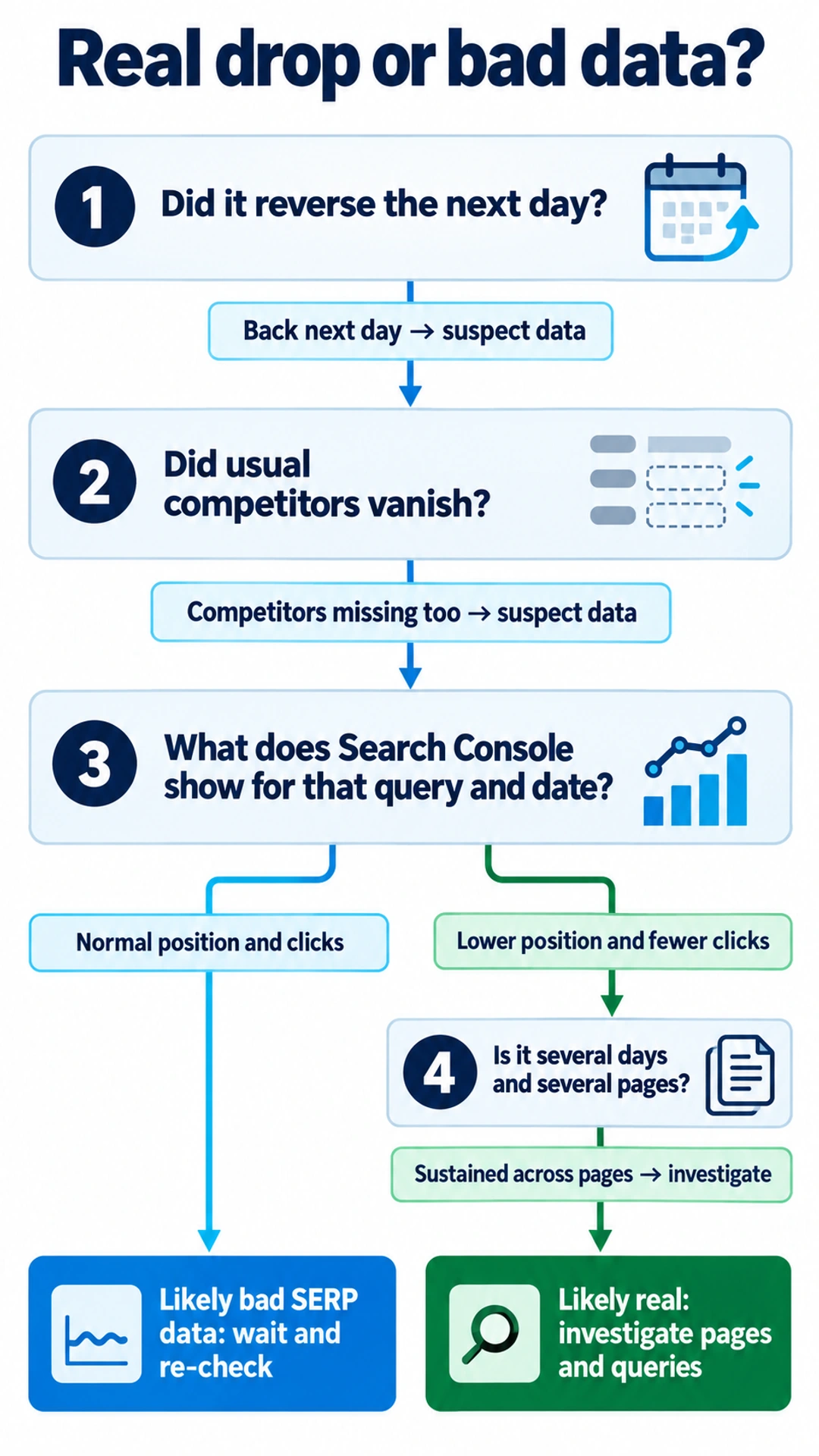
- The drop reverses the next day. AccuRanker says more than 9 in 10 poisoned runs last one day, and about 2 in 100 last three days or longer.
- Usual competitors vanish too. AccuRanker's "sandwich" check flags page 1 when it keeps fewer than half of the sites that appeared both the day before and the day after.
- Local results come from the wrong town. Poisoned local pages can list businesses from other cities.
- The suspect dates line up. AccuRanker flags sudden drops on October 16, 21 or 24, 2026 as worth checking.
A re-check often clears it up. AccuRanker says a re-fetch with another session comes back normal about 3 times in 4. AccuRanker also cites Nozzle, which found page 2 poisoned about 1.5 times as often as page 1. Drops from page 2 deserve extra scepticism.
3. The Search Console check: same query, same date
Search Console doesn't scrape. It reports what Google actually showed real users, so it's your best tiebreaker.
- Open the Performance report for Search results.
- Filter by the exact query that dropped.
- Set daily granularity and include the suspect date plus a week either side.
- Look at clicks, impressions and average position on that date.
If your tracker says "not in top 100" but Search Console shows normal impressions, clicks and position that day, the tracker is probably wrong. If Search Console shows the same fall, take it seriously.
Read the numbers with Google's caveats in mind:
- Average position isn't the same metric. Google defines it as the average position of the topmost result from your site. Results also vary by time, place, device and search history. Don't expect it to match a single tracker check.
- Data arrives late. Search Console data is normally available after 2–3 days, and the newest days can be preliminary. Check Saturday's drop on Tuesday, not Sunday.
- Days follow California time. Daily data uses Pacific time, so a European tracker's "Saturday" and Search Console's Saturday don't line up exactly.
- Low-volume queries can be missing. Search Console omits some rare queries. No data for a query isn't proof of a drop.
If you want the full diagnostic for losing visibility, see what to check first when your site disappears from Google.
4. Fake drop vs real volatility: October 24 as an example
October 24, 2026 had both problems on the same day, which makes it a useful test case.
On the data side, it was AccuRanker's worst poisoning day. On the ranking side, Barry Schwartz posted on X that Google Search ranking volatility was "heated" on Saturday, October 24. In his Search Engine Roundtable report on October 25, he cited strong volatility readings across many third-party tools and heavy chatter among SEOs. He believes there was "some Google Search ranking adjustment" from Friday into Saturday. Google hasn't confirmed it. It followed other unconfirmed volatility around October 16 and October 20–21, after the September 2026 spam update ran from September 24 to October 8.
Barry also noted that "the Google tracking tools are struggling but many said they have mitigated the issues by now." The next day he shared AccuRanker's update, and Glenn Gabe quoted it with "Now we have more information from Accuranker. And it's not good."
So on one Saturday you had real reports of movement and a spike in bad tracker data. Some drops that day were probably real. Some were probably fake. The tool alone can't tell you which.
How I'd separate them:
| Signal | Points to bad SERP data | Points to real volatility |
|---|---|---|
| Duration | Back to normal the next day | Still down after several days |
| Competitors | Most usual competitors vanished too | The usual competitors are there, reordered |
| Search Console | Normal position and clicks that day | Lower position and fewer clicks, sustained |
| Scope | Scattered keywords, often page 2 | Groups of related pages or queries |
| Google confirmation | Not relevant | Check the Search Status Dashboard |
At the time of writing, the dashboard's latest listed ranking update is the September 2026 spam update. Nothing is listed for October 24. For a longer view of updates and volatility, use our Google algorithm update tracker.
5. What to ask your rank tracking provider
Every rank tracker scrapes Google, so every one of them is exposed. The question is what they do about it. AccuRanker describes three layers: cleaner collection, a history check with a re-fetch before storing data, and monitoring after storage.
Its re-fetch rule is a reasonable benchmark. A page that keeps fewer than half of its usual sites gets fetched again with another session. If both sessions agree, the change counts as real. AccuRanker notes that about 1 in 20 desktop and 1 in 12 mobile pages lack enough history for that check, so it isn't perfect.
Questions I'd send your provider:
- Detection: How do you detect poisoned or cut-down results pages?
- Re-fetch: Do you re-check suspicious results with a different session before reporting them?
- Share affected: What share of your data was affected on October 24, 2026, by device?
- Flagging: Do you mark or correct suspect data points, or do they stay in my history?
- Local: How do you check that local results come from the right location?
If the answer is vague, treat single-day movements in that tool with more caution. That's a judgement about the data, not about the vendor.
6. A practical rule: don't react to one day
Google's own guide to debugging traffic drops says there "might not be anything fundamentally wrong" when rankings move, and that "positions aren't static." It separates a small drop, such as position 2 to 4, from a large one, such as 4 to 29. It also advises avoiding radical changes if a page is already performing well.
My rule:
- Wait for a second day. Most poisoned runs last one day. A real drop will still be there.
- Check your own data first. Search Console for the query and page, then analytics for traffic and conversions.
- Look at the pattern, not the keyword. One keyword on page 2 means little. A cluster of related pages falling together for a week means something.
- Compare periods. Google suggests comparing a stable period with the drop, and checking whether it's site-wide or limited to some pages.
- Only then change the page. If you need to read an update in your own data, see reading a core update in Search Console.
Expert Insight
I'd treat a one-day drop in a rank tracker as a question, not an answer. Rank trackers are good at trends across many keywords. They're weak evidence for a single keyword on a single day, especially this month. Search Console and your traffic data come first.
Tracking is also getting harder in AI results. If you report on AI features, see which pages AI Overviews cite on brand searches. A ranking position there isn't the whole picture either.
FAQ
Why does my rank tracker show a drop that Search Console doesn't?
Your tracker may have recorded a poisoned or cut-down results page. Google has been serving some scrapers a different set of results since late September 2026. Search Console reports real user data, so check it for the same query and date. Also remember that average position means the topmost result from your site, so the numbers won't match exactly.
Was there a Google update on October 24, 2026?
Not a confirmed one. Barry Schwartz reported heated ranking volatility on October 24 based on third-party tools and SEO chatter. Google's Search Status Dashboard listed no update for that date at the time of writing.
How long do poisoned SERPs last?
AccuRanker says more than 9 in 10 poisoned runs last one day, and about 2 in 100 last three days or longer. Cut-down pages can persist for hours.
How do I know if a ranking drop is real?
It lasts more than a day, Search Console shows the same fall in position and clicks, your usual competitors are still on the page, and it affects related pages or queries. Google's guide also suggests checking whether the drop is site-wide.
Should I switch rank trackers?
Not because of one bad day. Ask your provider how it detects poisoned pages, whether it re-fetches before reporting, and what share of its data was affected. Choose based on those answers.
Is my Search Console data affected by poisoned SERPs?
Search Console reports real searches, not scraped pages, so it shouldn't be affected in the same way. It has its own limits: a 2–3 day delay, California-time days and some omitted rare queries.
A rank tracker shows you what it saw. Search Console shows you what users saw.
How Growing Search can help: if you're not sure whether a drop is real, our SEO audit checks your Search Console data, affected pages and update timing before recommending changes. No provider controls Google's rankings or what scrapers are served. A clear diagnosis tells you whether to act.
About the Author