Your About Page Might Be Your Most Cited Page in AI Search. Here's How to Check It
Use the Search Console Gen AI report to see if your About page shows in AI Overviews and AI Mode, what the data misses, and what to fix first.
You can check whether your About page shows up in AI Overviews or AI Mode in Search Console's Generative AI performance report: group by Pages and find your About URL. An impression there means a link to that page was shown in an AI answer. The report has no queries or clicks, so it doesn't prove visits or explain why Google chose the page. I'd fix the About page people actually read first (accurate history, people, products, details you can verify), not build a separate page for AI.
Lily Ray shared an observation worth checking on your own site: on one enterprise site, the About page had five times the homepage's Gen AI impressions. Picture finding that in your report, on the page nobody has wanted to rewrite in years. It's tempting to read it as a signal to build a special page for AI. I'd start with the check, before commissioning another version of your content.
What Lily Ray saw, and what it doesn't tell you
Lily Ray reported that one anonymous enterprise site's About page had five times the homepage's Gen AI impressions. That observation describes one site, not a general pattern for About pages.
In her X post, read October 22, 2026, she wrote:
"I'm working on an enterprise brand's website, and something interesting stood out in its Google Search Console Gen AI report: The most cited page on the company's website in AI Overviews & AI Mode, with 5x more impressions than the homepage, is its 'About' page."
She described it as follows:
"It's a comprehensive, detailed page about the company's history, background, and evolution over time."
"It's not a 'special page' created for LLMs or AI agents. It's written for humans, visually appealing..."
Observed: Ray reported higher impressions for that URL. Assumed, not established: the page's depth caused those impressions, or the same approach would produce similar results elsewhere. The brand was not named, and no queries were shared.
One site's report doesn't establish a pattern. Her recommendation also echoes advice SEOs have given since E-A-T in 2017: provide accurate company information. The new part here is a report you can inspect.
Google's report documentation defines impressions as links to your site shown in generative AI features. Read “most cited” in that limited sense.
| What you see | What you can observe | What you still need to verify |
|---|---|---|
| About page has high Gen AI impressions | Links to that URL appeared in AI Overviews or AI Mode | Which queries triggered them; the report doesn't show queries |
| About page beats the homepage in Pages | Relative visibility of those URLs | Whether users clicked; there is no clicks metric |
| Chart and table numbers differ | Chart aggregates by property, table by page | Whether your comparison uses the same aggregation |
| Page doesn't appear | Few or no impressions, or possible exclusion | Indexing, snippet eligibility, nosnippet and noindex controls |
How to check your About page in the Generative AI report (6 steps)
To check whether your About page appears in AI Overviews or AI Mode, open Search Console's Generative AI performance report. Group by Pages and find your About URL.
1. Open the report
Google launched the report to some sites on June 3, 2026. Its help documentation says it reached all websites worldwide by August 31, 2026. It covers AI Overviews and AI Mode; Discover has its own report, and Search Labs experiments are excluded.
Verify you're reviewing the Search report. If it's missing, Google lists insufficient Gen AI impressions or exclusion from these features as possible reasons. Review what Search Console's Generative AI reports actually measure before interpreting an empty screen as a technical failure.
2. Group by Pages and find the About URL
Look for the final URL after redirects. Google mostly assigns page data to the canonical URL, so check which address represents your About page.
Verify any /about and /about-us variants against the final destination. Don't treat separate spellings as separate content without checking redirects and canonicalization. An absent variant doesn't establish that the underlying page never appeared.
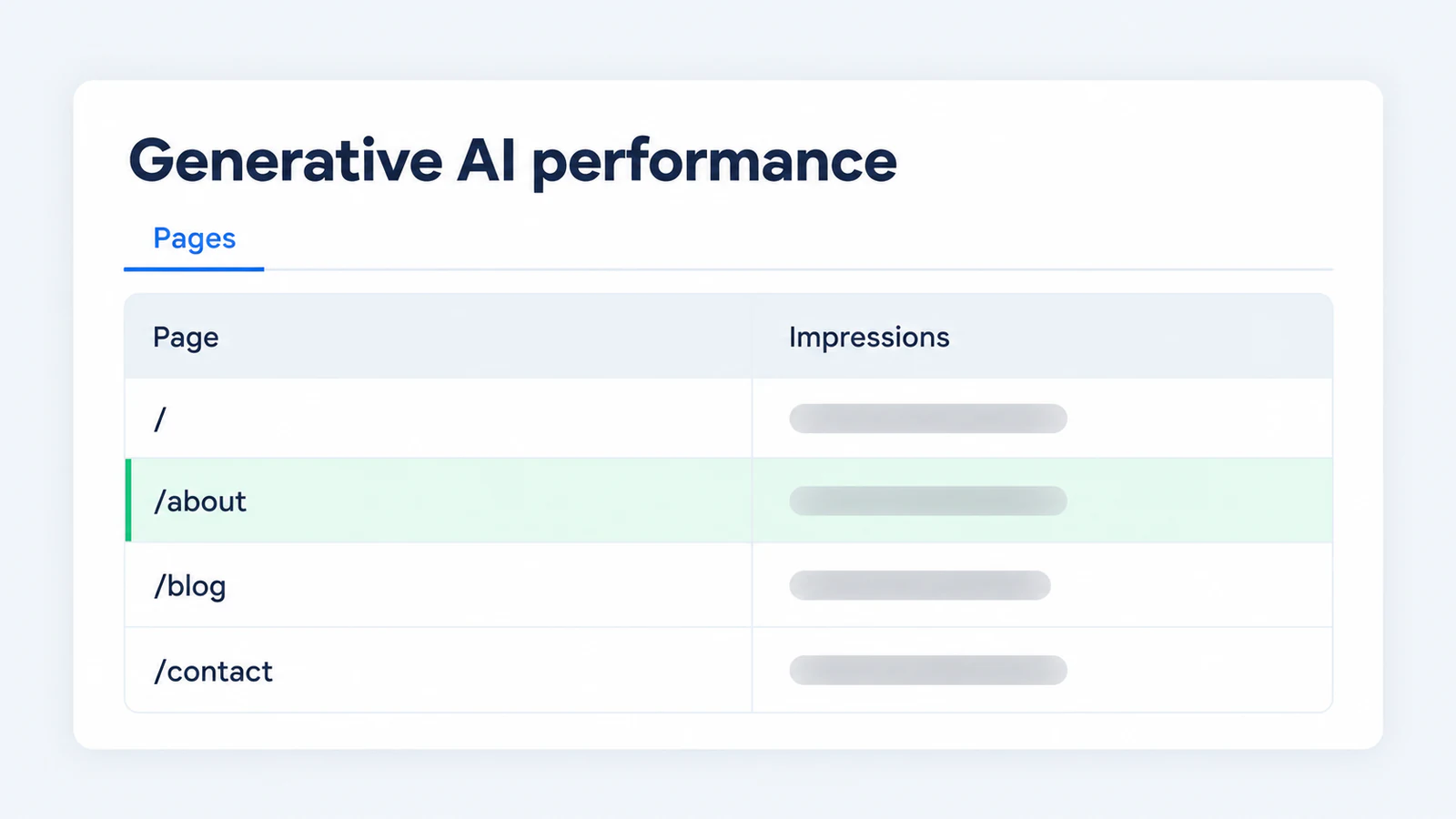
3. Compare with the homepage and key business pages
Start with the pages that matter to your business. Compare the About page with the homepage and three to five important pages, using the same dates and filters.
Verify relative impressions in the Pages table. Before celebrating or worrying, remember that the chart aggregates by property while this table aggregates by page. Different totals don't, by themselves, establish missing data.
4. Segment by Countries, Devices and search type
Use Countries and Devices to inspect where the observed visibility occurs. The search type filter separates Web text-based results from Web multimodal results, including Lens and Circle to Search.
Verify that filters remain consistent when comparing pages. Dates use Pacific Time. A filtered result describes that segment; it doesn't establish the pattern for your entire audience or explain why Google selected a link.
5. Cross-check the classic Performance report
Open the Performance report with Web search type. Google says this view also includes Gen AI data, alongside classic search results.
Verify queries and clicks there for wider context. You cannot assign those clicks or queries specifically to AI Overviews or AI Mode using this mixed view. A change in both reports doesn't establish the cause.
6. Export and track over time
Use Export to save the chart and table. Record the date range, filters and URLs so the next comparison remains understandable. The usual 1,000-row limit applies.
Verify that your export includes the rows you need. In a July 29, 2026 support reply, Fivetran said searchAnalytics.query did not expose AI Overviews or AI Mode data. That's Fivetran's reported limitation, not a separate Google API confirmation. CSV export is the practical route described in that reply.
Should you build an LLM-only page instead?
I'd avoid it. Improve the page people actually read before maintaining a separate version for machines.
Google's AI features guidance says no additional requirements or special optimizations are necessary for AI Overviews or AI Mode. It also says you don't need new machine-readable files, AI text files, markup or special schema. That is the useful starting point in Google's AI search guidance.
Ray says separate LLM pages create an easily gameable surface. Her post notes that Google, OpenAI and Anthropic haven't explicitly requested separate LLM versions or Markdown content. Her concerns about prompt injection, exaggerated claims, future discounting and collateral damage are her opinion and predictions, not documented outcomes in this case.
The distinction matters when considering entity files like EntityMap. A file or second page isn't evidence that an AI feature will select your content. For the narrower file question, Google says you don't need llms.txt.
| Question | LLM-only page | Improving your human About page |
|---|---|---|
| Asked for by Google, OpenAI or Anthropic? | Not explicitly, according to Ray | Consistent with Google's people-facing content guidance |
| Who reads it? | Machines, in theory | People and machines |
| Risk | Gameable; future discounting is Ray's opinion | Low; accuracy still needs review |
| Maintenance | Another version to keep synchronized | One source of truth |
| How to verify? | Hard to isolate its effect | Gen AI report plus Performance context; neither proves causation |
What a comprehensive About page includes (checklist)
A comprehensive About page explains the organization with details people can verify. It doesn't need an invented word target or a separate AI voice.
Ray's recommendation is direct:
"Make your company's history, expertise, people, products, and reputation easy to find, understand, and verify."
NN/G's research on About Us summaries supports placing key facts at the top to help people understand the organization and build trust. Use that as a usability decision, not evidence of an AI ranking benefit.
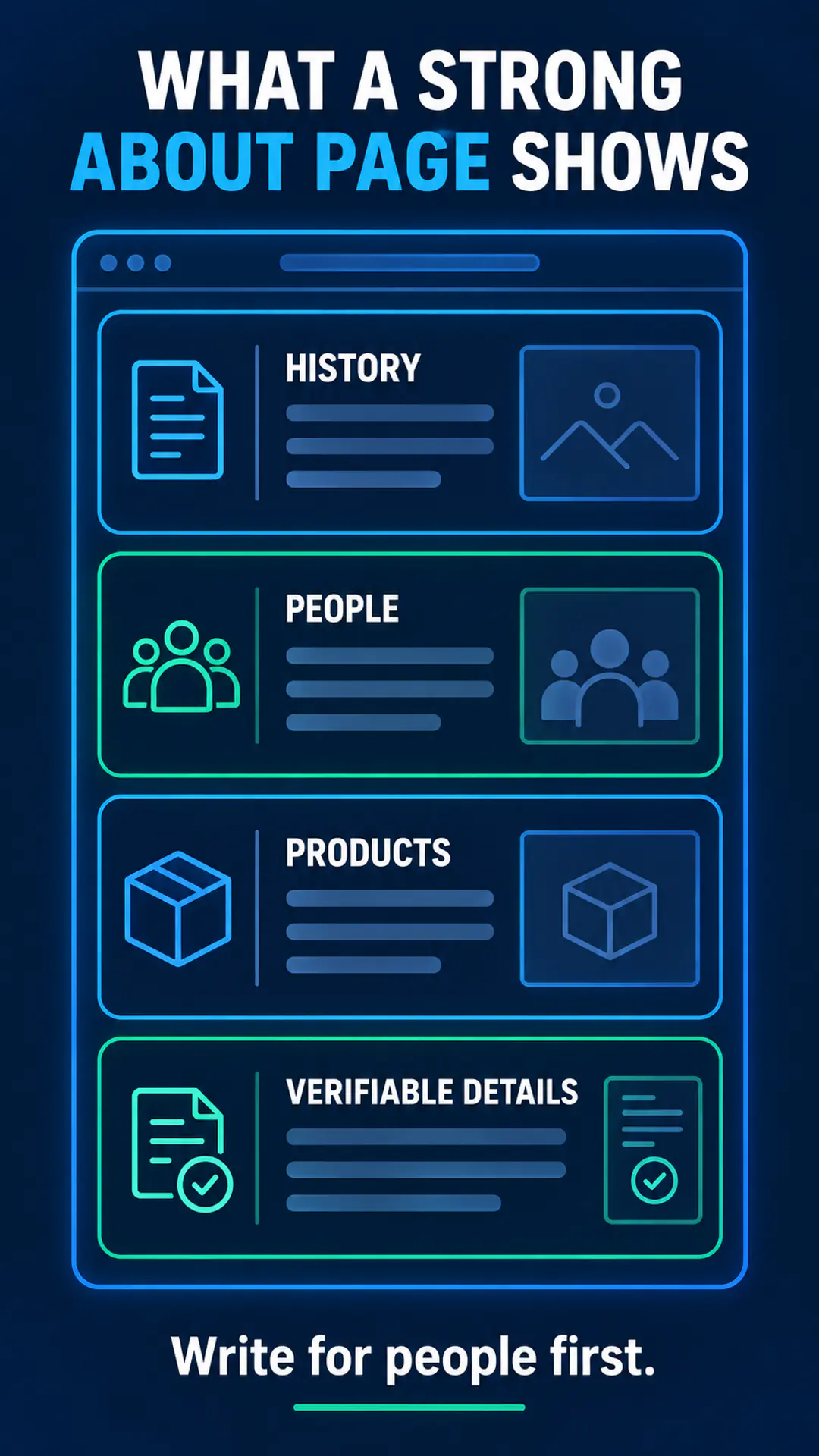
- [ ] Put a short key-facts summary at the top.
- [ ] Describe company history with dates you can support.
- [ ] Identify people and explain their relevant expertise.
- [ ] Describe products and services, with useful internal links.
- [ ] Include reputation signals readers can verify elsewhere.
- [ ] Keep important content in text, not only images or video.
- [ ] Check crawling, indexing and snippet eligibility.
- [ ] Add useful internal links to and from the page.
- [ ] Keep Organization structured data consistent with visible text.
- [ ] Update Merchant Center and Business Profile information where applicable.
- [ ] Check contact and location details for basic consistency.
- [ ] Add details you can support.
Where Organization structured data fits
Google's Organization documentation allows markup on the homepage or one page describing the organization, including the About page. There are no required properties; use the most specific applicable subtype.
This markup helps Google understand administrative details and disambiguate the organization. It isn't a requirement for AI inclusion. You can check which entities your About page names as a review aid, then verify every detail against the visible page.
Expert Insight
I'd check the Gen AI report before rewriting anything. If your About page already shows up, keep it accurate and easy to verify. If it doesn't, fix crawlability, internal links and missing facts before considering a separate AI version.
For the wider evidence question, review what actually gets pages cited in AI search. Keep the distinction between eligibility, observed visibility and an explanation of selection.
Is the About page a ranking factor?
An About page isn't a ranking requirement by itself. It can still help readers assess who runs an organization.
SEJ's coverage of John Mueller's answer provides that framing: About and Contact pages aren't ranking requirements per se, while the article argues for their trust value. That doesn't establish a direct ranking boost.
Google says AI Overviews and AI Mode may use query fan-out: several related searches and different models. Links can vary. Read how AI Overviews build an answer for that context, rather than assuming a visible link reveals one ranking factor.
FAQ
Does the report show which queries triggered my About page?
No. The documented metric is impressions, and the report doesn't provide queries. The classic Performance report provides query context, but mixes classic and AI search data. Use it to investigate the wider picture, not to reconstruct an AI-only query list or claim a specific trigger.
Does “most cited” mean most clicks?
No. In Ray's observation, it means the highest Gen AI impressions on that site. An impression records a link shown in an AI feature. It doesn't prove a click, a visit or revenue. The report also doesn't provide CTR or position to fill those gaps.
Do I need an LLM or Markdown version?
No special version is required by Google's AI features guidance. I'd maintain accurate human-facing content first. Ray's concern that dedicated LLM pages could be discounted is her prediction. Treat it as a reason for caution, rather than evidence that every such page has already been discounted.
Should Organization schema go on the homepage or About page?
Google allows either the homepage or a single page describing the organization. An About page qualifies. Choose the most specific applicable subtype and keep its details aligned with visible content. The documentation lists no required properties, and adding this markup doesn't establish that AI features will cite the page.
Why don't I see the report?
Google lists insufficient Gen AI impressions and exclusion from Search generative AI features as possible reasons. Check those possibilities before assuming rollout is still pending. Review indexing and snippet eligibility as part of the investigation. Missing report access alone doesn't identify the exact cause for your site.
Will a better About page get me cited?
It may make the organization easier to understand and verify, but it cannot promise selection. Google's baseline is an indexed page eligible to show with a snippet. Review nosnippet, data-nosnippet, max-snippet and noindex controls where relevant. Google-Extended concerns training and grounding in other systems; keep that distinction clear.
An About page that shows up in AI answers is a visibility signal. It doesn't prove clicks, revenue, or why Google chose it.
How Growing Search can help
Growing Search can review your Gen AI report and prioritize fixes to human pages through an AI SEO audit. Start with the evidence and decide what needs attention. No provider controls which links AI features show.
About the Author