How Perplexity Search Works, a Reader's Evidence Check
Explore a four-step Perplexity Search evidence review. Compare documented search capabilities with browser observations before sharing a recommendation.
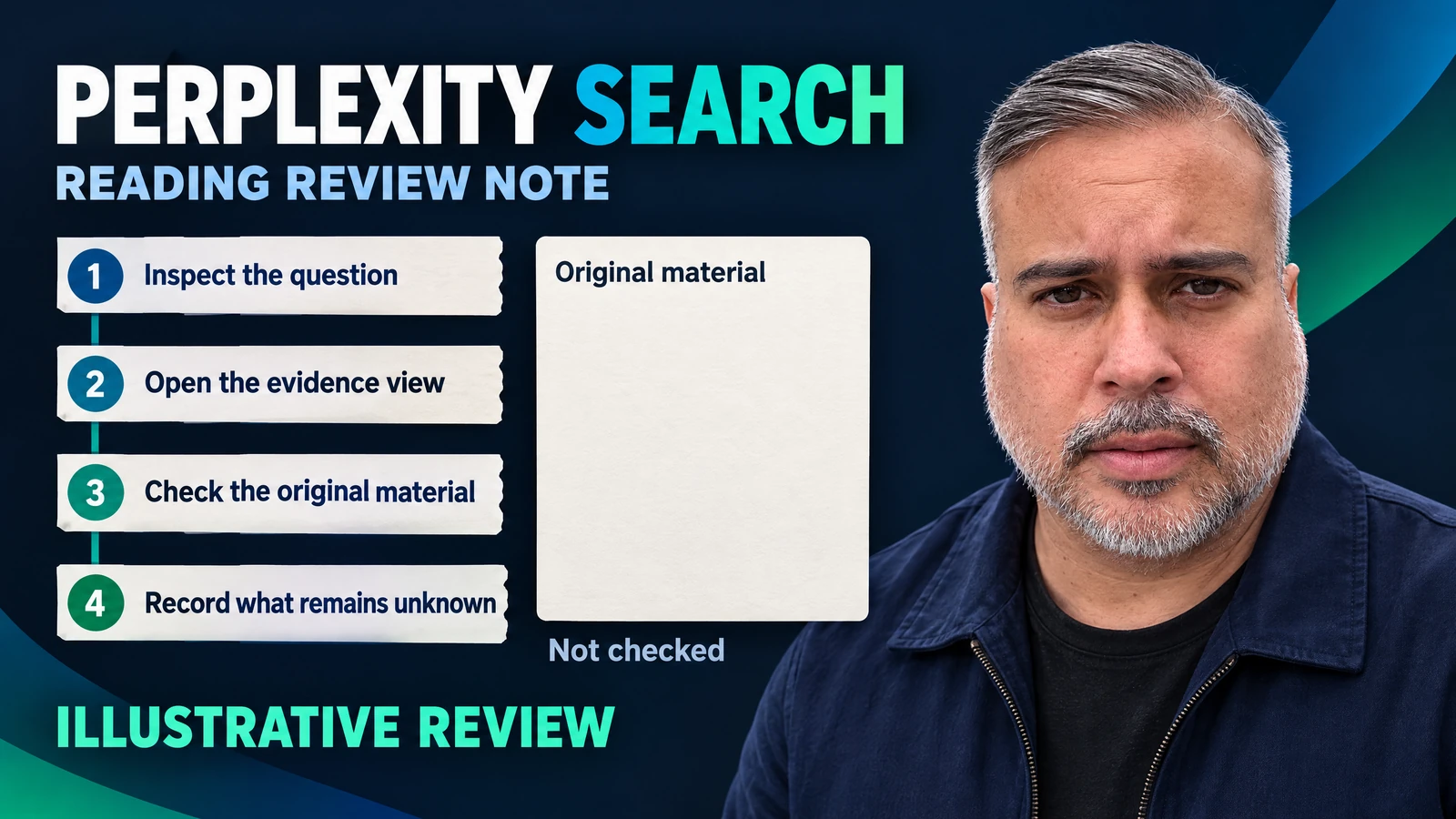
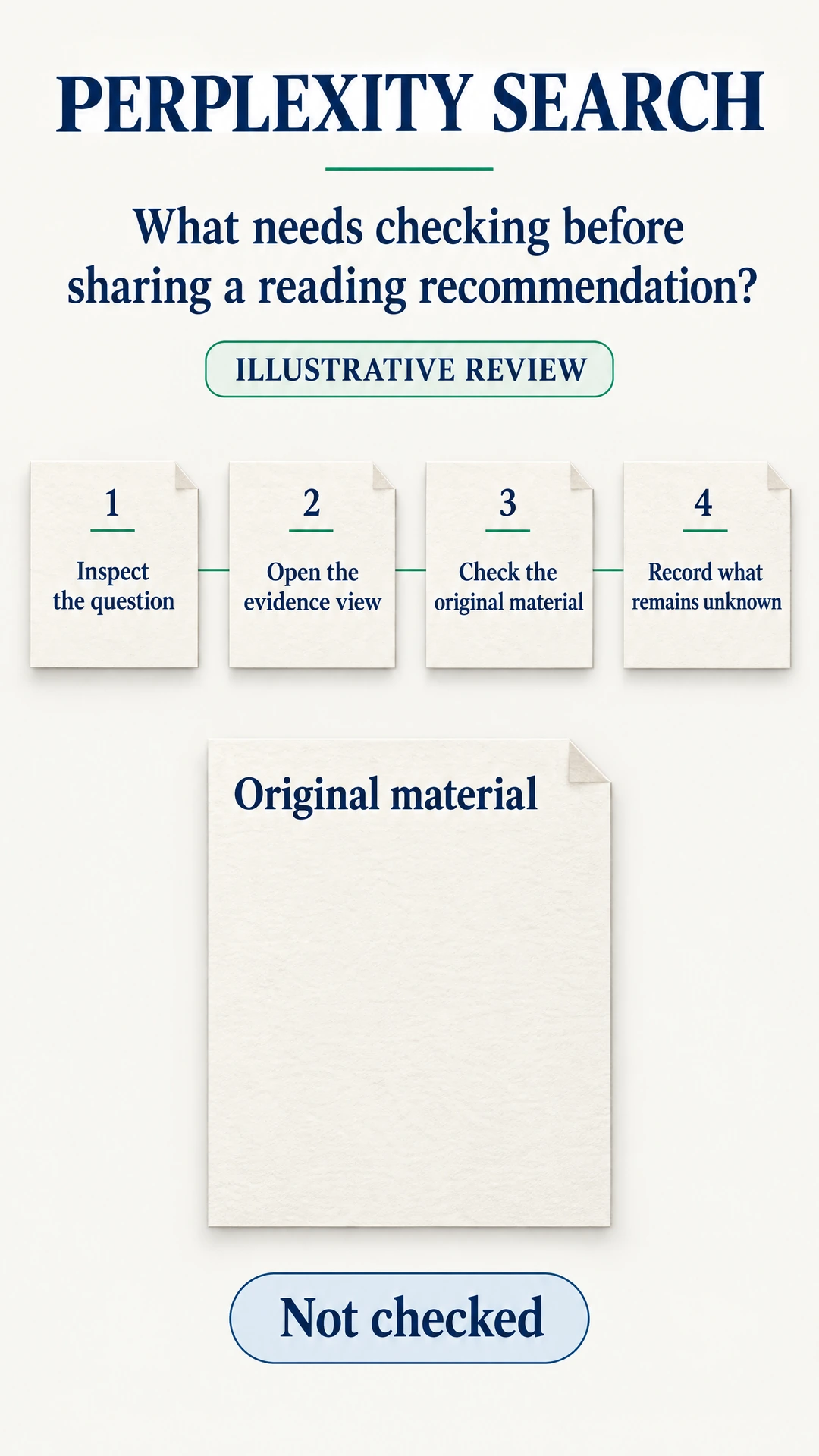
At the fourth panel of our fictional reading note, Not checked remains beside the empty Original material card. Perplexity's documented search can connect a question with a summary and source links, but describing that capability gives this editor no reading to inspect.
The person is preparing to share a reading recommendation. No book or recommendation text has been supplied, so the useful decision concerns what to request before sharing anything. I would preserve the unresolved status while making that request specific. Reaching the last teaching panel should help explain the next job, without implying that the job was performed.
TLDR Use the four-step review sequence to identify the question and the material a recommendation would need. The panels reveal editorial prompts while the label-only card stays empty. Not checked remains fixed outside it.
The question before a recommendation
Inspect the question begins with “What needs checking before sharing a reading recommendation?” The wording asks for a review task, without identifying the recommendation itself. An editor would need its intended purpose before deciding which material could help examine it.
Ask what the note should help its recipient understand. The person might be seeking background reading or a reason to consider a particular argument. Those are possibilities to clarify, with neither selected by this exercise. A useful request should make the intended purpose visible to the person supplying material.
If the requester later narrowed the purpose, the review could be narrowed too. Keep the changed task explicit rather than quietly evaluating a different reading. A colleague receiving the note should be able to tell which question the proposed check would settle.
That request could prevent an unnecessary collection of pages. Without a defined purpose, a colleague could send related reading and leave the editor unsure what to inspect within it. The first panel therefore concerns the question a later review would answer, rather than the number of sources someone could gather.
The exercise has given the editor a task to clarify, with no recommendation whose merits could be assessed.
Evidence requests in the interactive sequence
Read the four panels in order and notice which questions each one adds. Open the evidence view asks what material would be needed. Check the original material concerns what could be inspected once it was supplied. Record what remains unknown concerns the account of the work the editor can give now.
These are our teaching choices. The sequence opens review prompts, without submitting a question to Perplexity or assigning a source. Its arrows describe the reader's movement through the exercise, with no claim about a provider's retrieval order.
The fixed status is useful when returning to a previous panel. The editor can understand a question more precisely without having acquired the evidence to answer it. Keep the difference visible in the note rather than treating navigation as a completed review.
Our ChatGPT Search walkthrough offers another original evidence exercise. Comparing the questions a reader needs answered can be useful, provided each product's documented behavior keeps its own scope.
Source links and website labels
Opening the evidence view should prompt a request for material, while the card provides none.
Consumer Help describes Perplexity searching the internet and summarizing information, with numbered links to original sources. Follow-ups can retain previous-query context. This describes the consumer feature, without guaranteeing correctness or freshness for every answer. A linked source still needs inspection before a recommendation can be judged.
Some citations carry Government, Academic or Trusted domain labels. These concern websites, rather than individual pages or claims. An absent label is not a negative quality judgment, and a label is not an endorsement or a substitute for reading the source. No label is assigned to our missing material.
For the fictional note, identify which material the requester intended before commenting on its usefulness. If several resources became available later, record which one was examined and which question that inspection concerned. That description would let the recipient follow the reasoning without relying on a general impression of the reading.
The Gemini source-comparison exercise works with supplied illustrative text. The editor here lacks even that starting material, so the immediate request is for something to inspect, without assigning a support judgment.
An empty card before reading
Check the original material opens the third panel beside a card containing only Original material. There is no title underneath it or excerpt hidden behind the next step. The separate Not checked status describes the unfinished editorial task.
Request the intended material and the purpose of the proposed recommendation together. Receiving an identifier alone would still leave the content to obtain. Receiving an excerpt could permit a narrower inspection, but the resulting comment would need to describe that portion rather than suggesting an entire reading had been reviewed.
The scope of a later review belongs with its conclusion. If a recipient cannot identify the material examined, ask for that information before repeating the judgment. A polished recommendation would leave the same problem unresolved if its reason could not be traced to inspected material.
The Claude resource-review exercise considers the identity of intended material through a different task choice. That editorial distinction may help formulate a request, while it supplies no Perplexity result and no reading for this note.
Browser observations and interpretation
The REVIEWED status in Steve Toth's reported Perplexity recordings needs its study context. He reports 48 conversations, each an opening question and 2 follow-ups, captured September 25, 2026. Browser HAR evidence omits server activity not sent to the page. He interprets REVIEWING, REVIEWED and SELECTED as a distinction between considered material and citations. Those meanings are his reading, not vendor documentation. REVIEWED cannot independently prove a full-page inspection.
API output and publisher access
The board's evidence view contains teaching questions, with no developer response to process. Search API documentation describes ranked web results returned as structured data for developer processing. This API scope does not establish how consumer answers are assembled, and our exercise performs no API request.
Crawler documentation describes PerplexityBot as surfacing and linking websites in search results, rather than collecting foundation-model training content. Perplexity-User supports user actions and may visit a webpage to help answer and link it. Those roles do not guarantee that a particular page appears or is cited.
If a publisher is investigating available content, inspect the material exposed for reading and keep that observation with the relevant page. The JavaScript rendering guide gives questions for that separate investigation. It cannot establish that the fictional note's missing material was accessed.
A usable note with unresolved work
Record what remains unknown closes the teaching sequence with the recommendation and its intended material still absent. The editor can now explain which request would make a later review possible. No result in the exercise would justify approval or rejection of a particular reading.
Give the recipient enough context to respond to that request. Which purpose should the recommendation serve, and what material would let someone inspect its reason? Asking both leaves the decision open while identifying work that could resolve it.
Keep the unresolved status attached to the note until the evidence supports a different account. The recommendation itself still awaits material to examine before anybody could honestly describe it as checked.
Frequently Asked Questions
Does a source link complete a recommendation check?
Consumer Help describes numbered links to original sources. The material still needs inspection before the recommendation can be evaluated.
Does a missing source label mean poor quality?
The documented absence of a label is not a negative judgment. Labels concern websites, rather than validating individual claims.
Does REVIEWED prove a full-page inspection?
That reported status and its meaning belong to Toth's dated observations and interpretation. It cannot independently establish a full-page read.
What changes after the fourth teaching panel?
The editor has seen questions for a review. No material has been supplied or inspected, and the status remains Not checked.