How ChatGPT Deep Research Works, Interactive Guide
Explore a ChatGPT Deep Research flowchart from brief to sourced report. Learn to refine the question, handle evidence gaps and check citations.
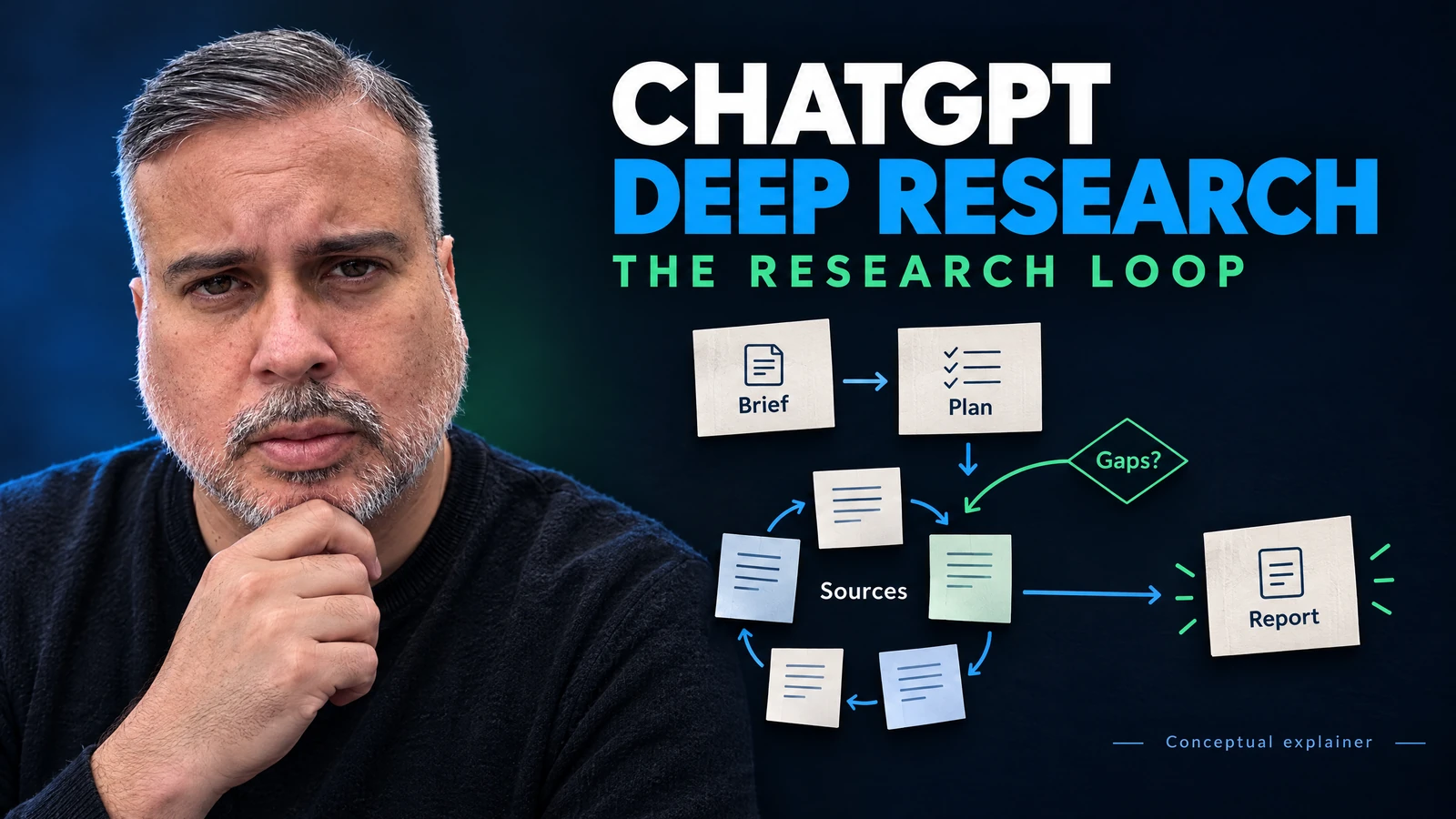
In a hypothetical quarterly content review, an ecommerce team asks which questions its Canadian help center should answer next. ChatGPT Deep Research can produce a report from multiple sources, but I would define the content decision before sending it off to investigate. A recommendation to publish a delivery guide is difficult to evaluate if nobody has identified the question the existing page leaves unanswered.
The useful research result connects a proposed action to evidence the editor can inspect. A longer list of article ideas would leave that decision unresolved.
TLDR Start with the question and source boundaries, review the proposed investigation, then inspect the evidence behind the report. The interactive diagram lets you follow a broad brief, a defined task or a contradiction needing more research. These are teaching examples, with documented behavior separated from observations and interpretation.
The brief before the first search
The team's first request could be “Research content ideas for Canadian customers.” It leaves the researcher to decide what counts as a useful idea. The answer could cover ecommerce trends without checking a single page in the company's help center.
A stronger teaching brief asks for unanswered delivery-status and returns questions in the current public help pages. It defines the output as a proposed content action, linked evidence, and any question that requires clarification from the company. No actual customer records or company policies are supplied in this example.
Source instructions define what the editor should expect from the report. They do not certify that every collected page will be appropriate, so each recommendation still needs checking.
OpenAI's product documentation describes Deep Research as an investigation across multiple sources with a report to review. The user supplies the question, scope and desired result. Availability depends on account and workspace settings.
For this content task, I would include the current public help-center pages and any relevant public product documentation. A discussion thread might suggest a useful customer question, while the company's current instructions would be needed to establish its answer. Keeping those roles separate helps the editor evaluate a recommendation.
The question could become “Which delivery-status questions remain unanswered in our Canadian help center, and should we update an existing page or create a new one?” That is narrow enough to make a surprising result useful. Finding that a page already answers the question could justify improving its visibility rather than writing another article.
A plan with a concrete question
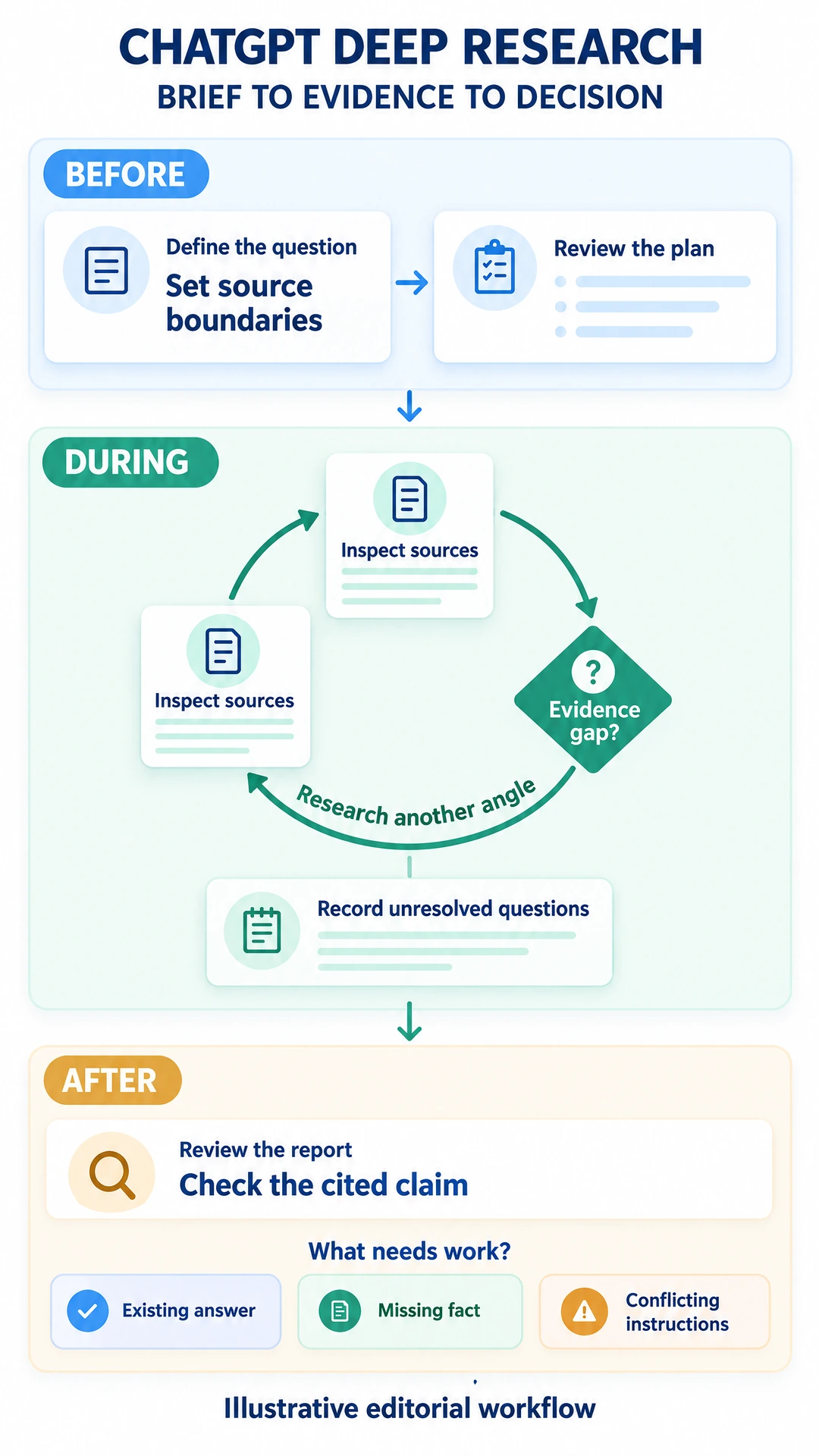
Select the broad-brief scenario in the diagram. The refinement loop illustrates what happens to the task when an important boundary is missing. Then switch to the defined task and follow its route toward the plan.
Steve Toth's Deep Research study reports 19 three-turn conversations recorded on September 25, 2026, including a research brief, plan and progress-related browser fields. Their meanings are explicitly inferred. A browser capture shows traffic reaching the client, not every server operation. This project did not replicate the experiment, and the diagram does not establish a universal private sequence.
For our hypothetical editor, the plan should make it possible to spot a wrong task. Does it investigate unanswered help-center questions, or has it become a competitor content roundup? The second could be useful for another brief, but it would not settle this one.
I would check that the plan connects source review to the requested content decision. Collecting more pages is easy to describe. Explaining which page could establish the missing fact requires more thought.
An evidence gap during the investigation
Suppose the example finds a help page whose instructions differ from a promotional page. A report could smooth over the conflict and recommend a new guide. That would leave the editor responsible for a policy assumption the research never settled.
Choose the conflicting-evidence scenario and follow the return arrow. The loop represents looking for the missing support, rather than treating the first collected material as sufficient.
OpenAI's web search API guide describes reasoning-based search that can continue searching after examining results. This API capability helps explain the loop, without specifying every consumer Deep Research run or a fixed stopping threshold.
In the teaching case, another pass could check the applicable version of the public instructions or look for a documented correction. If neither resolves the contradiction, the report should identify the unresolved question. The diagram's evidence check is an editorial teaching choice, not a claim that OpenAI uses our checklist internally.
For the editor, that result changes the next assignment. Someone needs to clarify the instructions before a writer expands them. A citation to each conflicting page would document the problem, without turning either statement into the company's confirmed answer.
Reading the report before assigning work
A recommendation for a new delivery-status article should identify the question the current pages leave unanswered. I would check that connection before assigning its copy.
A recommendation tied to its evidence
For each proposed help-center update, open the cited page and compare its text with the recommendation. If the report proposes an article explaining order-tracking updates, which source establishes the process it would describe? A general claim about customer service cannot answer that operational question.
The report should also distinguish an unanswered question from an answer that is difficult to find. Those problems require different work. The team might need to improve a page heading or its internal links instead of adding another URL.
| Research finding in the example | Next editorial action |
|---|---|
| The answer exists on an appropriate public page | Improve its discovery or presentation if necessary |
| A useful question has no supported answer in the supplied material | Ask for the missing company fact |
| Current pages give conflicting instructions | Resolve the contradiction before expanding the copy |
An unresolved question with a named next action
If two public pages give different returns instructions, the report should identify the conflicting statements. A note naming the applicable product and source version gives a product owner something to check. A vague request for “more research” leaves that assignment undefined.
This is where I would resist a tidy report. A document with one visible unresolved question can help the team make a better assignment than a finished-looking content calendar based on an assumption.
Our earlier AI citation factors analysis discusses evidence behind source appearances. Here, I would apply the more immediate reader test, confirming that the linked material supports the recommendation before commissioning work.
Useful evidence for publishers
The same exercise can improve the pages the team already publishes. A current help article with specific instructions is more useful to someone checking a company fact than a promotional paragraph saying the service is easy to use. That is a recommendation about evidence quality, not a guarantee of an AI citation.
Keep relevant conditions close to the claim. If instructions apply to a particular product or service area, the reader should not have to resolve that scope from an unrelated page. The EntityMap assessment examines a related problem of consistent entity information, without promising that a special file fixes visibility.
Access matters as well. If the important text depends on client-side code, an AI assistant rendering review can help identify what is available to inspect. A research report cannot be evaluated against documentation that the reader cannot reach.
Product evidence and API analogies
The retained Deep research API guide describes clarification and prompt rewriting, while distinguishing an API workflow receiving a fully formed prompt. It also carries an explicit deprecation notice. Its design discussion does not establish current model names or require every consumer run to follow the same steps.
Interpret the diagram’s evidence labels within those scopes. The arrows explain possible task relationships, rather than disclosing every server operation.
A research brief for the next quarter
Before the content team starts another investigation, I would choose the decision the report needs to support. For this hypothetical help center, the question is whether to improve an existing answer, request a missing fact, or commission a new explanation supported by the company's documentation.
Ask for a report whose recommendations include their evidence and unresolved questions. Review the result against that request. This makes the investigation easier to evaluate without relying on report length or a particular number of searches.
For a smaller question, a ChatGPT Search answer may provide enough material to inspect. The research format becomes useful when the task requires relating several sources and deciding what remains unanswered.
Frequently Asked Questions
What should a Deep Research brief include?
Define the question, scope and desired result. For a content task, add the permitted source types and the decision the report should support. These instructions help define a reviewable task without guaranteeing that every finding will be correct.
Does Deep Research always make the same number of searches?
The checked sources do not establish a universal consumer search count. Toth's reported observations belong to his dated sample, while the API documentation describes capabilities within its own scope.
Can a report resolve a fact absent from its sources?
Treat that fact as unresolved until suitable evidence is available. A generated recommendation or a citation to a general page cannot establish a missing company instruction.
Should the final report be checked before use?
Open the evidence supporting its recommendations and check its scope. Keep contradictions and missing facts visible so the next content assignment does not depend on an unsupported assumption.