How ChatGPT Search Works, With an Interactive Flowchart
Follow an interactive ChatGPT Search flowchart to understand search decisions, candidate sources and citations, with a practical SEO audit.
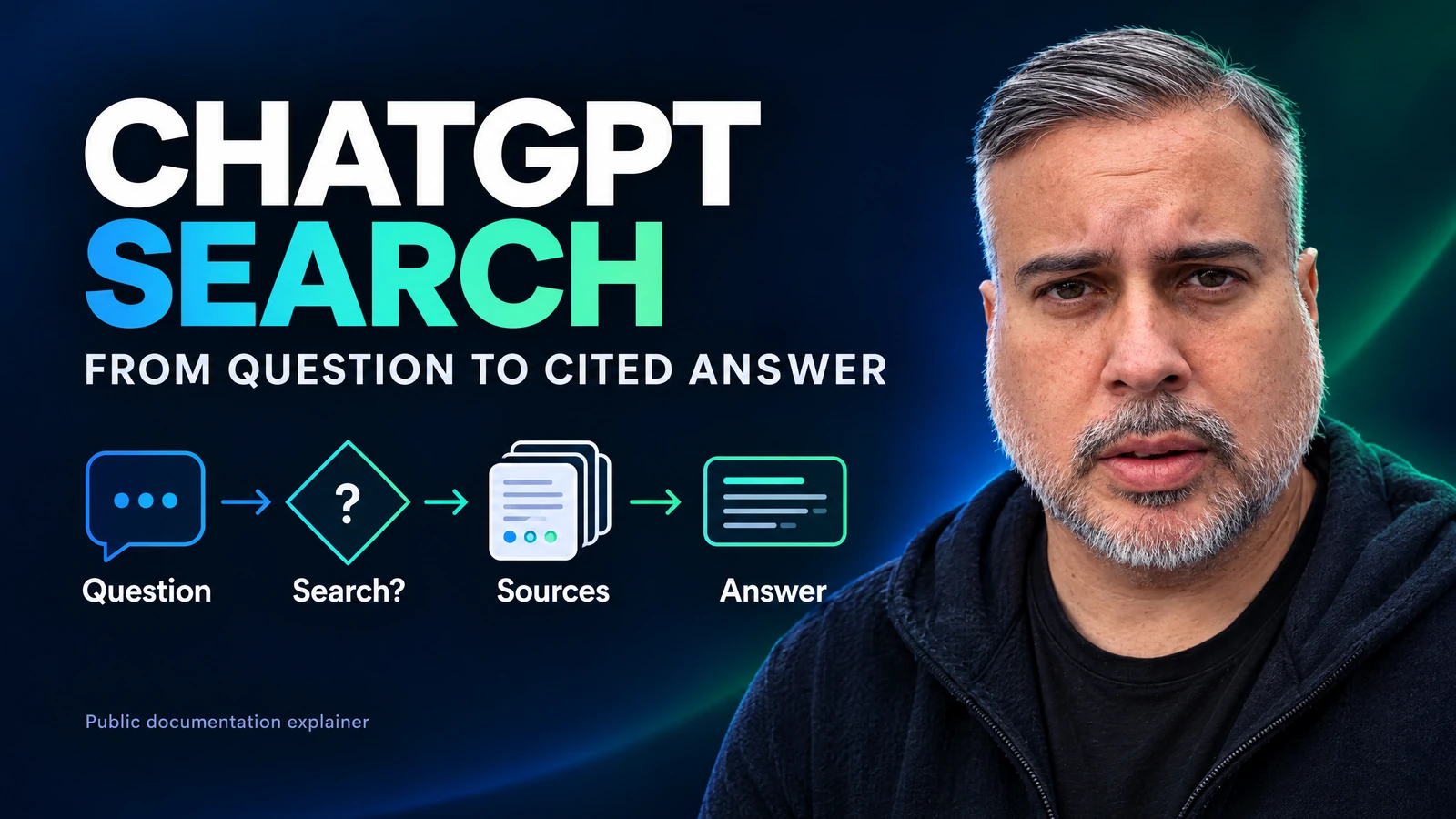
Ask ChatGPT which website monitoring tool suits a small agency, and a useful answer needs more than a list of product names. It needs evidence about the agency's requirements. ChatGPT can search the web and present sources alongside generated text, but finding a page and citing it are separate outcomes. I would audit the evidence behind a recommendation before treating a missing citation as a ranking problem.
Our hypothetical agency adds a requirement for Canadian hosting. Suddenly, a general comparison cannot settle the purchase. The next useful source must answer a narrower question.
TLDR ChatGPT Search can connect a question with web sources and a cited answer. The diagram separates that teaching journey into decisions the reader can follow. Its paths are illustrative, with labels distinguishing documented behavior from observations and interpretation. Crawler access, citations, and referral visits need separate measurements.
Interactive flowchart
ChatGPT Search, step by step
Try a searched answer, a no-search example, or a second search after an evidence gap.
Open a stage to read its example and evidence. The connection list includes every branch.
The question and available conversational context are the starting point. This is a conceptual input node. A small team asks which monitoring tool fits Canadian hosting requirements. Write for the decision behind a question, including constraints a buyer would ask about.
Your question
Question and conversation
Documented
→ Web lookup needed?
Illustrative example
SEO decision
This teaching branch separates searched and model-only answers. Consumer routing is private. A product comparison can benefit from current provider pages. Track searched answers separately from model-only mentions when auditing visibility. API choice, not a disclosed consumer routing rule.
Web lookup needed?
A teaching branch
Interpretation
→ Answer without a web lookup (No lookup)→ Build useful search queries (Search)
Illustrative example
SEO decision
Evidence and limits
Illustrative answer without a fresh web lookup. A canonical-URL explanation may come from model knowledge. A model mention alone provides no evidence of a fresh visit to your page.
Answer without a web lookup
Current sources unverified
Interpretation
Illustrative example
SEO decision
Toth reports rewritten queries. Diagram queries are teaching examples. A teaching query could be “website monitoring Canadian data hosting”. Use customer wording and specific use cases. Repeating one keyword misses related questions.
Build useful search queries
Wording can change
Reported observation
→ Retrieve candidate pages
Illustrative example
SEO decision
The API lists retrieved sources separately from citation annotations. A feature page can be retrieved even if the answer never links to it. Check that important pages can be accessed. Retrieval still provides no citation guarantee.
Retrieve candidate pages
Candidates are not citations
Documented
→ Select supporting material
Illustrative example
SEO decision
Toth reports URL-moderation labels. Their role in selection is inferred. A dated product page may support a hosting claim. A vague sales paragraph may not. Support product claims with details a reader can verify, including dates where they matter. The full selection rules remain private.
Select supporting material
Selection rules remain private
Interpretation
→ More information needed? (Evidence gap)→ Write an answer with citations (Enough support)
Illustrative example
SEO decision
Evidence and limits
Reasoning-based API search can search again. Consumer behavior has no disclosed fixed sequence. The first pages omit data residency, so the example tries a narrower query. Answer follow-up questions about limits and requirements on the relevant page. An API capability, illustrated rather than a universal product rule.
More information needed?
Fill an evidence gap
Documented
→ Build useful search queries (Search again)
Illustrative example
SEO decision
Evidence and limits
When ChatGPT web uses search, citations appear in the chat. A citation lets the reader inspect support for a claim. A hosting statement includes a link so the reader can inspect it. Audit the cited claim and destination together. A domain mention is a different event. Documented visible product behavior. Citation accuracy still needs checking.
Write an answer with citations
Claims linked to web pages
Documented
→ Open and check the source
Illustrative example
SEO decision
Evidence and limits
Compare the source with the exact claim, its date and its scope. Reader action, not an internal ranking stage. The reader checks whether the provider page still supports Canadian hosting. Correct outdated destination pages before counting an appearance as useful visibility. Editorial advice for the reader, not an internal ranking operation.
Open and check the source
Check the date and claim
Interpretation
Illustrative example
SEO decision
Evidence and limits
Read every connection and branch
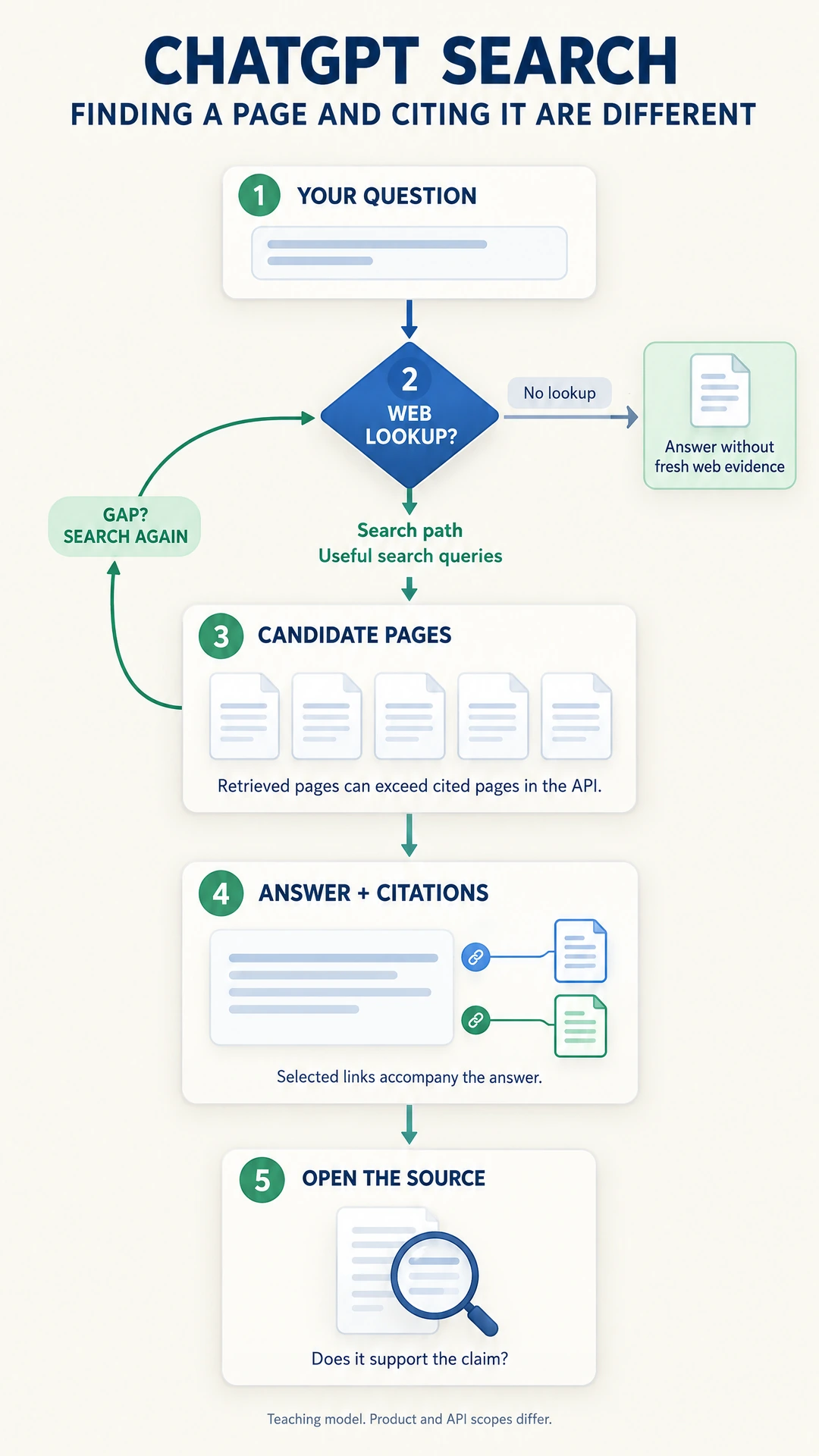
- Your question → Web lookup needed?
- Web lookup needed? → Answer without a web lookup (No lookup)
- Web lookup needed? → Build useful search queries (Search)
- Build useful search queries → Retrieve candidate pages
- Retrieve candidate pages → Select supporting material
- Select supporting material → More information needed? (Evidence gap)
- More information needed? → Build useful search queries (Search again)
- Select supporting material → Write an answer with citations (Enough support)
- Write an answer with citations → Open and check the source
What the browser study observed
Toth reports rewritten queries, candidate sources, citation references and URL-moderation labels in 53 three-turn conversations captured on September 25, 2026. Browser captures do not reveal all server activity.
A question with two possible routes
Start with the concept scenario in the diagram. A question about a canonical URL can be answered without a fresh web lookup. That short route helps explain a basic reading habit, checking whether an answer has supplied current evidence before relying on it.
Now choose the comparison scenario. Product requirements introduce facts that need checking. For our agency, an explanation of monitoring is less useful than evidence about the services available to its team.
ChatGPT's web search documentation confirms that search results and citations appear in the chat when web search is used. It also notes that workspace settings can limit availability. The diagram's branch is a teaching distinction, while the private rule governing every consumer search decision remains undisclosed by that page.
The difference becomes easy to spot with a pair of questions. “What does uptime monitoring mean?” asks for a concept. “Which tools support my current requirements?” asks for an evaluation. A fluent paragraph can answer the first while providing too little evidence for the second.
From a broad prompt to useful searches
The agency's opening request is conversational. A purchasing comparison, however, needs several pieces of evidence. Alert delivery and hosting location cannot be settled by the same generic claim about ease of use.
In the diagram, the search-query stage represents turning that broad request into more useful questions. Example searches could address Canadian hosting or notification options. These are our teaching examples, rather than captured ChatGPT search strings.
Steve Toth's ChatGPT Search analysis inspired this visual explanation. It reports 53 three-turn browser conversations recorded on September 25, 2026, including rewritten search queries and citation-related fields. Toth explicitly describes the meanings of those labels as inferred. Browser traffic reveals what reaches the client, rather than every operation on the servers. We have not replicated that experiment, and the diagram does not convert its observations into a universal execution sequence.
For a publisher, I would use the query stage to review customer questions. If the hosting policy is available only in a sales conversation, the website gives a reader little evidence to check. Publishing an accurate answer improves the page's usefulness, without establishing a new ChatGPT ranking factor.
Retrieved pages and visible citations
Move to the candidate-page node, then the cited-answer node. The gap between them is the distinction to remember during an audit.
OpenAI's API web search guide documents a sources collection that can contain more retrieved URLs than an answer's inline citations. This is an API capability, which illustrates the difference without proving that the consumer ChatGPT interface exposes the same fields or uses an identical implementation.
Suppose a monitoring overview appears among the agency's candidate material. A retrieved URL alone cannot prove how much page content was read or how it influenced the response. A citation adds an inspectable source link. The buyer's next task is to compare its text with the claim beside that link.
| Observation | Supported conclusion | Remaining question |
|---|---|---|
| A search crawler requests a page | The request occurred | Did a particular answer cite it? |
| A URL appears in API search sources | It was retrieved in that API operation | Was it cited in the answer? |
| An answer cites a URL | The source link was shown | Does its text support the nearby claim? |
An existing ChatGPT citation research article examines retrieval and citation data. For an individual page audit, I would inspect the cited passage before drawing a conclusion from an aggregate study.
The buyer's practical question is narrower than the product category. Does the source establish the hosting location required for this plan? A page discussing availability across Canada would not, by itself, establish where the service stores data.
Follow-up questions and evidence gaps
Choose the follow-up scenario and watch the diagram return to the search route. The extra loop represents a gap in the available evidence. Reasoning-based search in the OpenAI API can involve further searches, although the loop here is a conceptual illustration rather than a rule for every ChatGPT conversation.
Our agency now needs reporting that it can share with clients. A recommendation based on the earlier hosting requirement leaves that detail unresolved. Adding the reporting constraint gives the comparison a different job.
This is a useful exercise for a content team. Take a broad buying question and add the requirement a salesperson hears near the end of a call. Then open the relevant page. If the answer requires guessing, flag the gap for the person who knows the product.
Avoid filling that gap with a sentence that merely sounds reassuring. “Built for agencies” cannot establish how a client report is shared. A precise explanation can state the supported delivery method and its limitations. That gives the buyer something to evaluate before committing.
Search access and training permission
A useful page still needs accessible content. Check the permissions intended for search separately from the policy for model training.
OpenAI's crawler documentation assigns OAI-SearchBot to search discovery and GPTBot to content that may be used for model training. The controls are independent. ChatGPT-User supports certain user-initiated visits and is not the automatic search crawler. Sites opted out of OAI-SearchBot can still appear as navigational links.
For a search-access check, review robots.txt alongside firewall decisions and server responses for verified requests. An allow rule cannot demonstrate that the request reached the page successfully. Nor does a successful fetch promise a citation.
If the useful information appears only after client-side scripts execute, include the page in an AI assistant JavaScript rendering review. Test the page's accessible content before commissioning a rewrite.
Keep product naming consistent across those pages. The EntityMap assessment offers a related discussion of entity clarity and the limits of a special-file approach. A buyer should be able to recognize that a policy page and a comparison describe the same service.
A small audit with separate outcomes
I would start with one commercially useful question, rather than an enormous prompt list. Save its wording and the conversation context, then record the cited URLs with the date. Open the source supporting the recommendation and compare the relevant claim with the text on that page.
Use separate records for access, citation, and referral. Access evidence includes an observed crawler request and its response status. For a citation, save the URL shown in the sampled answer. A referral record requires analytics evidence linking a visit to the click, with unattributed traffic left unattributed.
Those distinctions prevent a technical fix from being reported as a business result. Our hypothetical agency could remove an access error and receive no citation in the next sample. It could appear in an answer without receiving a visit. Each outcome answers a different question.
The Bing AI visibility reporting guide is another useful example of matching a metric to the decision it can support. Use a report within its platform and measurement scope.
For the first content change, I would choose the missing buyer detail. Explain the actual hosting policy or reporting method with the product owner's help, then check the revised page against the same question. A buyer can evaluate the improved resource regardless of whether a future AI answer selects it.
Frequently Asked Questions
Does every ChatGPT answer search the web?
A chat answer alone does not establish that a web lookup occurred. Check the search activity and source links available in the response. The diagram shows a conceptual no-search route, without predicting which path the service will choose for a particular prompt.
Does allowing OAI-SearchBot guarantee a citation?
No. Allowing search crawling helps provide access. Citation and ranking outcomes remain separate from the site's crawler permissions.
Can a site block training while allowing search?
OpenAI documents independent controls for GPTBot and OAI-SearchBot. A publisher can disallow GPTBot while permitting the search crawler, according to its content policy.
Does a citation prove that an answer is correct?
A citation gives the reader a source to inspect. Verify that the source supports the specific claim and applies to its context, rather than treating the link as proof by itself.