ChatGPT Cites Only 1.93% of Reddit Pages — What 1.4M Prompts Reveal About AI Citation Mechanics
Ahrefs analyzed 1.4 million ChatGPT prompts and found Reddit is retrieved constantly but almost never cited. Plus: IAB data shows social media ads overtaking search for the first time at $117B vs $114B.
Updated April 17, 2026Francisco Leon de Vivero
A new study from Ahrefs, published April 15, 2026, offers the most granular look yet at how ChatGPT decides which sources to cite — and which to silently consume. The research analyzed 1.4 million ChatGPT 5.2 desktop prompts from February 2025, tracking every URL retrieved and whether it in the end received a citation.
The headline finding: ChatGPT's overall citation rate sits at almost exactly 50/50 — 49.98% of retrieved URLs get cited, 50.02% do not. That average, though, masks dramatic disparities by source type, with Reddit sitting at the extreme end of the "used but never credited" spectrum.
1.4M
ChatGPT prompts analyzed
49.98%
Overall citation rate
1.93%
Reddit citation rate
67.8%
Non-cited URLs from Reddit
1. The Ahrefs Study: Methodology and Scale
The study, authored by Louise Linehan and Xibeijia Guan, used cosine similarity scores computed from open-source embeddings to approximate ChatGPT's internal semantic matching process. This let the researchers reverse-engineer how the model evaluates title-to-query relevance when deciding which retrieved pages to cite. Across 1.4 million prompts, ChatGPT retrieved an average of roughly 16.5 URLs per prompt , nearly identical for both cited pages (16.57) and non-cited pages (16.58). The retrieval step itself is source-agnostic. The discrimination happens downstream, during the citation selection phase. Not at the retrieval gate. After it.
Key Methodological Note: The study examined ChatGPT 5.2's desktop interface. Reddit content enters the retrieval pool through a dedicated "Reddit source" channel , separate from standard web search , established via OpenAI's May 2024 data partnership with Reddit. This structural separation is a key factor in the citation gap.
2. Citation Rates by Source Type , The Reddit Anomaly
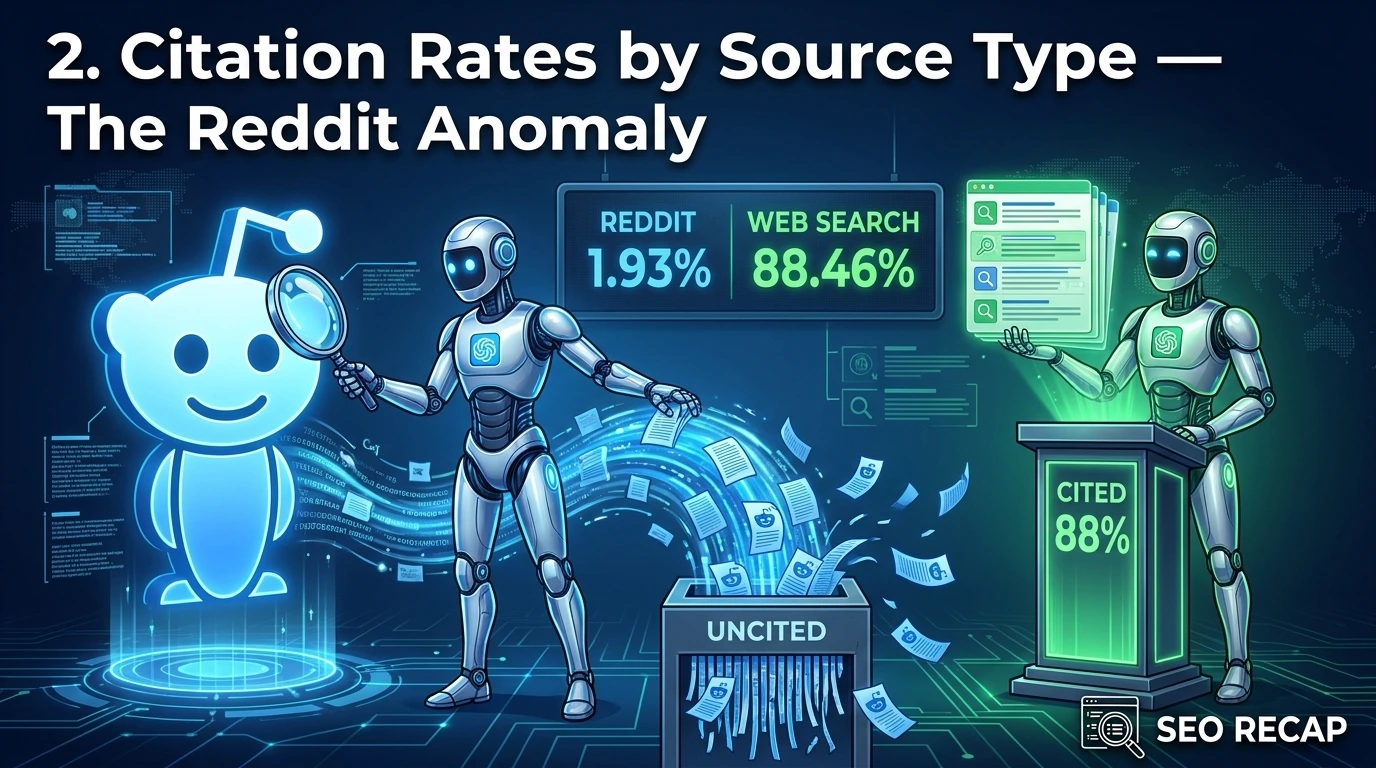
Standard web search results are cited at an 88.46% rate , nearly 9 in 10 retrieved search pages make it into the response. Reddit, by contrast, is cited only 1.93% of the time, despite representing an enormous share of the retrieval pool.
Source Type
Citation Rate
Total Retrieved URLs
Web Search
88.46%
25,563,589
News
12.01%
3,940,537
Reddit
1.93%
16,182,976
YouTube
0.51%
953,693
Academia
0.40%
185,337
The visualization of non-cited URL distribution makes Reddit's role even starker:
Reddit
67.8%
67.8%
Search
~15%
~15%
News
~12%
~12%
YouTube
~4%
~4%
Academia
~1%
Reddit functions as a massive context reservoir. ChatGPT reads it voraciously to understand sentiment, user experiences, and conversational knowledge , then cites more "authoritative" web search results instead. More than two-thirds of all uncited URLs in ChatGPT responses come from Reddit. OpenAI paid for that data partnership and then buried the attribution. Make of that what you will.
Compositional Artifacts Warning: The researchers found that initial aggregate statistics were misleading. For example, non-cited pages appeared to have snippets 14.81% of the time vs. 4.36% for cited pages , but this was entirely driven by Reddit's metadata patterns dominating the non-cited pool. When analyzed per source type, the relationships often reversed.
3. What Actually Gets Cited: URLs, Titles, and Fanout Queries
Beyond source type, three specific factors significantly predict citation probability.
URL Structure: 8.67 Percentage Point Advantage
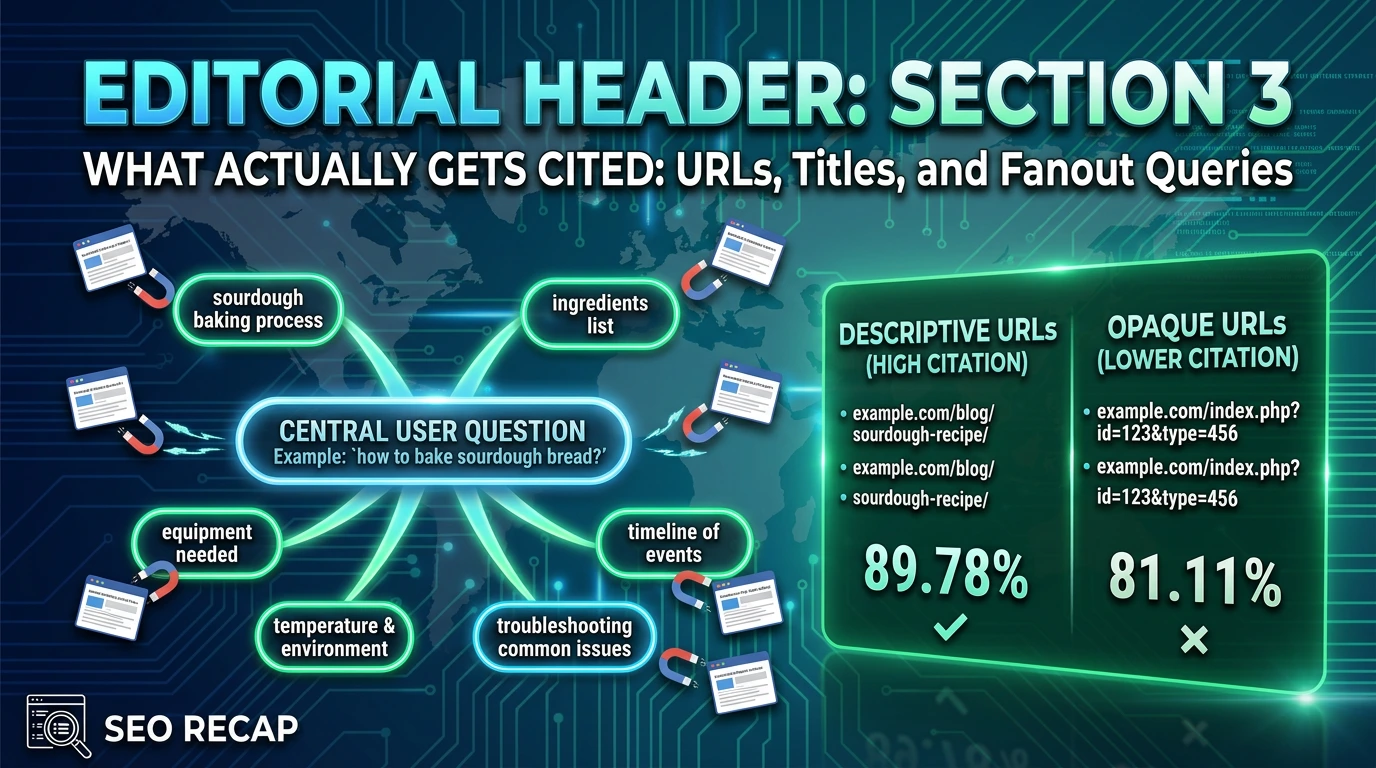
Pages with natural language, descriptive URL slugs (e.g., `/how-to-tune-meta-descriptions`) achieve an
89.78% citation rate compared to 81.11% for opaque or non-semantic URLs (e.g., `/article/58291`). That 8.67 percentage point gap is a real optimization lever , something our URL Slug Generator can help with directly.
89.78%
Citation rate , descriptive URLs
81.11%
Citation rate , opaque URLs
Title-to-Query Semantic Alignment
Cosine similarity scores between page titles and queries tell a clear story:
Comparison
Cosine Similarity
User prompt vs. cited URL title
0.602
User prompt vs. non-cited URL title
0.484
Fanout sub-query vs. cited title (best match)
0.656
The Fanout Query Mechanism ,
The Most Actionable Finding ChatGPT doesn't simply match pages against the user's original prompt. It generates internal "fanout" sub-queries , decomposing the user's question into specific information needs , and then matches pages against these narrower sub-questions. The highest citation probability goes to pages whose titles align with these granular sub-queries (0.656 cosine similarity) rather than the broad original prompt (0.602). This aligns with the
agentic search patterns we've been tracking, where AI systems decompose queries before acting.
What This Means in Practice: If a user asks "What's the best CRM for small businesses?", ChatGPT internally generates sub-queries like "CRM pricing comparison under $50/month," "CRM features for teams under 10 people," and "easiest CRM onboarding process." Pages titled to match these specific sub-questions , not the generic parent topic , win citations. This is the AI-era equivalent of long-tail keyword optimization.
4. Page Age and Authority Signals
The study shows a strong preference for established content. Cited pages in the search category have a median age of approximately
500 days (~1.3 years), with cited pages observed as old as 2,700+ days (7.4 years). Non-cited pages tend to be significantly younger. This contrasts with earlier research: a previous Ahrefs study from July 2025 found a median cited page age of 958 days. The shift toward newer-but-still-established pages may reflect ChatGPT's evolving retrieval calibration, but the core pattern holds , fresh-off-the-press content rarely gets cited. This age-bias compounds the broader citation dynamics we analyzed in an earlier 815K-page study. For news content, the pattern inverts slightly: cited news pages have a median age of ~200 days while non-cited news pages skew older at ~300 days, suggesting recency matters more within the news category where timeliness is intrinsic to value.
What This Tells Us About AI Authority Signals
ChatGPT uses page age as a proxy for content that's been validated over time , pages that have accumulated backlinks, user engagement, and indexing history. The implication for evergreen content strategies is direct: building authoritative, lasting content pays compounding dividends in the AI era, just as it does in traditional SEO. Same game. Higher stakes. If you're working on tuning for AI citation likelihood, our
LLM Citation Checker can help score your content across ChatGPT, Perplexity, and Gemini.
5. Actionable SEO Implications for AI Citation Optimization
The Ahrefs study translates into a concrete optimization checklist for sites that want to be cited by AI systems.
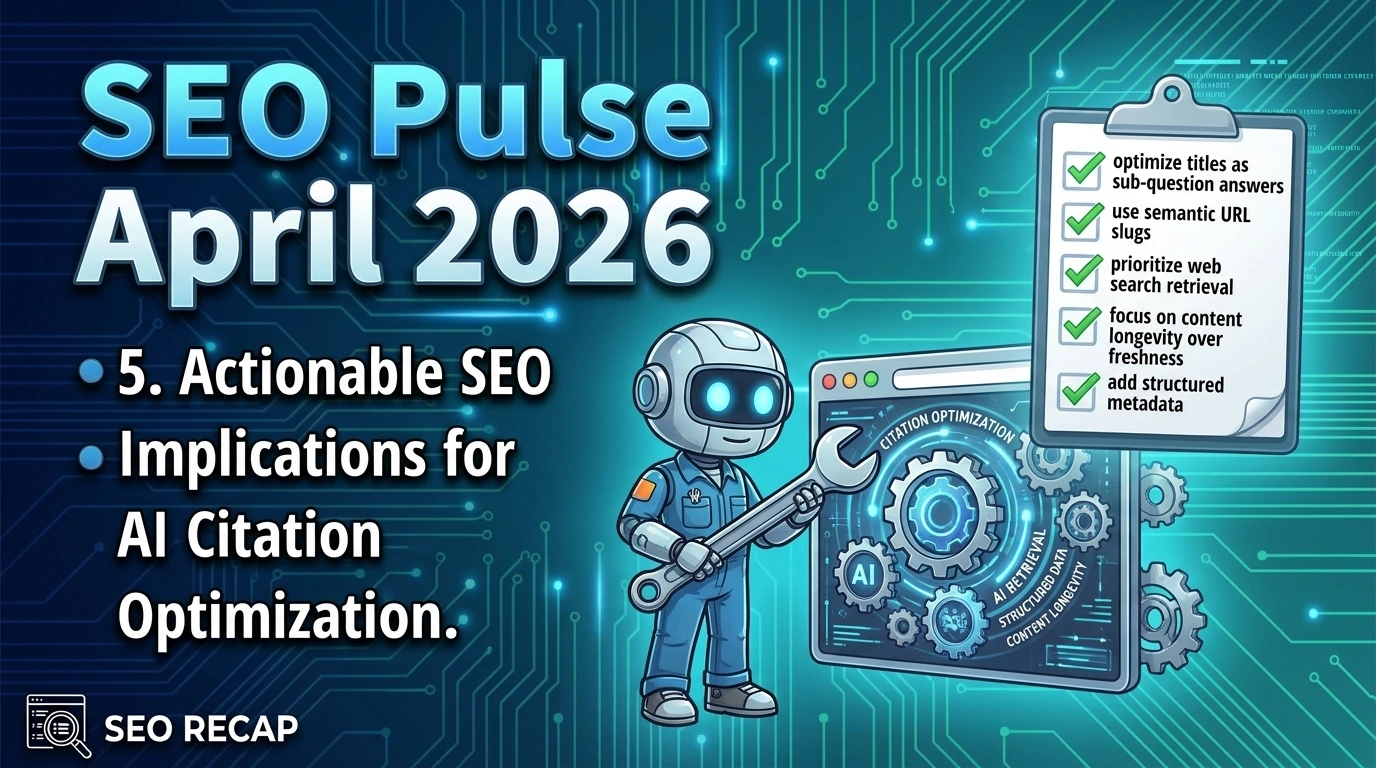
Tune titles for sub-questions, not just topics. Think about the specific fanout queries a user's broad question might decompose into. Structure content to answer these narrow, specific sub-questions explicitly , and reflect that specificity in your `` tags and H1s. <strong>Use descriptive, semantic URL slugs.</strong> The 8.67 percentage point gap is real. Avoid numeric IDs, hash-based paths, or parameter-heavy URLs. Use human-readable slugs that describe the content. <strong>Prioritize web search retrieval over social and platform channels.</strong> The 88.46% vs. 1.93% gap between search and Reddit means being retrievable via standard web search is overwhelmingly more valuable for citation purposes than appearing through platform-specific channels. <strong>Build content with longevity in mind.</strong> Pages aged 1-2 years outperform both brand-new and extremely old content. Create evergreen resources designed to accumulate authority over time, then refresh them periodically rather than publishing net-new pages. <strong>Include structured metadata , but know its limits.</strong> Having snippets available correlated with higher citation rates (2.52% of cited search pages had snippets vs. 0.09% of non-cited), but the effect is secondary to title relevance and URL quality. Our <a href="/tools/ai-overview-optimizer/">AI Overview Optimizer</a> can help assess your content's readiness for AI-driven search features. <hr class="cite-divider"> <figure class="cite-figure" style="margin:2rem 0">
<img src="/assets/images/posts/chatgpt-citation-mechanics/chatgpt-citation-mechanics-section6-iab-report.webp" alt="IAB 2025 report showing social media overtaking search in ad revenue" width="1376" height="768" loading="lazy" style="width:100%;height:auto;border-radius:12px;aspect-ratio:16/9">
</figure> <h2 id="6-iab-2025-report-social-media-overtakes-search-in-ad-revenu">6. IAB 2025 Report: Social Media Overtakes Search in Ad Revenue</h2><p>The Interactive Advertising Bureau's annual report shows a watershed moment:</p> <strong>social media advertising ($117 billion) has overtaken search advertising ($114 billion)</strong> as the largest digital ad category in the United States. <div class="cite-stat-grid">
<div class="cite-stat-card"><div class="cite-stat-num">$294B</div><div class="cite-stat-label">Total U.S. digital ad revenue 2025</div></div>
<div class="cite-stat-card"><div class="cite-stat-num">$117B</div><div class="cite-stat-label">Social media ads (+32% YoY)</div></div>
<div class="cite-stat-card"><div class="cite-stat-num">$114B</div><div class="cite-stat-label">Search ads (+11% YoY)</div></div>
<div class="cite-stat-card"><div class="cite-stat-num">$78B</div><div class="cite-stat-label">Digital video ads (+25% YoY)</div></div>
</div> The momentum shift is hard to ignore. Search ad growth decelerated from 15% in 2024 to 11% in 2025, while social surged 32% , a $29 billion year-over-year increase , and digital video accelerated from 19% to 25% growth. This revenue rebalancing adds financial pressure to the <a href="/insights/ai-slop-loop-spam-dsa/">AI-generated content arms race</a> already straining organic search quality. <div class="cite-table-wrap">
<table class="cite-table">
<thead><tr><th>Category</th><th>2025 Revenue</th><th>YoY Growth</th></tr></thead>
<tbody>
<tr><td>Social Media</td><td>$117 billion</td><td><strong>+32%</strong></td></tr>
<tr><td>Search</td><td>$114 billion</td><td>+11% (down from 15%)</td></tr>
<tr><td>Digital Video</td><td>$78 billion</td><td><strong>+25%</strong> (up from 19%)</td></tr>
<tr><td>Commerce Media</td><td>$63 billion</td><td>+18%</td></tr>
<tr><td>Creator Economy</td><td>$37 billion</td><td>Projected $44B in 2026</td></tr>
<tr><td>Programmatic (total)</td><td>$162 billion</td><td>+20%</td></tr>
</tbody>
</table>
</div> <div class="cite-callout">
<strong>Context for SEO Professionals:</strong> The IAB notes that category overlap exists , a social video ad may be counted in both social and video categories. Still, the directional shift is unmistakable. As AI-powered search features like Google's AI Mode fragment the traditional search results page, the relative growth slowdown in search advertising may accelerate. Commerce media ($63B, +18%) now represents over 20% of all digital ad spend, reflecting the rise of retail media networks.
</div> <h3 id="what-this-means-for-the-seo-industry-search-isnt-declining-1">What This Means for the SEO Industry</h3><p>Search isn't declining , $114 billion is a massive market growing at double digits. But the growth momentum has clearly shifted. The combination of AI-driven search fragmentation (fewer traditional clicks), social commerce maturation (TikTok Shop, Instagram Checkout), and the explosion of retail media networks is redirecting marginal ad dollars away from search. This ad revenue shift compounds the</p> <a href="/insights/ai-overviews-gambling-seo/">CTR collapse from AI Overviews</a> we covered recently , organic visibility is being squeezed from multiple directions at once. And it's not slowing down. For SEO practitioners, this reinforces the need to think beyond traditional organic search. AI citation optimization (as the Ahrefs study shows), social search optimization, and video SEO represent growth vectors where organic visibility is expanding rather than contracting. <hr class="cite-divider"> <h2 id="7-chrome-ai-mode-gets-side-by-side-browsing-google-announced">7. Chrome AI Mode Gets Side-by-Side Browsing</h2><p>Google announced on April 16 that Chrome's AI Mode on desktop now supports side-by-side browsing , clicking a link in AI Mode opens the webpage in a side panel rather than navigating away from the AI interface. The update, announced by Google Search VP Robby Stein and Chrome VP Mike Torres, is currently available in the U.S. with international rollout to follow. Plus, there are new features: a "plus menu" on Chrome's New Tab page and within AI Mode lets users attach open browser tabs, images, and PDFs as context for their AI searches. Users can now combine multiple sources in a single AI Mode query and access canvas and image creation tools directly.</p> <div class="cite-callout">
<strong>Publisher Impact:</strong> The side-panel model changes how users interact with cited sources. Instead of a full-page visit, users view content alongside the AI response , potentially reducing time-on-page and engagement metrics while still technically delivering traffic. For analytics, watch for changes in session duration and bounce rates from AI Mode referrals. This is closer to a "preview" interaction than a traditional visit.
</div> <figure class="cite-figure" style="margin:2rem 0">
<img src="/assets/images/posts/chatgpt-citation-mechanics/chatgpt-citation-mechanics-section7-chrome-ai-mode.webp" alt="Chrome AI Mode side-by-side browsing feature and publisher impact" width="1376" height="768" loading="lazy" style="width:100%;height:auto;border-radius:12px;aspect-ratio:16/9">
</figure> <div class="post-related">
<h2>Related Articles</h2>
<ul>
<li><a href="/insights/ai-slop-loop-spam-dsa/">The AI Slop Loop, Google's New Spam Weapons, and DSA's Final Days</a> <span class="post-related__meta">April 16, 2026 , AI misinformation cycle and spam enforcement</span></li>
<li><a href="/insights/agentic-search-canonical/">Google Agentic Search Hits 75M Users and Mueller's 9 Canonical Override Scenarios</a> <span class="post-related__meta">April 15, 2026 , Agentic restaurant booking expands to 8 countries</span></li>
<li><a href="/insights/back-button-spam-chatgpt-citations/">Google's Back Button Hijacking Spam Policy and the 815K-Page ChatGPT Citation Study</a> <span class="post-related__meta">April 14, 2026 , New spam enforcement + LLM citation data</span></li>
<li><a href="/insights/ai-overviews-gambling-seo/">AI Overviews vs Gambling SEO , The 61% CTR Collapse</a> <span class="post-related__meta">April 13, 2026 , How AI Overviews are reshaping high-competition verticals</span></li>
<li><a href="/insights/core-update-gsc-llm/">March 2026 Core Update Aftermath and the 11-Month GSC Bug</a> <span class="post-related__meta">April 12, 2026 , Core update recovery patterns and LLM bot crawling crisis</span></li>
</ul>
</div> <div class="cite-faq" id="faq"> <h2 id="frequently-asked-questions">Frequently Asked Questions</h2> <div class="cite-faq-item">
<h3>What percentage of Reddit pages does ChatGPT actually cite?</h3>
<p>According to Ahrefs' study of 1.4 million ChatGPT 5.2 prompts, Reddit pages are cited only 1.93% of the time they are retrieved. This is despite Reddit comprising 67.8% of all non-cited URLs in ChatGPT's retrieval pool, meaning the AI heavily uses Reddit content for context but almost never attributes it.</p>
</div> <div class="cite-faq-item">
<h3>What is the overall citation rate for pages retrieved by ChatGPT?</h3>
<p>The overall citation rate across all source types is approximately 49.98%. However, this varies dramatically by source type: standard web search results are cited 88.46% of the time, news content 12.01%, Reddit 1.93%, YouTube 0.51%, and academic sources only 0.40%.</p>
</div> <div class="cite-faq-item">
<h3>Do URL structures affect whether ChatGPT cites a page?</h3>
<p>Yes. Pages with natural language, descriptive URL slugs achieve an 89.78% citation rate compared to 81.11% for pages with opaque or non-semantic URLs , an 8.67 percentage point advantage. Readable URLs serve as an additional relevance signal for ChatGPT's citation algorithm.</p>
</div> <div class="cite-faq-item">
<h3>How much did search advertising grow in 2025 according to the IAB?</h3>
<p>Search advertising revenue reached $114 billion in 2025, growing 11% year-over-year , down from 15% growth in 2024. Meanwhile, social media advertising surged 32% to $117 billion, overtaking search as the largest digital ad category for the first time.</p>
</div> <div class="cite-faq-item">
<h3>What are ChatGPT's fanout queries and why do they matter for SEO?</h3>
<p>Fanout queries are internal sub-questions that ChatGPT generates from a user's original prompt. Pages whose titles closely match these sub-queries (cosine similarity 0.656) are significantly more likely to be cited than pages matching only the broad original prompt (0.602). Optimizing for specific, granular questions increases your chances of being cited by AI.</p>
</div> <div class="cite-faq-item">
<h3>How does page age affect ChatGPT citation probability?</h3>
<p>Cited pages tend to be older and more established. The median age of cited search pages is approximately 500 days (about 1.3 years), with cited pages observed up to 2,700+ days old (7.4 years). ChatGPT favors pages with established authority and indexing history over newer content.</p>
</div> <div class="cite-faq-item">
<h3>What is the total size of the digital advertising market in 2025?</h3>
<p>According to the IAB's annual report, total U.S. digital advertising revenue reached $294 billion in 2025, a 13% increase year-over-year. The market is now led by social media ($117B), followed by search ($114B), digital video ($78B), commerce media ($63B), and creator advertising ($37B, projected to reach $44B in 2026).</p>
</div> </div> <div class="prose-author">
<img src="/assets/images/francisco/francisco-conference.jpg" alt="Francisco Leon de Vivero" width="120" height="120" loading="lazy">
<div class="prose-author__body">
<p class="prose-author__name">Francisco Leon de Vivero</p>
<p class="prose-author__role">VP of Growth at <a href="https://www.growingsearch.com/">Growing Search</a></p>
<p>15+ years in enterprise, ecommerce, and international SEO. Former Head of Global SEO Plan at Shopify. Speaker at UnGagged and SEonthebeach. Now leading growth strategy at Growing Search.</p>
<p><a href="https://www.linkedin.com/in/seofrancisco/">LinkedIn</a> · <a href="https://www.youtube.com/c/SEOFrancisco/videos">YouTube</a> · <a href="/consultation/">Book a Consultation</a></p>
</div>
</div>
</div>
<section class="newsletter-signup newsletter-signup--article" aria-labelledby="newsletter-signup-title-article" aria-describedby="newsletter-signup-description-article">
<div class="newsletter-signup__inner">
<div class="newsletter-signup__copy newsletter-signup__copy--embed-led">
<p class="newsletter-signup__eyebrow">SEO Pulse weekly</p>
<h2 id="newsletter-signup-title-article">Get the weekly SEO Pulse</h2>
<p id="newsletter-signup-description-article">Practical SEO, AI Search, technical SEO and ecommerce. One useful email each week.</p>
</div>
<div class="newsletter-signup__form" data-newsletter-form="article" data-beehiiv-form-id="c350d52a-9166-4754-858e-b49cc139b7c7" data-beehiiv-state="blocked">
<p class="newsletter-signup__consent" data-beehiiv-consent-message>The embedded form uses a third-party service and loads only if you accept optional analytics.</p>
<button class="button button--secondary newsletter-signup__consent-button" type="button" data-cookie-settings data-beehiiv-consent-button>Review preferences</button>
</div>
<p class="newsletter-signup__note">
By subscribing, you agree to receive SEO Pulse emails. Confirm your email to complete signup. Unsubscribe anytime.
<a href="/privacy/">Privacy Policy</a>.
<a href="/privacy/#cookie-choices" class="text-link" data-cookie-settings>Cookie settings</a>.
</p>
</div>
</section>
<div class="post-next-steps">
<div class="section-heading post-next-steps__heading">
<p class="eyebrow">Next step</p>
<h2>Turn this background reading into a more current SEO plan.</h2>
<p>Use the most relevant current page below if this topic is still on your roadmap, then review the proof and contact paths if you want direct support.</p>
</div>
<div class="path-grid">
<article class="path-card path-card--accent path-card--service card-with-mark">
<div class="service-mark" aria-hidden="true">
<svg viewBox="0 0 64 64" aria-hidden="true" focusable="false">
<defs>
<linearGradient id="grad-tech" x1="0%" y1="0%" x2="100%" y2="100%">
<stop offset="0%" stop-color="#23b7ff" />
<stop offset="100%" stop-color="#1a6fff" />
</linearGradient>
</defs>
<rect x="17" y="17" width="30" height="30" rx="9" fill="url(#grad-tech)" />
<path d="M24 28h16M24 36h11" fill="none" stroke="#fff" stroke-width="4.5" stroke-linecap="round" />
<circle cx="44" cy="36" r="4" fill="#ff9e3d" />
</svg>
</div>
<p class="audience-card__kicker">Current service page</p>
<h3><a href="/technical-seo-advisory/">Technical SEO Advisory</a></h3>
<p>The goal is not audit sprawl. It is translating complex technical issues into prioritized actions that development and marketing teams can actually execute.</p>
<a class="text-link" href="/technical-seo-advisory/">Explore this service</a>
</article>
<article class="path-card">
<p class="audience-card__kicker">Experience</p>
<h3><a href="/experience/">See the proof behind the advice.</a></h3>
<p>Review Francisco’s platform background, speaking, awards, judging, and leadership experience before reaching out.</p>
<a class="text-link" href="/experience/">Review experience</a>
</article>
<article class="path-card">
<p class="audience-card__kicker">Contact</p>
<h3><a href="/consultation/#cal-inline-embed">Start a focused consultation.</a></h3>
<p>Use the consultation page if you want help turning this topic into clearer priorities, next steps, and measurable SEO momentum.</p>
<a class="text-link" href="/consultation/#cal-inline-embed">Book the consultation</a>
</article>
</div>
</div>
</div>
<aside class="post-sidebar">
<div class="sticky-card sticky-card--service card-with-mark">
<div class="service-mark" aria-hidden="true">
<svg viewBox="0 0 64 64" aria-hidden="true" focusable="false">
<defs>
<linearGradient id="grad-tech" x1="0%" y1="0%" x2="100%" y2="100%">
<stop offset="0%" stop-color="#23b7ff" />
<stop offset="100%" stop-color="#1a6fff" />
</linearGradient>
</defs>
<rect x="17" y="17" width="30" height="30" rx="9" fill="url(#grad-tech)" />
<path d="M24 28h16M24 36h11" fill="none" stroke="#fff" stroke-width="4.5" stroke-linecap="round" />
<circle cx="44" cy="36" r="4" fill="#ff9e3d" />
</svg>
</div>
<p class="eyebrow">Current topic path</p>
<h2>Technical SEO Advisory</h2>
<p>Technical SEO support for teams dealing with crawlability, indexing, migrations, site structure, rendering, Core Web Vitals, and engineering backlogs.</p>
<a class="button button--secondary" href="/technical-seo-advisory/">Explore current page</a>
</div>
<section class="newsletter-signup newsletter-signup--sidebar" aria-labelledby="newsletter-signup-title-sidebar" aria-describedby="newsletter-signup-description-sidebar">
<div class="newsletter-signup__inner">
<div class="newsletter-signup__copy">
<p class="newsletter-signup__eyebrow">SEO Pulse weekly</p>
<h2 id="newsletter-signup-title-sidebar">Get one useful SEO email each week.</h2>
<p id="newsletter-signup-description-sidebar">Practical SEO, AI Search, technical SEO and ecommerce.</p>
</div>
<div class="newsletter-signup__form" data-newsletter-form="sidebar" data-beehiiv-form-id="d056e941-69ac-482b-ae48-d79db2a3cb52" data-beehiiv-state="blocked">
<p class="newsletter-signup__consent" data-beehiiv-consent-message>The embedded form uses a third-party service and loads only if you accept optional analytics.</p>
<button class="button button--secondary newsletter-signup__consent-button" type="button" data-cookie-settings data-beehiiv-consent-button>Review preferences</button>
</div>
<p class="newsletter-signup__note">
Confirm your email to subscribe. Unsubscribe anytime.
<a href="/privacy/">Privacy Policy</a>.
<a href="/privacy/#cookie-choices" class="text-link" data-cookie-settings>Cookie settings</a>.
</p>
</div>
</section>
<div class="sticky-card author-card">
<div class="author-card__image">
<picture><source type="image/webp" srcset="/assets/optimized/bTHSfTn-Ag-240.webp 240w, /assets/optimized/bTHSfTn-Ag-360.webp 360w, /assets/optimized/bTHSfTn-Ag-480.webp 480w" sizes="14rem"><img src="/assets/optimized/bTHSfTn-Ag-240.jpeg" alt="Francisco Leon de Vivero" loading="lazy" decoding="async" width="480" height="508" srcset="/assets/optimized/bTHSfTn-Ag-240.jpeg 240w, /assets/optimized/bTHSfTn-Ag-360.jpeg 360w, /assets/optimized/bTHSfTn-Ag-480.jpeg 480w" sizes="14rem"></picture>
</div>
<p class="eyebrow">About Francisco</p>
<h2>Francisco Leon de Vivero</h2>
<p>VP of Growth at Growing Search and global SEO expert with 15+ years across Shopify, enterprise search, international growth programs, awards judging, and conference speaking.</p>
<ul class="feature-list feature-list--compact">
<li>Former Head of Global SEO Framework at Shopify</li>
<li>VP of Growth at Growing Search</li>
<li>Speaker, educator, and search awards judge</li>
<li>Focus on technical, international, and growth-led SEO</li>
</ul>
<a class="button button--secondary" href="/about/">View full profile</a>
</div>
<div class="sticky-card">
<p class="eyebrow">Need expert help?</p>
<h2>Turn these SEO insights into an action plan.</h2>
<p>Book one focused hour if you want help turning these ideas into clear priorities and measurable SEO progress.</p>
<a class="button button--primary" href="/consultation/#cal-inline-embed">Book a $200 Consultation</a>
<a class="button button--ghost" href="/case-studies/">Review case studies</a>
</div>
<div class="sticky-card">
<p class="eyebrow">Read Next</p>
<ul class="related-posts">
<li>
<a href="/insights/year-long-ab-tests-seo/">Can Year-Long A/B Tests Hurt SEO? What Google Actually Said</a>
<span>July 15, 2026</span>
</li>
<li>
<a href="/insights/ai-referral-traffic-gsc-audit/">Copilot AI Referral Traffic Fell 96% From Its Peak. Did Microsoft Lose AI Search?</a>
<span>July 14, 2026</span>
</li>
<li>
<a href="/insights/faq-schema-ai-pivot/">Google Killed FAQ Rich Results: The Full Timeline and Why Schema Now Serves AI, Not SERPs</a>
<span>May 13, 2026</span>
</li>
</ul>
<a class="text-link" href="/blog/">Browse all blog articles</a>
</div>
</aside>
</div>
</article>
</main>
<footer class="site-footer">
<section class="newsletter-signup newsletter-signup--footer" aria-labelledby="newsletter-signup-title-footer" aria-describedby="newsletter-signup-description-footer">
<div class="newsletter-signup__inner">
<div class="newsletter-signup__copy">
<h2 id="newsletter-signup-title-footer">SEO Pulse weekly</h2>
<p id="newsletter-signup-description-footer">One useful email each week on practical SEO, AI Search, technical SEO and ecommerce.</p>
</div>
<div class="newsletter-signup__form" data-newsletter-form="footer" data-beehiiv-form-id="883ada2c-59a0-4b47-a3e8-fc7b1728e0cc" data-beehiiv-state="blocked">
<p class="newsletter-signup__consent" data-beehiiv-consent-message>The embedded form uses a third-party service and loads only if you accept optional analytics.</p>
<button class="button button--secondary newsletter-signup__consent-button" type="button" data-cookie-settings data-beehiiv-consent-button>Review preferences</button>
</div>
<p class="newsletter-signup__note">
Confirm your email to subscribe. Unsubscribe anytime.
<a href="/privacy/">Privacy Policy</a>.
<a href="/privacy/#cookie-choices" class="text-link" data-cookie-settings>Cookie settings</a>.
</p>
</div>
</section>
<div class="container site-footer__grid">
<div class="site-footer__intro">
<p class="footer-kicker">SEO Francisco</p>
<h2 class="site-footer__title"><span class="site-footer__title-line">Francisco</span>Leon de Vivero</h2>
<p class="site-footer__lede">Francisco leads growth at Growing Search and helps brands connect technical SEO, international visibility, content systems, and measurable business outcomes.</p>
<div class="footer-pill-row">
<span class="footer-pill">VP of Growth at Growing Search</span>
<span class="footer-pill">Toronto and Montreal offices</span>
<span class="footer-pill">15+ years in SEO</span>
<span class="footer-pill">Technical, Shopify, and international SEO</span>
</div>
</div>
<div class="site-footer__panel site-footer__panel--explore">
<p class="footer-kicker">Explore</p>
<div class="site-footer__stack">
<div class="site-footer__group">
<p class="site-footer__subhead">Navigation</p>
<ul class="footer-list footer-list--primary">
<li><a href="/services/">Services</a></li>
<li><a href="/industries/">Industries</a></li>
<li><a href="/case-studies/">Case Studies</a></li>
<li><a href="/tools/">Tools</a></li>
<li><a href="/blog/">Blog</a></li>
<li><a href="/about/">About</a></li>
<li><a href="/contact/">Contact</a></li>
</ul>
</div>
<div class="site-footer__group">
<p class="site-footer__subhead">Services</p>
<div class="footer-service-grid">
<a class="footer-service-link" href="/international-seo/">International SEO</a>
<a class="footer-service-link" href="/technical-seo-advisory/">Technical SEO Advisory</a>
<a class="footer-service-link" href="/shopify-seo/">Shopify SEO</a>
<a class="footer-service-link" href="/toronto-seo-consultant/">Toronto SEO Consultant</a>
<a class="footer-service-link" href="/ai-seo/">AI SEO</a>
<a class="footer-service-link" href="/ai-seo-audit/">AI SEO Audit</a>
<a class="footer-service-link" href="/content-marketing/">Content Marketing</a>
<a class="footer-service-link" href="/link-building/">Link Building</a>
<a class="footer-service-link" href="/online-reputation-management/">Online Reputation Management</a>
<a class="footer-service-link" href="/youtube-seo/">YouTube SEO</a>
<a class="footer-service-link" href="/growth-accelerator-team/">Growth Accelerator Team</a>
</div>
</div>
</div>
</div>
<div class="site-footer__panel">
<p class="footer-kicker">Connect</p>
<ul class="footer-list">
<li><a href="#" data-chat-toggle>Chat with Sophie</a></li>
<li><a href="https://wa.me/16474930660" target="_blank" rel="noreferrer">WhatsApp</a></li>
<li><a href="/consultation/#cal-inline-embed">Book $200 Consultation</a></li>
<li><a href="https://www.growingsearch.com/" target="_blank" rel="noreferrer">Growing Search</a></li>
<li><a href="/blog/">Blog & Articles</a></li>
<li><a href="https://ca.linkedin.com/company/growingsearch" target="_blank" rel="noreferrer">LinkedIn</a></li>
<li><a href="tel:+16474930660">+1 647 493 0660</a></li>
</ul>
</div>
<div class="site-footer__panel">
<p class="footer-kicker">Offices</p>
<ul class="footer-list footer-list--offices">
<li>
<strong>Toronto</strong>
<span>240 Richmond Street W, Toronto, ON Canada M5V 1V6</span>
</li>
<li>
<strong>Montreal</strong>
<span>1275 Avenue Des Canadiens-De-Montreal L'Avenue, Montreal, Quebec H3B 0G4</span>
</li>
</ul>
</div>
</div>
<div class="container site-footer__meta">
<p>Book a focused $200 SEO consultation or explore broader growth support through Growing Search.</p>
<p>Toronto and Montreal, Canada</p>
<a href="/llm.txt" class="site-footer__sitemap-link">LLM.txt</a>
<a href="/sitemap/" class="site-footer__sitemap-link">Sitemap</a>
<a href="/privacy/" class="site-footer__sitemap-link">Privacy</a>
<a href="/terms/" class="site-footer__sitemap-link">Terms</a>
<a href="/accessibility/" class="site-footer__sitemap-link">Accessibility</a>
<a href="/editorial-policy/" class="site-footer__sitemap-link">Editorial Policy</a>
<a href="/ai-transparency/" class="site-footer__sitemap-link">AI Transparency</a>
<a href="/privacy/#cookie-choices" class="site-footer__sitemap-link" data-cookie-settings>Cookie settings</a>
</div>
</footer>
<section class="consent-banner" data-consent-banner hidden role="dialog" aria-labelledby="consent-banner-title" aria-describedby="consent-banner-description">
<div class="consent-banner__body">
<p class="consent-banner__eyebrow">Your privacy</p>
<h2 id="consent-banner-title">You control optional analytics.</h2>
<p id="consent-banner-description">We use strictly necessary storage to remember your choice. Google Analytics and Microsoft Clarity load only if you accept analytics. <a href="/privacy/">Read the privacy policy</a>.</p>
</div>
<div class="consent-banner__actions">
<button class="button button--primary" type="button" data-consent-accept>Accept analytics</button>
<button class="button button--secondary" type="button" data-consent-reject>Reject</button>
<button class="consent-banner__settings" type="button" data-consent-configure>Configure</button>
</div>
</section>
<dialog class="consent-dialog" data-consent-dialog aria-labelledby="consent-dialog-title">
<form method="dialog" class="consent-dialog__panel" data-consent-form>
<div class="consent-dialog__header">
<div>
<p class="consent-banner__eyebrow">Privacy preferences</p>
<h2 id="consent-dialog-title">Choose what can load</h2>
</div>
<button class="consent-dialog__close" type="button" data-consent-close aria-label="Close preferences">×</button>
</div>
<div class="consent-option">
<div>
<strong>Necessary storage</strong>
<p>Keeps essential features working and remembers your choice. Always on.</p>
</div>
<input type="checkbox" checked disabled aria-label="Necessary storage, always on">
</div>
<label class="consent-option" for="consent-analytics">
<span>
<strong>Optional analytics</strong>
<span>Allows Google Analytics and Microsoft Clarity to measure site usage.</span>
</span>
<input id="consent-analytics" type="checkbox" data-consent-analytics>
</label>
<p class="consent-dialog__policy"><a href="/privacy/">Privacy policy</a></p>
<div class="consent-dialog__actions">
<button class="button button--primary" type="submit" data-consent-save>Save preferences</button>
<button class="button button--secondary" type="button" data-consent-dialog-reject>Reject analytics</button>
</div>
</form>
</dialog>
<div class="chat-dock" data-chat-dock>
<section class="chat-panel" id="site-chat-panel" data-chat-panel hidden aria-labelledby="site-chat-title">
<div class="chat-panel__header">
<div>
<p class="chat-panel__eyebrow">SEO Francisco · AI assistant</p>
<h2 id="site-chat-title">Sophie, AI assistant</h2>
</div>
<button class="chat-panel__close" type="button" data-chat-close aria-label="Close chat">Close</button>
</div>
<div class="chat-panel__disclosure" data-chat-disclosure>
<strong>You are chatting with AI, not a person.</strong>
<span>You can reach a person through <a href="https://wa.me/16474930660" target="_blank" rel="noopener noreferrer">WhatsApp</a>. <a href="/ai-transparency/">AI transparency</a></span>
</div>
<div class="chat-thread" data-chat-thread aria-live="polite" aria-atomic="false"></div>
<form class="chat-form" data-chat-form>
<label class="sr-only" for="site-chat-input">Chat reply</label>
<input class="chat-form__input" id="site-chat-input" data-chat-input type="text" autocomplete="off" placeholder="Type your reply">
<div class="chat-form__actions">
<button class="button button--primary" type="submit" data-chat-submit>Send</button>
<button class="button button--ghost chat-form__restart" type="button" data-chat-restart hidden>Start over</button>
</div>
<p class="chat-form__help" data-chat-help>Your messages and contact details may be processed to answer and follow up. Do not share sensitive data. See our <a href="/privacy/">privacy policy</a>.</p>
<p class="chat-form__status" data-chat-status aria-live="polite"></p>
</form>
</section>
</div>
<aside class="sophie-scroll-card" data-sophie-scroll-card aria-label="Chat with Sophie" hidden>
<button class="sophie-scroll-card__close" type="button" data-sophie-scroll-dismiss aria-label="Minimize Sophie chat prompt">×</button>
<div class="sophie-scroll-card__media">
<img src="/assets/images/sophie/sophie-chat-openart-low-blue.webp" alt="AI-generated illustration of Sophie, SEO Francisco AI assistant" width="1792" height="1008" loading="lazy" decoding="async">
<span class="sophie-scroll-card__call" aria-hidden="true">
<svg viewBox="0 0 24 24" focusable="false"><path d="M22 16.92v3a2 2 0 0 1-2.18 2 19.79 19.79 0 0 1-8.63-3.07 19.5 19.5 0 0 1-6-6A19.79 19.79 0 0 1 2.12 4.18 2 2 0 0 1 4.11 2h3a2 2 0 0 1 2 1.72c.12.9.32 1.77.59 2.61a2 2 0 0 1-.45 2.11L8 9.69a16 16 0 0 0 6.31 6.31l1.25-1.25a2 2 0 0 1 2.11-.45c.84.27 1.71.47 2.61.59A2 2 0 0 1 22 16.92Z"/></svg>
</span>
</div>
<div class="sophie-scroll-card__body">
<p>Sophie is an AI assistant. Need a quick SEO answer?</p>
<div class="sophie-scroll-card__actions" aria-label="Contact options">
<button class="sophie-scroll-card__cta" type="button" data-chat-toggle data-sophie-scroll-cta aria-controls="site-chat-panel" aria-expanded="false">
<svg viewBox="0 0 24 24" aria-hidden="true" focusable="false"><path d="M21 15a2 2 0 0 1-2 2H8l-5 4V5a2 2 0 0 1 2-2h14a2 2 0 0 1 2 2z" fill="none" stroke="currentColor" stroke-width="2" stroke-linecap="round" stroke-linejoin="round"/></svg>
Chat with Sophie (AI)
</button>
<a class="sophie-scroll-card__cta sophie-scroll-card__cta--whatsapp" href="https://wa.me/16474930660" target="_blank" rel="noreferrer" data-sophie-scroll-dismiss-link>
<svg viewBox="0 0 24 24" aria-hidden="true" focusable="false"><path d="M17.47 14.38c-.3-.15-1.76-.87-2.03-.97-.27-.1-.47-.15-.67.15s-.77.97-.94 1.17c-.17.2-.35.22-.65.07-.3-.15-1.26-.46-2.4-1.48-.89-.79-1.49-1.77-1.66-2.07-.17-.3-.02-.46.13-.61.14-.14.3-.35.45-.52.15-.17.2-.3.3-.5.1-.2.05-.37-.02-.52-.08-.15-.67-1.61-.92-2.2-.24-.58-.49-.5-.67-.51h-.57c-.2 0-.52.07-.8.37-.27.3-1.04 1.02-1.04 2.49s1.06 2.88 1.21 3.08c.15.2 2.1 3.2 5.08 4.49.71.31 1.26.49 1.69.63.71.23 1.36.2 1.87.12.57-.09 1.76-.72 2.01-1.41.25-.7.25-1.29.17-1.41-.07-.13-.27-.2-.57-.35zM12.05 21.78c-1.79 0-3.55-.48-5.08-1.39l-.36-.22-3.78.99 1.01-3.69-.24-.38A9.82 9.82 0 0 1 2.2 12.05c0-5.46 4.45-9.9 9.91-9.9a9.83 9.83 0 0 1 7 2.9 9.82 9.82 0 0 1 2.9 7c-.01 5.46-4.45 9.9-9.91 9.9l-.05-.17zM12.05 0C5.44 0 .1 5.34.1 11.92a11.87 11.87 0 0 0 1.6 5.97L0 24l6.3-1.65a11.9 11.9 0 0 0 5.69 1.45h.05C18.64 23.8 24 18.46 24 11.92 24 5.34 18.66 0 12.05 0z" fill="currentColor"/></svg>
WhatsApp
</a>
</div>
</div>
<button class="sophie-scroll-card__mini" type="button" data-sophie-scroll-restore aria-label="Restore Sophie contact options">
<span class="sophie-scroll-card__mini-avatar">
<img src="/assets/images/sophie/sophie-chat-openart-low-blue.webp" alt="" width="96" height="96" loading="lazy" decoding="async">
</span>
<span class="sophie-scroll-card__mini-phone" aria-hidden="true">
<svg viewBox="0 0 24 24" focusable="false"><path d="M22 16.92v3a2 2 0 0 1-2.18 2 19.79 19.79 0 0 1-8.63-3.07 19.5 19.5 0 0 1-6-6A19.79 19.79 0 0 1 2.12 4.18 2 2 0 0 1 4.11 2h3a2 2 0 0 1 2 1.72c.12.9.32 1.77.59 2.61a2 2 0 0 1-.45 2.11L8 9.69a16 16 0 0 0 6.31 6.31l1.25-1.25a2 2 0 0 1 2.11-.45c.84.27 1.71.47 2.61.59A2 2 0 0 1 22 16.92Z"/></svg>
</span>
</button>
</aside>
</body>
</html>