April 2026 SEO: Core Update, GSC Error and AI Crawlers
Diagnose April's ranking changes, Search Console logging error and AI crawler activity separately. Coinciding dates do not establish that one caused another.
April's search reports can contain a ranking change and a measurement correction in the same chart. A decline in impressions during that period does not establish that the March core update reduced visibility. Start by identifying the affected metric, then connect it to a dated incident or a reproducible change on the site.
The distinction also applies to crawler activity. An increase in AI requests is evidence about server access, while a change in search clicks describes acquisition. Both deserve investigation, but combining them into a single explanation can produce a content rewrite for a logging problem or a bot block for an unrelated ranking decline.
The confirmed March core update window

Google's March 2026 core update record gives a start of March 27 at 02:00 and an end of April 8 at 06:00, US/Pacific. The earlier March spam update began March 24 and lasted 19 hours and 30 minutes. Preserve the distinction between these windows when annotating an April analysis.
Those announcements establish when Google rolled out updates. They do not identify why an individual URL lost traffic, or prove that a whole industry received a particular treatment. A claim about the hardest-hit site types needs its own dataset and method. The update name alone cannot supply that evidence.
Google's core update guidance recommends waiting at least a full week after completion before analyzing the effect in Search Console. Compare equivalent periods and inspect the pages and queries with the largest changes. Keep country, device and search type constant so a changed mix does not become an apparent page-quality result.
For this April retrospective, the completion date provides a historical comparison point. It is not a claim that the March update is still rolling out. An investigation performed later must also account for subsequent releases and site changes within its chosen period.
The Search Console error through April 27
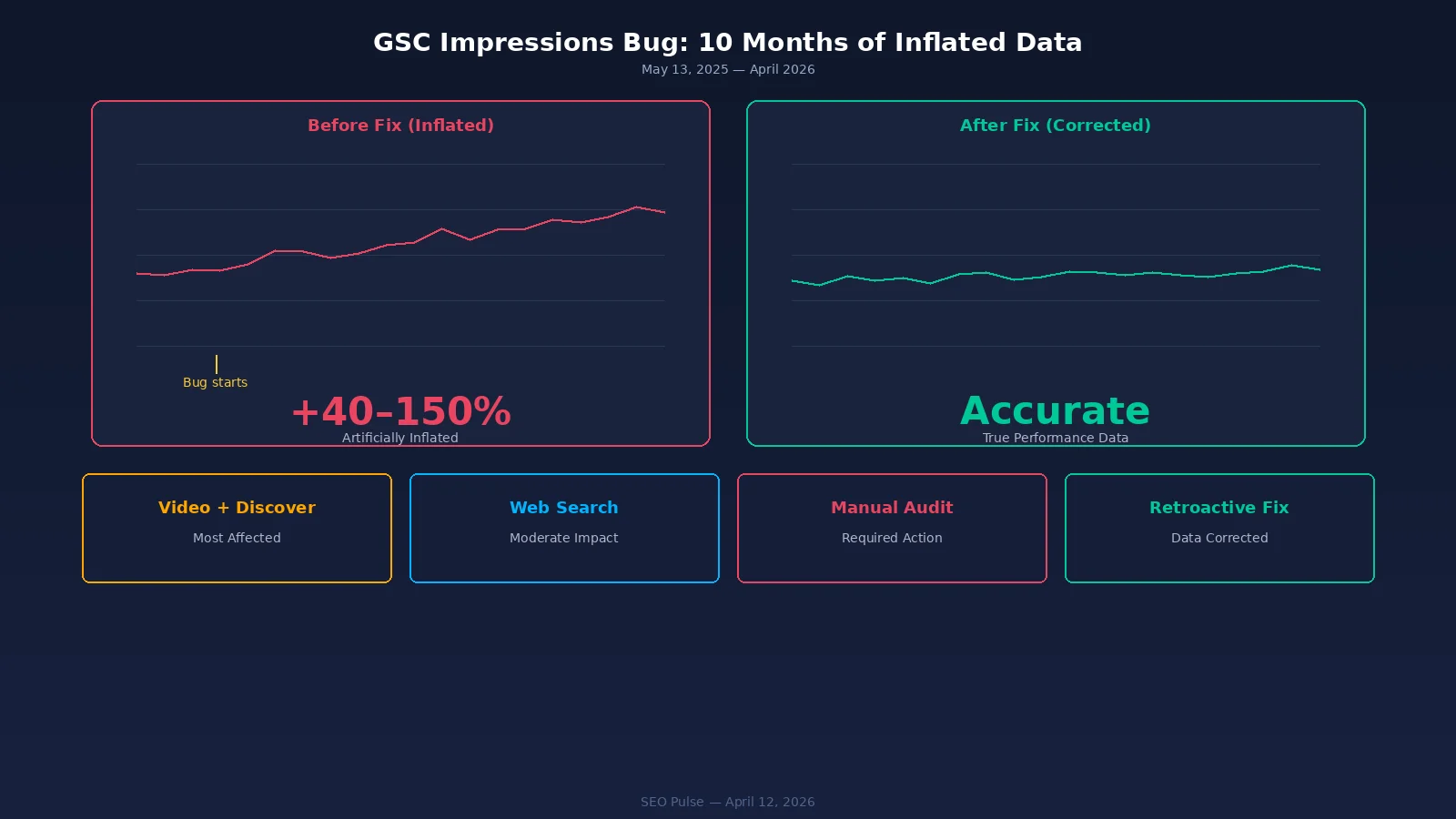
Google's data anomalies record now specifies that an impression-logging error affected data from May 13, 2025 through April 27, 2026. The issue is resolved. Impressions and the related metrics CTR and average position were affected. Clicks were not affected, and the issue concerned logging.
This corrects an incomplete early-April diagnosis. Average position cannot be treated as an unaffected control for this incident. CTR also uses impressions in its denominator, so an apparent CTR change needs to be read with the logging window in view. A correction to a report does not demonstrate a matching change in actual search demand.
| Metric or record | What the incident establishes | Review action |
|---|---|---|
| Impressions | Reporting was inaccurate during the documented window | Annotate affected comparisons and retain original exports |
| CTR and average position | Google identifies both as affected related metrics | Avoid treating either as an independent control |
| Clicks | Unaffected by this logging error | Review page and query changes, without assuming other causes are absent |
| Server and analytics records | Different systems with their own coverage | Use them as corroboration, without expecting identical counts |
Keep the property, filters and export date with each report. If an earlier recommendation depended on a CTR decline, reopen its evidence rather than automatically reversing the change. A revised title may still have been useful, but the original chart alone cannot establish its necessity or result.
The anomaly record also distinguishes other reporting incidents. Confirm that the date and report type match the incident being cited. A logging issue in one Search Console report is not permission to dismiss every decline in the property.
AI crawler studies and the site's own server load
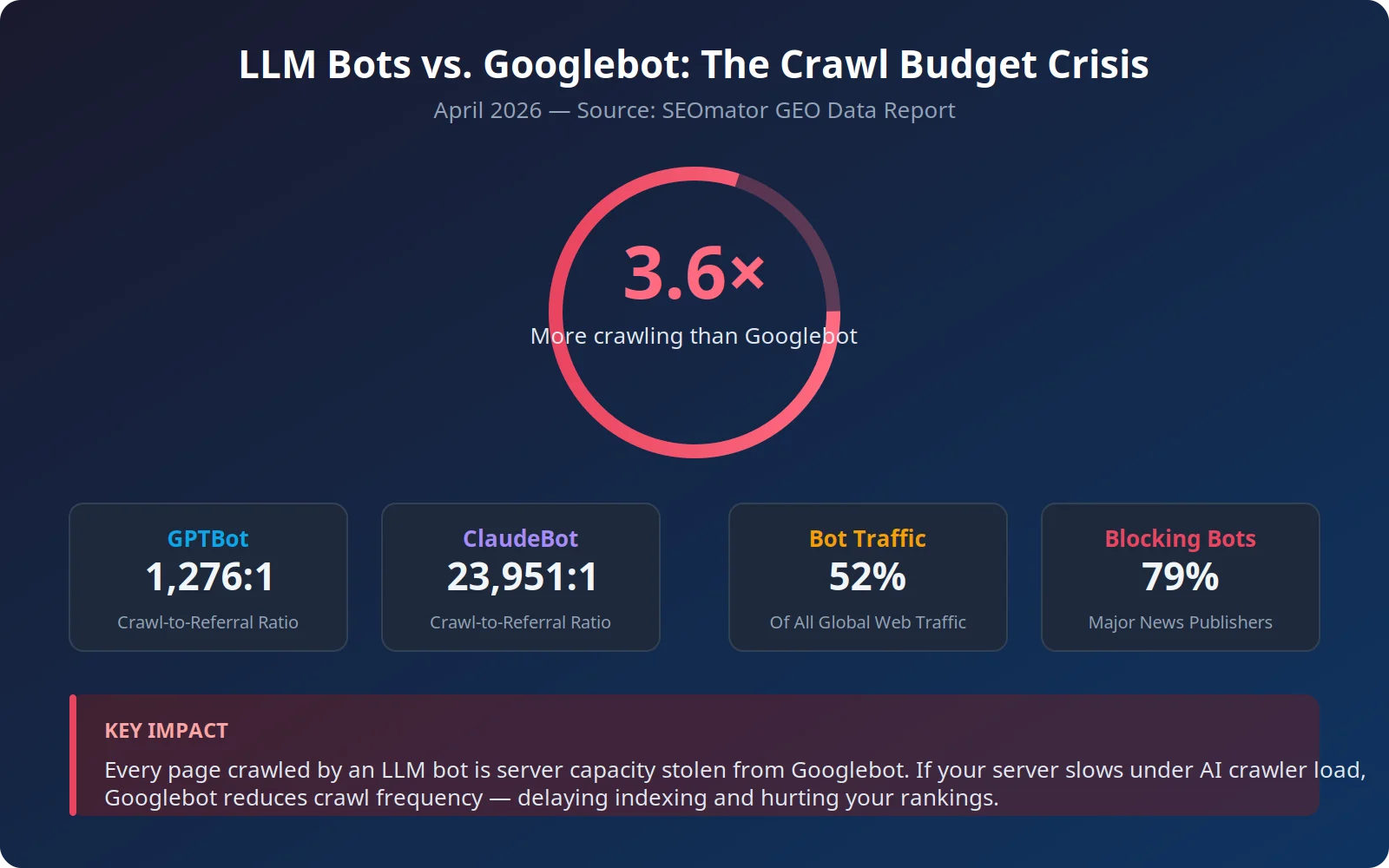
Claims that AI bots universally out-crawl Googlebot erase differences between networks and samples. In Vercel's crawler analysis, GPTBot generated 569 million requests and Claude 370 million in the reported monthly window, compared with Googlebot's 4.5 billion. Those are observations on Vercel's network, rather than a census of the web or an estimate for this site's infrastructure.
A separate Alli AI-authored sponsored analysis reported ChatGPT-User making 3.6 times as many requests as Googlebot in its sample. The stated dataset comprised 24,411,048 proxy requests across 69 customer websites between January 14 and March 9, 2026. That is a provider-specific observation. It cannot establish a universal ratio, and it should not be combined with Vercel's counts as if the networks and collection methods were identical.
The operational question is which requests consume resources on the property being reviewed. Group verified requests by agent and template, then inspect response codes, bytes and request frequency. A large count of parameter URLs or repeated errors can justify technical work even when the provider sends little human referral traffic.
Resource contention requires evidence of capacity pressure. A request from an AI bot does not automatically subtract a request from Google's crawl budget. If response latency or error rates increase during a request surge, inspect the affected endpoints and compare Googlebot responses for the same interval. That provides a basis for testing a mitigation.
OpenAI's crawler documentation distinguishes GPTBot for potential training use, OAI-SearchBot for search and ChatGPT-User for certain user-initiated actions. Search and training controls are independent. Apply an access policy to the intended agent rather than blocking all requests whose names suggest AI.
A crawler hit does not establish a citation or conversion. Keep a separate record of observed answers and identifiable referrals. A crawl-to-referral ratio can describe two aggregates, but it does not identify which crawl caused which visit.
JavaScript access and crawler identity
Vercel's study reported that the major AI crawlers it examined did not execute JavaScript, even when they fetched script files. The practical check is to inspect the initial HTML response for essential product details and links. Content visible only after a client-side interaction may be unavailable to a fetch-only reader.
Keep the study's scope attached to that finding. It does not prove that every current assistant or browser agent has the same rendering behavior. Compare the specific requester with the content it received, and validate its identity where the provider publishes verification information.
Neither a Markdown file nor a protocol label guarantees discovery. Google's AI features guidance says no special AI text files or additional schema are needed for its search features. Useful content must still be accessible and eligible under the documented search requirements. Evaluate a format change for an observed access problem rather than treating it as a ranking shortcut.
Seer's CTR findings and their limits
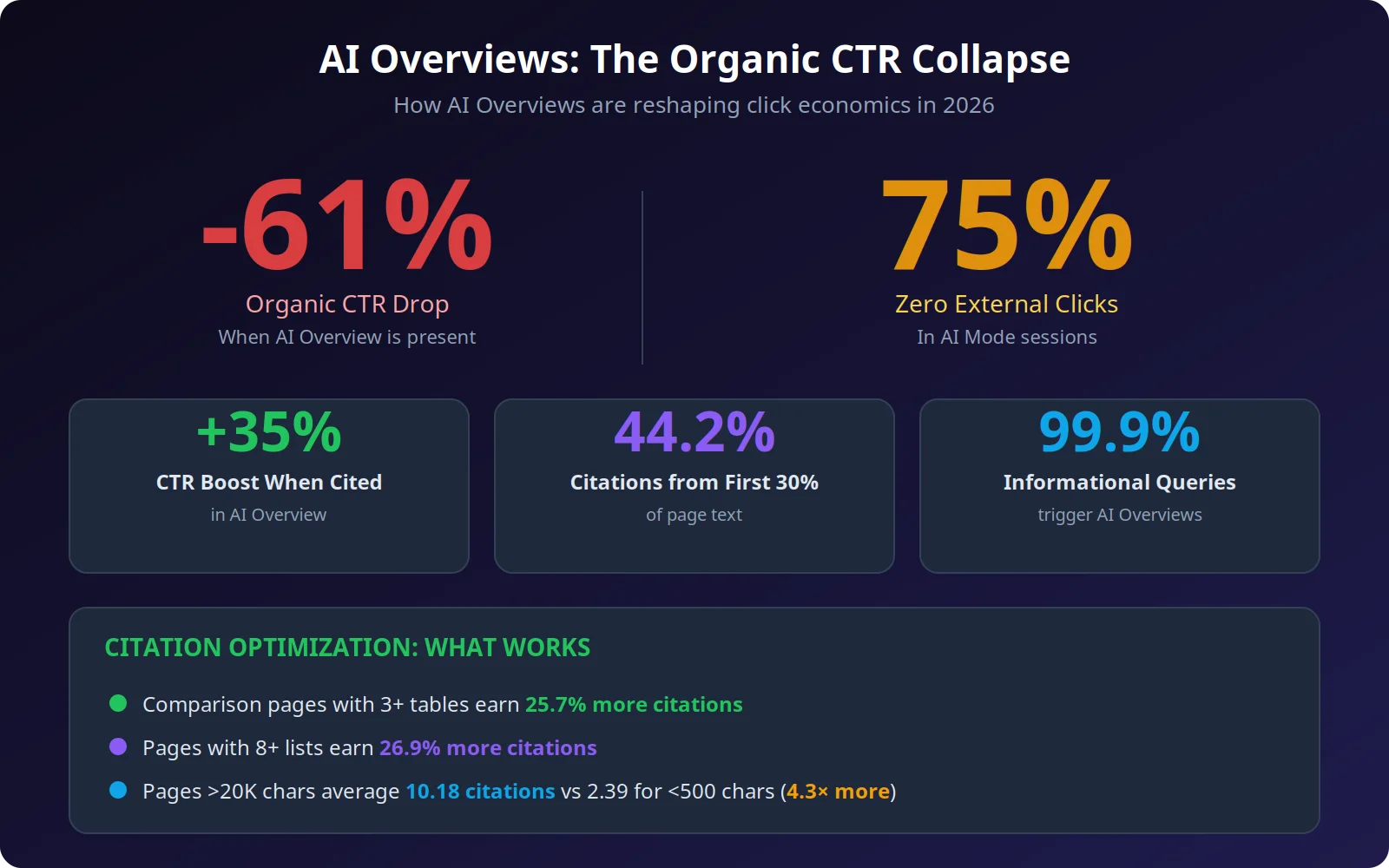
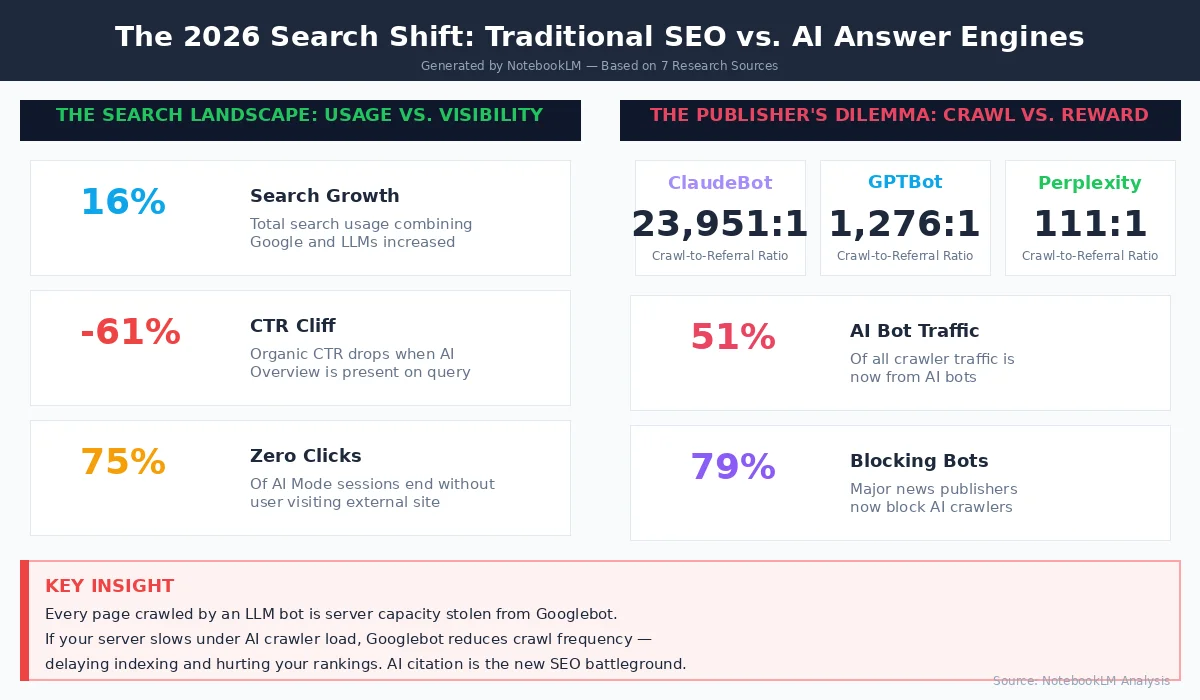
Seer Interactive's September 2025 analysis retained an important warning about informational search. It studied 3,119 informational and educational terms across 42 client organizations, covering June 2024 through September 2025. For its AIO-query series, the report described a 61% decline in organic CTR across that period.
That result is evidence from a defined panel, without a universal prediction that every page loses 61% when an Overview appears. The report also found declining CTR for queries without AI Overviews. Its design therefore does not isolate AI Overviews as the cause of every observed movement.
In Q3 2025, the cited-brand group had organic CTR of 0.70%, compared with 0.52% for the uncited group. Seer described this as a 35% relative advantage and explicitly warned that the comparison cannot prove citation causes higher CTR. Stronger brands may be more likely to receive both citations and clicks.
Use the study to justify inspecting the site's query cohorts and search appearances. It does not justify adding a fixed number of comparison tables or expanding every page to a character threshold. Publish the detail required to answer the query and verify its contribution. Formatting advice needs to serve the explanation rather than an unsupported citation formula.
Weekly and monthly views without losing the incident dates
Google announced weekly and monthly Search Console views in December 2025. They were not a new April 2026 launch. Aggregation helps reduce day-to-day variation when inspecting a longer trend, while the daily view helps locate a change around a dated event.
Use both views when an incident begins or ends inside a week. A monthly total can combine data with different reporting conditions. Aggregating those days does not repair the logging error or create a clean experiment. Retain daily exports and annotations so the underlying comparison remains auditable.
A staged investigation for the April changes
Begin with a preserved export and an event timeline. Mark the March spam update, the core update and the documented logging window. Add the site's own releases. Keep each event's source so a later reviewer can distinguish an official announcement from an internal deployment.
Then isolate the affected cohort. If clicks declined, compare the same pages and queries under consistent filters and examine their indexability and public responses. If the main change is in affected impression-derived metrics, qualify the comparison before using it to justify a rewrite.
Review crawler load in parallel only when server evidence warrants it. Test a narrowly scoped access or capacity change and retain the before-and-after response records. Avoid claiming Googlebot recovery merely because another bot's request count fell.
Content improvements should answer the problems found on the affected pages. More accurate evidence or a better explanation can justify an edit. An update date or a promise to recover within four weeks cannot. Keep a change log and evaluate the result in a defined subsequent window.
Reopen decisions that depended on affected metrics
Locate reports and work orders that used impression-derived metrics during the logging interval. Preserve the original chart and the decision it supported. Then ask which part remains evidenced by clicks, page observations or another valid source. A recommendation can remain sensible while its original justification needs correction.
For example, a hypothetical team may have rewritten a page after a reported CTR decline. The logging incident means the CTR evidence needs qualification. It does not prove the rewrite was harmful or unnecessary. Compare the page's actual information gap and later outcomes without using the affected series as an independent control.
Do not reconstruct every property's historical impressions with a single multiplier. The official incident does not supply a uniform correction factor. Keep the limitation in recurring reports so a later reviewer does not repeat the same inference from an unannotated export.
Verify resource contention before blaming crawler traffic
Use the property's logs to identify verified requesters, templates, status codes, response times and transferred bytes. Align those records with origin capacity and error observations. Distinguish cached requests from expensive origin work. A high count alone does not establish pressure on the infrastructure.
If latency or errors rise during a surge, inspect whether Googlebot requests were actually affected in that interval. Look for the same endpoint and response behavior rather than assuming every AI request displaced a Google request. A narrowly scoped mitigation can then be tested against useful content coverage and service quality.
Keep training and search-purpose decisions separate. A business may choose different access policies, but the evidence should identify the agent and expected effect. Falling request volume after a block is a verified response to that policy. It is not proof of recovered indexing or organic traffic.
Compare the crawler studies without pooling their totals
Vercel's network and the Alli provider sample differ in customers, collection and time. One can report Googlebot as larger while another reports a specific user-triggered agent exceeding it. The observations are not logically inconsistent, and they cannot be merged into a universal ratio by adding their requests.
Preserve the sponsored/provider-authored context of the Alli analysis. Retain its 69-site sample and request window alongside the 3.6-times result. For a business decision, reproduce the relevant classification on the actual property instead of assuming its request mix matches either network.
Use the Seer comparison to ask a site-specific question
The cited-versus-uncited CTR comparison is observational. Stronger brands or different query groups can affect both citation and clicks. Keep the 35% relative comparison attached to its cohorts and do not present it as an expected lift from acquiring a citation.
Select comparable informational queries and inspect actual result layouts where observations exist. Retain brand, market and device. Review ranking, demand and page changes as alternatives. A missing historical screenshot cannot be recreated by looking at today's results, so leave that feature state unknown.
A week-by-week investigation with separate completion checks
First preserve exports and official incident annotations. Then isolate click changes and verify affected pages. Next investigate server pressure only where the logs show a reason. Finally implement a bounded correction and repeat the relevant response or content test.
Each queue should have an owner, evidence and a later observation window. Technical completion means the intended response or task works. A performance conclusion requires its own subsequent data. Weekly or monthly aggregation can make a trend easier to read, but cannot repair an impression-logging error or establish recovery within a fixed number of weeks.
Questions about the April diagnosis
Why should the crawler studies remain separate?
Vercel and the Alli provider sample use different populations and windows. Preserve their methods and sponsorship context rather than pooling requests into a universal ratio.
What would support a resource-contention hypothesis?
Verified request patterns aligned with latency, errors and capacity pressure on affected endpoints. A high request count alone does not demonstrate displaced Googlebot crawling.
When did the March 2026 core update finish?
The official record gives April 8, 2026 at 06:00 US/Pacific. It began March 27 at 02:00. The announcement establishes the rollout window, without diagnosing an individual site's changes.
Which metrics did the impression error affect?
Google identifies impressions, CTR and average position for May 13, 2025 through April 27, 2026. Clicks were unaffected by that logging error.
Should every AI crawler be blocked?
No universal policy follows from request volume. Identify the agent's purpose and verify server pressure before choosing a scoped access rule. Search and training agents can have different controls.
Does citation guarantee higher organic CTR?
No. Seer's cited-brand cohort had higher CTR in its sample, but the study explicitly does not establish that citation caused that difference.
Do monthly reports correct the logging problem?
No. Aggregation changes the reporting interval. Preserve daily data and incident annotations when the comparison crosses the affected window.
About the Author