How to Audit Location Pages for Doorway Risk
Audit location pages by checking the user task, canonical attribution and local offer before choosing a treatment. Shared listings alone do not establish doorway abuse, and missing Search Console rows do not prove zero traffic.

A marketplace can show the same listing to people in neighboring cities without making either search useless. The difficult decision is whether those searches need separate indexable pages. Audit the destination each page provides before recommending fewer city URLs or another round of rewritten introductions.
John Mueller's November 24, 2026 Bluesky reply offers a useful starting point. He discussed the technical cost of duplicating inventory across locations, explicitly setting quality and spam aside. Google's current doorway policy supplies a separate test. Treating the exchange as a new official warning would overstate what he said and encourage changes without a diagnosis.
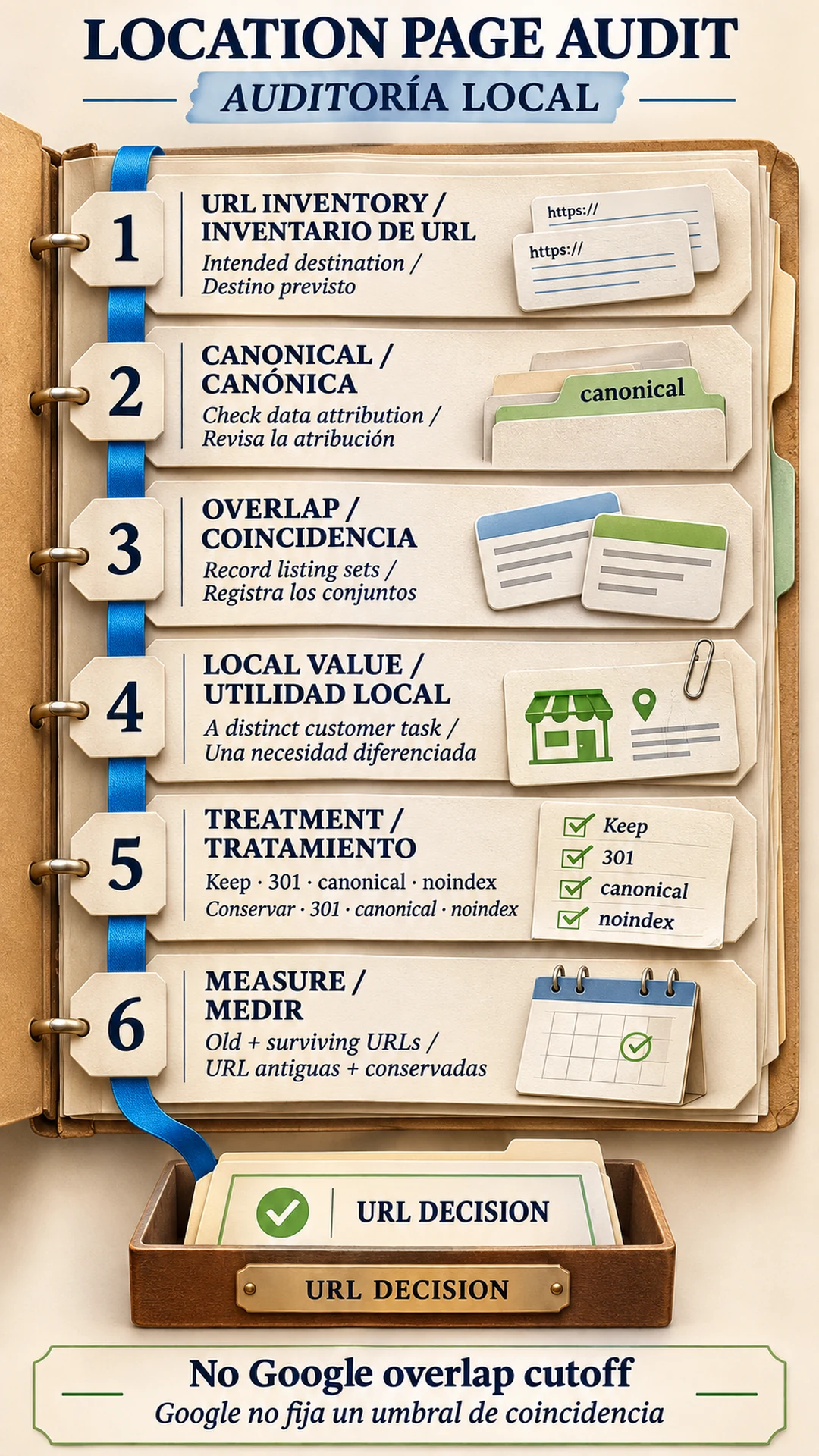
TLDR. Build a complete location-URL inventory, check where Search Console assigns canonical data, and compare the local task each page completes. Measure listing overlap as supporting evidence. Keep useful destinations and consolidate equivalents with a treatment that preserves the user's task. Duplicate listings, missing clicks and non-indexing labels cannot establish doorway abuse on their own.
Mueller's shared-inventory comment
Preston's November 23 question described a marketplace with geographic and offer-type landing pages that repeat listings. On November 24, 2026, Mueller replied on Bluesky:
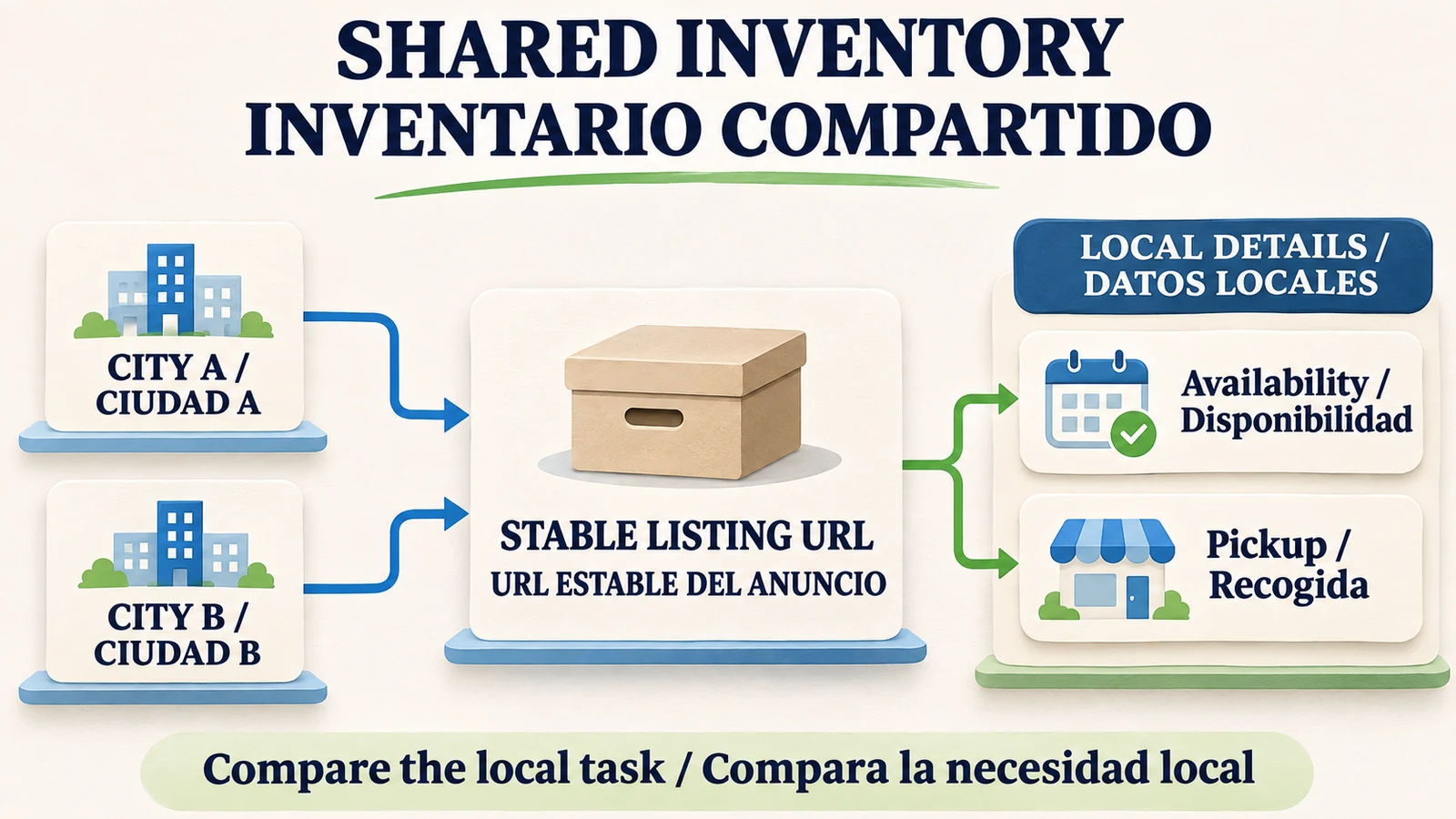
One model that I've seen work well is to have a shared inventory section, and just details per individual location. Duplicating all inventory × locations would be challenging to manage for Search, purely just from a technical POV, even ignoring quality or spam aspects.
This is a personal comment by Mueller, not Google Search Central documentation, a policy announcement or a verdict on Preston's site. He did not use the word “doorway.” His observation about a model he has seen work is his experience.
Barry Schwartz's November 25 Search Engine Roundtable report used the “Fewer Pages Better” framing and an Apple pickup-selector analogy. Those interpretations belong to SER. A shared product page with location selection is an option to evaluate, without becoming a requirement for every marketplace or service business.
Doorway abuse, duplication and crawl demand
Google's doorway abuse policy concerns pages created for similar searches that lead through intermediate destinations less useful than the final destination. Its examples include geographic pages that funnel visitors elsewhere and substantially similar pages outside a useful browsing hierarchy.
That makes the local promise worth testing. If a city page presents an unchanged inventory pool and customers must restart their search elsewhere to find availability, investigate its role. A common booking system alone cannot settle the question. Separate branch pages can provide useful local information while completing transactions through the same form.
Scaled content abuse addresses large amounts of unoriginal, low-value content produced primarily to manipulate rankings. Neither the URL count nor automation alone proves abuse. Google's SEO Starter Guide also states that duplicate content itself is not a spam-policy violation.
The technical cost deserves its own investigation. Unnecessary city and offer combinations can consume crawling resources. The crawl-budget guidance and faceted-navigation documentation explain that problem, especially for large or frequently changing inventories. They do not establish that Preston's site, or any site with repeated listings, is crawl-constrained.
A canonical-aware Search Console audit
I would start with the CMS or crawl inventory, using sitemaps to look for missing URLs. Before interpreting your Search Console data, I would separate physical branches from service areas and marketplace city filters so each page is assessed against the task it serves. Distinguish known URLs from intended indexable canonicals, and retain an unknown category when evidence is missing. A Search Console export cannot provide the complete inventory denominator. The index-bloat audit explains this first review.
For each URL, record the user task beside its HTTP response and indexing instruction. Add the declared canonical and Google's selected canonical where available. Note internal-link and sitemap membership so a later decision can be implemented consistently. This register is a proposed audit method, not an audit performed on Preston's marketplace.
Performance data for the page family
Choose a search type and date window before filtering the location family. Hold country and device filters consistent when comparing periods. Use page filters to identify the destinations, then examine the queries they serve. This illustrative RE2 pattern uses a placeholder domain and paths:
^https://www\.example\.com/(locations|cities)/
Replace both with the site's structure. Google's filter help documents partial matching and case-insensitivity by default. The initial anchor makes this example match the beginning of the URL. The Search Console regex guide covers syntax limits, including unsupported lookarounds and backreferences.
Separate pages with recorded clicks from those with impressions but no clicks. Keep explicit zeros distinct from absent rows. Search Console generally assigns performance to Google's canonical URL, so an alternate can appear inactive while another URL receives its data. Query privacy and truncated tables limit what exports can establish. Business outcomes require their own valid measurement.
Indexing reasons and selected canonicals
Use the Page indexing report to select representative URLs for inspection. Its examples are not an exhaustive crawl. “Alternate page with proper canonical tag” can be the expected outcome. A different Google-selected canonical warrants comparison with the intended destination.
“Crawled, currently not indexed” means Google crawled the page and did not index it. The label cannot diagnose doorway abuse. Investigate an important intended canonical using the indexing-status guide. Keep discovered-but-not-indexed pages separate, since they describe discovery without a recorded crawl.
Check Google's selected canonical in the indexed URL Inspection result. A successful live test checks current access conditions without establishing indexing or the eventual canonical choice.
Listing overlap with explicit denominators
Listing overlap can identify pages to compare, provided the comparison is reproducible. The following method is editorial analysis, not a Google spam metric. None of the reviewed documentation supplies an overlap percentage that defines a doorway.
Let A and B be stable listing-ID sets from comparable city and offer pages. Record capture times and use equivalent availability rules. Cover pagination, and distinguish the full eligible pool from the default results a customer sees. A first-page sample establishes overlap only for that sample.
Report the size of A and B, their shared IDs and their combined distinct IDs. Then calculate:
Jaccard overlap = |A ∩ B| / |A ∪ B|
A's shared proportion = |A ∩ B| / |A|
B's shared proportion = |A ∩ B| / |B|
The directional proportions matter when a small catchment is contained within a larger one. Record N/A for an empty denominator. An extraction failure is missing evidence, while an empty result set is an observation with its own cause to investigate. Changing stock and incomplete pagination must remain visible in the record.
Identical item IDs still leave the local decision unresolved. Ordering by distance, pickup eligibility or a location-specific service restriction can change which offer is useful. Compare those conditions alongside the sets. Compare text separately if the concern is boilerplate, because inventory overlap does not measure prose duplication.
Local detail and the customer's decision
A branch's opening hours can determine whether a customer can collect an item. Access instructions or branch-specific service limits can change the visit. These are useful differences because they affect an action, while a substituted city name adds little to an unchanged offer.
For a marketplace, assess local availability and distances against the promise of the landing page. A service-area page can explain travel boundaries or booking restrictions without inventing a storefront. Reviews and examples need attributable evidence relevant to the location or service they support.
These are editorial checks informed by people-first content guidance, rather than a required Google field list. Staff profiles belong where they help the local decision. Generic city history does not compensate for an inventory selection that ignores the city.
Applicable LocalBusiness structured data should describe the actual business and visible facts. Google's structured-data guidelines require accurate representation and do not guarantee rich-result display. Schema provides no exemption from doorway policy. The local SEO service page gives context for local visibility work.
Shared inventory and the treatment decision
Before adding another city page to your site, I would ask which local decision the shared destination leaves unresolved. I would first test whether a location selector with accurate local details resolves that gap. Keep a separate indexable branch or city page when it supports a distinct task, and inspect whether the selector creates unnecessary crawlable permutations.
Preston's follow-up concerned a storage listing relevant to Pasadena and Glendale and near-identical city pages. Mueller did not answer in the captured thread. Editorial options include keeping a stable listing URL discoverable from several useful city routes, or consolidating equivalent landing pages while preserving location choice. The exchange establishes no rule assigning every listing to only one city.
Choose the technical mechanism after deciding the desired destination and access:
| Intended behavior | Treatment | Important limit |
|---|---|---|
| A distinct local destination remains useful. | Keep and improve the page. | Accurate local value matters. Distinct content alone does not guarantee ranking. |
| A retired URL has an equivalent replacement. | Permanent server-side 301 or 308. | Move visitors to the relevant task, avoiding a blanket homepage redirect. |
| Duplicate or very similar URLs remain accessible. | rel=canonical with consistent link and sitemap signals. | Google can choose another canonical. Visitors stay on the opened URL and crawling does not immediately stop. |
| A functional page should remain outside Search. | noindex, with crawling allowed. | Google must see the instruction. This is neither canonical consolidation nor crawl prevention. |
| A page is removed without a relevant replacement. | 404 or 410, after assessing improvement. | Removal and consolidation are different decisions. |
Google's documentation explains permanent redirects, canonical signals and noindex. Canonicalization expresses a preference among equivalents. It should not combine substantively different local offers simply because their listings overlap, and Google advises against using noindex merely to select between same-site canonicals.
Robots.txt addresses crawling. Blocking an existing URL can prevent Google seeing a new noindex or canonical instruction, so plan the sequence before applying controls. For future unwanted combinations, review URL generation and internal links as part of the architecture. No treatment guarantees improved rankings.
Core-update timing and measurement
The official dashboard records the November 2026 core update as completed on November 24. Google preannounced the December update on November 24, scheduled for December. That notice is not a rollout-start confirmation. It gives no location-page target or exact release date.
Google's core-update guidance recommends waiting at least a full week after completion before assessing changes, then comparing with a week before the rollout. Avoid speculative mass consolidation to meet an assumed deadline. This guidance does not impose a blanket freeze on correcting a verified defect. The migration timing discussion explains the difficulty of attributing changes when releases overlap ranking updates.
Before implementation, preserve the URL and canonical baseline. Record each change date and the update milestones separately. Follow old and surviving URL families together so canonical reattribution does not become an apparent traffic loss. Compare the search tasks represented by queries, then add business outcomes only where measurement exists. Server evidence can help assess crawling if access is available.
Changing inventory and seasonal demand remain alternative explanations, along with other releases. If the November assessment overlaps December's eventual rollout, retain that uncertainty. A lower indexed-page count can be the intended consolidation outcome, but success depends on the useful destinations and customer journeys that remain. The sources provide no recovery deadline.
Frequently asked questions
Are all city pages doorway pages?
No. Assess the purpose and usefulness of each destination against Google's current policy. A shared booking form or repeated listing alone cannot establish doorway abuse.
Must a listing appear in only one city?
The captured Mueller reply establishes no such rule. His response to Preston's follow-up is absent from that thread snapshot. Several useful routes to one stable listing URL are an editorial option to investigate.
Should location pages with no clicks be deleted?
Check canonical attribution and the measurement window first. Keep explicitly recorded zeros separate from missing rows. Search Console does not measure every business outcome, so no clicks alone cannot justify deletion.
Is canonicalization the same as noindex?
Canonicalization expresses a preferred URL among duplicate or very similar pages. Noindex excludes a page from Search after Google processes the instruction. A permanent redirect also moves visitors, so these treatments serve different intended behavior.
Does LocalBusiness schema prevent doorway risk?
No. Applicable markup must describe the actual visible business facts. It cannot supply missing local usefulness or exempt a page from Google's spam policies.
Has the December 2026 core update started?
The November 24 dashboard notice preannounces a December release, without confirming a rollout start. Check the current incident before making timing decisions. No location-page enforcement target is established by that notice.
About the Author