Why New Articles Don't Show Up in Google Discover
New articles can be eligible for Discover without being selected. Check access, Search indexing, preview readiness and reporting limits. The first hours are an editorial review window, with no documented Google deadline.
A Google job post describes newly ingested documents expiring before they accumulate enough engagement evidence to demonstrate their quality. For an editor watching a new article receive no visible Discover traffic, that sounds like an explanation. It is an engineering clue with limits, and treating it as a deadline would lead to the wrong work.
A blocked URL or misleading preview deserves attention. An indexed article with no visible Discover row needs a more careful interpretation, because eligibility, recommendation and reporting are separate observations. I would start with the defects a publisher can verify before treating early Discover silence as an engagement problem.
TLDR. Check access and Search indexing, then review the image and the headline's promise. Use the first hours as an editorial review window, without inventing a Google qualification deadline. A job post supports a cold-start hypothesis, while Google's publisher documentation defines the checks. External referral traffic has no documented causal route into Discover in the reviewed evidence.
Google's Discover job post and the cold-start hypothesis
The Google Careers post Senior Software Engineer, Discover Feed Recommendations, reported by Barry Schwartz on November 22, includes this wording:
Because core retrieval and ranking rely heavily on historical engagement, newly ingested documents remain unindexed and expire before reaching the signal thresholds needed to show their quality.
This is Google recruitment copy, rather than publisher documentation. A cached capture of the original job listing corroborated the sentence during November 23 research. The clean URL no longer returned the opening, so the capture does not establish that the job remains live. Its original publication date was not established.
The surrounding paragraph also describes an exploration system already built to address the bottleneck, including cold-start retrieval and lifecycle controls. Omitting that context would make the post sound like a universal exclusion of new articles, even though it describes work to overcome the problem.
StarSearch and zero-history discovery appear in the recruitment text. Damien Andell's suggestion that StarSearch concerns very-low-traffic content remains his interpretation, as reported by Schwartz. It should not become a confirmed Google explanation through repetition.
A new document having little historical evidence is a plausible reason a recommendation system might need exploration. That is the cold-start hypothesis supported by this description. The wording supplies no numeric engagement threshold, expiry duration or list of publisher actions. It also does not map unindexed to Google's Search index or a Search Console status. Investigate Crawled, currently not indexed as a separate Search finding.
Search indexing, Discover eligibility and report visibility
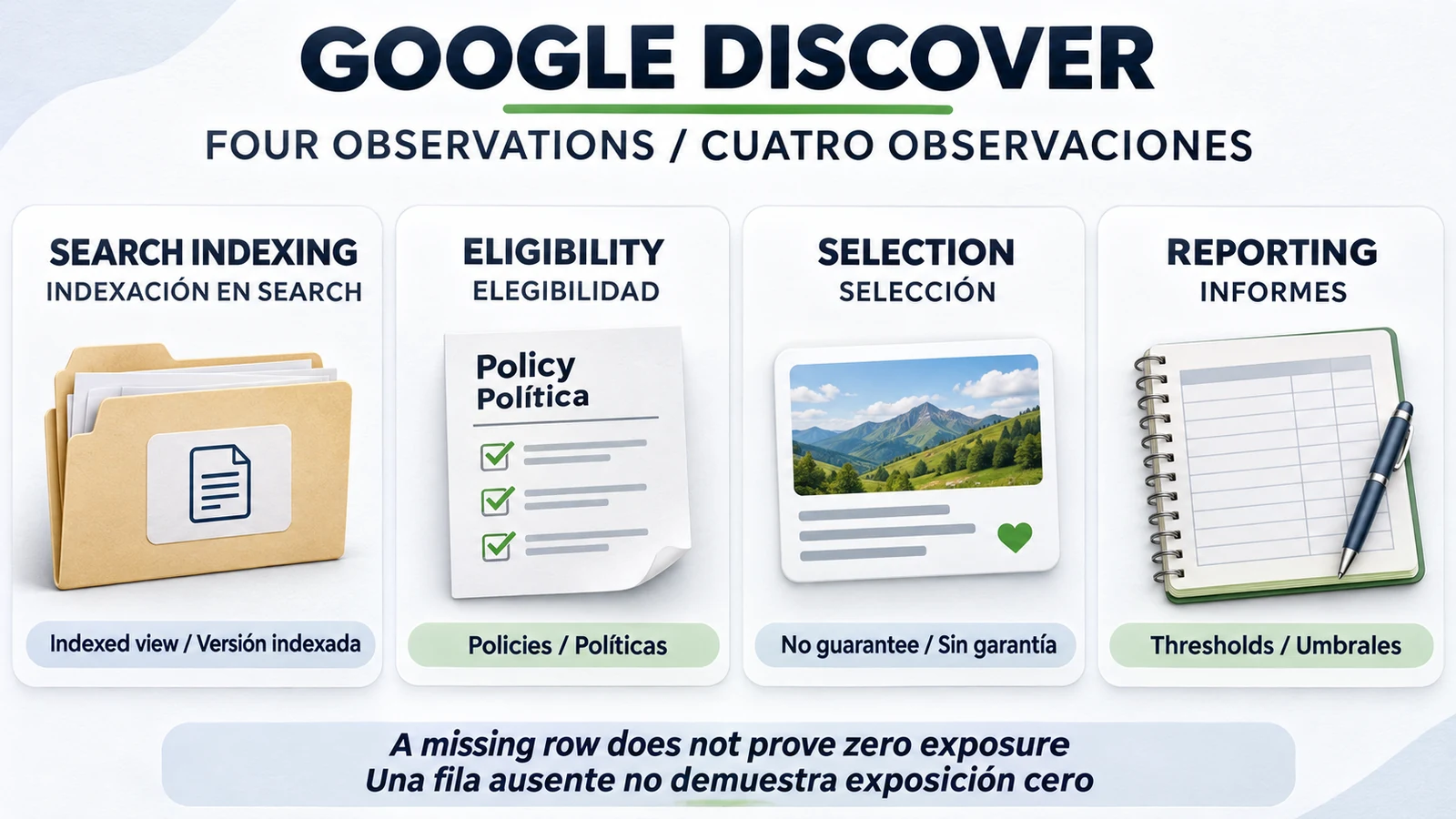
Google's Discover guidance says indexed content that meets Discover policies is automatically eligible. Appearance is not guaranteed. No special tags or structured data are required, and relevant older content can appear.
That leaves a gap between eligibility and an actual recommendation. Discover responds to a reader's interests, so a page meeting the baseline is not promised an audience. Reporting introduces another limit because Search Console may not display every observation.
| Layer | Evidence to examine | Limit on the conclusion |
|---|---|---|
| Access and Search indexing | Public response, indexing directives and indexed URL Inspection information | A working live page does not prove inclusion in the index. |
| Discover eligibility | Search indexing and Discover policy compliance | Eligibility does not guarantee selection. |
| Discover selection | Observed Discover performance, when available | An absent row cannot explain a recommendation decision. |
| Reporting visibility | Canonical URL, date view, filters and impression thresholds | Missing report data cannot prove zero exposure or expiry. |
First-hours checks for a newly published article
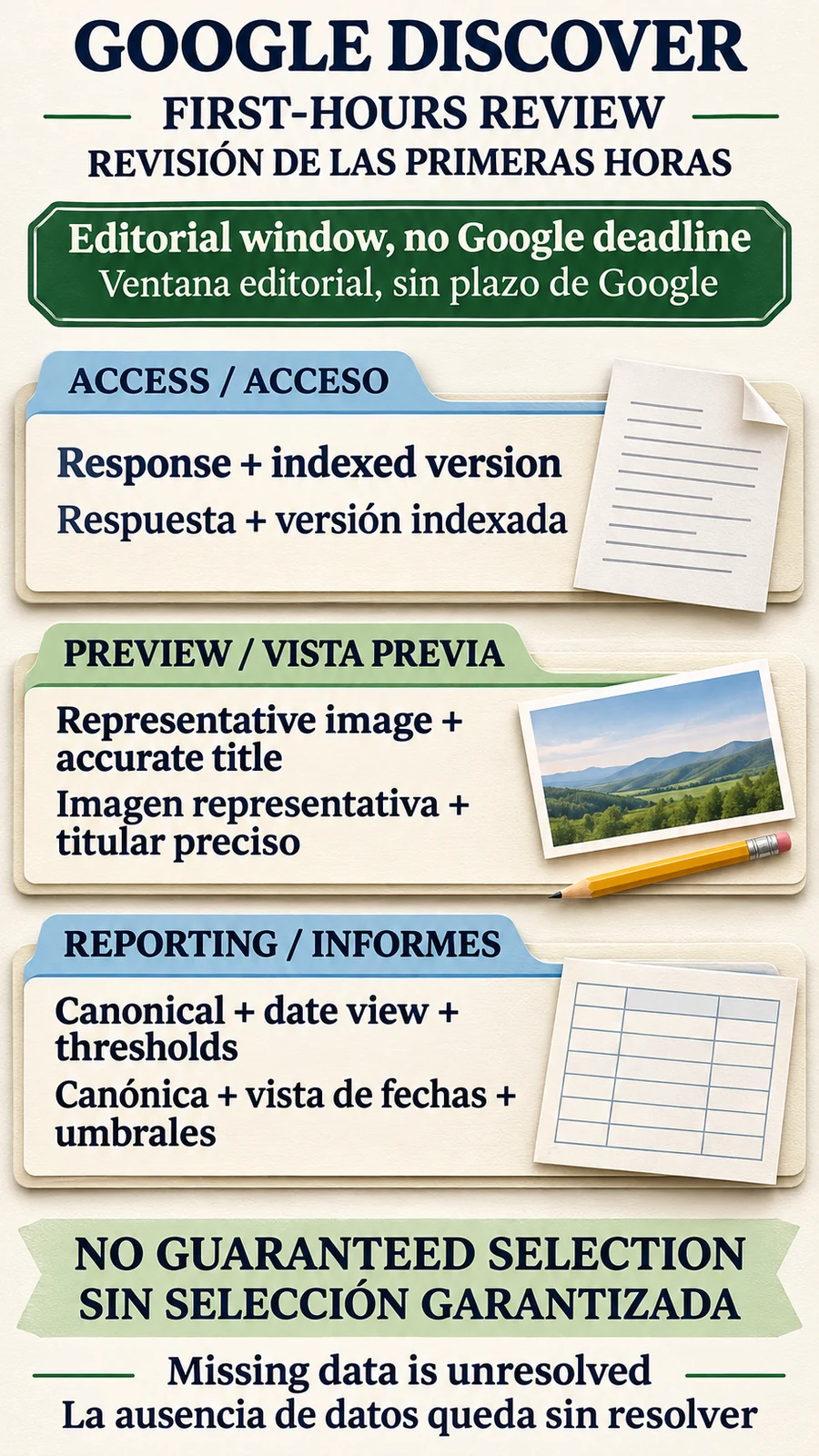
The first-hours review is an editorial workflow, not a Google deadline. Its purpose is to find a release defect while the team can act on it. Keep a result and timestamp for each check rather than turning every healthy result into a Discover prediction.
Access and the indexed version
Fetch the exact URL and confirm it returns the article. Google's Search technical requirements include Googlebot access, HTTP 200 and indexable content. A login wall or an erroneous response supplies a concrete issue to investigate before discussing recommendation signals.
Then examine URL Inspection. The indexed view concerns Google's last indexed version. A live test checks current access and indexability conditions, with limits. Passing that test does not prove indexing or predict the canonical Google will select.
Save those findings separately. If a page is working now but the stored information reflects an earlier version, the observations can both be accurate. Neither view explains why Discover did or did not recommend that URL.
Discovery routes and crawl requests
Check that the article has a crawlable internal link and is included in the intended sitemap. This is an operational discovery review, without a promise of immediate crawling or indexing. A successful fetch and an audience visit also answer different questions.
Google's recrawl guidance supports requests through URL Inspection for individual managed URLs and sitemaps for larger sets. Repeated requests for the same URL do not speed crawling. The general guidance allows days to weeks and does not guarantee inclusion. That range concerns crawling, rather than an article's Discover lifetime.
The image file and preview permission
Inspect the actual image and its crop. Google's Discover recommendations include images at least 1,200 pixels wide, with more than 300,000 pixels overall and a 16:9 aspect ratio. Enable large previews through max-image-preview:large or AMP. A large source file cannot compensate for a crop that hides the subject.
The robots preview specification defines a permission. Allowing large previews does not force Google to use one. Review the returned HTML and applicable HTTP headers for restrictions, rather than relying solely on a CMS setting.
Google's image guidance supports preferred-image hints such as og:image and schema metadata while retaining automated selection. Use a representative, high-resolution image. Generic logos and text-heavy previews are discouraged, so a large headline card is not automatically the best candidate just because its dimensions pass.
Original photography is an editorial choice when it adds information to the story. The guidance does not make every reused photograph ineligible. A small image is worth fixing for large-preview readiness, without treating it as proof of the entire traffic outcome.
Headline, contribution and publisher details
Compare the title with the passage that delivers its promise. If the headline suggests a new finding, a reader should be able to identify that finding in the body. Replacing an accurate title with a more sensational one introduces a reader problem while leaving the selection question unanswered.
People-first content guidance asks about original analysis and added value beyond rewriting sources. For an article explaining a new Google statement, the contribution can be a useful distinction or a supported diagnostic method. Producing more summaries does not supply the missing value in this page.
Discover content policies also require nonmisleading previews. News sources should make authorship and dates clear, with publisher identity and contact information available. Review sponsored-content transparency and the balance of promotional material. Check actual policy evidence before assuming a penalty. The absence of a manual action does not establish selection.
Audience distribution without an invented Discover trigger
Send the article to subscribers when it serves them. A timely newsletter or social post can deliver the work directly to an existing audience. This recommendation concerns audience value, rather than a documented Discover mechanism.
The reviewed evidence does not establish that those referral clicks trigger Discover selection. It supplies no external-traffic quota to reach before an article expires. If newsletter visits rise and Discover later increases, the sequence alone cannot establish causation.
Keep the channel and send time beside measured referral results. Record Discover performance separately. That preserves the value of distribution without turning a useful editorial action into an unverified ranking instruction.
Discover measurement in Search Console
I would keep a missing Discover row marked unresolved until the canonical and reporting limits have been checked. The Discover performance documentation gives minimum impression thresholds for the property's report visibility and for displayed rows. It does not give numeric threshold values. Data below row thresholds can still contribute to totals.
Check the canonical URL before deciding the article is missing. Discover clicks and impressions are credited to that URL, which can differ from the address being filtered. Preserve the property and filter state with the observation. The same measurement discipline helps explain Search Console and GA4 differences without treating one system as a complete substitute for the other.
The 24-hour view includes preliminary hourly data by default and uses the browser's local time. Other date views default to complete days and use Pacific Time. Today's figures, and sometimes yesterday's, may change. Comparing a local-hour window with a Pacific-Time day can create an apparent mismatch before any editorial change has occurred.
Visible tables are limited to 1,000 rows, so their sum can differ from chart totals. Weekly or monthly grouping can help smooth daily movement. Save a comparable baseline before assigning a cause to a spike or decline. Google describes Discover traffic as supplemental and variable, which makes a single day's movement a weak basis for a new publishing strategy.
Editorial changes after the checks
Google's February 2026 Discover update announcement emphasized local relevance and original, timely, in-depth work from sites with topic expertise. It also aimed to reduce sensationalism. The announcement's initial scope was English-language users in the US, with wider expansion planned. That document alone does not verify later global rollout or diagnose a November article.
Use the findings to choose an edit. Repair access when the response is wrong. Improve the image when it fails the preview review. Develop the reporting when the headline promises more than the story delivers. These changes have a reason that can be assessed even if Discover traffic never arrives.
Avoid repeated submissions and unsupported engagement deadlines. Mass-publishing thin pieces can reduce the attention given to each article without resolving the original problem. If the release review finds no defect, record that result and leave the selection question unresolved. The next review can then compare evidence instead of inheriting a speculative diagnosis.
Frequently asked questions
Can an indexed article receive no Discover traffic?
Yes. Google-indexed content that meets Discover policies is eligible, but appearance is not guaranteed. Missing Search Console data also needs to be interpreted within reporting thresholds.
Does the job listing define a deadline for new articles?
No. It describes a historical-engagement bottleneck and an exploration system built to address it. It gives no expiry duration or publisher qualification window. The first-hours review is an editorial workflow.
Does Discover require social or newsletter clicks?
The reviewed official guidance gives no external-traffic quota. Distribution can reach subscribers directly, without establishing that referral clicks cause Discover selection.
Does a live URL Inspection pass prove indexing?
No. A live test checks current access and indexability conditions. Review the indexed information separately. Neither result explains a particular Discover recommendation decision.
What image size does Google recommend for Discover?
Google recommends at least 1,200 pixels of width, more than 300,000 pixels overall and a 16:9 aspect ratio. Enable large previews through max-image-preview:large or AMP. These checks do not guarantee selection.
Can a missing Discover row prove zero exposure?
No. Report visibility and displayed rows depend on minimum impression thresholds, and metrics are credited to the canonical URL. Missing data cannot establish zero exposure or document expiry.
About the Author