Good SEO Is Good GEO for Google. Measure Assistants Separately.
Google says foundational SEO serves its AI Search features. Keep that shared work, then measure ChatGPT and Perplexity separately. Google's AI impressions are a subset of Web totals.

Brendon Kraham's June 2026 Think with Google guidance gives an SEO lead a reason to keep the existing roadmap funded. Google's generative search features use its existing index and core ranking and quality systems. The statement supports continued investment in accessible pages and useful information, even as the way Google presents that information changes.
The qualification matters when a proposal extends the same promise to ChatGPT and Perplexity. Google's explanation cannot establish visibility in those assistants. Keep the shared SEO foundation, but require separate evidence for each provider before declaring the work sufficient or buying a duplicate content program.
A marketing director should be able to ask which buyer problem a proposed change solves and which observation will show what happened. A Google impression export answers a different question from a saved Perplexity response. Neither, by itself, proves an incremental sale.
TLDR. Good SEO remains the foundation for Google's AI Overviews and AI Mode. Shared foundations do not promise identical citations, including within Google. Keep Google Search reporting together with its AI-impression subset, then measure ChatGPT and Perplexity separately. Distinguish citations from identifiable referrals and business outcomes.
I agree with Google's advice for Google Search, but I would ask for separate ChatGPT and Perplexity evidence before calling an SEO program sufficient across assistants.
Google's guidance on SEO and GEO
Kraham's article makes a Google-specific case for foundational SEO. It is published guidance from Google, dated June 2026, rather than a new November announcement or an independent measurement of how every assistant selects sources. That scope makes the advice useful without asking it to explain another company's product.
For a team choosing between fixing inaccessible information and publishing a special bot-oriented page, Google's generative AI optimization guide supports the former priority. Start with information a person needs and make it available to Search. A new acronym does not remove an indexing problem or verify a product claim.
The shared foundation also has a limit inside Google. Its AI-feature documentation explains that AI Overviews and AI Mode can produce different responses and supporting links. Sharing systems therefore does not mean that a standard result list and both AI features will cite the same pages.
This distinction changes the acceptance criteria for an SEO task. A successful indexing check confirms a technical condition. A saved answer confirms what appeared under that observation's conditions. A ranking report supplies another view. Keep those artifacts available rather than using one as proof of all the others.
Shared SEO priorities before extra content production
For the next planning cycle, prioritize access to the pages that answer consequential buyer questions. Check that the intended page can be indexed and is eligible for a snippet. If the page's main explanation cannot be read, producing another summary elsewhere leaves the original access problem unresolved. The AI Overviews explanation distinguishes eligibility from observed inclusion.
Then inspect the explanation itself. Consider a hypothetical software buyer trying to establish whether a product is available in their country. A verified availability section resolves a purchase uncertainty. Another generic definition of the product category may add pages while leaving that uncertainty untouched. The same useful section can serve a conventional search visitor and someone arriving from an assistant.
Google's people-first content questions support original value beyond summarizing other sources. Apply that to evidence the business can verify. Have the product owner check the availability restriction, then put the limitation beside the relevant claim. The editorial reason to make that improvement exists before any later citation effect is measured.
Explicit business and author information also deserves review. Consistent names and a visible explanation of responsibility help a reader assess who is making the claim. Treat this as an editorial priority. The available sources do not measure entity clarity as a dominant citation factor or assign a percentage of visibility to it.
Controls deserve a purpose-specific check too. Google's generative AI inclusion control covers participation in its generative features. Include is the default without a parent setting, and child properties may inherit a parent's choice. Review the actual configuration when participation is in question, rather than prescribing an extra opt-in for every site. Passing that check cannot guarantee selection.
ChatGPT and Perplexity citation evidence
OpenAI describes query rewriting and web search in ChatGPT. Its crawler documentation distinguishes OAI-SearchBot, used for search discovery, from GPTBot, associated with potential training. A training decision and a search-discovery decision therefore need their own technical review.
Perplexity describes a search index in its product explanation and documents different roles for PerplexityBot and Perplexity-User. The latter concerns a user-triggered fetch. These descriptions justify checking the intended access path. They do not expose every search partner or ranking decision, and an allowed bot is insufficient evidence of a citation.
There is also observational support for preserving separate source lists. Khadija Zaman's Wellows citation study compares citation sets across assistants and Google AI features and observes differences between them. Its commercially skewed English sample covers January through June 2026, with one run per question and engine. This is the vendor's research, rather than an SEOFrancisco experiment or a comparison with Google's ordinary top-ten rankings.
Use that finding to justify checking each provider. It does not establish a universal overlap rate, explain why any particular page was selected or prove which optimization caused a change. Website-level agreement also cannot be substituted for page-level overlap. The budget decision needs none of those stronger claims.
A shared page may help several providers. Whether it appears in a particular answer remains an observation to collect. The ChatGPT search walkthrough and Perplexity walkthrough explain how to inspect visible sources without claiming access to the complete retrieval process.
Google AI impressions within Search reporting
I would keep Google's AI impressions inside the Google reporting group and give each assistant its own observation record.
Keep Google Search in a coherent reporting group, with AI visibility shown as a subset. Current Search Console help defines the dedicated Search report around AI Overviews and AI Mode impressions. Those impressions are included in Web performance data, so adding the dedicated total to the Web total would count included activity twice.
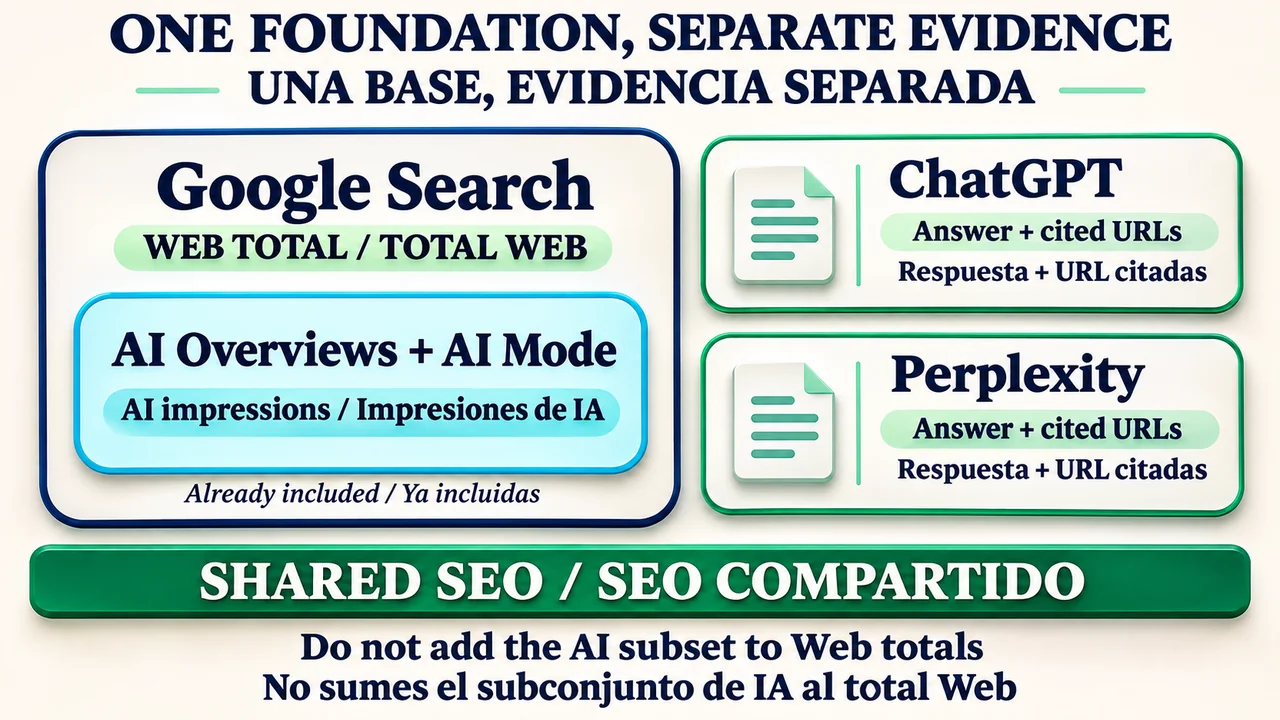
Use the AI view as an exposure baseline. The documented report does not provide a separate click, CTR, query or citation-position view, or split AI Overviews from AI Mode. Discover has a separate report. This prevents a convenient chart from becoming an unsupported AI-acquisition total.
Preserve the export conditions beside any comparison. Dates use Pacific time, and aggregation changes between property-level and URL-level views. A page table and an unfiltered property chart do not necessarily describe the same counting unit. The Google AI reporting guide develops these interpretation limits.
Google's current help records worldwide rollout on August 31, 2026. The June announcement's initial rollout language describes an earlier stage. Worldwide availability still does not establish a particular property's access. If the report is missing, inspect current help criteria, including impression volume and participation settings, rather than entering zero visibility in the report.
Annotate November 9-11, 2026 in comparisons. Google's data-anomaly record identifies an impression logging error in the Search generative AI report during that window. The incident establishes a reporting problem. It cannot establish an organic visibility loss or justify a content rewrite on its own.
Separate observations, referrals and explanations
For ChatGPT and Perplexity, keep separate response series using a stable set of buyer questions. Save the exact prompt and answer artifact. Record language and market, then retain account or search-mode conditions when known. Unknown conditions should remain explicit. A consumer-interface observation should not be silently combined with an API test.
| Reporting group | Evidence to preserve | Decision limit |
|---|---|---|
| Google Search overall | Comparable Web exports with dates and filters | Does not isolate AI-caused clicks or sales |
| Google AI visibility | Dedicated Search impressions within Web | Exposure subset, rather than an additive audience |
| ChatGPT | Dated answer and visible cited destinations | Does not reveal all retrieved candidates |
| Perplexity | Its own answer record and source checks | Does not establish ChatGPT's source selection |
| Website referrals | Observed source, landing page and defined events | Does not capture every unclicked AI exposure |
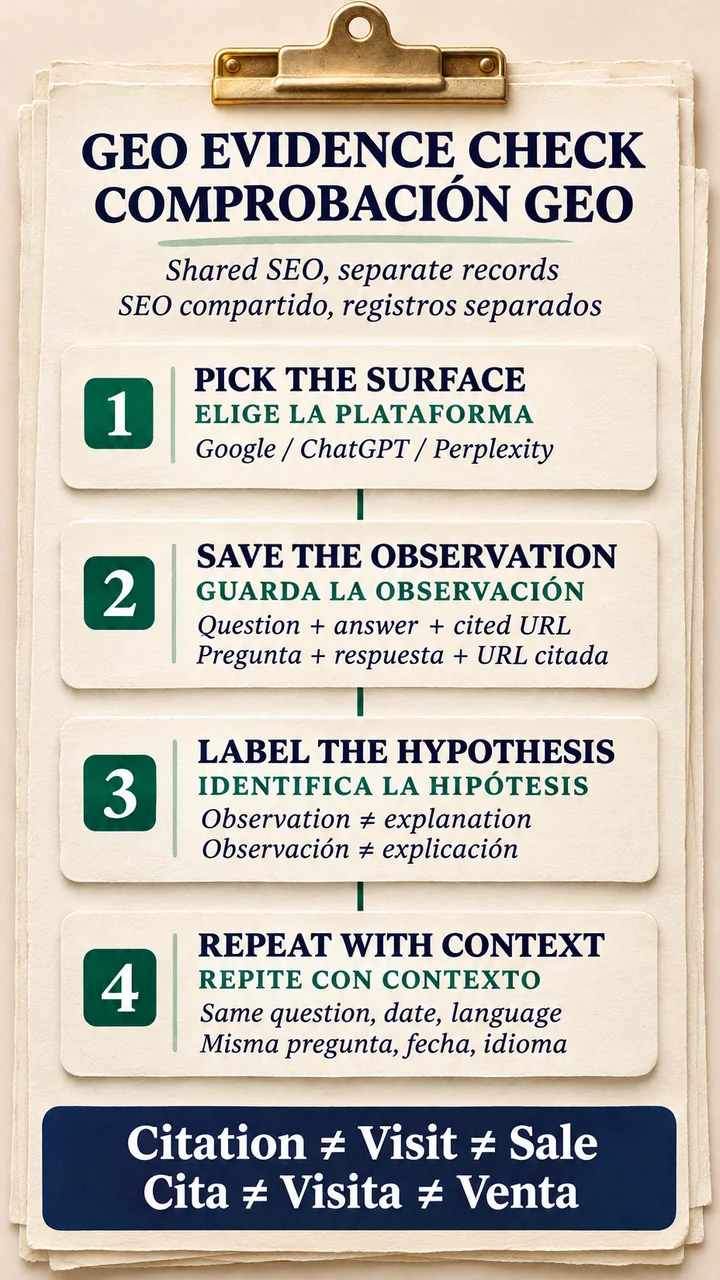
Retain answers without a citation too. If the panel changes, record the revision and preserve the earlier denominator. A selected collection of successful answers cannot support a claim about performance across the full question set.
A brand mention needs its own field. An assistant can name the product while citing an independent review. That is a mention with a third-party source, rather than an own-domain citation. Review whether the source supports the associated claim before counting the answer as useful representation.
The following record illustrates a proposed method, with no measured results. For the hypothetical availability question, the observation could be a saved answer citing a help page. An explanation that the product page omitted a country restriction would remain a hypothesis until the page and cited passage had been checked.
| Field | What belongs in it |
|---|---|
| Observation | Exact visible statement, cited URL and saved artifact |
| Interpretation | Possible explanation, explicitly labeled as a hypothesis |
| Next check | Product fact or access condition to verify |
| Repeat conditions | Same question, documented context and a dated follow-up |
Identifiable referrals supply evidence of visits where attribution survives. Keep actual referrer or campaign information, then evaluate agreed business events under consistent definitions. An unclicked citation is not a recorded session. A sale in a referral cohort does not isolate the incremental effect of a content edit. Do not fill the gap with an assumed conversion total.
For resourcing, the AEO and SEO scope comparison can help define the additional work. Provider-specific observation has a cost worth naming. It does not automatically require another writer producing a second page for the same buyer question.
Google's advice on bot-focused tactics
Kraham rejects bot-focused copy, keyword stuffing and artificial fragments. Search Central also says mandatory chunking and special AI files are unnecessary for Google Search. Remove those obligations from a Google brief when the justification is merely an undocumented preference of bots.
Useful structure remains worthwhile. A heading that tells a buyer where to find country restrictions helps them read the page. Breaking the explanation into isolated snippets can instead remove the conditions needed to understand it. Choose the structure around the reader's decision.
Google's position on LLMs.txt stops at its own Search guidance. It neither establishes a requirement nor demonstrates citation improvement in ChatGPT or Perplexity. The sources reviewed here establish no such benefit. Assess a file against a documented purpose before adding it to a retainer's required work.
For a shared SEO plan, approve the improvement when the buyer problem and supporting evidence are specific. For an assistant visibility claim, require the assistant's own observation. That gives the team a defensible reason to share the page work while keeping the reporting precise.
FAQ
Does good SEO guarantee a Google AI citation?
No. Google recommends shared SEO foundations for its AI features. Indexing and snippet eligibility do not guarantee display, and AI Overviews and AI Mode can show different supporting links.
Does Google's guidance apply to ChatGPT and Perplexity?
It describes Google Search. Useful content and technical access can serve a shared plan, but ChatGPT and Perplexity visibility needs separate observations and provider-specific access checks.
Should Google AI impressions be added to Web totals?
No. The dedicated Search AI impressions are included in Web performance data. Present them as a subset and preserve the same dates, filters and aggregation when comparing views.
Does LLMs.txt improve ChatGPT or Perplexity citations?
The sources reviewed here do not establish that benefit. Google's statement that special AI files are unnecessary for Search does not prove effectiveness in another assistant.
Is a brand mention the same as an own-domain citation?
No. An answer can name a brand while citing a third-party page. Record the mention and cited destination separately, then check whether the source supports the claim.
Does the November 9-11 reporting dip prove lost visibility?
No. Google's incident record describes a logging error affecting Search generative AI impressions on November 9-11, 2026. It is insufficient evidence of a visibility decline.
About the Author