AEO vs SEO: What the Work Includes, Through OpenAI's Hiring Brief
AEO shares technical access and useful buyer content with SEO. It adds tests of business representation in answers. Measure citations, referrals and business outcomes separately.
OpenAI's Growth Marketing Manager, B2B SEO & AEO vacancy puts technical SEO and paid adoption in the same remit. Between them are buyer research and content, with experiments in AI answers. For a marketing lead deciding what to hire, that combination is more useful than a proposal promising a higher citation count.
The budget should support one acquisition program with an explicit answer-search testing component. Keep technical access and buyer information funded, then require evidence for the additional work. A team reporting citations still needs to explain which buyer decision its work helps and what business activity can be measured afterward.
The public vacancy establishes the responsibilities OpenAI is advertising. It reveals neither an internal playbook nor achieved results. Reading it as a hiring brief helps define work without claiming access to the company's program.
TLDR. AEO means answer engine optimization. In a practical brief, it covers discoverable, accurate business information in answer experiences and tests of how that information appears. It overlaps with SEO through technical access and useful content. Record answer accuracy and citations separately from referrals, then evaluate business outcomes with their attribution limits intact.
The SEO and AEO responsibilities in the posting
The advertised technical remit includes crawling and indexing, with rendering and site architecture. Internal linking, structured data and migration readiness remain part of the job. AEO experimentation appears alongside this work, supported by product information and evidence. Nothing in that scope suggests retiring the technical SEO roadmap.
The content responsibility follows business buyers from a problem through evaluation. Measurement extends to workspace creation and activation, then paid conversion and revenue. The posting also calls for experiments and cohort analysis, while asking the marketer to distinguish observed results from hypotheses.
That last distinction deserves a place in any agency proposal or job description. If a brand is absent from a captured answer, the observation is its absence under those conditions. A claim that the product page caused the omission is a hypothesis requiring investigation. Treating the two as interchangeable makes the subsequent recommendation difficult to evaluate.
The role also depends on partners outside search marketing. An engineer can resolve a rendering defect. A product owner can verify a feature statement, while analytics staff can confirm that an activation event represents useful adoption. Budget for those dependencies. A search specialist cannot correct product evidence that nobody is willing to verify.
Shared SEO foundations and the additional AEO questions
In this context, AEO is a working label for improving discovery and accurate representation in answer experiences, then testing the evidence. SEO covers discoverability in search and the usefulness of the resulting journey. These scopes overlap, including within Google's own AI search features. The labels do not describe two independent systems with a clean boundary between them.
Google's AI-feature guidance says existing SEO practices apply to AI Overviews and AI Mode. A supporting page needs to be indexed and eligible for a search snippet. There are no additional technical requirements, special AI files or special schema needed for those features, and eligibility cannot guarantee display.
For a site with access defects, this makes the priority concrete. Verify that the intended page can be reached and its important information read. Check the canonical choice and useful internal routes. The AI Overviews explanation separates a page condition from the answer a reader observes, which prevents an eligibility check from becoming an invented visibility result.
| Work area | Shared work | Additional question for answer search |
|---|---|---|
| Technical access | Discoverable pages and readable content | Which provider's access conditions have been checked? |
| Buyer information | Accurate answers to purchase questions | Does the recorded response represent the product correctly? |
| Supporting evidence | Verifiable claims and useful sources | Which URL is cited, and does it support the claim? |
| Measurement | Qualified visits and agreed business events | What answer visibility was observed before any visit? |
Provider differences need preserving. OpenAI's publisher FAQ identifies OAI-SearchBot for search discovery. GPTBot concerns potential training, a separate purpose. Review the relevant controls before copying a crawler policy from another site. Google's Search guidance does not establish another provider's requirements.
A brand mention and a citation also need different labels. An answer can name the product while citing an independent article. That is a recorded mention with a third-party source, rather than a citation to the business's domain. Inspecting the source through the ChatGPT search walkthrough is a useful reader habit before deciding what the result demonstrates.
Buyer content across the purchase decision
The vacancy names use-case and industry pages, alongside comparison and evaluation content. Practical guides and customer stories are included too. That content set gives a hiring manager a better test of capability than asking for an arbitrary number of FAQ pages.
Consider a hypothetical appointment platform for service teams. A dispatcher investigating a scheduling problem needs a different page from a manager comparing branch permissions. The product is the same, but the uncertainty the page needs to resolve changes.
| Content type | Buyer decision | Evidence the brief should request |
|---|---|---|
| Use-case page | Can this solve the scheduling task? | A checked workflow with relevant constraints |
| Industry page | Does it fit this sector's requirements? | Specific requirements and verified product fit |
| Comparison or evaluation page | Which option suits the team? | Dated criteria, limitations and fair alternatives |
| Practical guide | Can the team carry out the task? | Reproducible steps using current product behavior |
| Customer story | Has a comparable organization benefited? | Permission, context and a method behind any result |
A comparison should acknowledge a requirement the product does not meet. A guide should state which configuration it demonstrates. If a customer result cannot be substantiated, explain the workflow without inventing a success story. Each choice makes the page more useful to the buyer before any answer engine selects it.
Industry pages need distinct information. Swapping sector names across a template gives the writer no evidence about the sector's actual constraints. Google's people-first content questions ask for original analysis and value beyond rewriting other pages. That supports a smaller, verified content set when product expertise is the publishing bottleneck.
For the appointment example, a claim that the product supports distributed teams is incomplete if the page never explains who can administer each branch. Resolve that omission with the product owner, then put the relevant limitation beside the feature statement. Treat any later effect on citations as a test outcome still to observe.
Structured data must represent visible content. Use appropriate markup to describe checked information, then validate its implementation. Hidden claims or invented reviews cannot repair weak product evidence. Valid markup also supplies no guarantee of a rich result or an AI citation.
AEO measurement from visibility to business outcomes
A useful report keeps several kinds of evidence available without adding them into a single success score. A captured mention answers a visibility question. A cited URL identifies a source. An identifiable referral records a visit, while a business event records activity under its own definition. None of those observations automatically establishes the next one.
For a prompt panel, retain the exact questions and the assistant or search surface used. Record the date and market, plus account or personalization conditions when relevant. Save responses with their cited URLs. Repeat a fixed panel under documented conditions so the comparison has a denominator, and disclose any change in the panel.
Define each rate before presenting it. Brand mention rate can mean responses naming the brand divided by all sampled responses. Own-domain citation rate can mean sampled responses linking to that domain divided by all sampled responses. Multiple links in one response should not silently inflate a response-based rate. Neither rate estimates the share of all buyers who encountered the brand.
Accuracy deserves a separate review. A response can cite the business and still misstate a feature. Record the claim and the source passage supporting or contradicting it. Counting that response as a visibility observation is reasonable, while treating it as a marketing success requires judgment about the error.
Provider reporting covers another population. The February 2026 Bing AI Performance public-preview announcement describes citation reporting across supported Microsoft experiences and selected integrations. Grounding-query data is sampled. The announcement warns that citation activity does not establish page placement or authority within an answer. Keep its totals separate from a manually selected question panel.
Google includes activity from its AI Search features within Search Console's Web performance data. Do not present that overall data as a clean report of AI-driven acquisition. OpenAI documents utm_source=chatgpt.com tagging for ChatGPT search referrals in its publisher FAQ. That helps identify visits where the measurement survives, without reconstructing every preceding discovery event.
The AI attribution guide explains the missing connections. Someone may learn about a product in an answer and return through a different channel. A rise in direct visits is insufficient evidence to assign those sessions to AI. Keep a buyer's declared discovery source separate from the technically observed session source when both are available.
For commercial reporting, agree what qualifies a visit before comparing channels. Use consistent activation and conversion definitions, with the same follow-up window. Show counts and denominators for small referral cohorts. A recorded sale in a cohort is useful evidence, although it does not isolate how much incremental revenue an AEO edit caused.
An observed-results and hypotheses report template
Prepare the evidence note before making the content change. The entries below are hypothetical examples for the appointment product, not measured results.
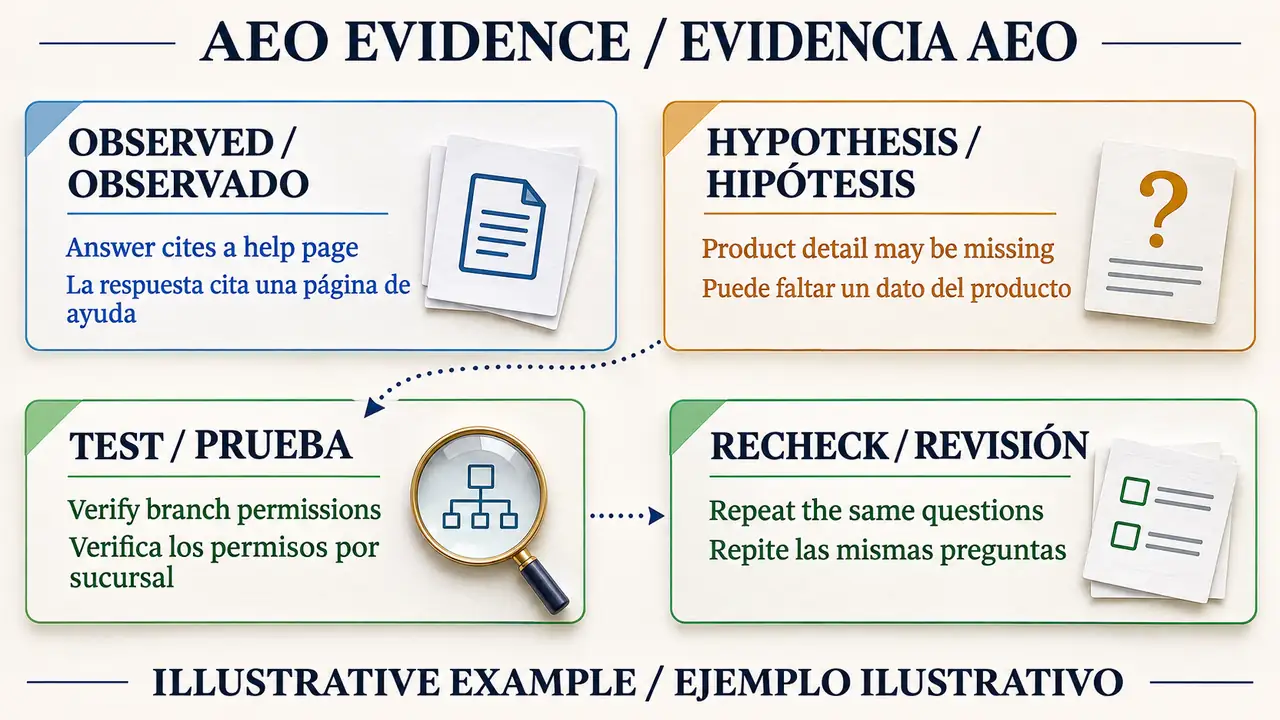
| Report field | Illustrative entry |
|---|---|
| Buyer decision | Evaluate branch-level scheduling permissions |
| Observed result | Saved answer cites a help page and omits the product name |
| Evidence | Exact prompt and response, date, surface, market, cited URL |
| Hypothesis | The product page does not explain branch permissions adequately |
| Planned change | Add a verified permission explanation and a useful help-page link |
| Comparison | Preserve baseline captures and record other changes in the period |
| Recheck | Repeat the fixed panel and inspect answer accuracy |
| Business measure | Qualified referrals and the agreed activation event |
| Unresolved limit | No controlled estimate of the edit's incremental effect |
The hypothesis proposes an explanation for the omission, but the captured answer cannot verify it. The query's wording or another source's coverage might explain the response. Even a useful page improvement can leave the next answer unchanged.
If citations rise after the edit, report the sequence and the sample definition. Save the changed page revision alongside the observation dates. Comparable unchanged pages can help inspect common movement, though they do not create random assignment. Model changes or a concurrent product launch can still affect the comparison.
This is the distinction worth requiring in a monthly report. It permits a team to recommend a next test without overstating the previous one. A null result can justify stopping an expensive rollout when the proposed mechanism has little support.
Priorities from zero observed AI presence
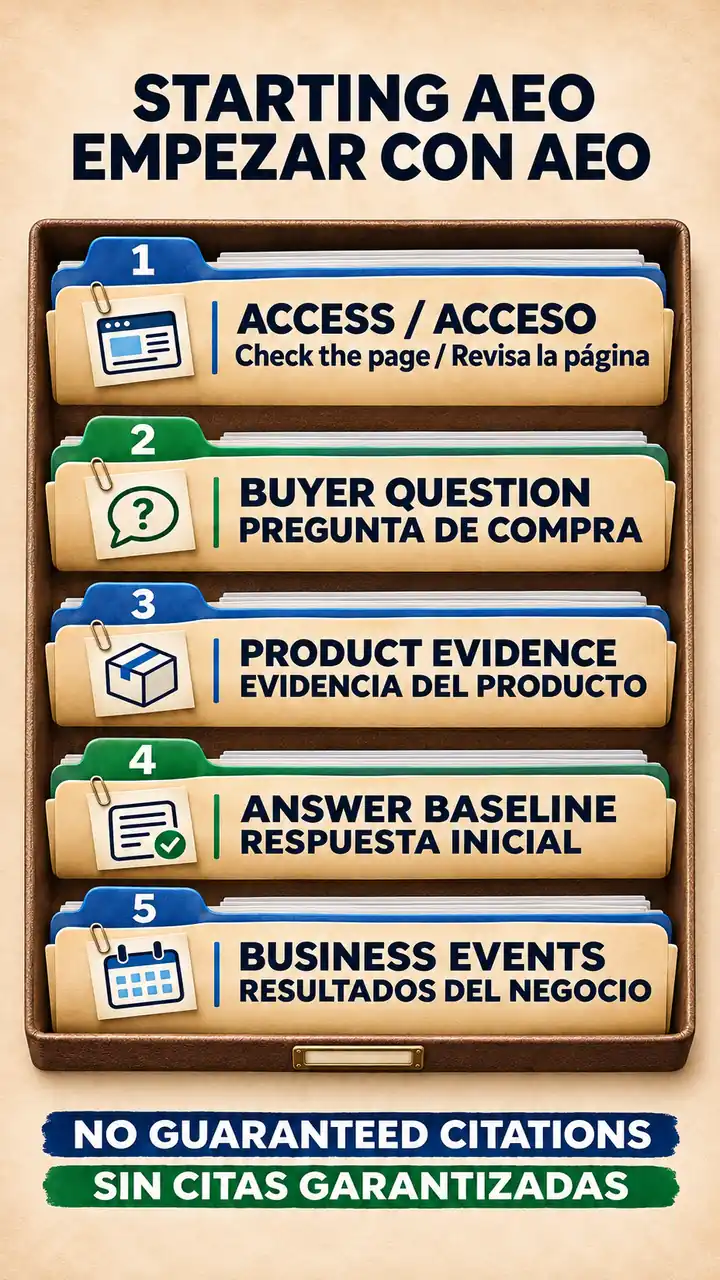
First define the zero. No citation in a selected question panel, no provider-reported citation and no identifiable AI referral describe different coverage. Write the source and period beside the finding. An unobserved brand in a small panel cannot be called absent from all AI answers.
When access is the demonstrated bottleneck, prioritize a technical SEO assessment before expanding content. For a reachable site with vague product information, choose one buyer question and improve the evidence on a relevant page. An existing page deserves consideration before a new URL, particularly if both would answer the same decision.
Establish the baseline before the change. Choose a question that matters to the business and that the product can answer honestly. Keep the initial experiment small enough to review its source evidence and downstream events. Scale after learning which work deserves the extra effort, including the possibility that another bottleneck needs attention first.
For hiring, request an access assessment and a prioritized content brief, followed by a documented experiment. Name the product-accuracy owner and the analytics partner. The AI SEO scope should explain how those deliverables inform a budget decision. The public posting supports asking for that connected remit, while providing no basis for promising a permanent citation position or a revenue lift.
Frequently asked questions
What is answer engine optimization?
AEO means answer engine optimization. In a practical marketing brief, it covers discoverable, accurate business information in answer experiences and tests of its representation. Inclusion remains controlled by each provider.
Does AEO replace SEO?
The advertised role combines technical SEO and AEO experiments. Google also keeps existing SEO requirements for its AI Search features. For hiring and budget decisions, define the shared work and the additional tests within one acquisition program.
Is special schema required for Google AI Overviews?
Google says no special schema is required for its AI features. Appropriate structured data should match visible content. A valid implementation guarantees neither display nor a citation.
Does a citation count measure customer acquisition?
A citation count describes source references within the report's coverage. Customer acquisition requires separate evidence of visits and agreed business events. Attribution gaps remain even when both reports are available.
What should a site with no AI visibility do first?
Define where and when visibility was checked. Investigate demonstrated access defects, then select a relevant buyer question and verify the product information available to answer it. Capture a baseline before testing a change.
Does the OpenAI vacancy prove an AEO tactic works?
The official posting establishes an advertised responsibility set. It provides no internal experiment or achieved growth result, and cannot establish that a particular tactic caused a citation or sale.
About the Author