How Google AI Mode Works, an Interactive Fan-Out Map
Explore Google AI Mode with an interactive map. Change a criterion, inspect related research questions and see why query fan-out needs scoped evidence.
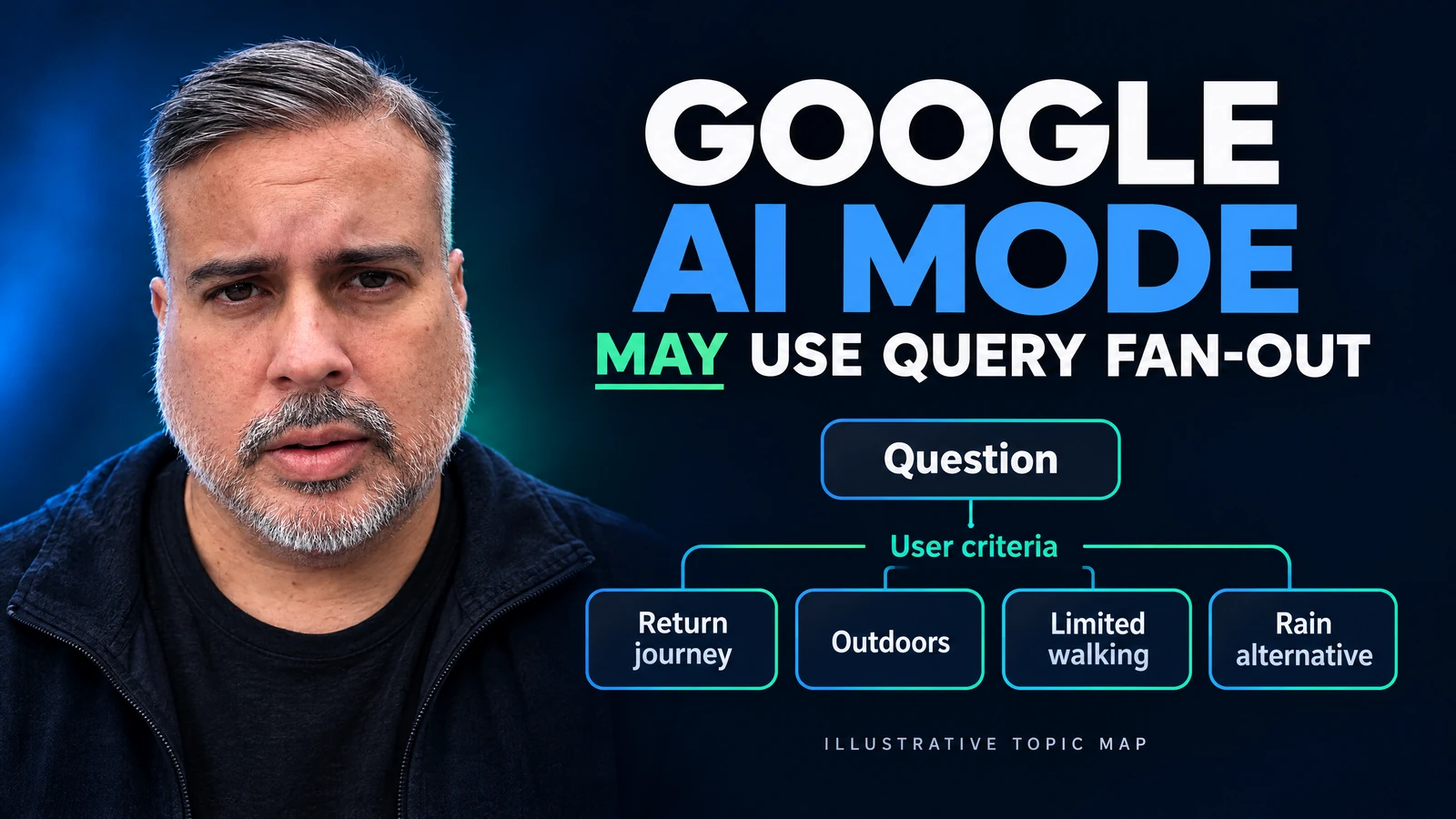
“What if it rains?” changes a hypothetical day trip from an outdoor idea into a plan with an extra evidence gap. A covered alternative would still need an applicable return journey and a walking requirement the visitor can manage. I would check those connections before treating either of our two concepts as a recommendation.
Google AI Mode helps explore a question with related requirements. The useful editorial question is which requirement a linked page can establish, especially after a follow-up changes the task. A pleasant activity description alone cannot settle the rest of the day.
TLDR Start with the requirements behind a request, then inspect the evidence each one needs. The interactive board connects four illustrative criteria with related questions and source types. Add a walking constraint or a rain follow-up to see what remains unresolved. Concept A and Concept B are possibilities to investigate, with no verified itinerary or winner.
One request with related questions
The starting brief asks for a return day trip by public transport with an outdoor activity. Choosing a destination would require more information than an attractive photograph or a general description of the region. The return part of the journey needs its own support.
AI Mode may use query fan-out, issuing related searches across subtopics and data sources. Its consumer Help describes responses with links and the ability to ask follow-ups. Those capabilities make the connection between requirements useful to examine.
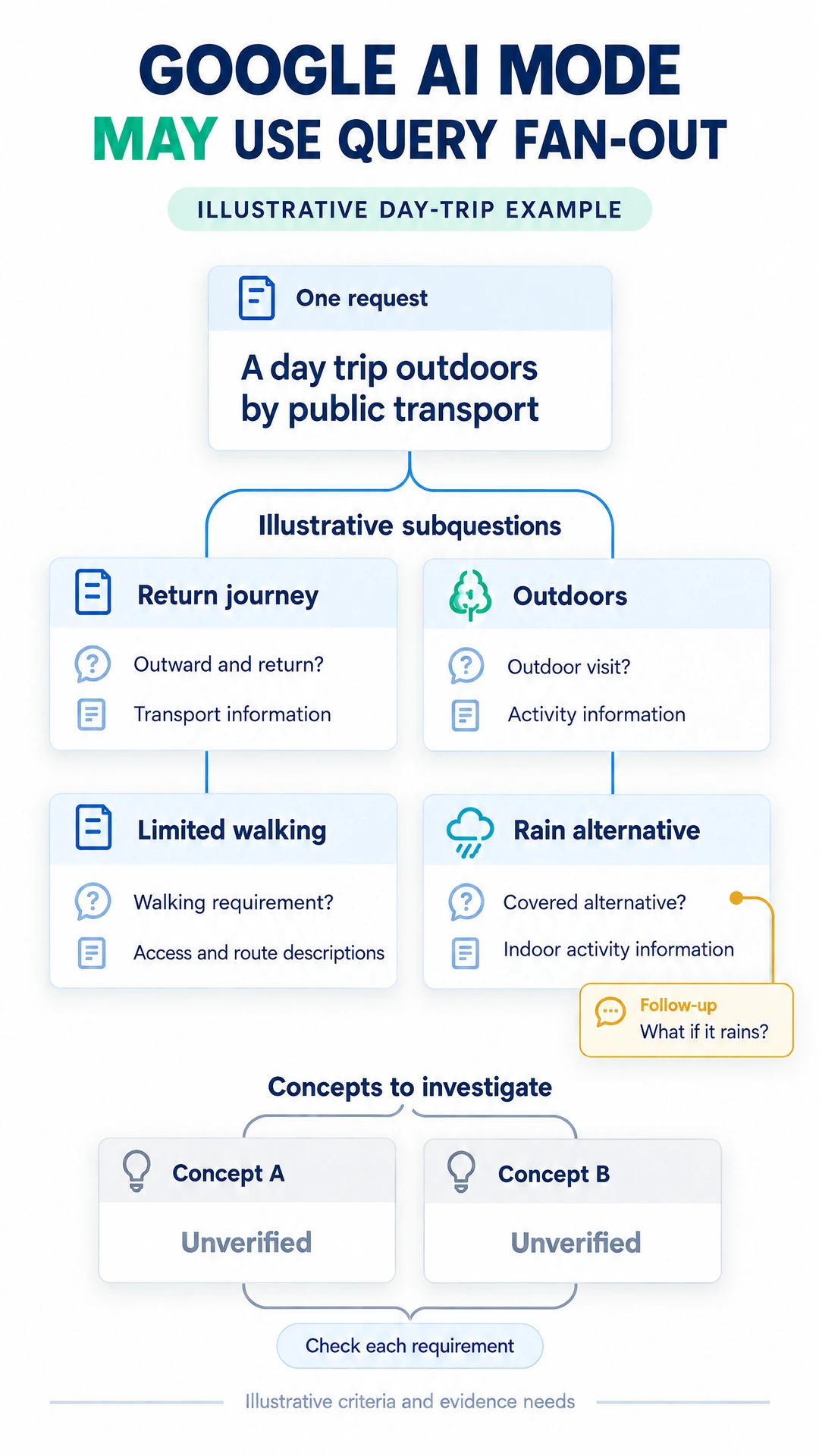
Select Return journey in the board. Its subquestion asks what would establish the outward and return journey for the intended day. Outdoors adds a different question about the activity. The spokes are our teaching examples, rather than actual Google query strings or a capture of its private execution order.
Concept A and Concept B have the same provisional status. Neither contains a verified transport route or a named attraction. Switching concepts provides another place to consider the evidence requirements, without pretending that one option is already better.
I would keep the transport question separate from the activity's description while evaluating either concept. A page could help explain an outdoor visit and leave the return service unresolved. That gap should remain visible in the recommendation rather than disappearing into a general statement that the trip is convenient.
A walking constraint in the brief
Add Limited walking to the starting selection. The research question now includes the connection between the transport arrival and the activity. The outdoor description cannot establish that connection on its own.
“Limited” also needs a meaning for the person making the trip. I would clarify the requirement before comparing a route description with it. The exercise supplies no numerical distance or walking time, so neither concept can be accepted or rejected from a made-up limit.
In an actual planning task, applicable access information could help with this question. The reader would need to check which part of the journey the description covers. A note about arriving at an activity may omit the return connection, or describe a different access point from the one under consideration.
The useful follow-on request is therefore specific to the gap. Ask what evidence establishes the walking needed between the transport leg and the activity. A second list of appealing destinations would leave that question unanswered. I would preserve any supported activity information and identify the additional evidence needed for the connection, rather than discard the whole investigation.
Our Gemini source-map exercise examines a related passage problem. Here, the new criterion changes the evidence needed for the request before a whole recommendation can be evaluated.
The rain follow-up
Choose Rain alternative after adding the walking condition. A covered suggestion introduces a new question about its relationship to the existing plan. Does the available evidence establish that the alternative also respects the transport and walking requirements?
The original outdoor idea remains the main activity being investigated. The follow-up adds a contingency, without supplying a weather forecast or establishing that an indoor option exists nearby. The board keeps both concepts provisional while displaying the new evidence need.
A useful illustrative follow-up could be “What covered alternative would still fit these transport and walking requirements if it rains?” Keeping the earlier conditions in the wording prevents the task from becoming a general request for indoor attractions.
The distinction between the walking change and the rain follow-up belongs to this teaching example. It does not establish two internal Google search modes. One adds a constraint to the concepts being considered, while the other asks for an alternative under a condition, with earlier constraints still relevant.
I would check the covered suggestion's applicable information before replacing the outdoor plan with it. If a response supplies an indoor idea but leaves the transport connection unsupported, the next question should address that connection. A polished paragraph cannot fill the missing service information.
Evidence behind a provisional recommendation
For Concept A, inspect the evidence type associated with the selected criterion. Then switch to Concept B and ask the same question. The board has no verified results to compare, so selecting either concept changes the context for investigation rather than producing a winner.
The following checks have different purposes.
- Applicable transport information could establish the journey for the intended day.
- Activity information could establish the outdoor visit under consideration.
- Route or access descriptions could address the walking requirement.
- A covered alternative would need checking against its own information and the earlier requirements.
This list describes source needs in our fictional case. It supplies no actual destination, timetable or operating condition. The reader still needs suitable evidence before turning a concept into a plan.
AI Mode can misinterpret content or miss context. I would therefore compare the recommendation with its linked material at the point where it becomes specific. If the text describes an activity without explaining its connection to transport, preserve that uncertainty.
For an investigation requiring several sources and a reviewable report, our Deep Research guide uses a different task structure. The immediate decision here is which requirement remains unanswered after the current follow-up.
Useful pages for those requirements
If I were editing pages relevant to this hypothetical trip, I would identify the part of the visit each page describes. An activity page should make its applicable conditions easy to find. A transport page would need information appropriate to the journey being checked. Combining those roles into a broad description of a pleasant day could obscure the evidence the reader needs.
Supporting-link candidates must be indexed and eligible for Search snippets, without additional technical requirements. Eligibility leaves selection uncertain, so I would assess the page's information rather than promise a citation from a content change.
Keep a relevant condition beside the claim it limits. If a description applies to a particular activity or period, a reader should be able to identify that scope before using it for another visit. Our AI citation factors analysis discusses appearances, while this exercise focuses on the information needed to assess a recommendation.
Access to the text is another practical question. An AI assistant rendering review can help investigate whether important page content is available to inspect. The source's usefulness still depends on what it establishes about the selected requirement.
Traffic from AI features is included in Search Console Web performance. That documented inclusion alone cannot attribute a site's change in clicks to our illustrated follow-up or establish which criterion prompted a visit.
Browser observations and unseen searches
Steve Toth's AI Mode study reports 30 three-turn conversations recorded on September 25, 2026. His browser captures did not list the underlying searches, and the meanings assigned to telemetry labels are inferred. This project did not replicate the experiment.
The four board spokes therefore explain our request's evidence needs without asserting a Google search count. Before acting on either concept, I would name the unresolved requirement and look for the material that could establish it. Adding a useful constraint is valuable when the uncertainty remains visible after the answer.
Frequently Asked Questions
What is query fan-out in Google AI Mode?
AI Mode may use related searches across subtopics and data sources. The teaching board illustrates related questions without disclosing actual query strings or a fixed search count.
Can the diagram show every search Google performed?
No. Its subquestions are editorial examples. Toth's dated browser sample did not list underlying searches, and the board is not a private execution trace.
Does an eligible page automatically appear in AI Mode?
No. Indexed, snippet-eligible pages are supporting-link candidates. Meeting those requirements does not guarantee an appearance.
Why does a rain alternative need another check?
A covered option must still satisfy the earlier transport and walking requirements. In this fictional exercise, neither concept has verified evidence, so the new suggestion stays provisional.