How Gemini Search Works, Interactive Source Map
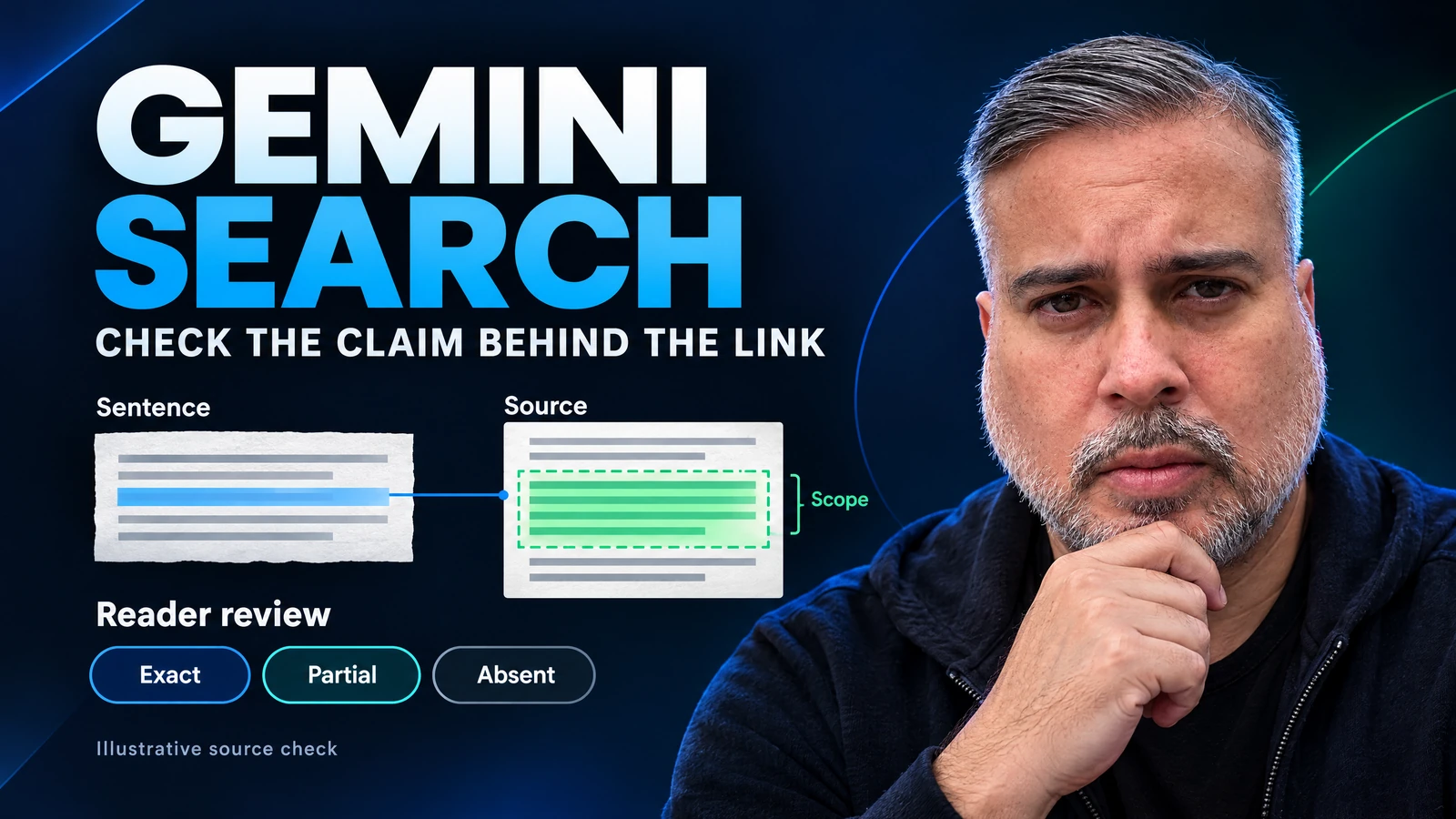
Trace a Gemini answer to its sources with an interactive diagram. See how Gemini Apps links differ from API grounding and what to verify.
An entrance with no steps would settle one question about an evening gallery visit. It would leave another unanswered if the exhibition were upstairs. In this hypothetical example, adding access requirements changes what a useful Gemini answer needs to establish, even if the same source link appears beside it.
I would review the sentence about the entrance separately from a promise about the entire visit. That difference is the most useful starting point for understanding Gemini Search. A relevant page can support a narrower statement than the answer makes.
TLDR Compare a specific Gemini claim with the text and scope of its linked source. The interactive map offers three illustrative gallery claims to inspect. Gemini Apps links and the API's grounding metadata provide different kinds of source information, and neither replaces reading the evidence behind a recommendation.
One visit, different claims
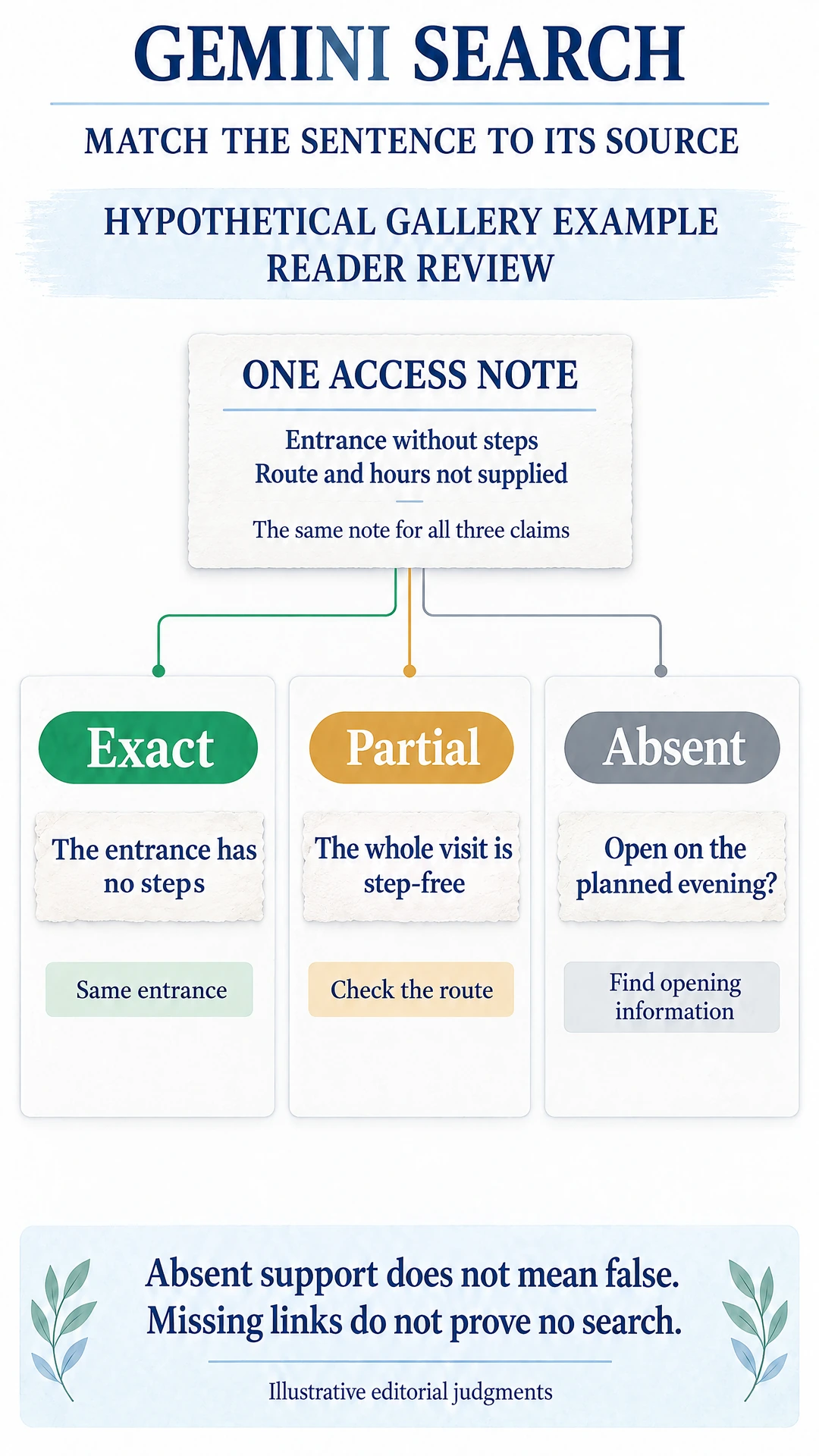
For our unnamed gallery, consider the teaching sentence “The entrance has no steps.” Its illustrative source card describes that entrance in the same terms. Within the card's scope, the statement has exact support. This exercise supplies no actual venue or access policy.
Now change the sentence to “The whole visit is step-free.” The entrance description has become insufficient. It says nothing about the route to each exhibition space, so I would mark support as partial and leave the rest unverified. Adding a few words to the answer has created a different evidence requirement.
The third case asks whether the gallery opens on the planned evening. The entrance card does not supply an applicable opening schedule. In our card exercise, support is absent. That assessment cannot tell us the gallery is closed, because the necessary information is missing.
Select each sentence in the map and compare its source card with the explanation. The labels describe an editorial judgment within this example, rather than a Gemini accuracy score or a disclosed internal classification. Try making the broad route claim narrower before searching for another source. Sometimes a useful correction is a more precise sentence.
Search results and visible source links
Some Gemini Apps responses are grounded on Search results. The consumer interface sometimes supplies sources or related links, inline or through its Sources panel. Links can include websites, uploaded files or connected Workspace material.
A missing link cannot establish that no search happened. For the gallery visitor, the practical consequence is an unresolved opening-hours claim. Request an applicable source or check the gallery's current information before using that claim to plan the evening.
When a link is available, open it at the point where the answer becomes specific. Does the page describe the entrance, the route through the building, or only the exhibition? A recognizable page title can distract from that difference. Comparing the actual passage with the sentence keeps the review focused on the requirement that matters.
This also separates two publisher questions. Appearing in a source list is one outcome. Providing sufficient evidence for the reader's decision is another. The distinction complements our ChatGPT Search explanation, where collected pages and visible citations have different meanings.
A source card with limited scope
Our illustrative access note describes one entrance and supplies no information about the exhibition route. Expanding it into a statement about the whole gallery would require additional information, such as an applicable description of the exhibition route. The limitation belongs beside the claim while it is being evaluated.
I would preserve the narrow supported wording in a research note and add a separate question about the route. A note pairing each requirement with its evidence gives the next check a purpose. Repeating a broad request for “accessible galleries” could produce more recommendations while leaving the same gap unresolved.
| Illustrative statement | Evidence in the teaching card | Reader decision |
|---|---|---|
| The entrance has no steps | Describes that entrance without steps | Retain the entrance claim within that scope |
| The whole visit is step-free | Describes the entrance only | Verify the route before extending the claim |
| The gallery opens on the planned evening | Entrance description, with no applicable schedule | Find the missing opening information |
These are invented teaching statements, not a recorded Gemini conversation. No opening time, venue identity or customer experience is represented as factual.
Dates deserve the same attention as physical scope. If an opening notice applied to a past exhibition, it could be accurate for that event and unsuitable for a later visit. I would compare the intended day with the notice's period before treating it as current evidence. An undated description of evening events would leave that check incomplete. Keeping the notice’s period in the research note prevents a historical statement from being treated as an answer about another evening.
Text segments in the Gemini API
In the Gemini API Search grounding documentation, enabling google_search lets the model decide whether search would help. A successfully grounded response includes groundingMetadata. Its groundingSupports associate text segments with entries in groundingChunks.
That association is useful for explaining a narrow passage check. Consider highlighting only the entrance sentence and opening its associated source. Extending the highlight to the entire visit would still require reading whether the material covers the additional claim.
The API fields do not establish the private Gemini Apps schema. Keep a consumer source panel and this developer metadata explanation separate. An association with a source also leaves the reader responsible for checking the statement, including conditions that might be elsewhere on the page.
Browser observations and their limits
Steve Toth's Gemini study reports 47 three-turn conversations captured on September 25, 2026, in buyer scenarios. It describes browser-visible search and citation structures while identifying their meanings as inferred. A browser capture cannot reveal every server operation.
Those observations suggest useful questions to investigate, such as which material appears beside an answer after a follow-up. They do not settle whether a gallery's entire route is accessible. The linked passage would be needed for that claim regardless of how interesting the browser traffic was.
The teaching diagram separates documented consumer behavior from an API analogy and original reader checks. It supplies no fixed query count or hidden ranking formula, and the gallery case does not claim to reproduce Toth's experiment.
Useful gallery pages for an evidence check
If I were editing the hypothetical gallery's site, I would put the entrance description and any documented route limitations where a visitor can compare them. A broad “accessible venue” statement would leave too much interpretation to the person planning the trip.
An opening notice should identify the period or event it covers. If an exception applies, put that condition beside the schedule rather than making the reader reconcile it with an unrelated announcement. This recommendation improves the evidence a visitor can inspect, without promising a Gemini citation.
Our AI citation factors analysis examines source appearances. A passage review asks the more immediate question of whether the page establishes the exact statement being evaluated. A publisher can use that distinction to choose which missing detail to fix first.
Consistent venue information also makes that comparison easier. The EntityMap assessment discusses entity consistency, while an AI assistant rendering review can help investigate whether important page text is available to inspect. Neither review substitutes for an accurate access description.
Before planning the illustrative visit, I would retain the supported entrance statement and request the route and applicable opening information. That is a concrete next question for Gemini or the venue's own documentation, with the unresolved requirements still visible.
FAQ
Does every Gemini answer include sources?
No. Gemini Apps does not provide links with every response. Their absence alone cannot show whether a web search occurred.
Can an entrance source confirm the whole visit is step-free?
Only if it also establishes the relevant route. Our illustrative entrance-only card leaves the full-visit claim partially supported, so the remaining access question needs its own evidence.
Are groundingSupports fields visible in Gemini Apps?
They are documented for the Gemini API. That documentation does not establish the consumer application's private schema or a guarantee that a source supports every linked statement.
Does absent support mean the claim is false?
No. In the gallery exercise, a card without an applicable schedule leaves the opening question unanswered. Find the missing evidence before assigning a true or false verdict.