Your Brand Ranks #1. So Why Is the AI Overview Citing Other Pages?
AI Overviews brand search data: 62.2% of cited brand pages don't rank in the top 10. Audit which URLs Google cites and fix product and About pages first.
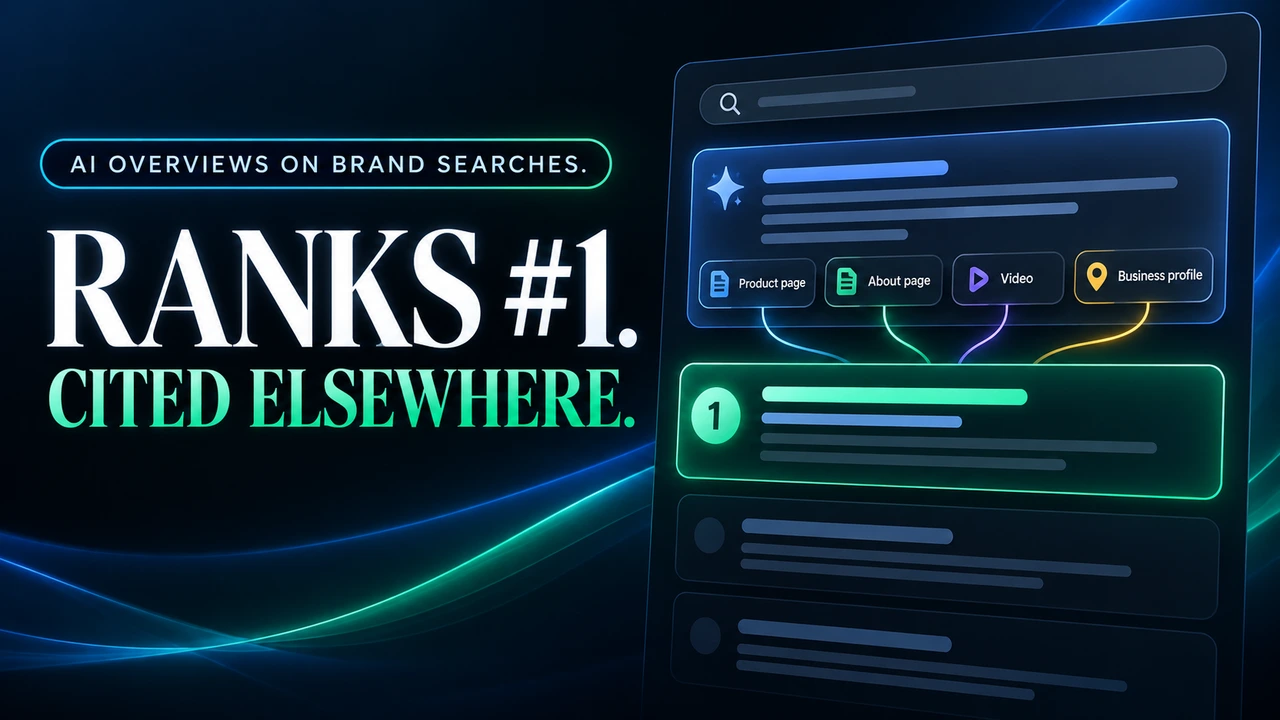
You search your company name, see your homepage in position one, and file the brand report as done. Then you notice the AI Overview above it. It's summarizing your business from a product page, an old About page, and a YouTube video you didn't make.
In an AI Overviews brand search, Google often cites pages that don't match your organic ranking. In SE Ranking's October 2026 study of 1,000 US brand keywords, AI Overviews appeared on 82.5% of searches on average, and 62.2% of the brand-site pages they cited weren't in the organic top 10 for that query. Your ranking report doesn't show which pages describe your brand.
That's a useful finding, with limits. It describes one desktop snapshot, not your brand, and it doesn't measure traffic or accuracy.
| What you see | What it can mean | What to verify next |
|---|---|---|
| Your homepage ranks #1 for your brand | Organic ranking looks fine | Whether an AI Overview appears above it |
| An AI Overview appears on some checks but not others | Normal variation; the study saw it switch on 11.4% of keywords | Repeat the check on different days |
| The AI Overview cites your product or About page | Google is pulling brand facts from deeper pages | Whether those pages are current and clear |
| It cites YouTube, app stores, reviews or your Business Profile | Off-site sources shape the summary | Which of those you manage or can respond on |
| It cites sites you don't control | Part of the story is outside your reach | What those sources say, and whether it's accurate |
1. What the study showed, and what it doesn't prove
SE Ranking's SE Visible team, in a study by Yulia Deda published October 22, 2026, checked 1,000 US and 1,000 German brand keywords across 17 industries. Each keyword was checked three times on desktop in October 2026. The sample was split evenly between SMB, mid-market and enterprise brands.
The headline numbers for the US:
- AI Overviews appeared on 82.5% of brand searches on average across the three checks. 75.6% of keywords showed one in all three checks, 87% at least once, and 11.4% switched between checks.
- The most searched brands triggered them less consistently. Keywords under 50K searches showed AI Overviews 85.2% of the time, compared with 63.3% for keywords over 1M.
- AI Overviews relied on the homepage about half as much as organic results. The homepage was 71.1% of brand-site URLs in the organic top 10, but 36.8% of brand-site URLs cited in AI Overviews.
- Deeper pages gained share. Product, service and category pages went from 6.1% of brand-site URLs in the top 10 to 22.9% of AI Overview citations. About pages went from 3.8% to 11.7%.
- 62.2% of cited brand-site pages weren't in the organic top 10. That rose to 92.6% for product pages and 84.6% for About pages. The homepage was the exception at 16.5%.
- Domain overlap stayed high. At the domain level, overlap between AI Overview citations and the top 10 was 98.3%. The domain usually matched; the page often didn't.
- 61% of citations came from platforms brands manage or take part in. That includes the brand website, app stores, Business Profiles, social and video platforms, and review sites.
Germany looked different. AI Overviews appeared on 40.4% of German brand searches, and 68.5% of cited brand URLs were outside the top 10. Don't assume the US figures apply to every market.
What the study doesn't prove:
- It's a desktop snapshot from October 2026. Mobile results and later months can differ.
- "Not in the top 10" doesn't mean the page doesn't rank. It may rank lower than position 10.
- It doesn't measure whether the AI Overview was accurate, or whether it changed clicks, traffic or conversions.
- These are patterns across a sample. They don't establish why Google picked a given page for your brand.
Aleyda Solis, who shared the study on X and is quoted in it, frames brand search as a mix of performance and branding, and points to optimizing third-party presence too. I'd treat that as the practical takeaway, not the exact percentages.
2. Why brand ranking reports no longer suffice
A brand ranking report tells you which URL ranks for your name. It doesn't tell you which URLs Google uses to describe you.
If your report says "brand keyword: position 1," it can be correct while the AI Overview summarizes your pricing from a support article and your history from a 2021 About page. In the study, an average AI Overview cited 2.57 brand pages, compared with 1.72 brand pages in the organic top 10. More of your site is being read than your rank tracker shows.
The homepage still matters. It was the most cited page type, and only 16.5% of cited homepages were outside the top 10. Your other pages are the gap.
If you already track AI answers in other tools, see AI visibility prompt trackers for what those numbers can and can't tell you. For background on the feature itself, start with how Google AI Overviews work.
3. How to audit which URLs the AI Overview cites
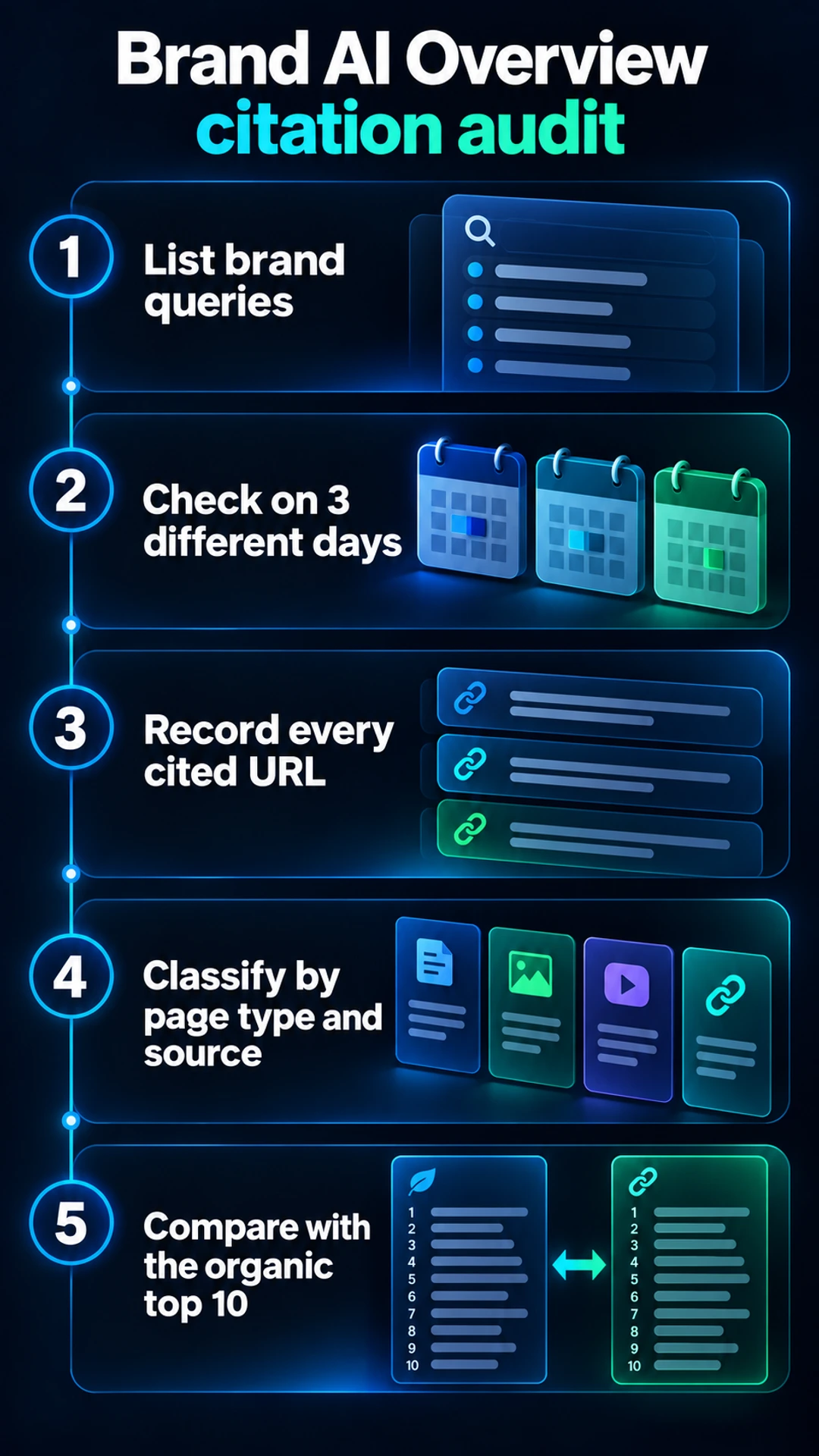
Check your brand queries manually, record every cited URL, and compare that list with the organic top 10. A spreadsheet is enough.
-
List your brand queries. Start with your brand name, then the variants people actually search: brand plus product, pricing, reviews, login or location. Search Console's query report is a reasonable place to find them.
-
Check each query more than once. The study saw AI Overviews switch on 11.4% of keywords across three checks. I'd check on three different days and note whether an AI Overview appeared each time. Signed-out or private windows reduce personalization; they don't create a neutral result.
-
Record every cited URL. Expand the AI Overview and copy each source link. Note the date, device and whether you were signed in.
-
Classify each citation. Use four buckets: your own site (with page type), platforms you manage (Business Profile, app stores), platforms where you publish or respond (YouTube, social, review sites), and sources outside your control.
-
Compare with the organic top 10. For each cited URL from your site, note whether it ranks in the top 10 for that query. The ones that don't are the pages your rank report was missing.
-
Read what the summary says. The study didn't measure accuracy, so this check is yours. Compare each claim in the AI Overview with the cited page. Mark anything outdated, vague or wrong.
The Brand Story Risk Tester can help structure that last step. If you want to connect citations with traffic, auditing AI referral traffic in Search Console covers what GSC can and can't separate.
4. Which pages to fix first
Start with the brand pages the AI Overview already cites, in this order: product or service pages, the About page, then the homepage.
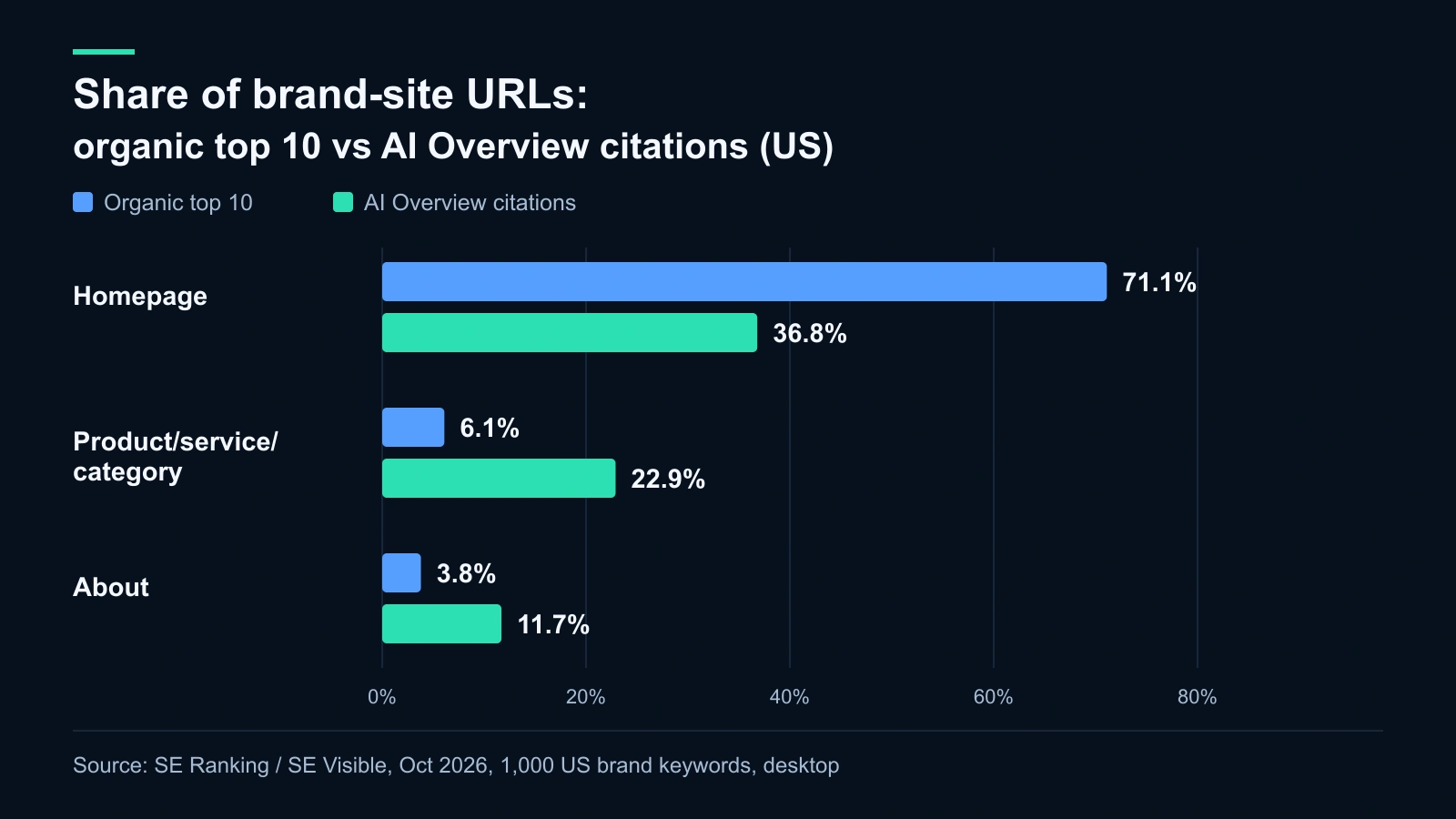
In the study, homepage, product and About pages together made up 71.4% of brand-site citations. Product pages and About pages were also the types most likely to be cited without ranking in the top 10.
- Product and service pages. Make sure each one says plainly what it is, who it's for, and what it costs or how pricing works, if you publish that. Remove discontinued products or mark them clearly.
- About page. Keep founding facts, leadership, locations and what the company does current and in text. See what an About page needs for AI search.
- Homepage. It's still the most cited page type. Check that the first screen explains the business in a sentence or two.
- Pricing, support and locations pages. In the study, 94.3% of cited pricing pages, 87.2% of support pages and 87.6% of location pages were outside the top 10. If your audit shows them cited, review them next.
Google's guidance on AI features says there are no special optimizations required for AI Overviews beyond normal SEO best practices, and that important content should be available in text. I'd read that as: fix clarity and accuracy, not markup tricks.
Dana DiTomaso's advice in the study comes down to the same thing: fix the pages the AI Overview is already pulling from.
Expert Insight
I'd start with the pages your audit shows being cited, not the pages you wish were cited. Update facts first, then wording. If a page is cited and out of date, that's the fix with the clearest evidence behind it.
5. Off-site sources: Business Profile, reviews, video and app stores
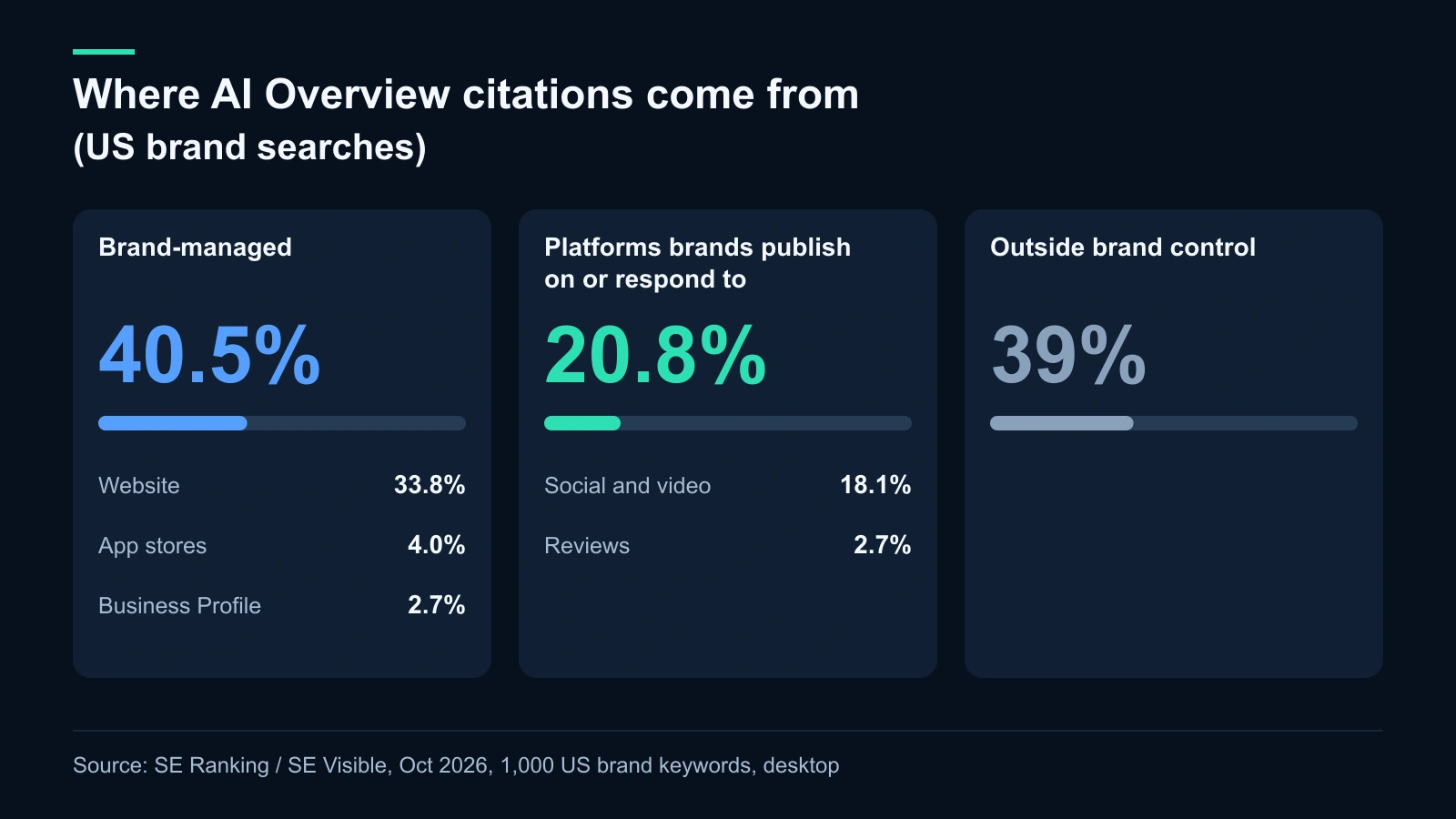
Your website was the largest single source in the study, but it wasn't most of the story. Brand-managed sources made up 40.5% of US citations: the website at 33.8%, app stores at 4.0% and Google Business Profiles at 2.7%. Platforms where brands publish or respond added 20.8%: social and video at 18.1%, mostly YouTube, and review sites at 2.7%.
In Germany, the Business Profile share was higher, at 6.4% of citations. That's another reason to check your own market before assuming the US mix.
What I'd check:
- Google Business Profile. Google's AI features guidance also recommends keeping Business Profile information up to date. Hours, categories, description and location details are worth a review.
- YouTube and social. If your own videos are cited, check titles and descriptions for outdated product names or claims.
- App store listings. Keep descriptions current if you have an app.
- Reviews. You can't edit reviews, but you can respond where the platform allows it.
The remaining 39% of citations came from sources outside the brand's reach. You can't change those directly. You can read them, note inaccuracies, and decide whether a correction request or better on-site information is the realistic response.
FAQ
Do AI Overviews show up for brand searches?
Often, in the US. SE Ranking found them on 82.5% of US brand keywords on average across three desktop checks in October 2026. The rate was lower in Germany, at 40.4%. Check your own brand queries, because frequency varied by market, industry and search volume.
Why does the AI Overview cite pages that don't rank in the top 10?
The study showed that it happens, not why. 62.2% of cited brand-site pages weren't in the organic top 10, even though domain-level overlap was 98.3%. Those pages may still rank below position 10. Treat it as a reason to audit cited pages, not as a ranking factor.
Which brand pages should I update first?
Start with pages your own audit shows being cited. In the study, homepage, product and About pages made up 71.4% of brand-site citations, and product and About pages were often cited without ranking in the top 10.
Is my brand ranking report still useful?
Yes, for organic rankings. It doesn't show which URLs Google cites in AI Overviews for your brand. Add a citation check for your main brand queries alongside it.
Does being cited in an AI Overview bring traffic?
The study didn't measure traffic or conversions. Use your own analytics and Search Console data, and keep citation visibility separate from traffic in your reporting.
Can I control what the AI Overview says about my brand?
Not directly. You can keep the pages and profiles you manage accurate and clear, and respond on platforms that allow it. About 39% of US citations in the study came from sources outside the brand's reach.
Ranking first for your brand doesn't tell you which pages Google uses to describe it.
How Growing Search can help: if you want a second look at which pages and sources AI Overviews use for your brand, our AI SEO audit covers brand queries, cited URLs and the pages worth fixing first. No provider controls what Google's AI features show. A clear audit tells you where to start.
About the Author