ChatGPT “Claim Your Business”: What Business Hub Analytics Measure
The November 6 report describes a Business Hub test with impressions, clicks and ownership verification. Cover and diagrams generated with AI.
The “Claim your business in ChatGPT” screen gives marketers a reason to prepare for first-party visibility reporting. The published evidence describes a test and a starting screen, with general access still unconfirmed. On November 6, 2026, Barry Schwartz reported that the feature is still being developed, with daily impressions and website clicks described by spotter Juozas Kaziukėnas.
I would prepare to use those counts alongside the measurement already in place. An OpenAI-side count could help answer whether a business appeared in responses or received link clicks. Explaining a change would still require investigation, particularly because the reported tool excludes the prompts behind those appearances.
At a glance. The November 6 evidence describes a Business Hub test with general access still unconfirmed. The reported analytics count business appearances and website link clicks daily. Keep prompt samples and website outcomes beside those totals, and treat ownership verification as an access requirement rather than a promise of visibility.
The November 6 evidence
Juozas Kaziukėnas described the analytics on LinkedIn. His account supplies the measurement detail. He described a work in progress, said he had seen early steps in August, and shared a banner for claiming a business. Both Schwartz reports depend on that account, so two publications should not be counted as two independent product tests.
Search Engine Roundtable’s report appeared at 10:32 am ET. Search Engine Land followed at 10:54 am. Chris Long’s captured LinkedIn post provides additional context for the Claim screen and the Search Console comparison. The screen is marked unreleased/beta.
The screen documents the proposed capabilities, while the metric definitions come from Kaziukėnas’s explanation. That evidence supports a preparation guide. It leaves the launch date and country availability unresolved. There is no official OpenAI announcement in the verified source set, and I would avoid publishing a signup walkthrough that assumes public access.
The Claim screen published by Search Engine Roundtable has an unreleased/beta label. The screen describes proposed capabilities. Kaziukėnas describes the analytics chart separately. See the Claim screen in Search Engine Roundtable.
Business Hub impressions and clicks
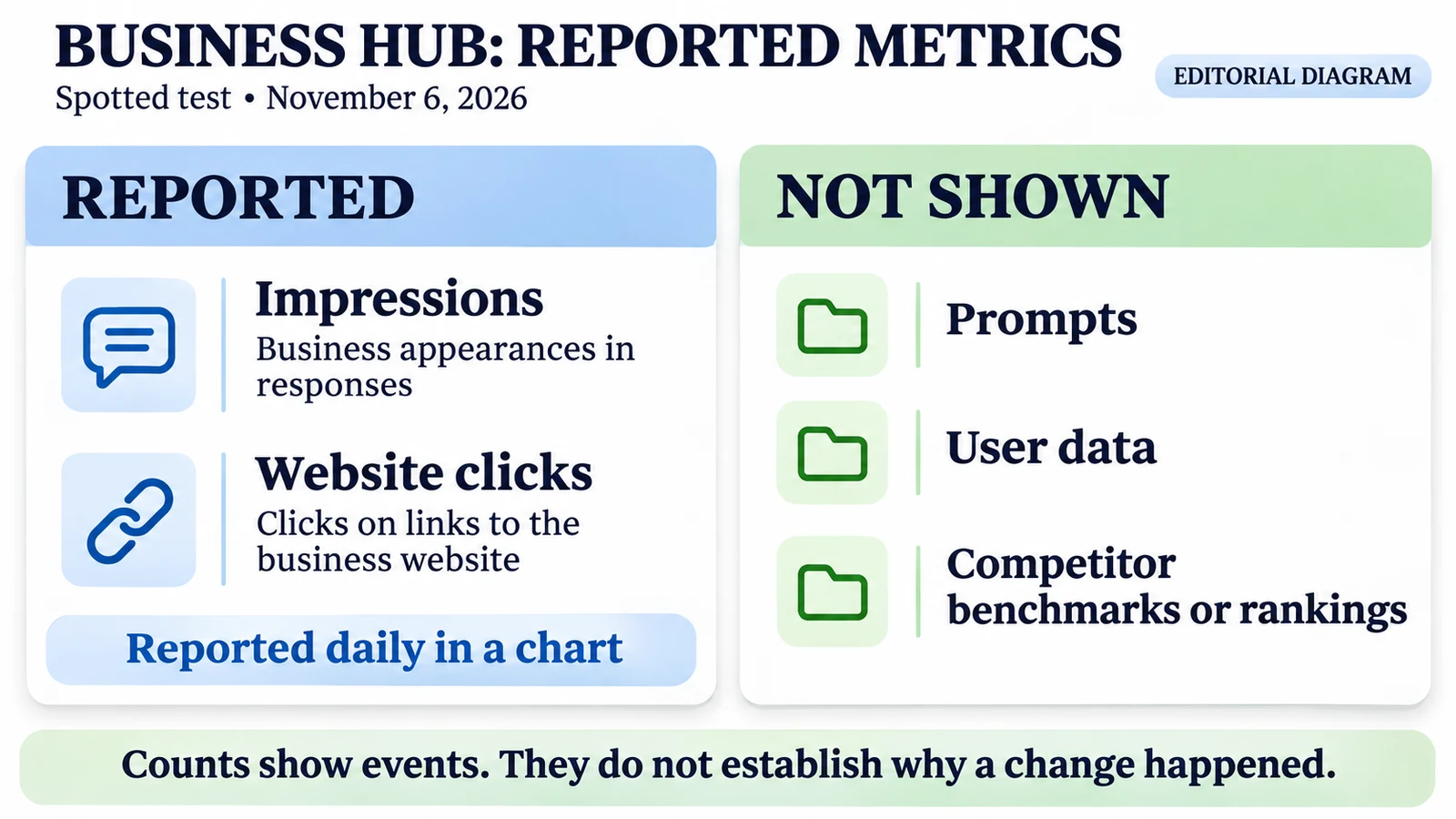
Kaziukėnas describes impressions as the number of times a business appeared in ChatGPT responses, and clicks as clicks on links to its website. He says the tool charts these events daily. Those definitions describe different events, which should stay separate in a report.
| Reported item | Meaning | Limit for an SEO decision |
|---|---|---|
| Impressions | Business appearances in responses | An appearance does not establish a website visit or a sale |
| Clicks | Clicks on website links | A link click does not establish a completed visit or conversion |
| Daily chart | Changes in the reported counts by day | A trend does not identify its cause |
| Prompts and user data | Not shown in the reported tool | You cannot reconstruct the conversations behind the totals |
| Competitor benchmarks or rankings | Not shown | Your own counts do not establish share of visibility |
An impression count would add a useful observation to the GEO attribution problem. It would not make every mention commercially valuable. A response could include a business during research without producing a click, while a visitor who does click could leave without buying.
The source material does not specify deduplication or reporting latency. It also does not establish a method for calculating a comparable CTR. Before deriving a ratio, I would check that the released documentation defines what each denominator includes.
A cautious Search Console analogy
“ChatGPT Search Console” describes a reasonable expectation of first-party performance information. It becomes misleading if it imports query reports, indexing diagnostics or other Google Search Console capabilities that the spotted feature has not demonstrated.
For this reader, the useful comparison is access to platform-reported counts for a business you represent. The absence of prompts is central to deciding what those counts can explain. This is also a different task from connecting Google Search Console to ChatGPT, or asking ChatGPT to analyze a spreadsheet.
Chris Long’s LinkedIn commentary illustrates the Search Console analogy. His reference to Lily Ray is secondary evidence in that account. Schwartz gives the public comparison in his November 6 report. Read Schwartz’s comparison.
The AI referral traffic and GSC audit addresses a separate measurement question. Giving both articles the same promise would make it harder for a reader to find the right workflow.
Reading the Claim screen before taking action
The screenshot is a starting screen, rather than a completed verification flow. Read its three cards as a description of the intended Hub scope. They do not prove that all the capabilities are usable today.
Step 1: Identify the mentions capability
The left card describes tracking how often a business is mentioned in ChatGPT conversations. It is the card closest to the analytics Kaziukėnas describes. The screenshot itself contains no performance totals or daily chart, so the metric definitions need attribution to his accompanying explanation.
Step 1. The mentions card describes tracking how often a business appears. Kaziukėnas gives the performance metrics separately from the screen. See the mentions card in the published Claim screen.
Step 2: Separate business information from reporting
The middle card concerns adding products and updating business information. The right card describes an agent answering questions using context a business controls. Those are proposed management capabilities, rather than additional measured outcomes. An editable fact does not demonstrate control over every ChatGPT response.
Step 2. The products card describes maintaining products and business information. The reported impressions and clicks belong to the measurement layer. See the products card in the published Claim screen.
The agent card describes answering questions using the context a business provides. The card leaves the extent of control over other ChatGPT answers unconfirmed. See the agent card in the published Claim screen.
Step 3: Read the authorization requirement
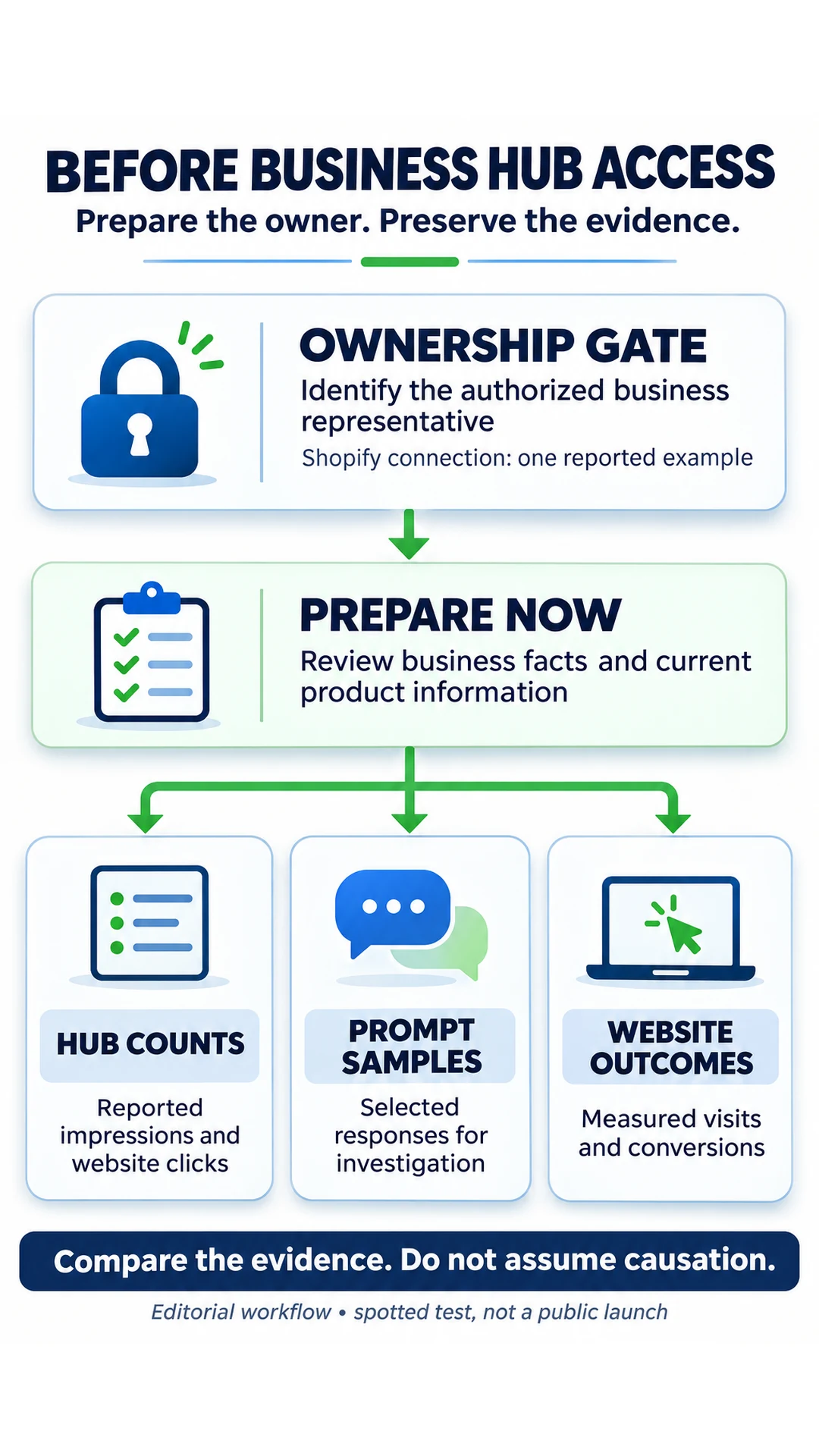
The footer requires verification that the person is authorized to represent the business. Kaziukėnas gives connecting a Shopify store as one ownership-verification example. That does not establish Shopify as the sole route or provide a full eligibility list.
For a store team, I would identify who can approve an ownership connection and maintain the business facts. If an agency manages the reporting, that person may still need the business owner’s authorization. Deciding responsibility now is useful without assuming the future verification process. I would wait for documented access instructions before connecting anything. The screen does not establish that anyone can claim any local business as they would manage a Google Business Profile.
Step 3. The footer asks the user to verify that they can represent the business. It shows the starting point, with subsequent verification steps still undocumented in the reports. See the authorization footer in the published Claim screen.
First-party counts beside prompt samples
If access becomes available, I would use the Hub for the events it reports and retain a consistent prompt sample for investigating possible explanations. A sample can show which competitors or sources appeared in the responses you tested. It cannot be treated as an exhaustive log of the conversations represented by a Hub total.
Start by recording the reporting dates and the business identity attached to the account. Keep the definitions shown in the interface with the baseline. Wait for documentation of any export or API before making it part of the process.
Next, compare the daily count with the same period in your prompt tracker. Preserve its model and market settings, and note product or content changes separately. A rise in both reports gives you a hypothesis to investigate. It does not prove the content change caused the rise.
Finally, review ChatGPT referral traffic and the outcomes recorded on the website. Keep platform clicks distinct from measured sessions. Different event definitions can produce different totals without either report being fraudulent or broken.
Preparation before a public launch
The practical work today concerns information and responsibility. It does not require pretending to have access to the Hub.
If your product pages disagree with your current offer, correct them. Check the business identity used on the About and contact pages, then assign responsibility for reviewing future changes. These are editorial recommendations based on the proposed management cards, not OpenAI eligibility requirements or a guarantee of more mentions.
For commerce teams, identify the authorized store owner who would evaluate a connection request. Keep the published catalog accurate in the meantime and give the person responsible for product facts a role in reviewing future updates. Shopify’s appearance in the report is useful context for that discussion, but it should not become an unsupported checklist for every business.
Retain the citation evidence you already collect. A count alone cannot explain how a ChatGPT citation formed, so the pages and response samples behind an investigation still matter.
Ownership and measurement preparation checklist
Availability and the ads distinction
Search Engine Land reported on November 6 that the feature was still in development. The unreleased/beta label and Kaziukėnas’s account describe testing. A public opening date, supported countries and general eligibility remain unconfirmed.
Search Engine Roundtable interprets the test as separate from ChatGPT ads and oriented toward organic responses. OpenAI documents campaign delivery in its ads reporting guide. I would keep campaign figures separate from the proposed Hub counts. ChatGPT advertising costs answer a different business question.
For a team planning its next measurement review, I would prepare a baseline now and assess the released documentation when access changes. If you need help deciding which evidence belongs in that baseline, an AI SEO audit can start with your existing visibility and referral records.
Frequently asked questions
Is ChatGPT Claim Your Business available to everyone?
The November 6 evidence describes a work in progress. A public rollout date, supported countries and general access rules remain unconfirmed.
What do the reported analytics measure?
Kaziukėnas describes daily business appearances in ChatGPT responses and clicks on links to the business website. Prompts, user data and competitor rankings are excluded from his description.
Is Shopify the only verification method?
The evidence does not establish that. Connecting a Shopify store is one example Kaziukėnas gives. A complete list of verification methods has not been established by these reports.
Would Business Hub replace prompt tracking?
The reported counts serve a different purpose from a controlled prompt sample. They could add first-party event totals, while prompt samples remain useful for examining selected responses and possible explanations.
Would a rise in clicks prove an SEO change worked?
No. The chart alone cannot establish cause. Compare the reporting period with your change log and response evidence, then examine what happened after visitors reached the website.
About the Author