ChatGPT Referral Traffic and the Clicky No-Click Future
Similarweb, Qwairy, and Profound data suggest ChatGPT became more click-capable after May 7, 2026. Here is what the referral spike means for AI search SEO, homepage strategy, and attribution.

TL;DR: The May 7, 2026 ChatGPT link change does not kill the no-click search problem. It makes the story more useful. AI search is becoming answer-first, but click-capable when the interface gives users trusted, visible brand links. Similarweb reported a roughly 150% to 157.7% week-over-week lift in ChatGPT referrals after the change, with about 60% of that traffic landing on brand homepages.
The real SEO lesson is simple: winning the AI answer is only half the job. The destination after the click now matters again, especially the homepage.
5-Minute ChatGPT Referral Traffic Breakdown
Watch why the no-click future is getting more clicky
A practical walkthrough of the May 7 ChatGPT link shift, the Similarweb referral spike, homepage readiness, and what SEO teams should measure next.
For the last year, the easiest AI search prediction was also the bleakest one: users would ask ChatGPT, Gemini, Perplexity, or Google AI Mode a question, get the answer in the interface, and never visit the websites that made the answer possible. That fear is not imaginary. Publishers have felt it. SEOs have measured it. Google AI Overviews have already pushed many query classes into lower-click behavior.
Then May 7 happened.
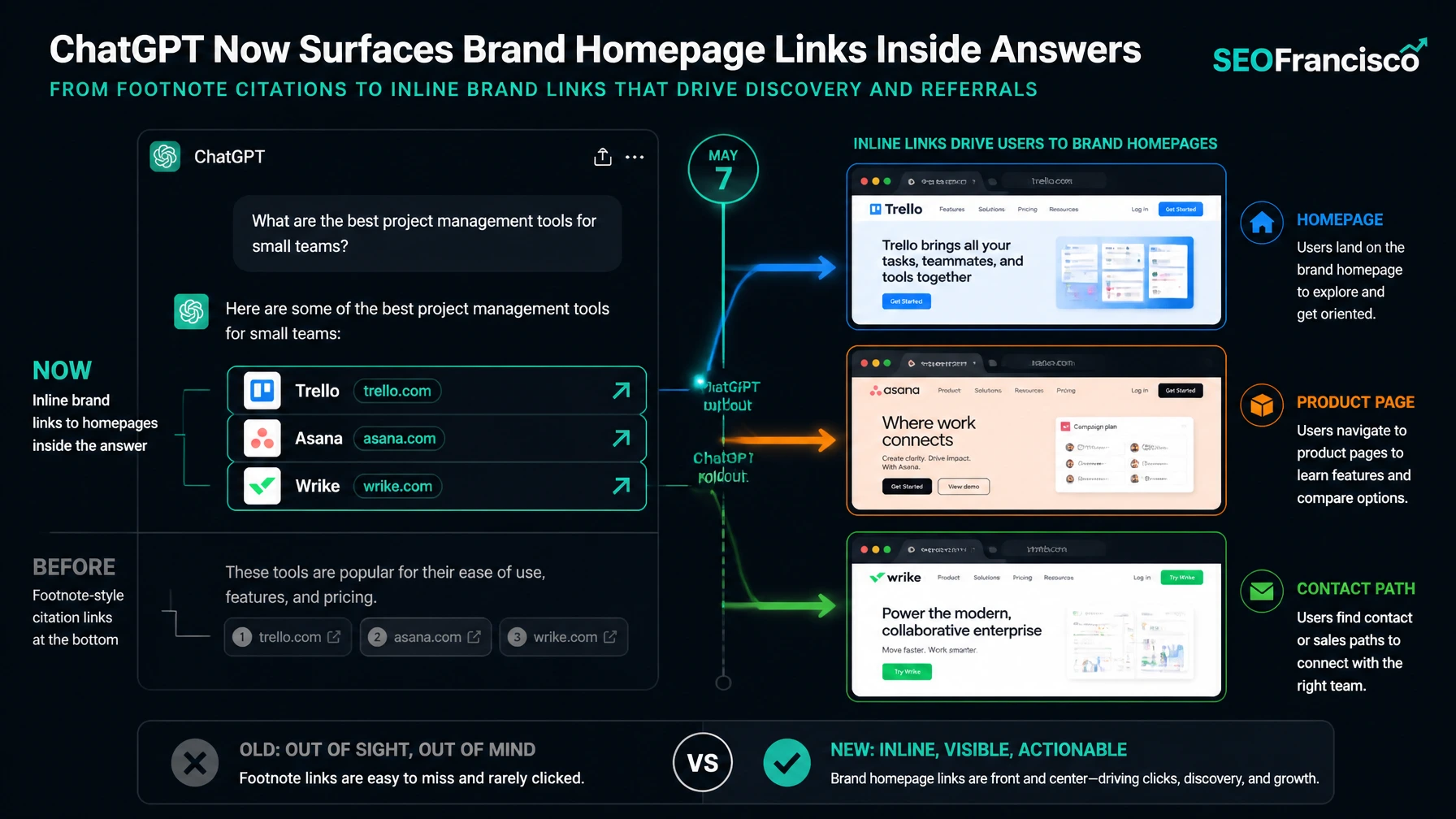
According to Similarweb's analysis, ChatGPT began surfacing more prominent links to brands inside answers on May 7, 2026. Referral traffic from ChatGPT increased sharply the following week. The linked pages also changed. Instead of sending only scattered visits to deep informational URLs, ChatGPT started sending far more users to brand homepages.
That changes the conversation. If AI answers can create measurable homepage traffic, then AI visibility is not only a perception metric. It can become a referral path. It can become a brand validation path. It can become a conversion assist.
There is a trap here, though. The wrong takeaway is "zero-click is over." It is not. The better takeaway is that AI search is becoming a mixed journey. Some queries end inside the answer. Some push users into brand discovery. Some lead to comparison, shopping, pricing, demo, support, or trust checks. SEO strategy has to cover both sides: become the answer and be ready for the click.
What Changed on May 7, 2026
OpenAI has not announced the exact mechanics as a named product update. That matters. We should not claim full access to every internal cause. What the public data does show is a visible behavior shift around May 7, 2026: more prominent links to brands appeared inside ChatGPT answers, and referral traffic moved at the same time.
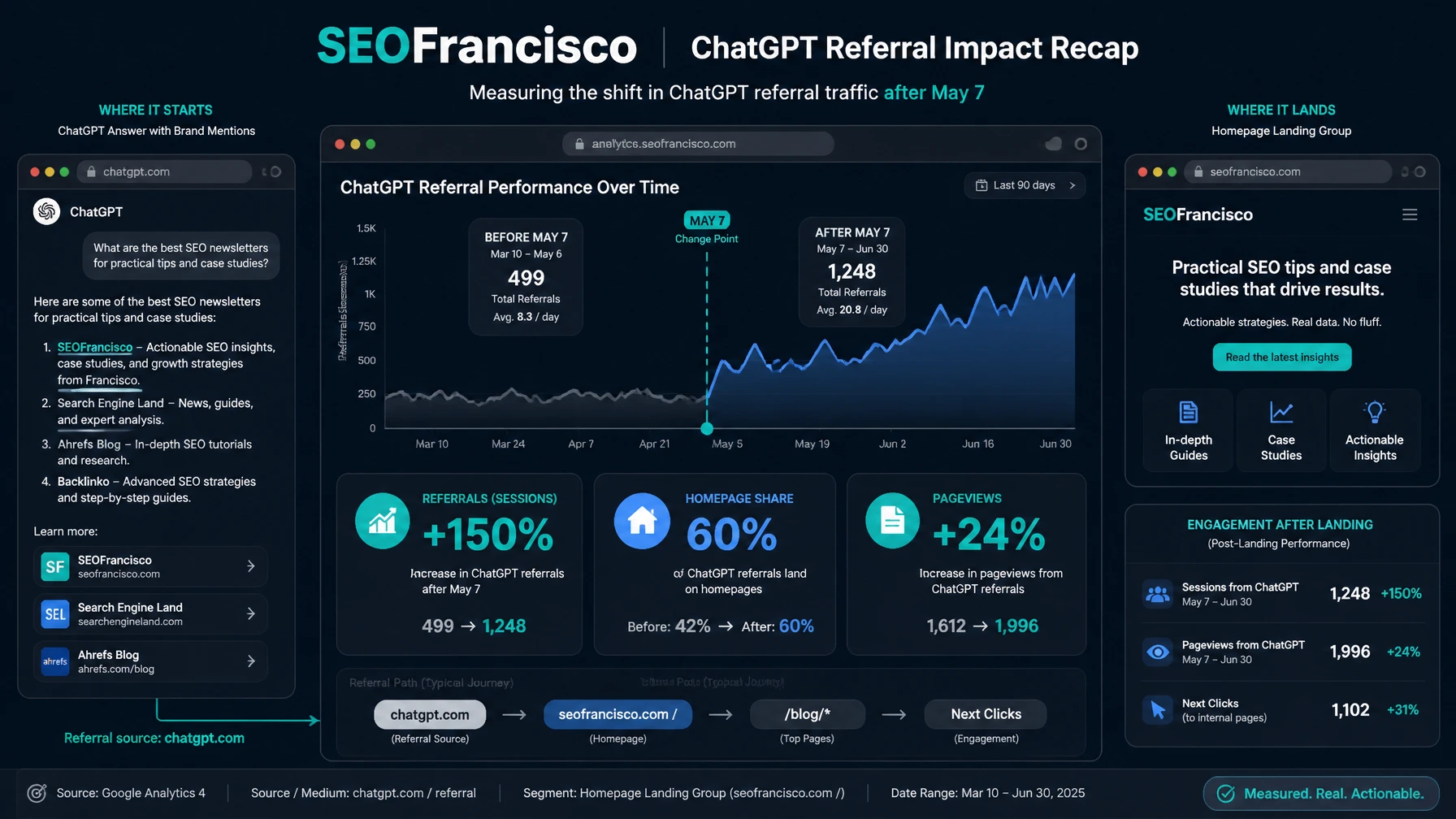
Similarweb described the change as ChatGPT surfacing more prominent links to brands directly within answers. Search Engine Roundtable summarized the same data for the SEO community: referral visits from ChatGPT rose roughly 150%, about 60% of the traffic landed on brand homepages, pageviews per visit rose 24%, and time on site rose 11%.
Qwairy measured the answer-side behavior from a different angle. Its study of more than 140,000 ChatGPT responses found that inline brand links moved from about 0.4% of answers to 6.2% after May 7, roughly a 14x increase. Qwairy also reported that the shift was specific to ChatGPT in its dataset, while Perplexity, Gemini, and Copilot did not show the same jump during the same period.
Profound described the pattern as a "Branded Link Update" and reported that monitored OpenAI referrals rose about 60% to 65% across its tracked brand sites, with B2B software and SaaS seeing stronger gains than ecommerce. Vendor data should be read with caution, but it is useful because it matches the direction of the Similarweb and Qwairy evidence.
The Similarweb Data
Similarweb's most useful contribution is that it looked beyond "did traffic go up?" and asked where the traffic landed and whether users behaved like qualified visitors.
The headline number is the referral lift. Similarweb reported a 157.7% week-over-week increase in total ChatGPT referrals after the May 7 change. Search Engine Roundtable rounded that to roughly 150% in its coverage. Either way, this is too large to treat as a normal weekly wiggle.
The homepage number is more important. Similarweb reported that homepage referrals grew 354.7% week over week. Before the change, roughly 26% to 32% of ChatGPT referrals landed on brand homepages. After the change, that share moved to around 60% and stayed there through the observed window.
That is a different kind of traffic. A user landing on a blog post from Google usually wants to resolve a specific question. A user landing on the homepage after ChatGPT recommends or mentions a company may be checking the brand itself. They want to know what the company does, whether it is credible, whether it fits their need, and what to do next.
Similarweb also reported that pageviews per visit rose from 3.8 to 4.7, a 24% lift, while average time on site rose from 3.5 to 3.9 minutes, an 11% lift. Those metrics are imperfect. More pageviews can mean curiosity, confusion, or poor routing. Longer time can mean engagement or friction. But as directional evidence, the pattern is encouraging: ChatGPT did not merely send more accidental visits. The visitors looked engaged enough to explore.
What the Data Proves
The safe claim is this: ChatGPT can send measurable referral traffic, and link visibility can change click behavior fast.
That is already enough to change how SEO teams work. A year ago, many AI visibility conversations stayed abstract: mentions, sentiment, share of voice, answer inclusion, brand co-occurrence. Those metrics still matter. But after May 7, the path from mention to session is clearer. If a brand is named and linked in an answer, the user has a direct route to the site.
The data also proves that destination mix matters. The homepage cannot be treated as a ceremonial brand brochure if ChatGPT is sending users there. It has to work as a landing page for people who have already heard a model's framing of the brand.
Finally, the data proves that AI referrals deserve their own analytics view. If ChatGPT traffic is mixed into referral, direct, or organic buckets without inspection, you will miss the story. You need to know whether the traffic comes from `chatgpt.com`, `openai.com`, app surfaces, UTM-tagged links, copied links, or branded search spillover.
What the Data Does Not Prove
The data does not prove that zero-click search is dead. Many informational queries will still end inside AI answers. Google AI Overviews can still compress organic clicks. Perplexity and AI Mode can still satisfy users without sending them downstream. Publishers can still lose traffic even while some brands gain homepage visits.
The data also does not prove revenue. Pageviews and time on site are helpful early signals, but they do not answer the business question. Did the visitor request a demo? Did they compare pricing? Did they return through branded search later? Did they convert in a CRM window that GA4 did not capture?
Nor does it prove clean causality. The May 7 timing is persuasive. Qwairy's answer-format data supports it. Similarweb's traffic data supports it. Profound's monitored-site data supports it. Still, model changes, UI tests, shopping features, user novelty, media coverage, and attribution behavior can overlap.
The right posture is neither hype nor dismissal. Treat the shift as a meaningful signal, then test it against your own data.
Why Homepages Are Back in the Conversation
The homepage has always been a strange SEO asset. It usually has the most authority, the most links, and the clearest brand signal, but it rarely ranks for many specific non-brand questions. Traditional SEO usually pushes users into category pages, service pages, guides, product pages, and comparison pages.
ChatGPT changes the entry point. If the model answers the user's question first and then links the brand, the homepage can become the continuation of the AI answer. That makes the homepage less like a directory and more like a proof page.
An AI-referred homepage visitor may be asking:
- Is this the company ChatGPT just recommended?
- Do they actually solve my problem?
- Are they credible in this category?
- Where is the service, product, pricing, demo, or case study that matches the answer?
- Can I trust the model's recommendation enough to continue?
Most homepages are not built for that journey. They speak to everyone and route slowly. AI referral traffic needs faster orientation. The user already has context from the answer. The homepage should confirm the fit, prove the claim, and route the visitor to the next specific page.
The New AI Referral Playbook
AI referral SEO has two sides. First, get named and linked in the answer. Second, make the linked destination worth the click.
Build Brand Entity Clarity
ChatGPT needs to understand what your brand is, what category it belongs to, who it serves, and why it should be associated with a prompt. That does not come from one blog post. It comes from consistent signals across your own site and third-party sources.
Use consistent brand naming. Keep organization schema clean. Maintain an About page that states the company, services, locations, authors, and proof points clearly. Build product and service pages that map to buying questions. Earn mentions on credible third-party pages where your buyers already compare options.
Create Answer-Ready Pages
AI systems need extractable, attributable answers. That means pages should include concise definitions, comparison sections, limitations, examples, original data, and clear summaries near the relevant heading. If a page rambles before answering the question, it is harder for a model to quote, summarize, or trust.
This does not mean writing for bots instead of people. It means writing pages that let both people and retrieval systems understand the point quickly. Our previous guide to query augmentation and agentic search explains why this matters: AI systems often decompose broad questions into narrower sub-queries before they retrieve or cite sources.
Make the Homepage an AI Landing Page
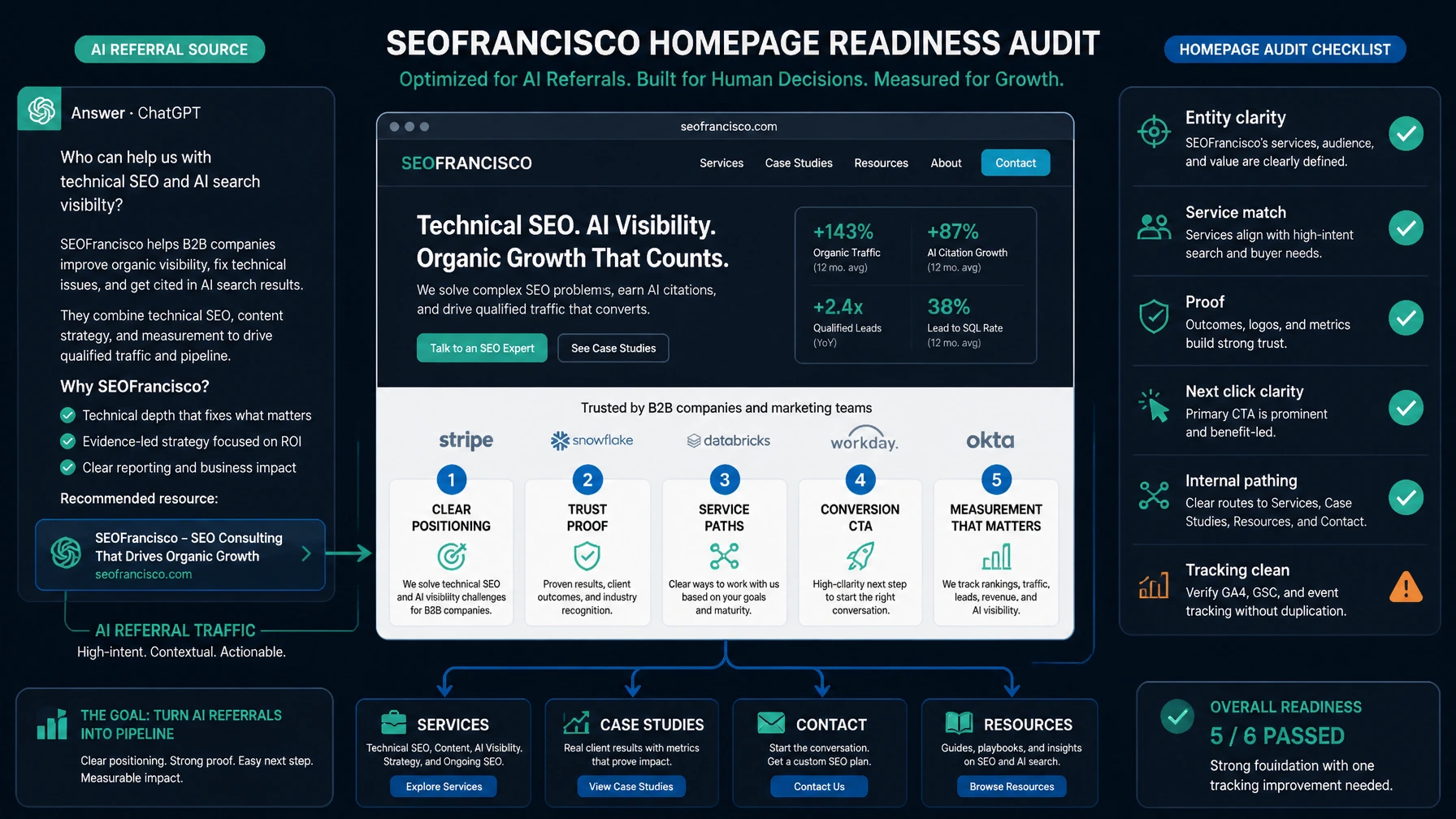
If ChatGPT sends users to your homepage, the page should answer the continuation question. Add clear category positioning, proof, internal links to relevant service or product pages, trust signals, comparison paths, and conversion actions. Do not force an AI-referred visitor to decode your brand from a vague hero section.
For SEOFrancisco, that means the homepage should quickly communicate AI search advisory, technical SEO, content strategy, and measurement expertise. For a SaaS company, it may mean making the product category, use cases, integrations, and proof points obvious above the fold.
Measurement Checklist for AI Referrals
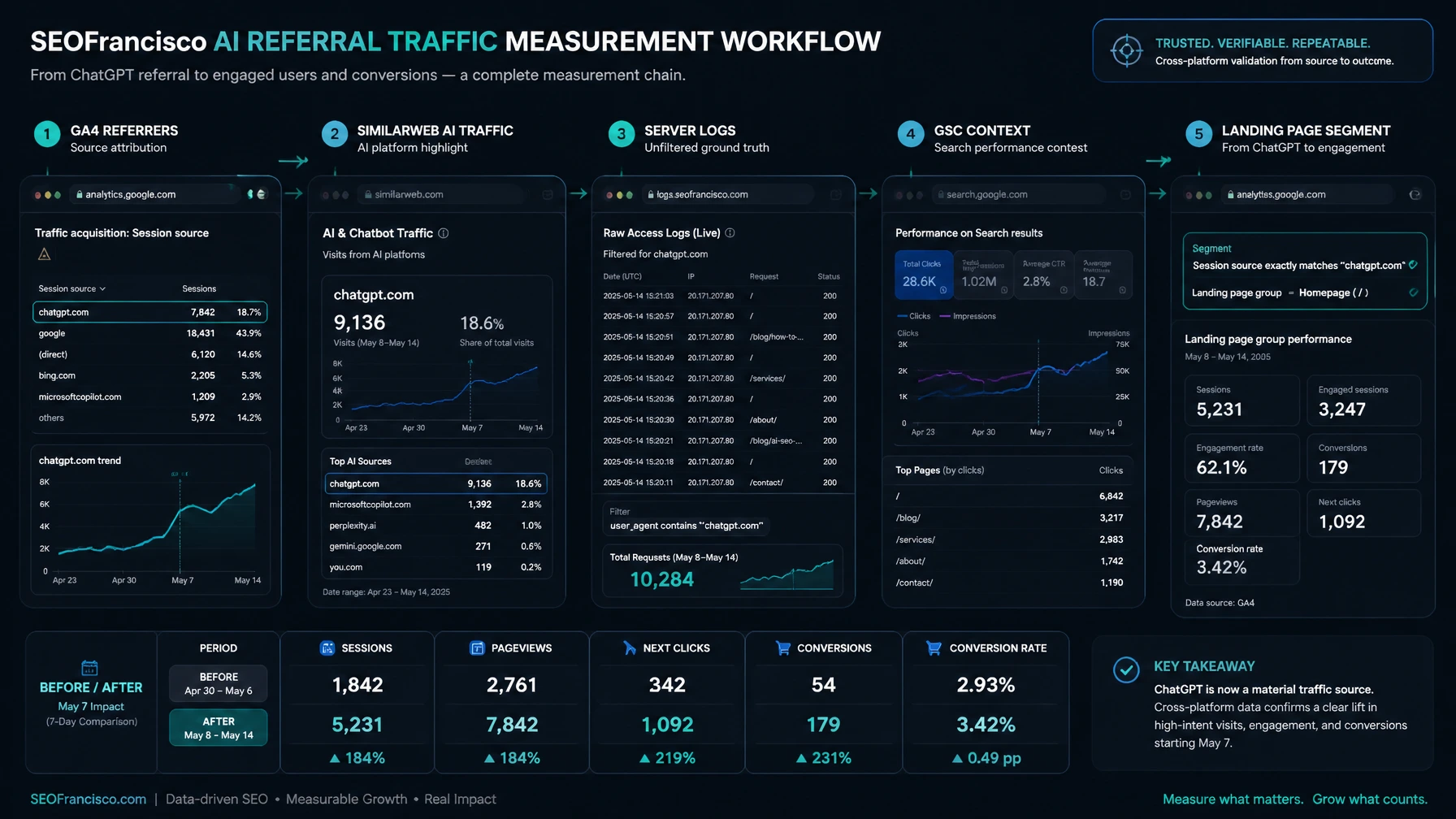
The May 7 story only matters if you can see it in your own data. Build the measurement layer before making strategy claims.
| System | What to Check | Why It Matters |
|---|---|---|
| GA4 | Sessions from `chatgpt.com`, `openai.com`, and other AI referrers by landing page. | Shows whether AI traffic is landing on the homepage, product pages, or articles. |
| Server logs | Referrers, 404s, redirect chains, GPTBot, OAI-SearchBot, and ChatGPT-User activity. | Separates human referral sessions from crawler behavior and broken destination paths. |
| Similarweb | Category trend, competitor referral growth, homepage share, and AI traffic quality. | Gives market context when your own sample is still small. |
| GSC | Branded query impressions and clicks before and after AI visibility movement. | AI discovery may come back as Google branded search later. |
| AI visibility tools | Prompts where your brand is mentioned, linked, linked correctly, or missing. | Connects answer presence with referral opportunity. |
Technical Checks Most Teams Will Miss
First, verify crawl access. OpenAI's ChatGPT Search help documentation explains that ChatGPT can use links and citations from web search. If you block the wrong crawler or send AI tools into broken canonical paths, you may reduce your odds of being found, linked, or represented accurately.
Second, monitor bad links. AI systems can still surface stale or broken URLs. The old problem of hallucinated or outdated links has not disappeared. Check your logs for 404s from AI referrers and set redirects for high-risk legacy URLs.
Third, separate crawler traffic from users. GPTBot activity does not equal a human session. OAI-SearchBot activity does not equal a conversion. But both can help explain why a page starts appearing in AI answers. The crawler layer and referral layer belong in the same report, not the same metric.
Fourth, track homepage events with more care. If homepage referrals rise, generic session counts are too blunt. Track clicks into service pages, pricing, demos, contact, comparison pages, case studies, newsletter signup, and key scroll depth. The question is not whether the homepage got more traffic. The question is whether it routed AI-driven visitors into the right decision path.
Where Qwairy and Profound Fit
Similarweb measured traffic behavior. Qwairy measured answer formatting. Profound measured monitored-site referral patterns and offered a category interpretation. Those are related signals, but they are not the same signal.
Qwairy's finding is useful because it explains a possible mechanism. If inline brand links appeared much more often, then more users had a visible click target. Similarweb's finding is useful because it shows clickstream movement after the same date. Profound's finding is useful because it suggests the effect was not evenly distributed by industry.
Use them together, but keep their limits separate. A link-frequency study does not prove user behavior. A clickstream study does not show the exact answer the user saw. A vendor study may have sample and category bias. Good SEO analysis respects those boundaries.
What to Do Next
Start with a 30-day AI referral audit.
- Pull GA4 sessions where source or referrer includes ChatGPT, OpenAI, Perplexity, Claude, Gemini, Copilot, and other AI surfaces.
- Split landing pages into homepage, product/service, pricing, comparison, blog, docs, support, and other.
- Compare engagement, conversion starts, and assisted conversion behavior against Google organic and direct traffic.
- Run 50 to 100 prompts where your brand should appear. Record whether the brand is mentioned, linked, and linked to the correct page.
- Check logs for AI referrers, crawler activity, broken URLs, and redirect chains.
- Update the homepage to answer the most likely AI-referred visitor questions.
- Create or improve pages that match comparison, category, use-case, and buying-intent prompts.
If you do only one thing, do this: open GA4 and inspect the landing pages for ChatGPT referrals. If most of the visits land on the homepage, your homepage is now part of your AI search strategy whether you planned it or not.
The SEOFrancisco Takeaway
The "no-click future" is not gone. It is more clicky than expected in the places where AI systems create brand intent.
That means the SEO job is expanding. We still need crawlable, indexable, useful content. We still need authority, structure, and citations. We still need to understand how AI systems choose sources. But we also need to own the post-answer journey.
The next KPI is not a single ranking position. It is a chain:
Prompt visibility -> brand mention -> linked mention -> correct destination -> engaged visit -> conversion path.
That is the practical future of AI search measurement. Not no-click. Not blue links. A mixed system where the answer shapes the click before the user ever lands on your site.
About the Author