ChatGPT Ads Cost vs Google Ads and Meta Ads
Compare ChatGPT Ads costs with Google and Meta, model $1K to $20K budgets, calculate break-even CPA, and learn campaign setup and optimization.

ChatGPT Ads Cost vs Google Ads and Meta Ads
ChatGPT Ads has crossed from invitation-only experiment into a self-serve beta that an eligible business can test with a verified account and a $25 U.S. daily minimum. The six-figure commitment associated with the early managed pilot no longer describes the entry point. OpenAI now recommends starting CPC campaigns with a $3 to $5 maximum bid.
That sounds competitive beside a reported $5.42 search CPC. It sounds expensive beside Meta's reported $0.70 traffic CPC or $1.92 lead CPC. Neither comparison tells us which platform will produce the cheapest qualified customer.
OpenAI publishes no platform-wide average CPC, conversion rate, CPA, CAC, or ROAS for ChatGPT Ads. Its $3 to $5 figure is a recommended maximum bid, not an observed average charge. The Google and Meta figures in this analysis come from third-party samples with different objectives, dates, and user journeys.
My verdict is that ChatGPT Ads has become a legitimate incremental test for higher-value offers that benefit from research and comparison. It has not earned replacement-channel status. An advertiser should make it compete for the next dollar against the marginal performance of Google and Meta, with Pixel and server-side measurement working before the first impression.
I would fund the first test with 5% to 10% of an existing paid-media budget, or from a separate experimentation allocation. That percentage is an editorial planning rule, not OpenAI guidance.
TL;DR
Evidence labels in this analysis are Official for current first-party documentation, Reported for a named third-party benchmark or trade report, and Modelled for transparent arithmetic that does not represent observed ChatGPT performance.
- ChatGPT Ads Manager Beta currently accepts self-serve advertiser accounts from Australia, Canada, Japan, Korea, New Zealand, the United Kingdom, and the United States.
- Advertiser eligibility, campaign geotargets, and the countries where users may see ads are three separate availability questions.
- OpenAI supports CPM, CPC, and conversion-optimized CPC campaigns. An oCPC campaign still bills per valid click, not per conversion.
- OpenAI recommends a $3 to $5 starting maximum CPC bid. That is a bid cap, not a published average CPC.
- A 2026 WordStream and LocaliQ search sample reported a $5.42 median CPC and $66.69 median CPL across Google Ads and Microsoft Ads campaigns.
- A 2025 WordStream and LocaliQ Meta sample reported a $0.70 median CPC for traffic campaigns and a $1.92 median CPC with $27.66 median CPL for lead campaigns.
- ChatGPT would need a click-to-lead rate of about 4.50% at a $3 actual CPC or 7.50% at a $5 CPC to match the $66.69 search CPL reference.
- Start with one country, one offer, CPC bidding, focused context hints, several distinct ads, and a specific landing page.
- Install the OpenAI Pixel and Conversions API, preserve
oppref, and deduplicate browser and server events with the same event ID. - Do not evaluate the channel on same-day conversion data. Delivery reporting can lag by 7 hours and attributed conversions may take 24 to 48 hours.
What ChatGPT Ads Is Today
ChatGPT Ads Manager is a beta advertising product with self-serve account creation, campaign management, reporting, and conversion measurement. Ads can appear inside eligible ChatGPT experiences while remaining visually separate from the answer.
The placement can meet someone during a product-research conversation. A buyer may be comparing software, evaluating a service, or narrowing a product shortlist. That context can carry more information than a social feed impression, although we do not yet know how much more it is worth.
OpenAI says ad matching can consider the current conversation's context and intent, the landing page, the title and copy, advertiser context hints, and select additional signals when ad personalization is enabled. The auction is relevance-weighted and second-price. A high bid cannot repair an irrelevant offer, and the winner may pay less than its bid cap.
Ads are not inserted into every ChatGPT session. OpenAI's consumer ads documentation excludes Plus, Pro, and Business users. Users who state that they are under 18, or whom OpenAI predicts are under 18, are also excluded. Enterprise and Edu are described as ad-free in the full consumer documentation. Sensitive and regulated conversations face additional restrictions.
ChatGPT also differs from keyword search. An advertiser gives the system broad context hints describing relevant conversations, needs, or themes. These hints are semantic guidance. They do not behave like exact-match keywords and do not guarantee delivery beside a particular prompt.
A Google Search advertiser can inspect queries and add negatives around explicit demand. A ChatGPT advertiser currently trades those mature controls for access to a conversational research moment and greater uncertainty about inventory, matching, and economics.
ChatGPT Ads Availability by Country
OpenAI's current Ads Manager availability table lists seven countries where a business can create a self-serve advertiser account.
| Advertiser business country | Self-serve Ads Manager Beta |
|---|---|
| Australia | Available |
| Canada | Available |
| Japan | Available |
| Korea | Available |
| New Zealand | Available |
| United Kingdom | Available |
| United States | Available |
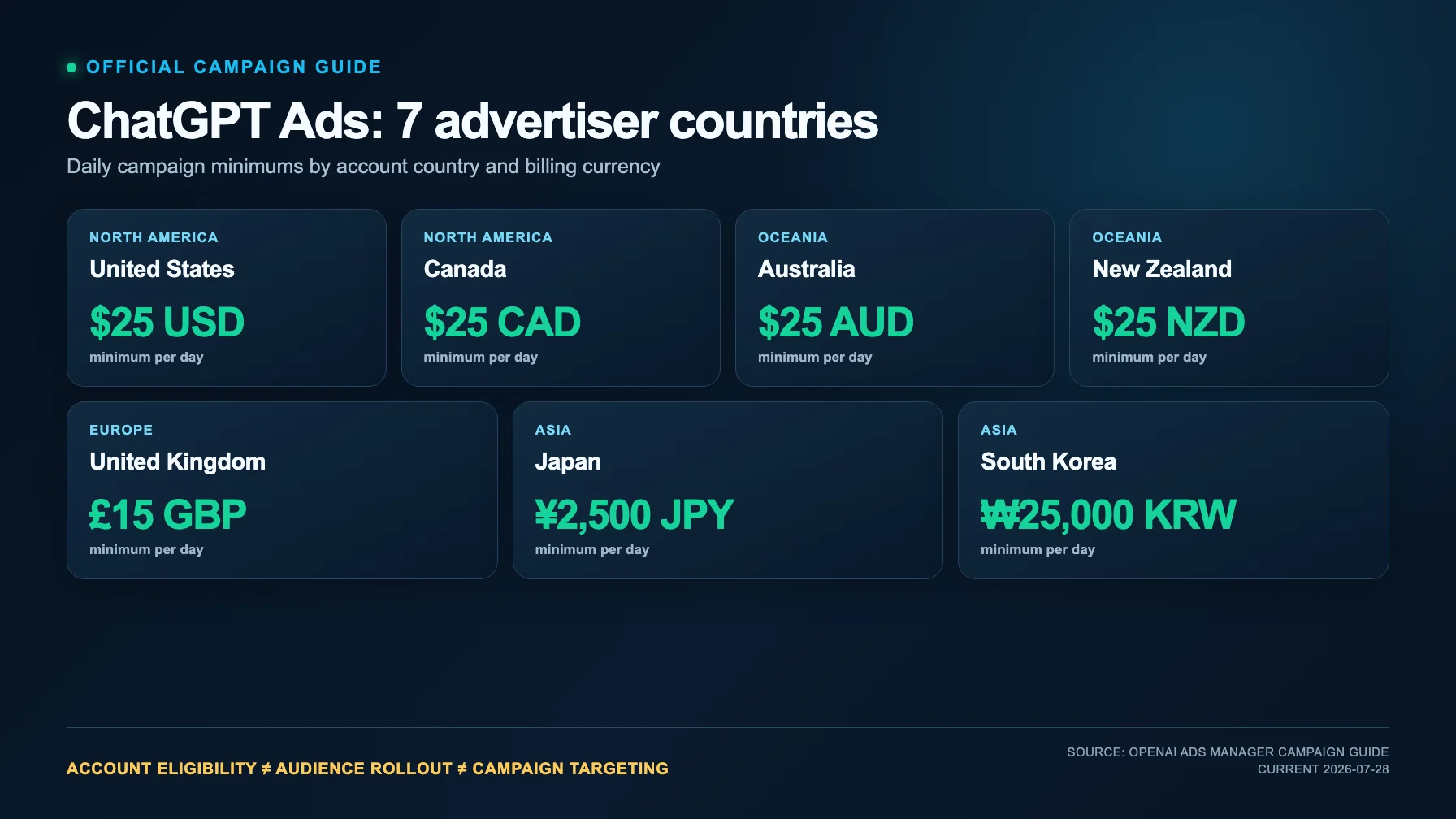
OpenAI's campaign documentation says location options appear in the campaign picker and may include countries plus supported states, regions, cities, DMAs, and postal targets. The picker is the operational source of truth for a specific account at launch time.
Consumer exposure follows a separate rollout. OpenAI began its user-facing test in the United States and later announced planned expansion to Canada, Australia, New Zealand, the United Kingdom, Mexico, Brazil, Japan, and South Korea. Mexico and Brazil appear in that announced consumer expansion but not in the current self-serve advertiser-account list.
Country, currency, and time zone deserve attention during account setup. OpenAI says those settings cannot be edited after creation. Fixing a mistake requires another advertiser account.
What ChatGPT Ads Costs Now
There is no public rate card showing an average ChatGPT CPC or CPM. The current product uses campaign objectives, local daily minimums, advertiser bid caps, and an auction.
Official daily campaign minimums
OpenAI's campaign creation guide gives the following minimum daily budgets.
| Advertiser account country | Minimum daily campaign budget |
|---|---|
| United States | $25 USD |
| Canada | $25 CAD |
| Australia | $25 AUD |
| New Zealand | $25 NZD |
| United Kingdom | £15 GBP |
| Japan | ¥2,500 JPY |
| South Korea | ₩25,000 KRW |
A daily budget is a delivery target, so spend can fluctuate. A campaign-total budget is a hard cap, although OpenAI warns that it does not pace evenly and may accumulate quickly.
For a U.S. campaign running every day, $25 multiplied by 30 days equals $750 in configured daily budget. That is arithmetic, not a minimum account commitment or a guarantee that the auction will spend the full amount.
Buying models and billing events
| Objective | What delivery optimizes for | Billing event |
|---|---|---|
| CPM | Reach or impressions | 1,000 impressions |
| CPC | Clicks or traffic | Valid click |
| oCPC | Clicks more likely to produce one selected standard conversion | Valid click |
The oCPC label can cause expensive confusion. Conversion-optimized CPC does not mean CPA billing. OpenAI's oCPC documentation says the advertiser still pays per valid click. The system uses the selected conversion event to influence delivery.
The selected event cannot be changed after the campaign is created. Custom events do not currently qualify for oCPC optimization. An existing CPM or CPC campaign also cannot be converted into oCPC, so a change of objective requires a new campaign.
The $3 to $5 number
OpenAI recommends starting a CPC campaign with a maximum bid of $3 to $5 per click. The adjective “maximum” does most of the work.
A $5 cap means the advertiser authorizes the auction to bid up to $5 for an eligible click. The relevance-weighted, second-price auction can clear below the cap. Weak relevance, low inventory, or competition may also prevent delivery. We cannot turn a bid recommendation into an average cost by repeating it often enough.
The early pilot price is history
The early controlled beta was a different commercial product. ADWEEK reported that OpenAI confirmed a $200,000 minimum commitment for select advertisers. Digiday later reported an initial $60 base CPM, buyer observations around $25 to $45 CPM, and a managed entry threshold that had fallen from $250,000 to $50,000.
Those figures explain how the market started. They do not describe today's self-serve minimums or predict today's auction CPM.
ChatGPT Ads Cost vs Google Ads and Meta Ads
The 2026 WordStream and LocaliQ search benchmark analyzed 13,474 U.S. search campaigns across Google Ads and Microsoft Ads from April 2025 through March 2026. Its reported medians were a 6.64% CTR, $5.42 CPC, 8.18% conversion rate, and $66.69 CPL.
The 2025 WordStream and LocaliQ Meta benchmark covered U.S. campaigns from April 2024 through June 2025. Traffic campaigns had a reported 1.71% CTR and $0.70 CPC. Lead campaigns had a reported 2.59% CTR, $1.92 CPC, 7.72% conversion rate, and $27.66 CPL.
| Platform input | Cost reference | Evidence | What the figure represents | Main limitation |
|---|---|---|---|---|
| ChatGPT Ads CPC | $3 to $5 | Official | OpenAI recommended starting maximum bid | Not average paid CPC |
| Search Ads | $5.42 | Reported | Median CPC in a Google and Microsoft search sample | Mixed platforms and industries |
| Meta traffic | $0.70 | Reported | Median CPC in a U.S. traffic-objective sample | Traffic is not a lead |
| Meta leads | $1.92 | Reported | Median CPC in a U.S. leads-objective sample | Different placement and intent |
| Meta leads | $27.66 | Reported | Median CPL in the same leads sample | Not a forecast for another account |
Google Search usually captures explicit demand with mature keyword controls and query reporting. Meta creates or captures demand through audience and creative delivery, where a cheap click can still represent casual interest. ChatGPT can meet a buyer during research and comparison, but public data does not show that its richer context consistently improves lead quality.
The question is therefore not “Which click costs less?” A better question asks what each additional $1,000 produces after lead qualification, gross margin, refunds, sales acceptance, and repeat revenue.
Budget Scenarios for $1,000, $5,000, and $20,000
The following table divides budget by a cost input. It estimates click capacity, not campaign performance.
| Budget | ChatGPT using $3 to $5 bid cap | Search using $5.42 CPC | Meta leads using $1.92 CPC | Meta traffic using $0.70 CPC |
|---|---|---|---|---|
| $1,000 | 200 to 333 clicks | 185 clicks | 521 clicks | 1,429 clicks |
| $5,000 | 1,000 to 1,667 clicks | 923 clicks | 2,604 clicks | 7,143 clicks |
| $20,000 | 4,000 to 6,667 clicks | 3,690 clicks | 10,417 clicks | 28,571 clicks |

The ChatGPT range treats the maximum bid as though it were the actual CPC. A second-price auction may charge less. Limited inventory or weak matching may also keep the campaign from spending. The Google and Meta columns use observed third-party medians rather than bid caps.
Published CPL produces another planning reference:
| Budget | Leads at $66.69 search CPL | Leads at $27.66 Meta CPL |
|---|---|---|
| $1,000 | 15 | 36 |
| $5,000 | 75 | 181 |
| $20,000 | 300 | 723 |
ChatGPT has no corresponding CPL benchmark, so any lead estimate requires an assumed conversion rate.
| Budget | ChatGPT at 2% CVR | ChatGPT at 5% CVR | ChatGPT at 8% CVR |
|---|---|---|---|
| $1,000 | 4 to 7 leads | 10 to 17 | 16 to 27 |
| $5,000 | 20 to 33 | 50 to 83 | 80 to 133 |
| $20,000 | 80 to 133 | 200 to 333 | 320 to 533 |
The ranges use an actual CPC between $3 and $5. A 2% CVR implies a $150 to $250 CPA. A 5% CVR implies $60 to $100. At 8%, the implied CPA falls to $37.50 to $62.50.
None of those conversion rates comes from OpenAI. They are sensitivity inputs designed to show what would need to happen.
How I would scope each budget
$1,000 is a feasibility test. Keep one country, one offer, and two or three context themes. In a U.S. account, the $25 daily minimum supports up to 40 configured days. Validate delivery, tracking, click quality, and early economics without building a large test matrix.
$5,000 supports structured learning. Add more creative angles and enough time to let conversion data settle. Split campaigns only when each cell can gather decision-level volume. A clean one-offer test is worth more than five underfunded campaigns.
$20,000 supports expansion after proof. Add another region, offer, or landing-page treatment only after the first cell has accurate tracking and acceptable economics.
Break-Even CPA and Required Conversion Rate
Click cost becomes useful when it is connected to unit economics.
Use these equations:
- Break-even CPA = gross profit per customer × acceptable acquisition share.
- Required click-to-customer CVR = expected actual CPC ÷ break-even CPA.
- Maximum break-even CPC = break-even CPA × expected click-to-customer CVR.
Assume a business earns $500 in gross profit from a new customer and allows 30% of that gross profit for acquisition. Its maximum CPA is $150.
| Actual CPC | Required click-to-customer CVR for $150 CPA |
|---|---|
| $1 | 0.67% |
| $3 | 2.00% |
| $5 | 3.33% |
| $8 | 5.33% |
A $5 click can beat a $1 click if it converts more than five times as well or produces customers with higher gross profit. Cheap traffic loses its advantage when sales rejects the leads, return rates rise, or the buyers never reach a second purchase.
The published competitor CPLs give a second threshold:
| ChatGPT actual CPC assumption | CVR required to match $66.69 search CPL | CVR required to match $27.66 Meta CPL |
|---|---|---|
| $3 | 4.50% | 10.85% |
| $5 | 7.50% | 18.08% |
Matching Meta's aggregate lead CPL is a demanding bar at a $5 CPC. A high-consideration B2B service may still accept a higher CPL if ChatGPT leads reach sales with better context and close at a higher rate. A low-margin ecommerce offer may fail even when the platform reports conversions.
I would compare qualified CPA, gross profit per click, sales acceptance, contribution margin, payback, and incrementality beside existing Google and Meta campaigns.
The same measurement discipline applies to organic AI traffic. A ChatGPT referral audit separates a visible AI mention from the visit and business outcome. Paid ChatGPT needs the same separation between impression, click, conversion, and profitable customer.
Step-by-Step ChatGPT Ads Campaign Setup
The fastest campaign launch is not the best first launch. Measurement errors do not backfill cleanly, while immutable account settings and locked campaign objectives make some mistakes expensive.
1. Create the advertiser account
Open ads.openai.com and sign in with the OpenAI account that should own the advertiser. Enter the legal business name, real website, logo, industry, and billing details.
Choose the country, currency, and time zone with care because they cannot be changed after account creation. Give team members their own access rather than sharing a login.
2. Complete identity and account review
OpenAI uses Persona for verification. Identity verification and the advertiser-account review are separate steps. OpenAI says it cannot expedite the review queue, and duplicate applications may slow the process.
3. Configure billing
Add the billing profile and card. OpenAI uses postpay billing and may place a temporary $100 authorization hold. A payment threshold controls when the card is charged, while campaign budgets control media.
4. Install measurement before delivery
Create the data source and install the OpenAI Pixel. Add the Conversions API when the development and consent setup allows it because browser and server signals fail in different ways.
OpenAI assigns a click reference named oppref. Preserve it through redirects, navigation, checkout steps, and server-side events. If the same conversion is sent from Pixel and CAPI, reuse the same event_id so OpenAI can deduplicate the two records.
Add static UTMs because dynamic UTM macros are not currently supported. Use the standard event closest to the commercial outcome, such as lead_created, order_created, trial_started, subscription_created, or appointment_scheduled. Confirm the event in Ads Manager, analytics, and the CRM or commerce system.
A technical SEO advisory can help when redirect chains, consent tools, client-side routing, or checkout domains break the identifier between click and conversion.
5. Choose the campaign objective
Use CPM when reach is the primary outcome. Use CPC for an initial traffic and landing-page test. Use oCPC after a supported conversion event is accurate and frequent enough to guide optimization. Moving to oCPC requires a new campaign.
6. Set geography, dates, and budget
Begin with one country and one commercial objective. Separate countries when language, currency, landing page, regulation, or unit economics differ.
Set a daily budget that can run past reporting and conversion lag. Do not divide $1,000 across ten locations because each cell may lack enough qualified outcomes for a decision.
7. Build focused ad groups
Each ad group should represent one product family, use case, or need. Context hints should describe conversations where the offer is genuinely useful.
Weak context hint:
marketing, AI, ads, software, growth
Stronger context hint:
Small ecommerce teams comparing tools that automate paid-media reporting across Google and Meta without replacing their analytics stack.
The second example supplies a buyer situation, category, comparison task, and constraint. Avoid keyword stuffing and add information beyond the title and copy.
8. Set the bid
For CPC, OpenAI recommends starting with a $3 to $5 maximum bid. Choose the lower end when the break-even CPC is tight. Raise the cap only when delivery is constrained and the higher possible actual CPC remains economically acceptable.
9. Create distinct ads
OpenAI's creative guidance recommends broad coverage through distinct messages rather than small rewrites of one claim.
Current format guidance includes:
- title of 16 to 24 characters recommended, 50 maximum
- copy of 32 to 48 characters recommended, 100 maximum
- square PNG or JPG, no larger than 1200 × 1200
- publicly accessible image URL
- relevant landing page with crawler access
Test materially different value angles such as saved time, total cost, or an implementation concern. Changing “Save reporting time” to “Spend less time reporting” does not create a useful new test. Keep the square image legible and do not fabricate a dashboard, result, certification, or customer quote.
10. Match the landing page to the conversation
Send the click to the page that resolves the promise. A comparison ad should reach a comparison or use-case page, while a local service ad should open a relevant location page. The homepage is usually too broad.
Do not block OAI-AdsBot or OAI-SearchBot from the destination. Review the page's mobile speed, form behavior, consent state, analytics, and conversion event before launch.
11. Validate and submit
Check names, bids, budgets, dates, locations, character limits, image availability, landing-page response, policy compliance, event mapping, and billing. OpenAI supports guided creation and bulk CSV upload.
OpenAI says an active campaign should begin showing impressions and clicks within 24 hours. Reporting may lag by up to 7 hours.
ChatGPT Ads Optimization Tips
Early optimization should remove uncertainty in a controlled order. Changing the bid, budget, creative, context hints, and page on the same day hides the cause of any movement.
Protect measurement first
Inspect oppref retention across every redirect and domain boundary. Compare Pixel events with CAPI events and verify deduplication. Reconcile Ads Manager, analytics, and the CRM using the same date, time zone, and conversion definition.
OpenAI says attributed conversions may take 24 to 48 hours. A same-day zero is not enough to pause an otherwise healthy test. A broken event is enough to stop spending until tracking is repaired.
Misconfigured conversion mapping does not backfill historical events. Run a small prelaunch transaction or lead test.
Optimize context hints by commercial need
Group hints around situations buyers describe, rather than isolated category nouns. Review which themes produce qualified visits and downstream outcomes. If the platform gives limited placement detail, use separate ad groups to preserve a readable test structure.
Judge creative by promise and outcome
CTR can identify an attractive message. It cannot prove that the message attracts the right buyer. Compare each angle on conversion rate, qualified rate, revenue per click, and post-click behavior.
Control bid and budget changes
Raise the bid cap when relevant ad groups cannot deliver and the new cap remains below the economic maximum CPC. Lower it when the actual CPA exceeds the break-even point and conversion quality does not compensate.
Scale budgets in measured steps after tracking and conversion quality stabilize. Leave enough time after a change for reporting and conversion lag.
Use oCPC only with a healthy signal
Create an oCPC campaign after the selected standard event is reliable and occurs often enough to evaluate. Keep the original CPC campaign as a clean reference when practical.
Choose a business outcome rather than a shallow event. If the valuable event is too rare, gather more CPC data before asking the system to optimize around a weak signal.
Add a stop-loss before launch
Set the stop-loss from unit economics and expected conversion volume, not frustration.
One practical rule is:
Pause an ad group when spend reaches 1.5 to 2 times the maximum acceptable CPA without a qualified conversion, after confirming that attribution delay and tracking are not responsible.
That multiple is an editorial test rule, not OpenAI guidance. Long sales cycles may need a larger window and an intermediate qualified-lead signal.
At campaign level, stop or redesign when:
- actual CPC requires a conversion rate above the landing page's credible range
- qualified CPA remains above the ceiling after the agreed learning budget
- the CRM rejects a large share of attributed leads
- the platform cannot deliver enough relevant volume
- the same offer already produces better marginal profit through Google or Meta
- tracking discrepancies prevent an economic decision
Document the decision before launch. Teams negotiate with bad results when the rule is written afterward.
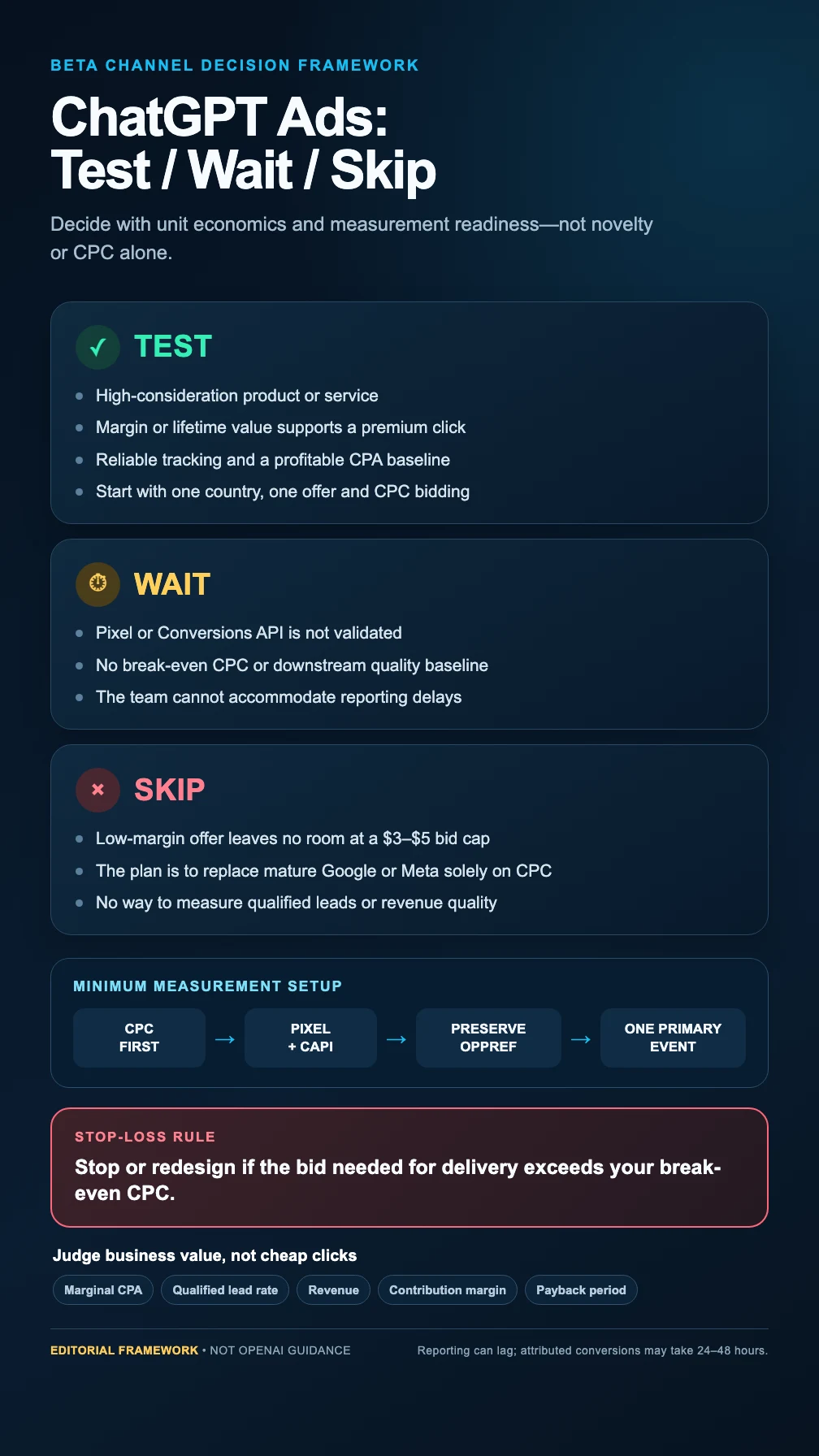
When ChatGPT Ads Is Worth Testing
ChatGPT Ads is strongest as a test when the product benefits from an explanation, comparison, or considered decision.
Good candidates include:
- B2B software with clear use cases and meaningful contract value
- professional services where the buyer researches expertise and fit
- higher-consideration ecommerce products with product-specific evidence
- subscriptions with enough lifetime gross profit to fund learning
- advertisers with reliable Google or Meta baselines
- offers supported by useful comparison, calculator, guide, or category pages
An established ecommerce SEO program can support paid conversational traffic when category and product pages already explain buyer fit, constraints, and proof.
The test is less attractive when:
- gross profit cannot tolerate a $3 to $5 bid cap
- the offer relies on an impulse click with little need for research
- conversion tracking is incomplete
- the business cannot identify qualified leads or contribution margin
- the landing page makes broad claims without proof
- existing Google Search demand is underfunded and highly profitable
- Meta creative has not been tested enough to establish a baseline
- the advertiser expects a predictable CPA from a beta with no benchmarks
Do not remove profitable Google demand coverage or Meta's best creative cells to fund novelty. Use an experimentation budget or the weakest marginal spend, then make ChatGPT earn more.
A Practical 30-Day Test Plan
For a U.S. advertiser with $1,000, I would use this starting structure:
| Element | Initial choice |
|---|---|
| Country | United States |
| Offer | One high-value product or service |
| Objective | CPC |
| Daily budget | $25 to $35 |
| Max CPC | Start within OpenAI's $3 to $5 guidance, subject to break-even CPC |
| Ad groups | 2 to 3 commercial context themes |
| Ads | 3 materially different angles per ad group |
| Landing pages | One specific page per offer or angle where needed |
| Primary event | Closest supported revenue or qualified-lead event |
| Measurement | Pixel, CAPI, static UTMs, oppref, CRM reconciliation |
In week 1, verify delivery, actual CPC, identifier retention, event mapping, and the landing page. Week 2 can remove misleading creative and inspect lead quality. Adjust bids during week 3 only where delivery or economics justify it. In week 4, compare qualified CPA and revenue per click with marginal Google and Meta results, then continue, redesign, or stop. Low-volume businesses may need longer than 30 days.
Prelaunch readiness checklist
- The offer has enough gross profit or lifetime value to tolerate a premium click.
- Break-even CPA and maximum CPC are written down.
- Required CVR at $3 and $5 remains credible for the landing page.
- Pixel, CAPI, UTMs,
oppref, and event deduplication pass an end-to-end test. - The last 90 days of Google and Meta qualified CPA provide a comparison baseline.
- Country, currency, and time zone have been checked before account creation.
- A 5% to 10% learning allocation is approved without a promised ROAS.
- The stop-loss and reporting-delay rules are agreed before launch.
An unchecked item is preparation work. Paying for traffic will not fix it.
Frequently Asked Questions
How much do ChatGPT Ads cost?
OpenAI recommends a $3 to $5 starting maximum CPC bid, not an average paid CPC. Daily campaign minimums begin at $25 USD in the United States and £15 GBP in the United Kingdom. OpenAI publishes no platform-wide average CPC, CPA, or ROAS.
Is there still a $200,000 minimum for ChatGPT Ads?
No current self-serve documentation requires $200,000. ADWEEK reported that amount for the early controlled pilot. Current self-serve campaigns use daily minimums, bid caps, and auction pricing.
Is ChatGPT Ads cheaper than Google Ads?
OpenAI's $3 to $5 recommended maximum CPC is below the cited $5.42 search median. One is a bid cap and the other is an observed Google and Microsoft benchmark, so CPA and customer quality decide value.
Is ChatGPT Ads cheaper than Meta Ads?
The cited Meta medians of $0.70 for traffic and $1.92 for lead-campaign clicks are lower than OpenAI's recommended cap. ChatGPT needs stronger conversion or lead quality to justify the premium.
What countries can use ChatGPT Ads Manager?
OpenAI currently lists Australia, Canada, Japan, Korea, New Zealand, the United Kingdom, and the United States for self-serve advertiser accounts. Consumer ads rollout and campaign geotarget availability follow separate lists.
Can a ChatGPT Ads campaign target Mexico or Brazil?
OpenAI announced Mexico and Brazil for consumer-pilot expansion, but neither appears in the seven-country advertiser-account table. Check the campaign location picker for current target availability.
Does ChatGPT Ads support keyword targeting?
The platform uses context hints that describe relevant conversational themes and user needs. OpenAI says they are broad semantic signals, not exact-match keywords, and they do not guarantee delivery in a particular conversation.
Does oCPC mean I pay only for conversions?
No. An oCPC campaign optimizes click delivery toward one selected standard conversion event, while billing remains per valid click. The campaign's CPA can be calculated after conversions occur, but CPA is not the billing event.
Should I install both the OpenAI Pixel and Conversions API?
OpenAI recommends using both when practical. Preserve the oppref click reference and send the same event_id with matching browser and server events so the platform can deduplicate them.
How long should I wait before optimizing?
OpenAI says reporting can lag by up to 7 hours and attributed conversions may take 24 to 48 hours. Confirm tracking immediately, but avoid judging conversion performance from same-day data alone.
Should ChatGPT Ads replace Google Ads or Meta Ads?
Not based on current public evidence. Use ChatGPT as an incremental test and compare qualified CPA, gross profit per click, lead quality, and incrementality with the marginal performance of mature campaigns.
About the Author