How to Track AI Overviews on Your Own Keywords (and Ignore the Rumors)
AI Overviews tracking without the rumors: build a fixed query set, measure presence and citations weekly, and read Search Console without double counting.
You open a viral post and suddenly need an answer for your next meeting. AI Overviews tracking starts with a fixed query set grouped by intent and country, measuring presence and citations week over week. Cross-check that record with Search Console, keeping AI impressions inside Web totals to avoid double counting.
| Metric | What it tells you | Where it comes from |
|---|---|---|
| AIO presence rate | How much of your query set shows an AI Overview | Consistent SERP checks |
| Citation rate | How often your domain appears when an AIO is present | AIO supporting links |
| Cited URL versus ranking URL | Whether the same page represents you in both places | AIO links and organic results |
| AI share of Web impressions | Your page's AI impressions relative to its Web total | Both Search Console reports |
| Clicks and conversions | Whether business outcomes move alongside visibility | Performance report for clicks, conversion records for conversions |
This is the weekly method I recommend as a practitioner. Google's documentation defines the features and reporting rules. The cohort size, checks and decision threshold below are my practice, not Google guidance.
1. Why rumors are useless for decisions
In late October 2026, after Alphabet's earnings call, claims that Google was removing or showing fewer AI Overviews spread widely. A widely shared post was part of that discussion. That gives you context for the questions arriving in your inbox, but no baseline for your site.
On October 31, Gagan Ghotra wrote: "in last couple of days I have talked to a lot of tools provider - no one in their scraping data is seeing lesser AI Overviews in results post earnings call."
That is his report of conversations with tool providers, not a published dataset. He also described more organic product grids in AI Mode answers. His reading was that Google wanted more ad space, with organic products and product ads within those grids. That interpretation does not establish Google's motive.
Neither the rumor nor the reply measures your queries. Google's AI features documentation says AI Overviews often do not trigger. It also says AI Mode and AI Overviews can use different models and techniques, producing different responses and links.
An observation about AI Mode cannot settle what happened to your AI Overviews cohort. For the feature mechanics, see how Google AI Overviews work.
2. Build a fixed query set by intent and country
I would start with 50-200 queries per site and freeze the set for a quarter. Tag each query by intent: informational, commercial, transactional, branded or support. Add country, language, device, page type and target URL.
Use these column names to build the cohort sheet. Leave the rows empty until you have selected your actual queries.
| Query | Intent | Country | Language | Device | Page type | Target URL | Cohort |
|---|
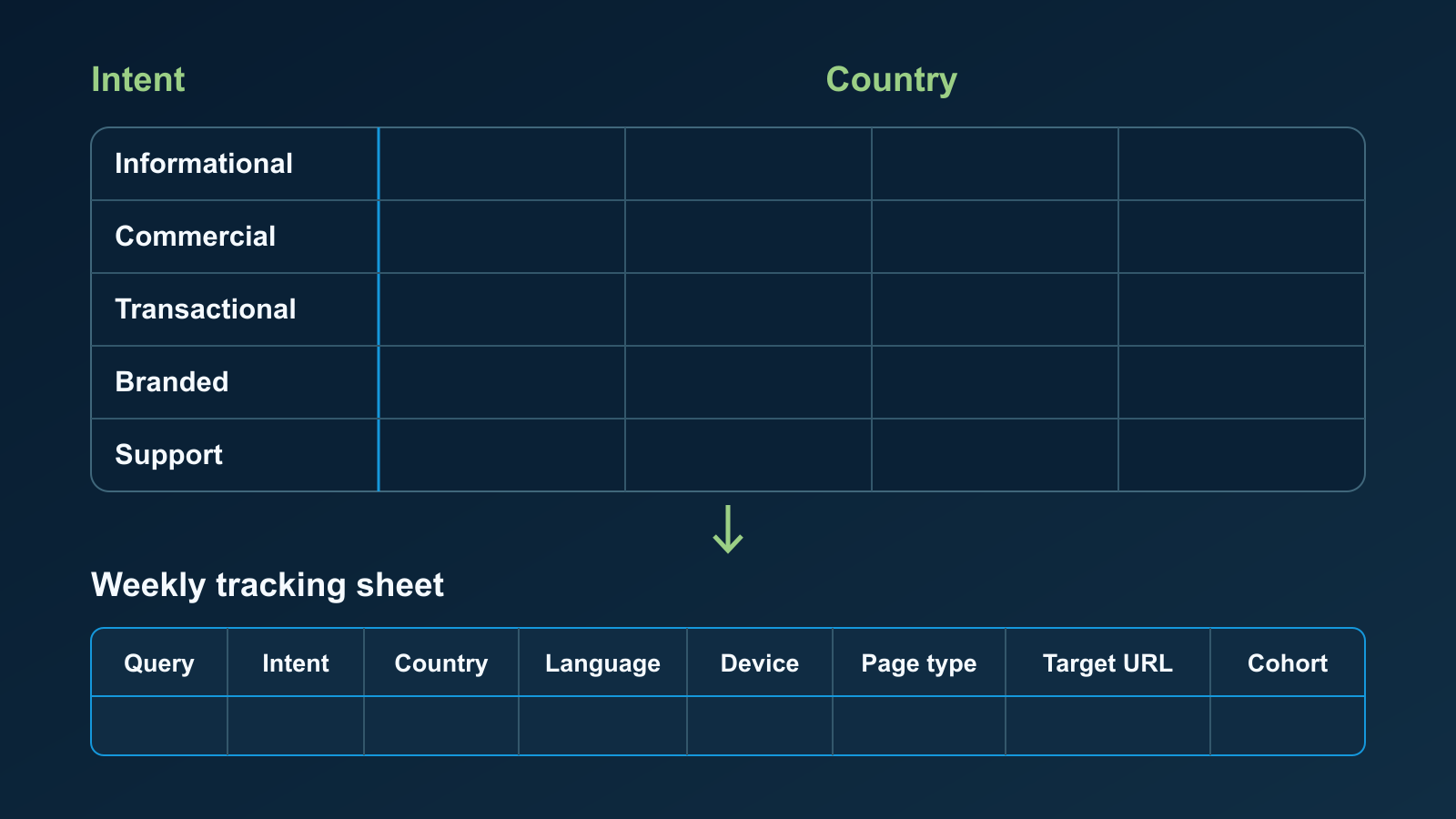
Compare each cohort with itself. If you add queries during the quarter, put them in a separate cohort rather than changing the existing denominator. Otherwise, a different selection can look like a change in AI Overview presence.
Keep branded queries identifiable. AI Overviews on brand searches belong in that context, rather than disappearing into a sitewide average. Keep the target URL visible too: it records which page should represent the topic.
3. What to measure each week for AI Overviews tracking
To track AI Overviews consistently, keep the device, country and language the same each week. Use logged-out sessions where possible, and record the tool and settings. A changed setup needs a note before its results reach the weekly report.
Record these measures for every cohort:
- AIO presence rate: queries showing an AI Overview divided by all queries in the cohort.
- Citation rate: queries citing your domain divided by queries showing an AIO. The denominator excludes queries without one.
- Cited URL versus ranking URL: record both and whether they match. Keep the intended target URL alongside them.
- Approximate citation position: note the page's place in the AIO link list. Layouts vary, so label it approximate.
- Organic position: record the cited URL's organic position separately from its place among AIO links.
Then bring in Search Console clicks and impressions for the same queries and pages. Keep the SERP observation and the performance result distinct: being cited does not establish that the citation produced a click.
Expert Insight
The most useful AI Overviews number is your own cohort's week-over-week trend. I would use that trend to decide what needs investigation, because an industry average answers someone else's question.
4. Cross-check Search Console without double counting
The Search Console Generative AI performance report gives you another view of visibility. According to the Search Console help page, it includes impressions for AI Overviews and AI Mode. Those impressions count links to your site shown in a generative AI feature. Search Labs experiments are excluded.
The data is already included in the Performance report's Web search type. Never add AI impressions to Web impressions. You would count the same activity twice.
For each canonical page, I would report:
AI share of Web impressions = AI impressions / Web impressions
Match the page, date range, country and device on both sides. The AI report uses Pacific Time dates. Label the share as AI Overviews plus AI Mode, because that report is not an AIO-only measurement.
Keep that label in the report you send to marketing. Your SERP sheet measures whether a summary appeared for selected queries. Search Console counts impressions of links to your site across both AI features. Those views answer different questions, so a change in one needs the context of the other before you explain it.
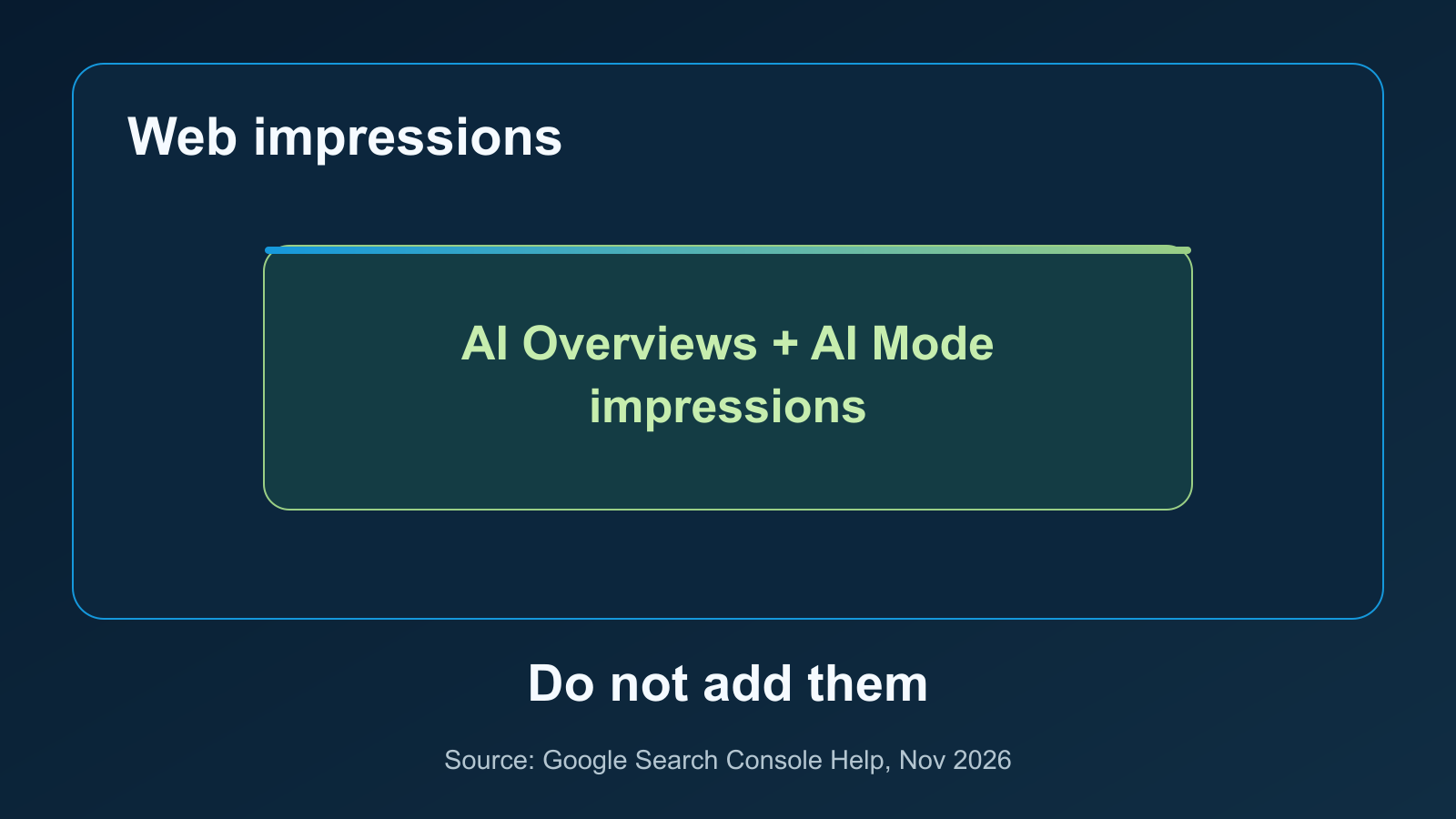
Check aggregation before comparing totals. The chart aggregates by property: two links from the same site in one feature count as one impression. A table grouped by page aggregates by page, so its total can differ from the chart. Keep those levels separate in your reporting.
The AI report has impressions and no clicks metric. Read page clicks in the Performance report, and do not attribute revenue to AI visibility from the AI report alone. Its page-level view complements your query checks without identifying which citation produced a visit.
5. Validate scraping tools with manual checks
Scraped results need validation before they influence a content decision. In its October 2026 Poisoned SERPs report, AccuRanker described normal-looking pages with swapped organic results. Some affected results remained after its checks.
Those findings concern its organic results sample, not your site or an AIO error rate. They support a practical precaution: check scraped observations. The figures and validation details are in rank trackers reporting bad SERP data.
Each week, manually sample 10-20 queries, prioritizing large reported changes. Use incognito, the correct country, and the same device and language. Save a screenshot with the date. If the tool and manual result disagree, re-run before reporting a trend.
A manual check is also a sample. AI Overviews can vary between runs and users. The related problem with AI visibility and prompt trackers is another reason to keep the sampled question and measurement conditions visible.
6. When a change justifies touching the content plan
My threshold is a trend lasting three or more consecutive weeks across a cohort, with clicks or conversions moving alongside it. One query cannot stand in for the cohort. Even when those signals agree, they do not establish the cause by themselves.
Within that threshold, these patterns justify reviewing the plan:
- AIO presence rises for commercial queries while clicks fall and impressions hold.
- A competitor is consistently cited for your core informational queries.
- The cited URL differs from the page intended to represent the topic.
Use the evidence to define the review: the affected intent, cited page, intended target and accompanying performance change. Give the team that brief before deciding which content to change.
A viral post, one week of data or one tool's chart does not meet that threshold. Keep collecting and validating before you change priorities.
7. A short weekly checklist
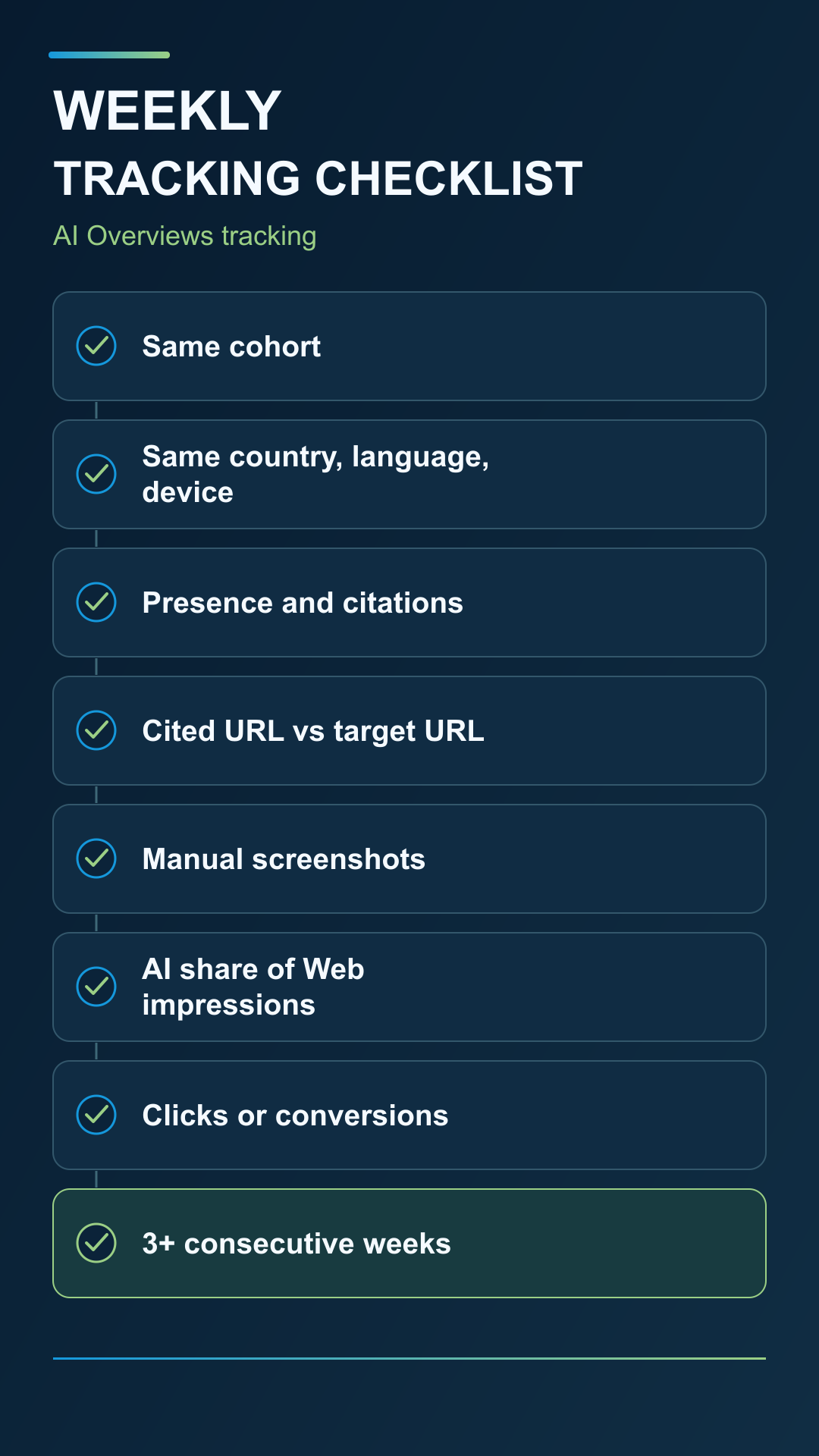
- Reuse the frozen query set and settings.
- Update presence, citations, URLs and positions.
- Check 10-20 queries manually and save dated screenshots.
- Re-run disagreements before circulating results.
- Calculate AI share of Web impressions for matching pages and filters.
- Compare clicks or conversions, then check the three-week decision threshold.
FAQ
Is Google removing AI Overviews?
As of November 1, 2026, Google's AI features documentation still describes AI Overviews as part of Search and contains no statement about removing them. Neither a viral claim nor Ghotra's provider conversations answers what happened to your keywords. Your own validated query data is the answer for your reporting.
How often should I check my AI Overview keywords?
I recommend weekly checks of the same query set and conditions. Keep that set fixed for a quarter, validate a manual sample each week, and look for three or more consecutive weeks before changing the content plan.
Can Search Console show AI Overview clicks?
The Generative AI report shows impressions, with no clicks metric. Use the Performance report for page clicks. That does not isolate clicks from an AI Overview citation.
Should I add AI impressions to my Web impressions?
No. Google says the AI report's data is already included in Web totals. Calculate a share using matching pages and filters instead of adding the two figures.
Do I need a paid tool to track AI Overviews?
You can start with a fixed query sheet, manual checks, dated screenshots and Search Console. A tool does not remove the need to validate results or keep settings consistent.
Do I need special markup to appear in AI Overviews?
Google says no special markup, AI text files or additional technical requirements are needed. A supporting page must be indexed and eligible to appear in Search with a snippet. Eligibility does not ensure a citation.
A validated trend can justify an investigation. It does not prove what caused it.
If you need help reviewing the measurement behind your content priorities, an SEO audit with Growing Search can be a place to start.
About the Author