Google August 2026 Spam Update: Evidence Before Edits
Google's August 2026 spam update finished after 2 days, 16 hours. Preserve the baseline, separate manual actions, and audit the affected pattern.

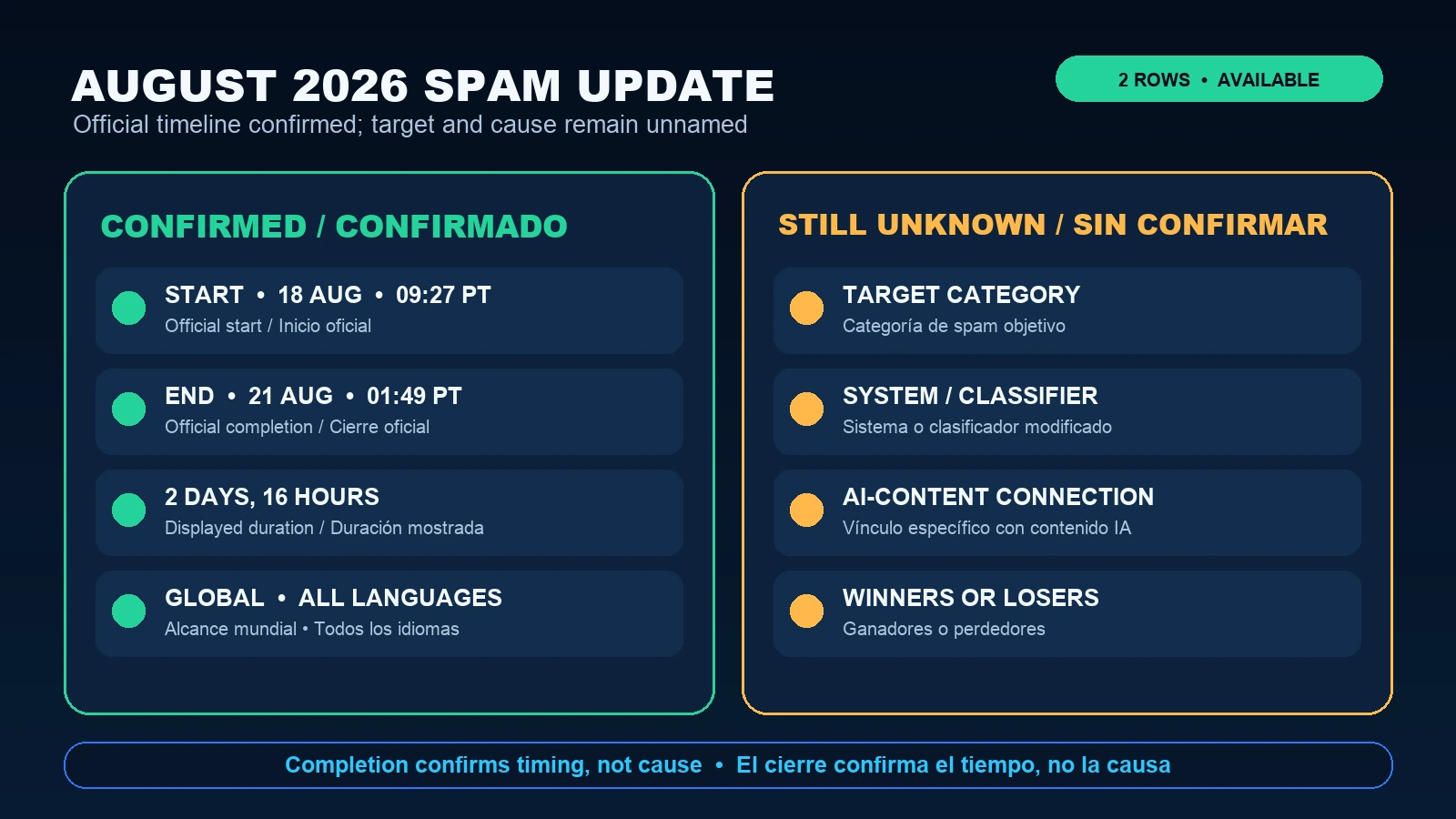
Google ended the August 2026 spam update on August 21 at 01:49 Pacific, after a start on August 18 at 09:27. The incident page now has a release row and a completion row, while the ranking history displays 2 days, 16 hours. The completion time is the measurement boundary that was missing during the rollout. It does not identify what Google targeted, so traffic movement still needs evidence before it can support a technical fix or policy remediation.
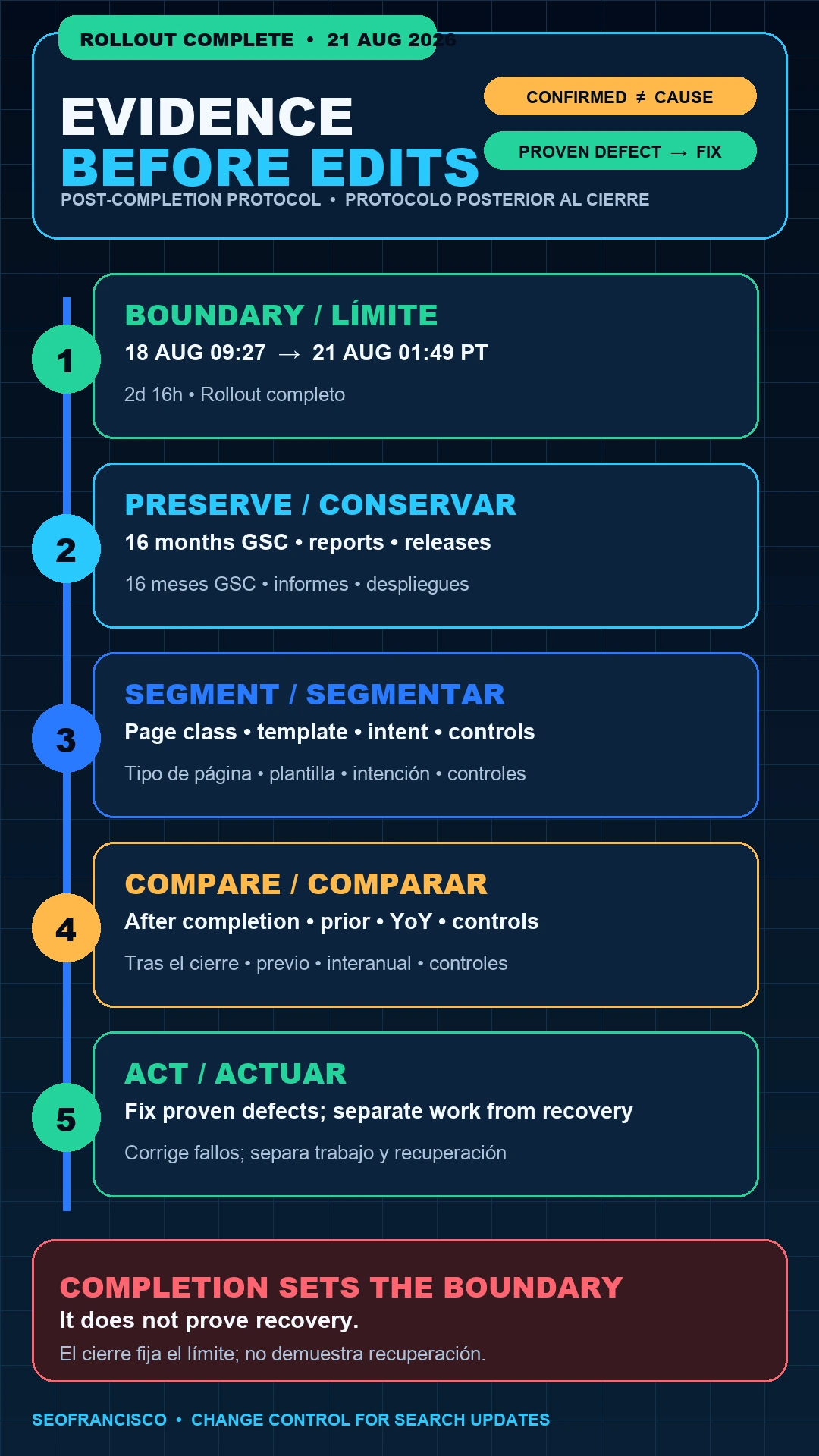
The sound response is to preserve evidence first, classify any loss against competing explanations, and approve changes only when a technical finding or policy pattern supports them.
TL,DR
- The official incident page records a start on August 18, 2026 at 09:27 Pacific and an end on August 21 at 01:49 Pacific. The update was global and applied to all languages.
- The incident page now contains 2 rows and confirms completion as of August 21. Google's ranking history labels the event
Availableand displays a duration of 2 days, 16 hours. - Google has announced no new policy and no target category for August. Claims about AI content, GEO abuse, links, or another specific target remain speculation.
- An automated spam update and a manual action have different evidence. Check Search Console's Manual Actions report before anyone describes a decline as a manual penalty.
- Freeze a reproducible Search Console baseline, deployment history, report states, and page-class inventory before broad edits contaminate the comparison.
- Match the observed loss to a technical cause or production pattern. Do not run the entire site through an undifferentiated rewrite.
- Google's automated reassessment can take months. Record remediation separately from rankings and set review dates without promising recovery.
Official Rollout Timeline
Google's incident record places the start at 09:27 Pacific on August 18, with the release note one minute later. The event affected ranking worldwide across all languages. Google ended it on August 21 at 01:49 Pacific.
The August 21 primary-source check found 2 rows on the incident page, one for release and one for completion. The completion row says the rollout was complete as of August 21. Google's ranking history changed the event to Available and displays 2 days, 16 hours.
This is the third spam update on Google's 2026 history. March lasted 19 hours and 30 minutes, June lasted 2 days and 1 hour, and August lasted 2 days and 16 hours on the history page.
The uncertainty also applies to the target. Google has not attached a new policy category, called the event link spam, described it as a core update, or tied it to AI-written pages. The previous June 2026 spam update analysis covered general triage. For August, use a narrower change-control record that can survive later investigation.
Automated Enforcement and Manual Review
Google describes spam updates as notable improvements to automated systems that detect search spam. SpamBrain is one example in the spam update documentation, though Google has not disclosed which system or classifier changed in August.
A manual action has a separate proof state. A human reviewer determines that pages violate policy, and Search Console reports the issue in the Manual Actions report. The account also receives a message. An automated ranking change does not create that report state or a reconsideration button.
Open the report and preserve the dated result before discussing a penalty. If it reports no issues, write that into the case file. An algorithmic decline may still justify a policy audit, but manual penalty would claim a human decision that the evidence does not support.
A confirmed action should be addressed immediately under the instructions for the affected pattern. The same urgency applies to a security issue or a proven technical defect. During the rollout, waiting for completion made sense only when the cause remained uncertain.
The Pre-Edit Evidence File
Broad edits made between the August 18 start and August 21 completion would contaminate the comparison that matters now. Once a team changes titles, internal links, copy, templates, and indexation rules together, a later rebound cannot be attributed to one intervention. A persistent decline becomes equally hard to explain.
Create a dated case folder and keep the raw exports unchanged. Add a short record of report filters, property, time zone, export time, and analyst so another person can reproduce the view.
Performance Baseline
Mark August 18, 2026 at 09:27 Pacific in the reporting system. Google's traffic-drop debugging guide recommends using up to 16 months of Search Console data to place a decline in seasonal context. Export that range, then preserve comparisons with the preceding period and the same period one year earlier.
Use separate views for Web, Images, Video, and News where they apply. Save page, query, country, device, and search-appearance dimensions with clicks, impressions, and average position. Search Console reporting lag makes the first few days provisional, so use the early snapshot to locate a pattern rather than announce a final impact figure.
Page Classes and Controls
Classify losing URLs by folder, template, intent, publishing method, and last meaningful change. A table of the 20 largest losses provides examples. Grouping those URLs reveals whether a shared process deserves scrutiny.
Choose unchanged pages with similar demand as controls. If one comparison template declines while a neighboring editorial template remains stable, the property total conceals the useful difference. If both groups move only in one country, demand or result-page composition deserves investigation before site quality becomes the working explanation.
Operational State
Preserve the Manual Actions, Security Issues, Page Indexing, and Crawl Stats states. Add server incidents and deployment records from the week around August 18, including changes to canonicals, redirects, noindex, robots.txt, rendered content, and internal links.
A component-level defect can resemble algorithmic movement. One canonical template may affect every article, while one robots rule may isolate a folder. The JavaScript rendering evidence review provides the right order when indexation or rendering evidence appears.
Loss Patterns and Evidence Thresholds
The loss pattern should choose the next test. Google's spam policies are broad, so reviewing every category with equal weight wastes time and encourages cosmetic edits.
| Observed evidence | Competing explanation | Threshold for action | Scoped response |
|---|---|---|---|
| Impressions stable while clicks fall | title, snippet, rich-result competition, or demand mix | positions remain stable and the click-through pattern changes by query | inspect snippets and search appearances before opening a spam audit |
| Positions and impressions fall across unrelated query groups | ranking-system movement, security, reporting, demand, or a sitewide deploy | the decline persists across folders after technical and report checks pass | inspect the production processes shared by the affected classes |
| One folder or template loses visibility | indexation defect, deploy change, or a page-class quality problem | the class declines against an unchanged control group | map that production method to the relevant policy risks |
| Movement begins with a release | canonical, redirect, noindex, robots, rendering, server, or internal-link defect |
logs and rendered output show a matching change | correct the defect and preserve the release boundary |
| Search Console confirms an action or security issue | human enforcement or compromise | the report itself supplies proof | remediate now and follow the report-specific process |
| Link-dependent pages move while comparable pages remain stable | lost link value or a link-policy problem | page-level link and ranking evidence supports the pattern | review the links without labeling August a link-spam update |
Policy review belongs at the level where the production risk exists. Hundreds of location pages built from swapped names may raise scaled content or doorway concerns. Copied manufacturer descriptions can point to scraping or thin affiliation. Third-party pages published for the host site's ranking signals belong in a site reputation abuse review. Rewriting a handful of introductions leaves each underlying system unchanged.
If no matching policy risk appears and the controls do not support a site-specific loss, record that outcome. Ranking movement is relative, and timing alone cannot show that Google judged the site as spam.
AI Content and GEO Claim Boundaries
Google's standing policies now cover attempts to manipulate generative AI responses in Search. Its July AI optimization guidance warns against publishing separate pages for query or fan-out variations primarily to manipulate rankings or generative AI responses. Both facts belong in a current policy audit.
No official source connects either behavior specifically to the August rollout. Headlines calling this an AI-content crackdown merge a standing policy with an unnamed system change. Google has also announced no August change to AI Overviews or AI Mode inclusion.
The generative AI content guidance distinguishes assistance from scaled abuse. AI can help with research and structure. Publishing many generated pages with little added value may violate scaled content rules. Purpose, evidence, originality, and the production pattern are stronger audit questions than the presence of a model in the workflow.
My reviews of Google's S-CTS and S-BERT spam research and Google's AI Search documentation add context for those system and policy boundaries. They do not identify an August target.
Scoped Changes After the Rollout
During the rollout, confirmed defects still deserved action. A broken canonical, compromised page, active manual action, or documented deceptive pattern had its own evidence and did not need an official end time. Pausing output from a risky template could also stop the affected class from growing during the audit.
Now that the official window has closed, uncertain ranking movement still needs tight change control. Assign each proposed edit a page class, hypothesis, owner, release date, and review date. Keep technical releases separate from content remediation when possible. A change register preserves the comparison between the affected class and its controls.
Avoid polishing individual pages when the production system creates the risk. Correct the generator, data source, editorial standard, moderation process, or indexation rule responsible for the class. If the evidence does not reach that threshold, preserve the baseline and continue measuring.
Post-Completion Measurement and Recovery Reporting
The August 21 at 01:49 Pacific end time supplies the official comparison boundary. Add it to the case file, then wait until Search Console contains the completed window. Rerun the saved exports with the same filters, search types, and comparison logic.
Check whether the affected class remains down against the prior period, the year-earlier period, and unchanged controls. Separate a click-only change from movement in impressions and average position. A recovery before any edit weakens the case for remediation tied to the update. A persistent class-level decline after technical causes are ruled out gives the matched policy audit more weight.
Google says automated systems may need months to recognize sustained compliance. A crawl, accepted indexing request, or short rebound does not prove reassessment. The stakeholder record should separate six fields: official rollout state, observed movement, affected page class, causes ruled out, approved changes, and next review date. Completed work can be reported as complete while ranking recovery remains unknown.
That distinction protects both the analysis and the client relationship. Evidence collected before edits supports a defensible explanation months later, even when the result differs from the original hypothesis. Teams needing an independent review can use technical SEO advisory support after the evidence file is assembled.
Frequently Asked Questions
When did the Google August 2026 spam update start?
The incident began on August 18, 2026 at 09:27 Pacific. Google posted the release note at 09:28, applied the update globally across all languages, and ended the rollout on August 21 at 01:49 Pacific.
Is the August 2026 spam update finished?
Yes. The official incident page records completion on August 21, 2026 at 01:49 Pacific and now contains 2 status rows. The ranking history labels the event Available and displays a duration of 2 days, 16 hours.
Does the update target AI-generated content?
Google has named no target for August. Existing guidance permits useful AI assistance and warns that scaled generation without added value may violate policy. No primary source ties AI-generated content specifically to this rollout.
Is a spam update the same as a manual action?
No. A spam update changes automated detection systems, while a manual action follows human review and appears in Search Console. A ranking decline during the rollout does not prove that a manual action exists.
How long can recovery take after a spam update?
Google says automated reassessment after improvements can take months, with no guaranteed timeline or outcome. Measure the affected page class after the official completion boundary and again over a longer period.
About the Author