Why Bing Deserves More Attention in SEO and GEO
Why Bing matters for SEO and GEO, how bulk BWT crawl checks work, and what crawl dates, lastmod and URL submission can tell you.
Bing deserves a place in an SEO review that includes visibility in ChatGPT. OpenAI documents a connection between Bing and some ChatGPT search workflows, which gives Bing crawl and index health a practical consequence beyond visits from its own results. If an important page is missing or its latest edit has not been crawled, that is a technical issue worth investigating before changing the content to chase an AI citation.
That is the case for giving Bing more attention. It comes from a documented route through which pages can become candidates for an answer, rather than evidence that every ChatGPT response depends on Bing. A bulk Bing Webmaster Tools checker can help inspect that route, provided its report keeps what Bing observed separate from what the checker infers.
At a glance. Bing is a documented provider in some ChatGPT search workflows. OpenAI also operates its own search crawler and indexed content. A generic bulk checker can compare Bing's reported crawl dates with reliable sitemap lastmod values to flag possible freshness gaps. Those warnings need investigation. Submission is a separate action, and neither a crawl nor an accepted submission guarantees indexing or an AI citation.
Bing's documented role in ChatGPT search
OpenAI's Enterprise and Edu documentation explicitly names Bing. ChatGPT may send it disassociated search queries to obtain web results. The workspace scope matters, so that statement should not become a claim about every ChatGPT account or answer.
The general search help page describes external search providers and query reformulation. The original ChatGPT search announcement describes third-party providers and partner content. These sources support monitoring Bing as part of search visibility. They do not publish an exhaustive routing map for every search mode.
The claim that OpenAI has no index of its own would be inaccurate. OpenAI documents OAI-SearchBot as its search crawler, and its offline web search documentation describes eligible workspaces using OpenAI's indexed and cached web content. Bing is one relevant source of search results within a system that also has other ways to retrieve information.
Google retrieval has a different evidence basis. Semrush reports independent tests involving Google-discovered pages. Olivier de Segonzac's analysis in Search Engine Land reports different retrieval pipelines across ChatGPT configurations. These are researchers' observations for their tested conditions, rather than an official OpenAI statement naming Google as a universal provider.
For a working SEO, the useful response is to check the systems that can supply pages and then measure actual answers separately. The ChatGPT Search workflow explains why discovery, page retrieval and the final citation need their own evidence. A Bing ranking cannot stand in for all of them.
A Bing review before content changes
If I were reviewing a recently updated site, I would put Bing's last crawl date beside the page's last meaningful edit before looking for a more complicated GEO explanation. That comparison would give me a short list to investigate, provided the sitemap dates are reliable.
The question is whether the available crawl record could describe the page before its update. A current, accessible page can still have an older reported crawl date. Even when Bing has fetched it, crawling and index inclusion remain different observations.
Bing search performance needs a separate review of the queries relevant to the site, including their reported impressions or clicks. AI visibility needs observed answers and citations, followed by website measurement when a visit occurs. The GEO attribution problem gets harder when a technical crawl signal is presented as proof of traffic or business value.
A generic bulk Bing Webmaster Tools checker
The approach below describes a generic checker using documented API methods. It is not a walkthrough of a specific product, and it does not describe a tool already available on SEOFrancisco.
1. Verify the site and obtain API access
The site must already be added and verified in Bing Webmaster Tools. Microsoft's API access guide places key generation under Settings > API Access. Although the workflow begins with the property to inspect, the key belongs to the user and covers that user's verified sites. It is not a key restricted to one property.
Microsoft recommends OAuth 2.0 and also documents API-key access. For the key-based inspection workflow, use a checker you trust before supplying the key. Microsoft specifically warns against giving it to an untrusted third party.
2. Supply URLs or a sitemap
The checker takes the verified site's address, authorized API access and a list of URLs. If it accepts a sitemap URL, it first reads the sitemap and extracts the pages to inspect, along with available lastmod values. That parsing is a feature of the checker, rather than an API parameter that inspects a whole sitemap in one call.
Keep the input useful for a decision. A list of recently updated articles answers a different question from a complete sitemap containing older pages. Grouping the results by directory or template can reveal where the possible gaps are concentrated, without turning each blank field into a sitewide problem.
3. Collect each URL's crawl information
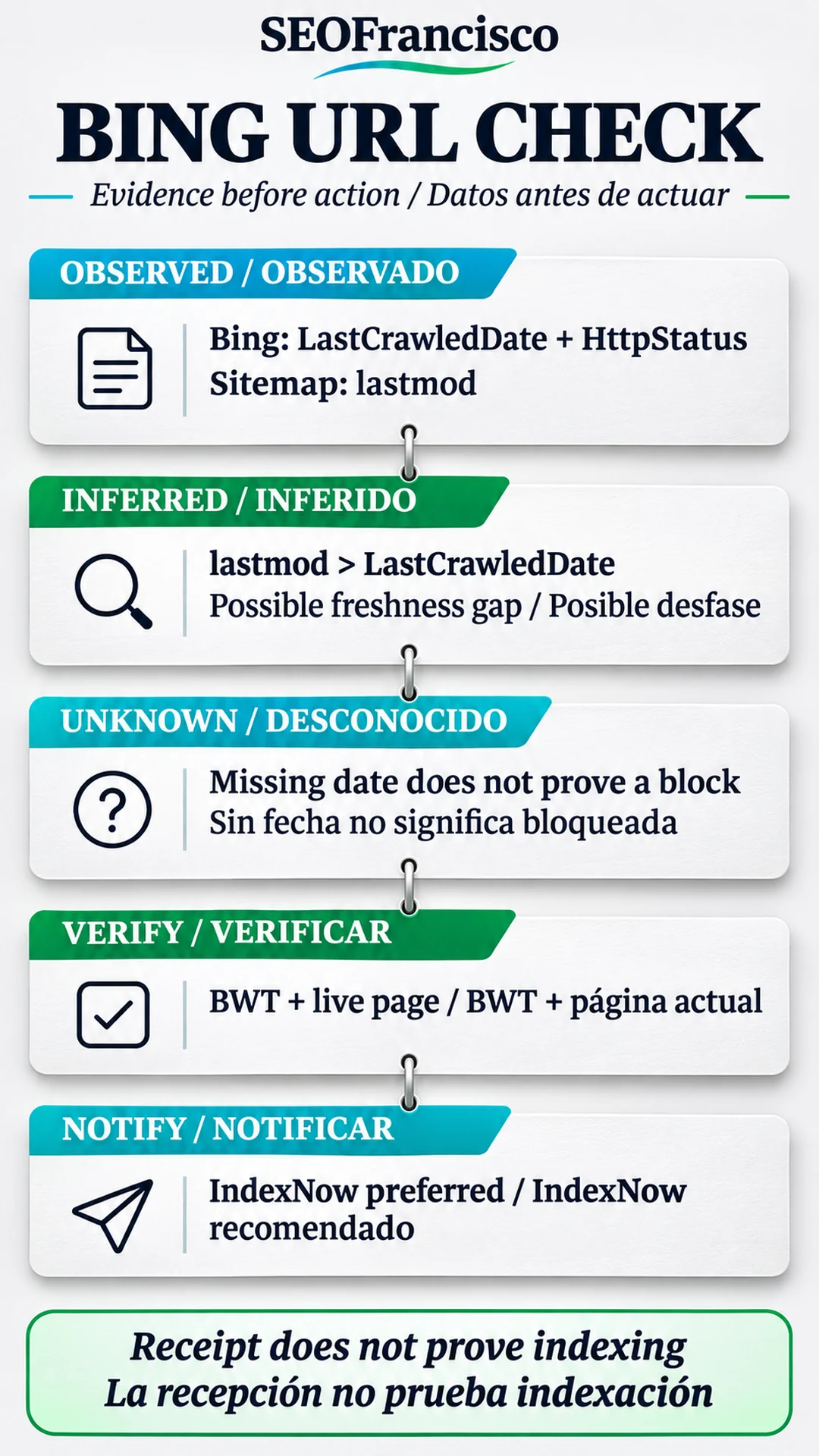
The checker calls GetUrlInfo for each URL. Its documented response includes LastCrawledDate and HttpStatus, alongside fields such as DiscoveryDate. Show the raw values so a reader can understand the basis of a warning.
There is no documented crawlable field. A checker that displays a crawlable or uncrawlable label has calculated an inference. An HTTP error can justify further investigation, but a historical response is not a live test of access. A missing crawl date means no usable date was returned. It does not prove the page has never been crawled, is blocked or is absent from the index.
Use the documented JSON/REST interface for a current implementation. Microsoft scheduled SOAP and POX retirement for August 31, 2026. The documentation checked on November 10, 2026 still contains older XML examples on some method pages, which should not dictate a new integration's protocol.
4. Compare the dates without overstating them
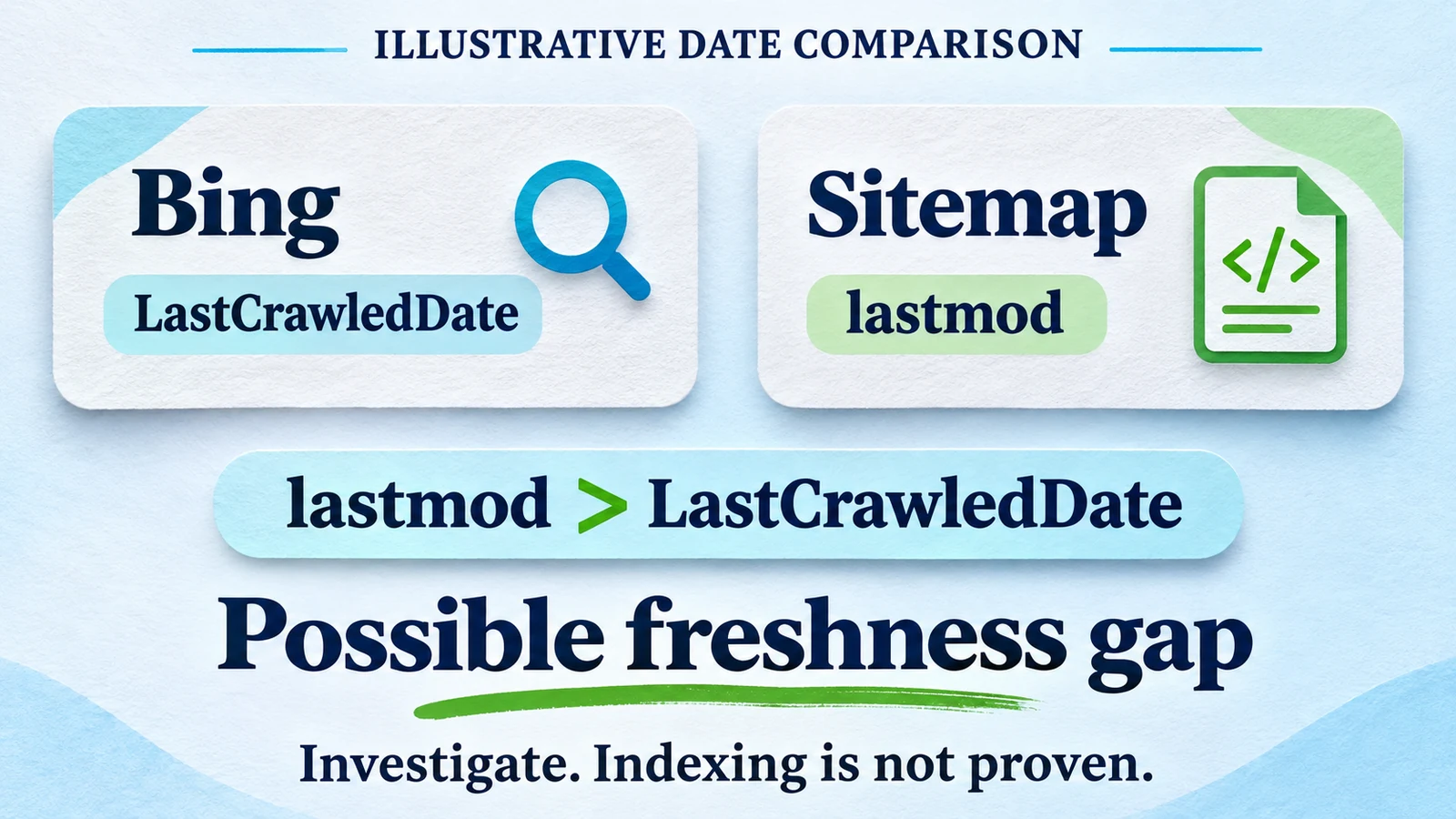
The sitemap protocol defines lastmod as the linked page's modification date, rather than the sitemap's generation date. When it is reliable and later than LastCrawledDate, the latest edit may await a crawl. Label that result as an inferred freshness gap.
| Reported situation | Useful reading | Limit |
|---|---|---|
Reliable lastmod is later than the crawl date |
The latest edit may await a crawl | Does not prove the text stored in Bing's index |
Crawl date is later than lastmod |
A reported crawl occurred after the declared edit | Does not prove successful indexing or canonical selection |
| Either date is missing or unusable | The freshness comparison is unknown | Does not establish a block or a current content copy |
| An HTTP error is reported | The URL needs investigation | Describes a reported response, not a live access test |
Normalize time zones before comparing timestamps. Also check how the CMS produces lastmod. If every deployment updates it across the sitemap, the report can flag pages whose content has not meaningfully changed. A precise-looking date comparison cannot fix unreliable input.
For that follow-up, I would inspect a few important URLs in Bing Webmaster Tools before sending anything. I would check whether a template problem explains the pattern, because submitting the same broken pages again would leave the underlying issue in place.
Optional submission after the inspection
Inspection and submission should be separate choices. Once the cause is understood, selected URLs with legitimate updates can be notified to search engines. Microsoft's URL submission guidance strongly recommends IndexNow. It still supports URL Submission, while warning that this method may be deprecated as IndexNow adoption expands.
For a checker that offers Bing URL Submission, SubmitUrlBatch accepts at most 500 URLs per call, within the available quota. The daily ceiling is up to 10,000 URLs per domain, resetting at midnight UTC. The actual allowance can be lower. Read GetUrlSubmissionQuota before submitting. Its daily and monthly values describe the returned allowance, and the sample figures in the documentation are not defaults.
Those are submission limits. They do not establish a daily inspection quota or a request rate for GetUrlInfo.
Authentication also needs a separate check. Current URL Submission help specifies OAuth 2.0, while older method references still show API-key examples. A generic inspection guide should not promise that the key used to read crawl information will also authorize submission.
An IndexNow HTTP 200 acknowledges receipt, rather than proving a crawl or indexing. The same distinction belongs in a bulk checker's action history. Record what was sent and what the service acknowledged, then verify the later outcome separately. An accepted notification cannot establish a ChatGPT citation.
I would like to build a similar bulk checker with a clearer separation between observed data and inferred warnings, plus a history of changes. That is a proposal for future work, and there is no SEOFrancisco checker to use today.
Frequently asked questions
Does Bing indexing guarantee a ChatGPT citation?
No. Bing is a documented provider in some ChatGPT search workflows, but inclusion in its index does not prove retrieval or citation in a particular answer. OpenAI also operates its own search infrastructure and uses other sources.
Does GetUrlInfo return a crawlable field?
No documented crawlable field exists. A checker must label any such status as inferred and show the observations behind it. Missing usable crawl data should remain unknown until investigated.
Does a newer lastmod prove Bing has the old page?
No. When lastmod is reliable and later than LastCrawledDate, it suggests that the latest edit may await a crawl. The comparison does not prove which content Bing stored or indexed.
Is Bing URL Submission still supported?
Yes. Microsoft still supports it and strongly recommends IndexNow. SubmitUrlBatch allows at most 500 URLs per call within remaining quota. Check GetUrlSubmissionQuota and the current authentication requirements before use.
Is there an SEOFrancisco bulk checker available?
No. This article explains a generic approach. A similar checker is proposed as future work, with no product available here today.
About the Author