SEO in 2026: The Multi-Platform Search Journey
SEO did not die. Learn how Google, YouTube, AI assistants, Reddit, reviews, and your website connect discovery, validation, and conversion.

SEO in 2026: The Multi-Platform Search Journey
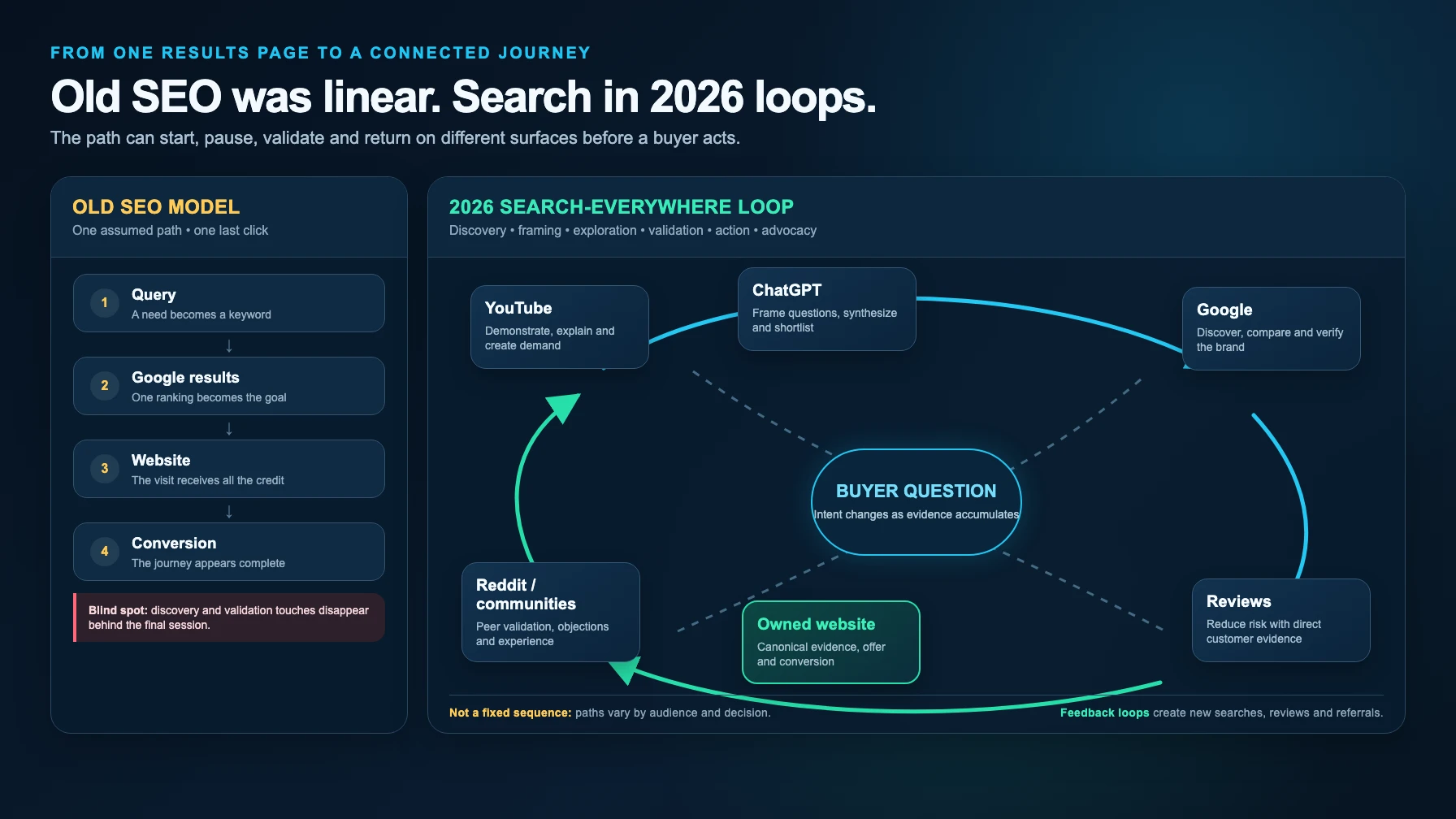
Brian Dean described a customer path at Exploding Topics that will feel familiar to many marketing teams. A buyer discovers a category on YouTube, asks ChatGPT for recommendations, searches the brand on Google, checks Reddit and G2, then visits the company website and buys.
The example came from Dean's public X post on July 30, 2026. An earlier Semrush video with Dean adds the detail that Exploding Topics had asked customers how they found the company and what they did before purchasing. Neither source publishes a sample size, interview dates, respondent mix, question wording, or the share of customers who used each step. Dean also says that customer paths vary.
That makes the sequence useful as a case, not a market benchmark.
The useful conclusion is larger than the five platforms in one anecdote. SEO did not die when people began searching on YouTube, ChatGPT, Reddit, Amazon, review sites, and social platforms. The customer journey became harder to observe because one surface may create demand, another may validate it, and a final branded Google query or website session may receive the conversion credit.
SEO in 2026 is still responsible for discoverability, evidence, relevance, and useful destinations. The job now follows the customer across the few search surfaces that matter for that audience instead of assuming every decision starts and ends on one results page.
TL;DR
- Brian Dean's YouTube to ChatGPT to Google to Reddit/G2 to website sequence is a first-person Exploding Topics example. It has no published sample or method and should not be treated as universal.
- Google still represented 73.7% of searches across 41 selected U.S. desktop domains in SparkToro and Datos's Q4 2025 analysis. Traditional search engines accounted for about 80% of the measured activity.
- Multi-platform does not mean equal platform importance. It means different surfaces can handle discovery, problem framing, comparison, trust validation, brand verification, and conversion.
- A model citation does not prove training. Training data, licensed access, live retrieval, citations, and recommendations are different mechanisms.
- Traditional SEO still controls crawlability, indexability, internal links, page structure, original evidence, entity consistency, and the quality of the owned destination.
- Select platforms from customer evidence and commercial need. Do not maintain every channel because someone called the strategy “search everywhere.”
- Repurpose one evidence base into native assets, rather than pasting the same article into YouTube, Reddit, LinkedIn, and review profiles.
- Measure the journey with customer-reported attribution, branded search, referrals, assisted conversions, review activity, repeated AI prompt probes, qualified leads, and revenue.
SEO Expanded Because Search Behavior Fragmented
The strongest data does not support a story in which ChatGPT replaced Google. SparkToro and Datos analyzed search activity across 41 selected domains using a 2025 desktop panel in the United States, EU27, and United Kingdom. In its U.S. Q4 2025 sample, Google accounted for 73.7% of searches. Traditional search engines represented about 80% of the measured total, compared with 10% for commerce sites, 5.5% for social platforms, and 3.2% for AI tools.
The boundaries belong beside those numbers. The study covers desktop behavior, uses an editorially selected domain set, and counts search activity rather than complete purchase paths. It still establishes two useful facts. Google dominated the measured activity, while a meaningful minority of searches happened elsewhere.
Volume also misses influence. A buyer can watch one detailed product demonstration, perform ten Google searches, read three community threads, and make one visit from a branded query. Counting interactions would make Google look like the whole journey. The video or community discussion may have carried the decisive evidence.
Google's messy-middle research offers a better mental model than a straight funnel. Buyers loop between exploration and evaluation while using search engines, social platforms, aggregators, and review sites. A person may discover a problem on YouTube, search the terminology on Google, ask an assistant for options, then return to Google with a brand and review modifier.
The practical change is an expanded audit boundary. Ranking pages remains important. So does knowing which surface first frames the problem, where prospects compare options, whose evidence answers objections, and what sends them toward the official site.
The Exploding Topics Sequence Is a Research Prompt, Not a Funnel
Dean's case deserves attention because it exposes an attribution problem. Analytics may record a direct visit or branded search at the end while missing the YouTube discovery, assistant recommendation, and review validation that happened earlier.
It does not tell a local dentist, ecommerce store, or enterprise software company to copy the same platform order. The public sources do not tell us how many Exploding Topics customers were interviewed or how often each path appeared. A buyer may start on Google and later use YouTube. Another may discover the brand through a colleague, validate it on G2, and never use ChatGPT.
Use the example to ask better questions:
- Where did recent customers first encounter the problem or category?
- Where did they first encounter the brand?
- Which sources helped them compare options?
- What reduced risk before they contacted the company or bought?
- Which final action appeared in analytics, and which earlier touches disappeared?
Ask customers rather than guessing. The difference between a strategy and channel fashion usually appears in those answers.
The Seven-Stage Multi-Platform Search Journey
A stage model works better than a fixed platform sequence because people can enter, leave, and return at different points.
| Stage | Customer question | Possible surfaces | Evidence to create | Primary measurement |
|---|---|---|---|---|
| Trigger and discovery | What is this problem or category? | YouTube, Google, social, newsletters, podcasts | Original explanation, demonstration, research | Qualified reach, search views, first-heard responses |
| Problem framing | What should I understand before choosing? | Google, YouTube, ChatGPT, publishers | Definitions, decision criteria, current facts | Nonbrand visibility, retention, cited-page coverage |
| Exploration | What options exist? | ChatGPT, Google, marketplaces, comparison sites | Category pages, use cases, structured facts | Mentions, citations, comparison engagement |
| Evaluation | Which option fits my constraints? | Google, YouTube, AI assistants, review publishers | Tradeoffs, pricing context, implementation detail | Qualified visits, assists, sales progression |
| Validation | Can I trust the claims? | Reddit, G2, Trustpilot, Google reviews, case studies | Verified reviews, customer evidence, limitations | Review activity, referral quality, objections |
| Brand verification | Is this the official and credible source? | Branded Google search, website, profiles, press | Entity consistency, bylines, policies, proof | Branded queries, returning visits, direct landings |
| Conversion and advocacy | Should I act, and what happens next? | Website, demo, trial, store, email, community | Specific offer, CTA, onboarding proof, review request | Qualified conversion, revenue, time to close, retention |
The table is a diagnostic, not a prescription. A local service business may rely on Google, maps, reviews, and its service pages. A technical B2B buyer may use YouTube, Google, an AI assistant, Reddit, vendor documentation, and sales calls. A commodity purchase might stay inside Amazon.
Map the stages first. Choose platforms after the map shows where an evidence gap affects a real decision.
Training, Licensed Access, Retrieval, and Citations Are Different
The weakest part of many multi-platform SEO arguments is the claim that YouTube or Reddit visibility matters because LLMs “train on” those platforms. Public documentation supports a more precise explanation.
| Mechanism | What happens | What can be claimed | What cannot be inferred |
|---|---|---|---|
| Model training | Data contributes to model development before the prompt | OpenAI names broad classes such as public internet information and partner data | A cited video, page, or thread was in a specific training set |
| Licensed or partner access | A platform supplies structured or permitted data under an agreement | OpenAI and Google have documented Reddit Data API partnerships | One Reddit post caused a recommendation |
| Live retrieval | An assistant searches current sources while answering | ChatGPT Search can rewrite prompts into targeted searches and retrieve web pages | Retrieval proves previous training use |
| Citation | A source link supports part of an answer | ChatGPT Search and Google AI features can show supporting links | The source was recommended, clicked, or used for training |
| Recommendation | A brand or option appears in the answer | Repeated tests can observe appearance frequency | One response establishes a stable rank or causal source |
OpenAI's model-development documentation identifies broad training-source classes. Its crawler documentation separately assigns training-related crawling to GPTBot and search-result eligibility to OAI-SearchBot.
ChatGPT Search may decide that current web information would help, rewrite the prompt into one or more searches, issue follow-up queries, and attach inline citations. Google's AI feature documentation says AI Mode can use query fan-out, while AI Mode and AI Overviews can show supporting web links. Google says a page needs normal Search eligibility and no special AI markup.
Reddit access offers another useful distinction. OpenAI's Reddit partnership includes access to Reddit's real-time structured Data API. Google's expanded Reddit partnership describes Data API access for display, training, and other uses. Those agreements support claims about access. They cannot identify which thread influenced a particular answer.
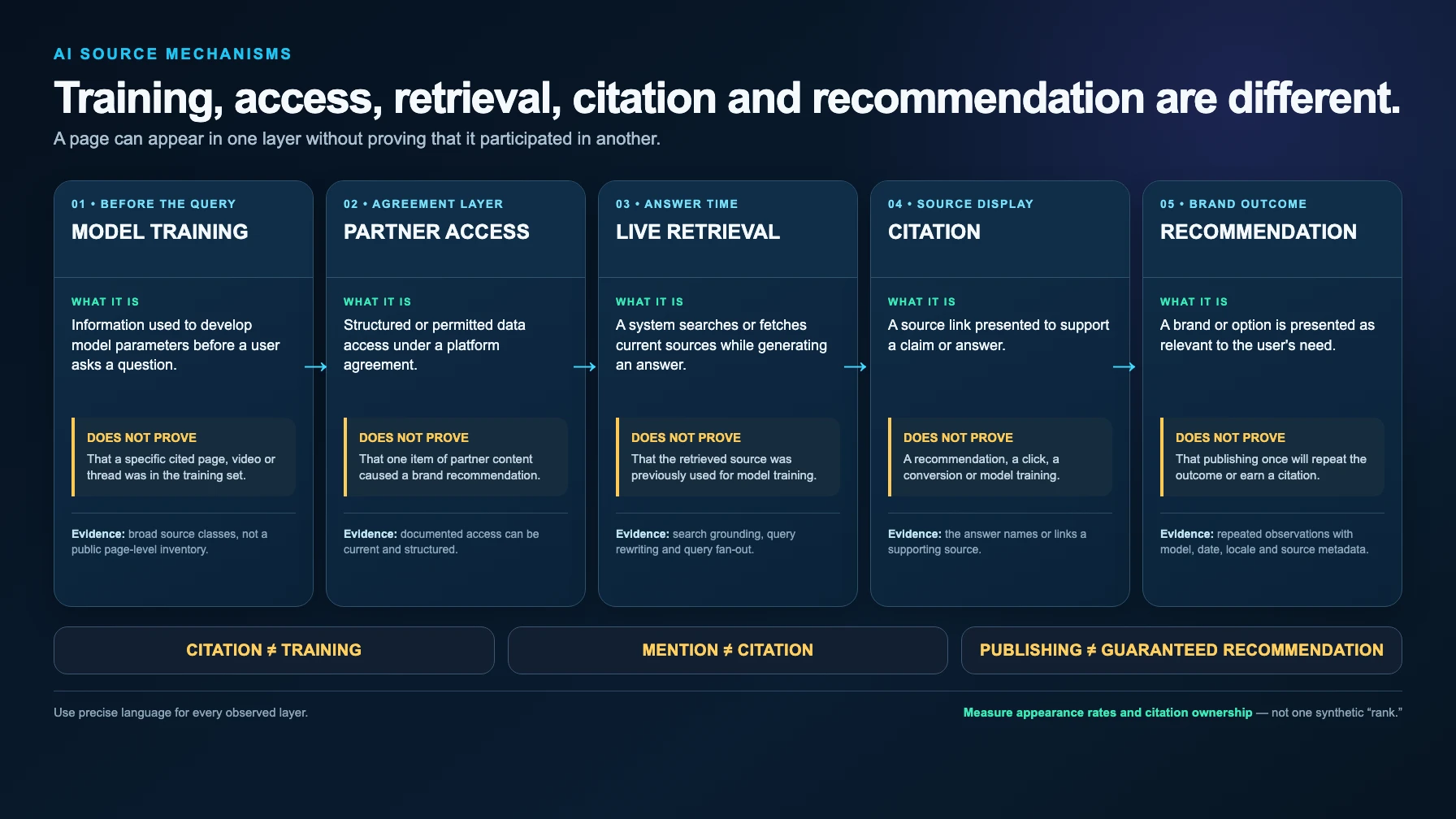
The safer operating assumption is that YouTube, Reddit, publishers, review sites, and first-party pages may contribute to discovery, validation, retrieval, or citations. Publishing on any one surface guarantees none of them.
What Traditional SEO Still Controls
Multi-platform search increases the value of the website instead of reducing it. The site remains the place where the company can maintain current product facts, define the offer, explain pricing, publish evidence, identify authors, document policies, and complete the conversion.
The traditional SEO foundation still controls:
- crawl and index eligibility
- descriptive titles and headings
- internal links and information architecture
- accessible, server-delivered facts where practical
- original research, comparisons, and demonstrations
- consistent brand, product, author, and organization details
- useful service, category, product, pricing, and case-study pages
- fast, understandable conversion paths
Google's AI guidance says established SEO practices apply to AI features. The page must be indexed and eligible to show a normal snippet. A speculative block of “AI schema” cannot compensate for weak content or a blocked page.
Owned evidence also supports the other surfaces. A video can link to a methodology page. An assistant can cite a current comparison. A community participant can point to documentation instead of repeating a sales claim. A review reader can verify the company's response on the official site.
The Google AI search optimization guide explains the technical and editorial foundation for pages that may appear in AI features. The same foundation serves ordinary search and branded verification.
Platform-Specific Playbooks
Google for explicit demand and brand verification
Google covers problem, category, comparison, local, brand, and navigation searches. Maintain technical eligibility and build pages around the decision the searcher needs to make.
Create a documented query taxonomy in Search Console. Separate nonbrand problems, category terms, alternatives, comparisons, brand spellings, and modifiers such as reviews, price, trust, scam, or a competitor name. A rise in brand-plus-review queries may reveal validation demand that a general brand total hides.
Do not reduce Google to the last click. A branded query may be the handoff from a YouTube video, AI answer, event, newsletter, or community discussion.
YouTube for demonstrations and expert explanation
Video earns its place when motion, voice, a screen, or a real person makes the answer easier to trust. Tutorials, demonstrations, teardowns, comparisons, and expert commentary have a clearer role than a narrated copy of the article.
YouTube's search documentation says ranking can use relevance, engagement, and quality. Relevance includes the title, description, tags, and video content. Engagement can include watch time for a query. Its recommendation documentation describes a separate system that uses viewer history, content performance, satisfaction, and other feedback.
Match the title to the viewer's question, deliver the promised answer early, and point to the next relevant asset through descriptions, playlists, cards, or end screens. Our analysis of YouTube brand mentions and AI citations explains why a correlation between YouTube presence and AI visibility does not prove that a video caused a recommendation.
ChatGPT and other assistants for synthesis and shortlisting
Answer engines can help a buyer frame the question, establish criteria, compare options, and retrieve current evidence. Make first-party pages easy to verify by including dated facts, named sources, methodology, product constraints, and honest comparisons.
Test representative prompts from sales calls, support tickets, Search Console, reviews, and on-site search. Record brand mentions and first-party citations separately. A brand can be recommended while another domain receives the citation.
Avoid announcing that the company “ranks number one in ChatGPT” after one successful response. The ChatGPT citation mechanics guide explains why fan-out, retrieval, and source selection need repeated observation. The review of AI visibility prompt trackers shows why a dated, repeated prompt panel is more useful than a favorable screenshot.
Reddit and communities for peer validation
Communities reveal how buyers describe problems when no company is controlling the vocabulary. They expose objections, workarounds, comparisons, and failure stories that keyword tools may miss.
Use that language to improve the product and first-party content. Participate when an employee or expert can add first-hand value, disclose the relationship, and follow the community rules. Manufactured threads, fake customer stories, and coordinated recommendations create reputational and legal risk.
The goal is useful participation and customer research. A Reddit thread is not an owned landing page, guaranteed citation, or controllable placement.
G2, Trustpilot, and reviews for risk reduction
Reviews help a buyer answer a different question from a category guide. The issue is no longer “what exists?” It becomes “will this work for someone like me?”
BrightLocal's 2026 Local Consumer Review Survey found that its 1,002 U.S. respondents used six review sites on average, while 68% said positive reviews led them to continue researching rather than purchase immediately. The study covers local businesses and self-reported behavior, so it should not be generalized to every buying category. It still shows that reviews can advance validation without closing the journey.
Ask eligible customers for honest feedback, reply helpfully, and keep profiles accurate. Do not suppress negative reviewers or tie an incentive to positive sentiment. The FTC's review solicitation guidance describes the disclosure and integrity boundaries.
The website for canonical evidence and conversion
Every off-site asset needs a logical next step, but that step is not always the homepage. A YouTube comparison can lead to a detailed comparison page. A Reddit answer may point to documentation. A review profile can link to the relevant product or service.
The destination should continue the same promise, prove the claim, explain fit and limitations, and make the action obvious. If the site cannot answer a buyer arriving directly from Google or an AI citation, more distribution will expose the weakness faster.
Reuse Evidence Without Creating Cross-Post Spam
Efficient distribution begins with one evidence base and produces different assets for different jobs.
Suppose a company interviews 20 customers about why implementation projects fail. The source material can support:
- a website report with methodology and full findings
- a YouTube walkthrough showing the failure patterns
- a Google-focused guide answering the main implementation query
- a short comparison table an assistant can retrieve and cite
- a transparent community response to a relevant question
- sales enablement that answers recurring objections
The facts remain consistent while the presentation changes. Copying the same 1,500-word article into every platform ignores why people use those platforms and creates duplicate maintenance work.
Give each derivative a native contribution. Video should show. Community participation should respond to the actual discussion. A comparison page should make tradeoffs inspectable. Review responses should address the customer's experience rather than repeat brand copy.
Maintain a source-of-truth sheet for names, prices, specifications, claims, and dates. When the product changes, update the canonical evidence and every derivative that depends on it. Entity inconsistency is expensive because customers and retrieval systems both encounter conflicting facts.
A 90-Day Implementation Plan
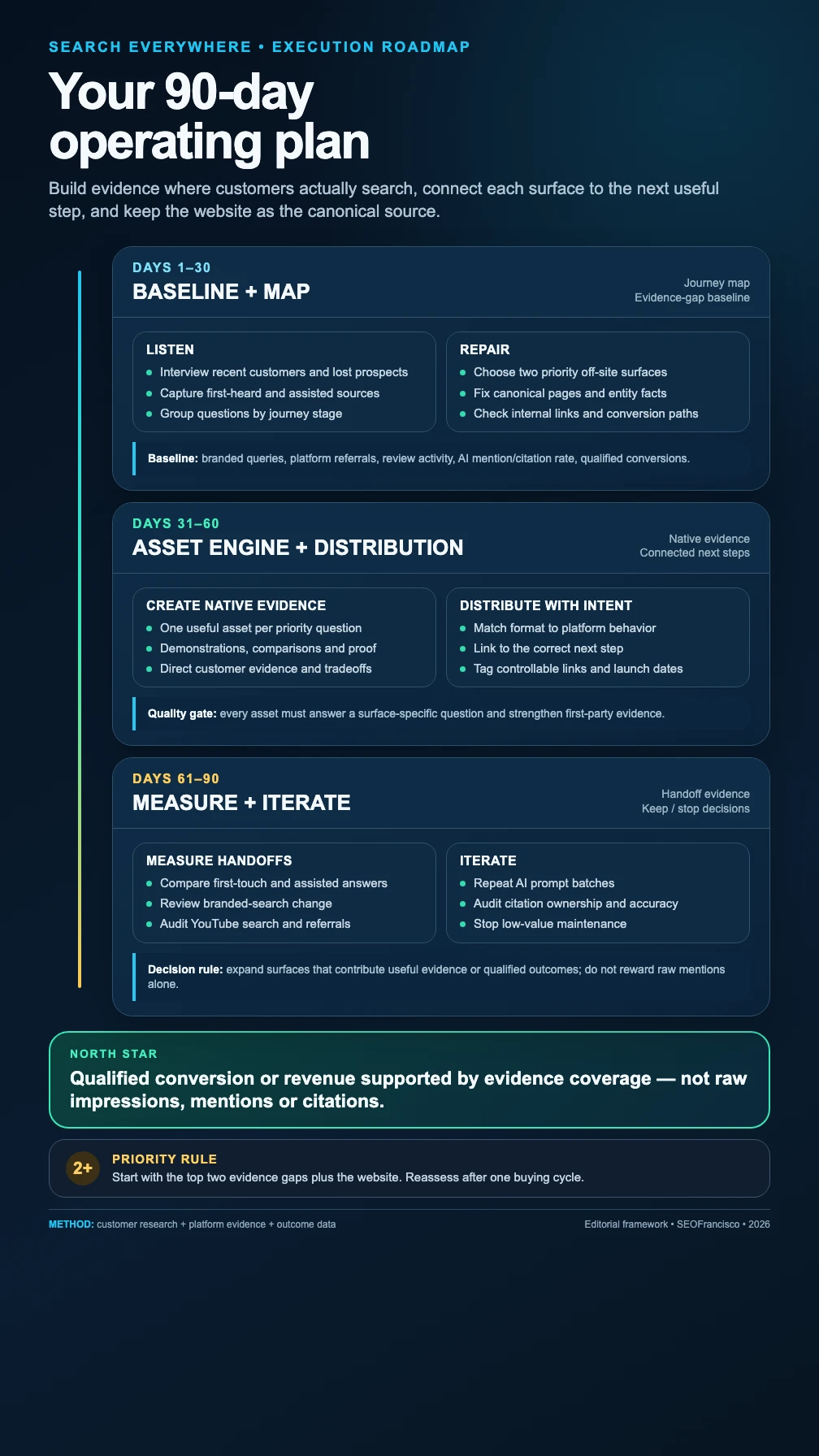
Days 1 to 30: map and repair
Interview recent customers, lost prospects, sales staff, and support teams. Ask where the problem was discovered, what else influenced the decision, and which source reduced the most uncertainty.
Group the answers by journey stage. Score each possible surface on observed customer use, commercial relevance, evidence gap, ability to contribute natively, measurement feasibility, and the team's capacity to maintain it.
Select the top two off-site gaps plus the website. Repair the canonical pages, internal links, entity facts, conversion path, and measurement baseline before increasing distribution.
Days 31 to 60: create native evidence
Choose one high-value question for each priority surface. Publish the format that helps on that surface, then connect it to the correct next step.
Add current first-party proof to the website. Useful additions may include methods, screenshots, limitations, pricing context, direct customer quotes, and case evidence. Request honest reviews from eligible customers and respond to them.
Record launch dates and add UTMs to every link the company controls.
Days 61 to 90: measure the handoffs
Compare first-heard and assisted-source survey answers. Review branded-query changes, YouTube search terms and retention, qualified referrals, review activity, and AI citation ownership.
Keep the surfaces that contribute useful evidence or qualified outcomes. Stop low-value maintenance. Expand only after one buying cycle gives the team enough evidence to make a decision.
The 90-day period is an operating boundary, not a promise of statistical certainty. Long sales cycles may require more time.
The Measurement Stack for a Journey No Tool Can Reconstruct
Last-click analytics will not recover a zero-click video view, an uncited AI mention, a copied community link, or a review read in another app. Use several imperfect layers and keep their limits visible.
Customer-reported attribution
Ask two post-conversion questions:
- Where did you first hear about us?
- What else helped you decide?
Start with open text, then offer optional channel categories. Keep the original response. Customers may name a creator, video, subreddit, review, prompt, event, or colleague that a fixed dropdown would miss.
Branded and nonbrand search
Use Google Search Console's Performance report to group problem, category, comparison, brand, brand-plus-review, pricing, trust, and competitor queries. Track impressions, clicks, pages, countries, and devices. Annotate major videos, press, campaigns, and community activity.
Search Console hides some low-volume queries. Average position also varies with time, place, device, and user history. Report trends without pretending the number is a universal rank.
Referrals and assisted conversions
Use static UTMs on controllable links in video descriptions, newsletters, creator placements, and profiles. In GA4, review session source, medium, campaign, landing page, engagement, and key events.
Treat direct traffic as unknown. Apps, copied links, privacy controls, and missing tags can hide an earlier touch. GA4's attribution reports, key event paths, and assisted-conversion views can redistribute credit under a stated model and lookback window. They cannot reveal a perfect causal history. The AI crawler ghost-citation analysis shows why crawler activity, citations, and attributable visits need separate reporting.
YouTube performance
Separate YouTube Search from browse, suggested, and external traffic. Track the exact search terms, thumbnail CTR, average view duration, watch time, and qualified referrals. A smaller video that generates branded search and qualified visits can be more valuable than a high-view video with no commercial handoff.
Review activity
Track review volume, rating, recency, response rate, profile views, referrals, and recurring objections. Compare periods or matched markets while controlling for spend and seasonality. Ask customers which reviews influenced them because a profile view alone does not prove influence.
AI prompt probes
Build a fixed prompt set from customer language. For each run, record the model, date, locale, account state, web-search state, brand mentions, cited domains, cited URLs, factual accuracy, and competitors.
Run each prompt repeatedly and report appearance rates. SparkToro's AI recommendation consistency experiment repeated 12 prompts 60 to 100 times and found substantial variation in lists and order. The experiment uses a narrow synthetic prompt set, but it demonstrates why one response is a weak rank report.
The AI search performance dashboard guide provides a way to keep visibility, citations, traffic, and business outcomes in separate layers.
Business outcomes
Qualified leads, sales, revenue, acquisition cost, time to close, and retention remain the outcome layer. Views, mentions, citations, and reviews diagnose where evidence appears. They do not replace commercial results.
When Google-First Is Still the Right Strategy
Search everywhere is a research principle, not a staffing requirement. A Google-first plan remains rational when customer interviews, Search Console, sales data, and revenue already show that Google captures most qualified demand. It also makes sense for urgent local services, strongly navigational categories, or small teams that cannot maintain credible native work on several surfaces.
The website and Google foundation should come first when pages are not reliably indexed, service or product facts conflict, local or merchant profiles are incomplete, internal links hide the best proof, or the conversion path is weak. Opening more channels before fixing those problems sends a larger audience toward an unreliable source of truth.
Google-first does not have to mean Google-only. A team can protect the proven acquisition engine and reserve a small, measured experiment for one adjacent surface. The adjacent channel earns expansion only if buyers actually use it, the team can contribute something native, and its role can be connected to validation or qualified outcomes. The zero-click survival analysis explains why owned proof and commercial measurement matter even when a platform does not send a visit.
Risks That Make Multi-Platform SEO Wasteful
- Publishing everywhere. Maintaining every platform spreads expertise and measurement too thin.
- Copy-paste distribution. The same generic asset rarely fits video search, a community question, a review profile, and a product page.
- Confusing training with retrieval. Current citations reveal supporting sources, not the model's complete training corpus.
- Treating mentions as citations. An assistant can name the brand while linking to another site.
- Prompt-rank theater. One favorable answer is not stable market visibility.
- Last-click tunnel vision. The final branded query may receive credit for demand created elsewhere.
- Astroturfing. Fake reviews and manufactured community conversations can violate rules, law, and trust.
- Entity inconsistency. Conflicting names, facts, pricing, and positioning weaken verification.
- Vanity metrics. Impressions and mentions without qualified outcomes can fund months of unproductive work.
- Platform dependency. Algorithms, partnerships, and citation patterns change. A strategy built around one external surface is fragile.
The final prioritization rule is simple enough to use. Start with the website and the two largest evidence gaps shown by customer research. Add another surface only when the team can explain its job, create something native, measure the handoff, and maintain the facts.
That rule also protects against a common measurement mistake. A branded Google visit at the end may be the visible consequence of a video, review, AI answer, event, or private recommendation. The ChatGPT referral traffic analysis offers a companion framework for separating observable sessions from no-click influence without assigning credit that the data cannot prove.
Frequently Asked Questions
Is SEO dead in 2026?
No. Google remains the largest measured search surface in the cited cross-platform study, while the owned website remains the canonical evidence and conversion layer. SEO now has to account for discovery and validation that may happen through video, AI assistants, communities, marketplaces, or reviews before the final search or visit.
What does “search everywhere” mean for SEO?
It means researching where a specific audience discovers problems, compares options, validates claims, and acts. It does not mean publishing on every available platform. Start with the website and the two most important evidence gaps in the real customer journey.
Does a ChatGPT citation mean the page trained the model?
No. A citation can come from live retrieval or search grounding. Model training, partner data access, retrieval, citations, and recommendations are separate mechanisms. Public documentation rarely supports page-level claims about training inclusion.
Should every company create YouTube videos and Reddit posts?
No. Use customer interviews, referral data, search behavior, sales feedback, and operating capacity to select platforms. Video suits demonstrations and expert explanation. Community participation suits first-hand answers and peer validation. Neither is mandatory for every audience.
How should content be reused across platforms?
Reuse the verified evidence and adapt the asset to the platform's job. A report can become a demonstration video, comparison page, community answer, and sales resource, but each version should add a native contribution instead of duplicating the same copy.
How can a company measure a multi-platform journey?
Combine first-heard and assisted-source customer questions with Search Console query groups, YouTube Analytics, tagged referrals, GA4 assisted paths, review activity, repeated AI prompt probes, and qualified business outcomes. No single report reconstructs every touch.
What should a company do in the first 90 days?
Map the journey and repair the website in days 1 to 30. Create native evidence on two priority off-site surfaces in days 31 to 60. Use days 61 to 90 to measure handoffs, stop low-value maintenance, and expand only where evidence or qualified outcomes justify the work.
About the Author