Ads in Google AI Mode and AI Overviews: What Changes for Organic Visibility
Google is scaling ads in AI Mode and AI Overviews. What the Q3 2026 call said, where AI Overview ads appear and how to track organic visibility.
You finally appear in an AI answer. Then you look at the other cards.
On Alphabet's October 28, 2026 call, Google said strong AI Mode query growth weighed on Search because AI Mode monetizes less, while it scales Google AI Mode ads and ads in AI Overviews. Ads within AI Mode are expanding internationally and into U.S. follow-up responses, giving SEOs a reason to measure organic visibility and clicks separately, without assuming rankings have changed.
| What Google said | What it did not say | What it means for SEO |
|---|---|---|
| AI Mode's lower monetization affected Search. | The size of that contribution. | Don't assign the slowdown to AI Mode alone. |
| Ads are expanding across markets and queries. | How much organic traffic will change. | Establish market-specific baselines. |
| Sponsored and organic product list items have similar CTRs. | CTRs for organic web links or text ads. | Keep product placements and website traffic separate. |
| AI Mode queries are mostly incremental. | Supporting volume data. | Treat this as Google's statement, not your traffic forecast. |
What Google said on the Q3 2026 call, and what it left out
The earnings call transcript gives two pieces of context that belong together. CFO Anat Ashkenazi said, "Google Search and other advertising revenues increased by 12% to $63.3 billion". Philipp Schindler named FX as "the single largest driver of Search deceleration relative to Q2".
He also cited retail advertisers in APAC affected by the EU eliminating its de minimis exemption, and media and entertainment spending normalizing after the FIFA World Cup. AI Mode was another factor. It wasn't identified as the largest one.
Schindler's full explanation matters:
it's worth noting that the strong growth in AI Mode queries had an impact because of the lower monetization we were seeing in AI Mode. To be clear, we feel very good about our trajectory here. Our ad experiments have shown promising results, and we're now scaling ads within both AI Overviews and AI Mode to more users and more queries, including, as I mentioned, international markets and multiturn ads in the U.S.
Pichai described Google as "focused on building the best Search user experience, followed by monetization". That describes Google's priority, not a commitment to preserve publishers' click volumes.
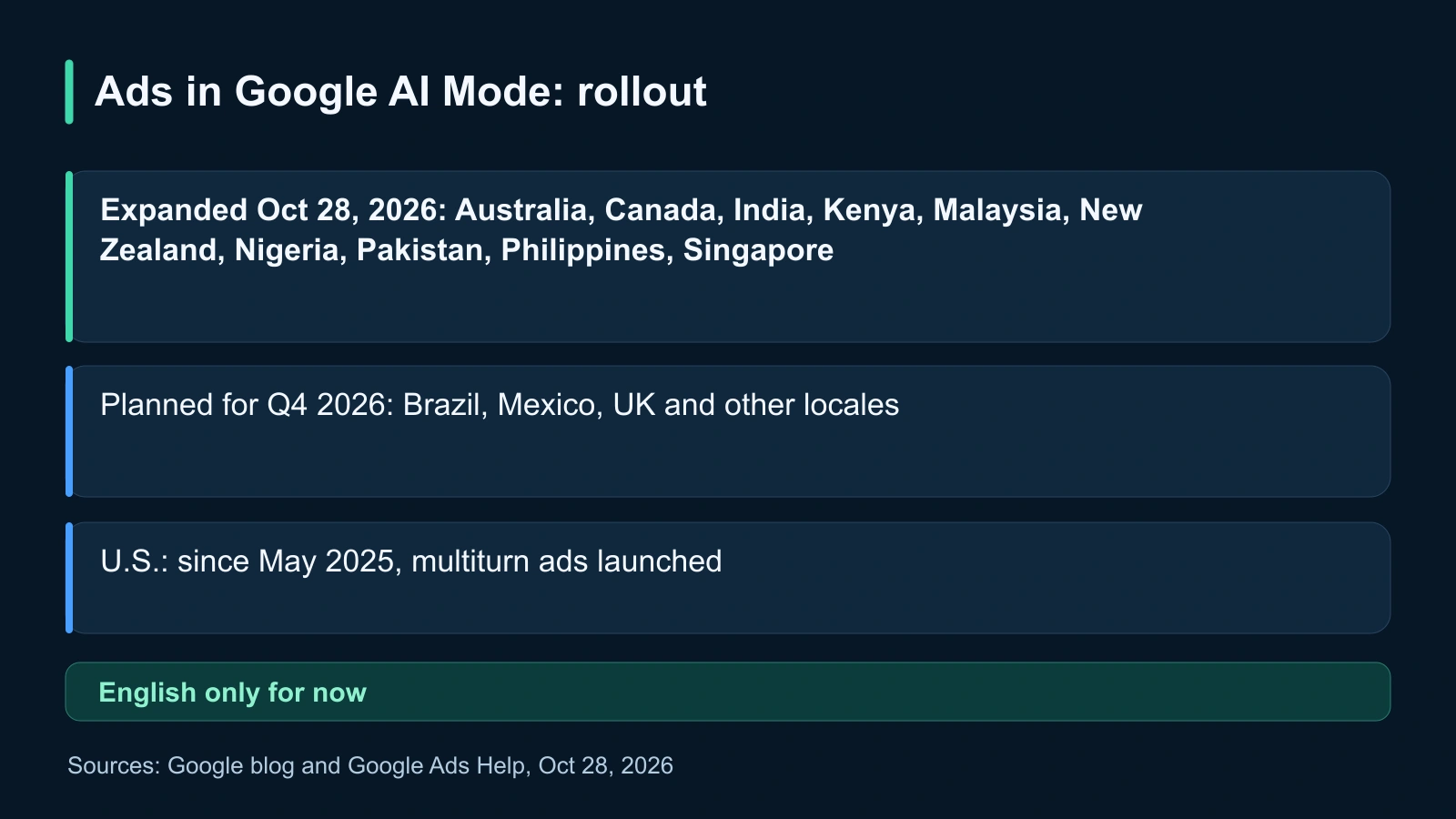
The Search Engine Land call coverage helps frame the unanswered questions. Google did not disclose:
- How much lower AI Mode monetization is, or its contribution to slower growth.
- Total AI Mode query volume.
- Data supporting its statement that most AI Mode queries are incremental.
- Actual CTR figures or the method behind the comparison.
- Separate AI Mode reporting for advertisers.
I'd keep those gaps visible when discussing this with leadership. Revenue growth, query growth and your site's organic performance measure different things. None supplies the missing numbers for the others.
Where AI Mode and AI Overview ads appear, and when
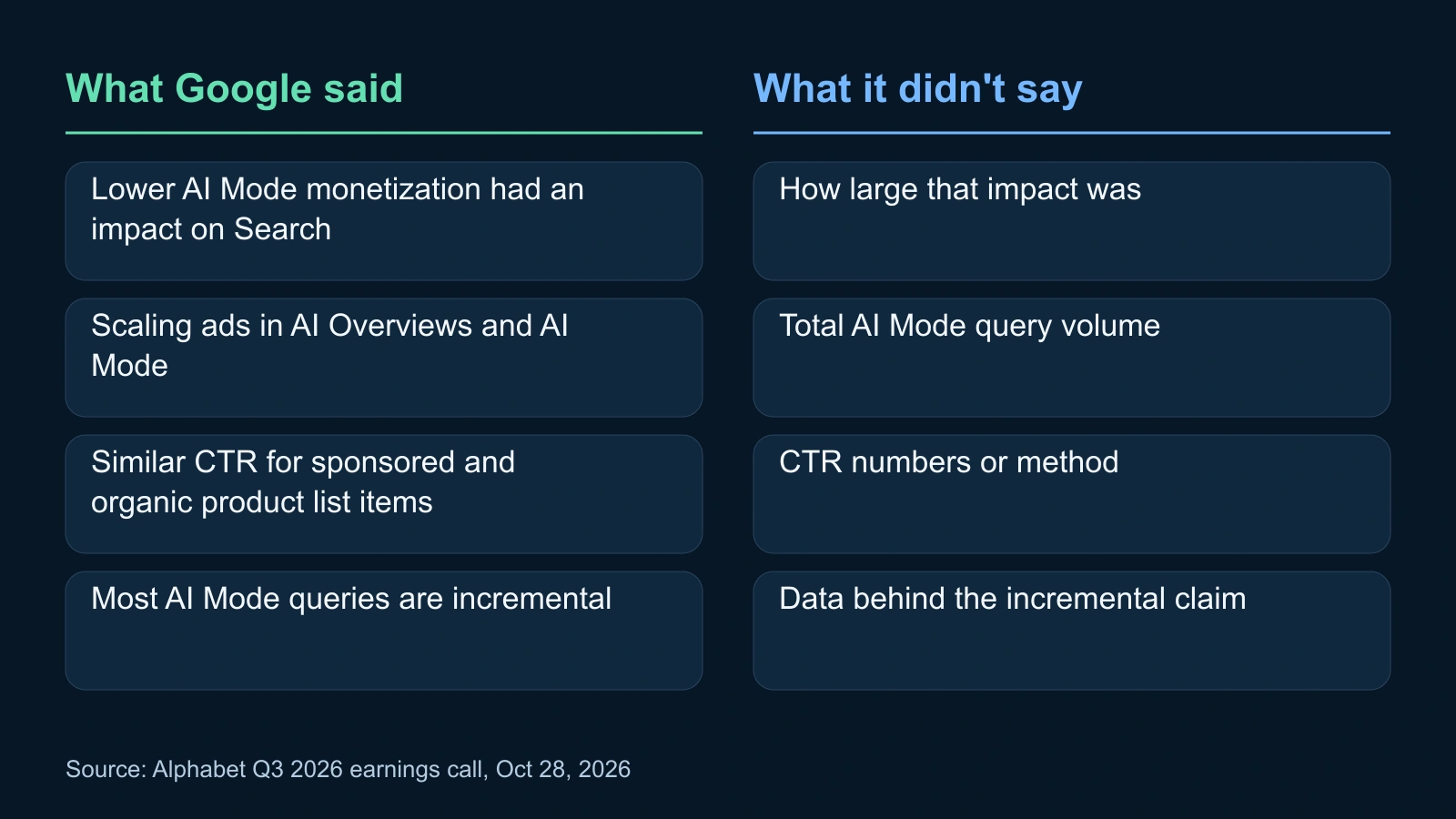
Google's October 28 announcement expands ads in AI Mode to Australia, Canada, India, Kenya, Malaysia, New Zealand, Nigeria, Pakistan, the Philippines and Singapore. Brazil, Mexico, the UK and other locales are planned for Q4 2026. Planned does not mean live on October 29.
Canada is part of this expansion, which makes it relevant to me here in Toronto. I'd review Canadian performance separately from U.S. performance: ads in AI Mode first launched in the U.S. in May 2025, as the rollout coverage explains. Those markets have different starting points.
The Google Ads Help page combines eligibility for ads within AI Overviews and AI Mode. It lists the U.S., Australia, Canada, India, Indonesia, Kenya, Malaysia, New Zealand, Nigeria, Pakistan, the Philippines and Singapore. Two exceptions matter: Indonesia is AI Overviews only; Pakistan is text ads only.
Ads above or below AI Overviews are available in 200+ markets. That is a different placement from AI Overview ads shown within the AI response. Don't use the larger number as the AI Mode rollout count.
The documented language is English only for now. Ads carry the "Sponsored" label. Multiturn ads have launched in the U.S., allowing ads on responses to follow-up questions.
Existing Search, Shopping and Performance Max campaigns are automatically eligible. Advertisers cannot target AI Mode separately or opt out, and reporting is aggregated into standard reports. Formats include text and Shopping ads, with local inventory and vehicle ads being tested.
For organic monitoring, this means country, language and placement all matter. A country's inclusion doesn't establish that every query contains an ad. For the underlying experience, see how Google AI Mode works.
The CTR claim you can't verify from outside
Schindler said: "Click-through rates are already similar between sponsored and organic product list items within AI Mode". The limiting words are "product list items within AI Mode".
The blog footnote identifies Google internal data from the U.S., August 20 to September 3, 2026. Google published no actual CTR numbers or method. You cannot reproduce that comparison from the announcement.
It doesn't cover text ads. It doesn't establish equivalent CTRs for organic web links generally. Some early summaries phrased the comparison more broadly than Google did; the narrower wording is what your reporting should retain.
I'd also avoid turning it into a benchmark for your own pages. A product item inside an answer and an organic website link aren't interchangeable measurements. The statement gives no basis for estimating how many visits an individual publisher will gain or lose.
If you're comparing advertising platforms, my ChatGPT Ads costs compared with Google and Meta article covers that separate discussion. This announcement supplies no paid-versus-organic traffic forecast.
Which queries I'd watch first
This is my reading of the documented placements, not a Google prediction about SEO losses. I'd start with commercial and product queries, branded queries with competing advertisers, and follow-up questions in the U.S.
Shopping ads make product queries an obvious monitoring group. Ads can match the query directly or use the query plus the AI response as context. Google says exact and phrase match apply only on direct commercial intent. That is a reason to examine commercial pages first, not evidence that every commercial query will show ads.
For branded queries where competitors bid, check whether your own pages still receive clicks when visible. The question overlaps with AI Overviews on brand searches: appearing in an answer doesn't settle what happens next.
Multiturn ads extend the question to later responses. I'd include follow-up questions in the review rather than treating the first prompt as the entire interaction.
Informational upper-funnel queries are less directly exposed in this reading. Schindler said many AI Mode queries are upper-funnel. They still matter for discovering your brand and becoming a supporting source; I'd keep them as a separate monitoring group.
Google Ads Help states: "Paid advertising does not influence the organic responses." Ad placement is not evidence of an organic ranking penalty.
Search Central says supporting links must be indexed and eligible for a snippet. No special markup or extra requirement applies. AI Mode SEO starts with those existing conditions, not an invented ad-related schema requirement.
How I'd monitor this by market in Search Console
The Generative AI performance report documentation describes impressions of your links within AI Overviews and AI Mode. After its initial June launch, it became available to all websites worldwide on August 31, 2026, according to the Search Central update.
You can examine pages, country of search origin, dates and devices, with Web text-based and Web multimodal filters. There is no click data. Sites with too few generative AI impressions may not see the report. AI Mode SEO reporting should keep visibility and clicks separate.
I'd use it alongside the main Performance report, where AI features fall under Web. Our earlier guide to Search Console generative AI reports covers that distinction. AI Console Now is where we track AI platforms' webmaster tools.
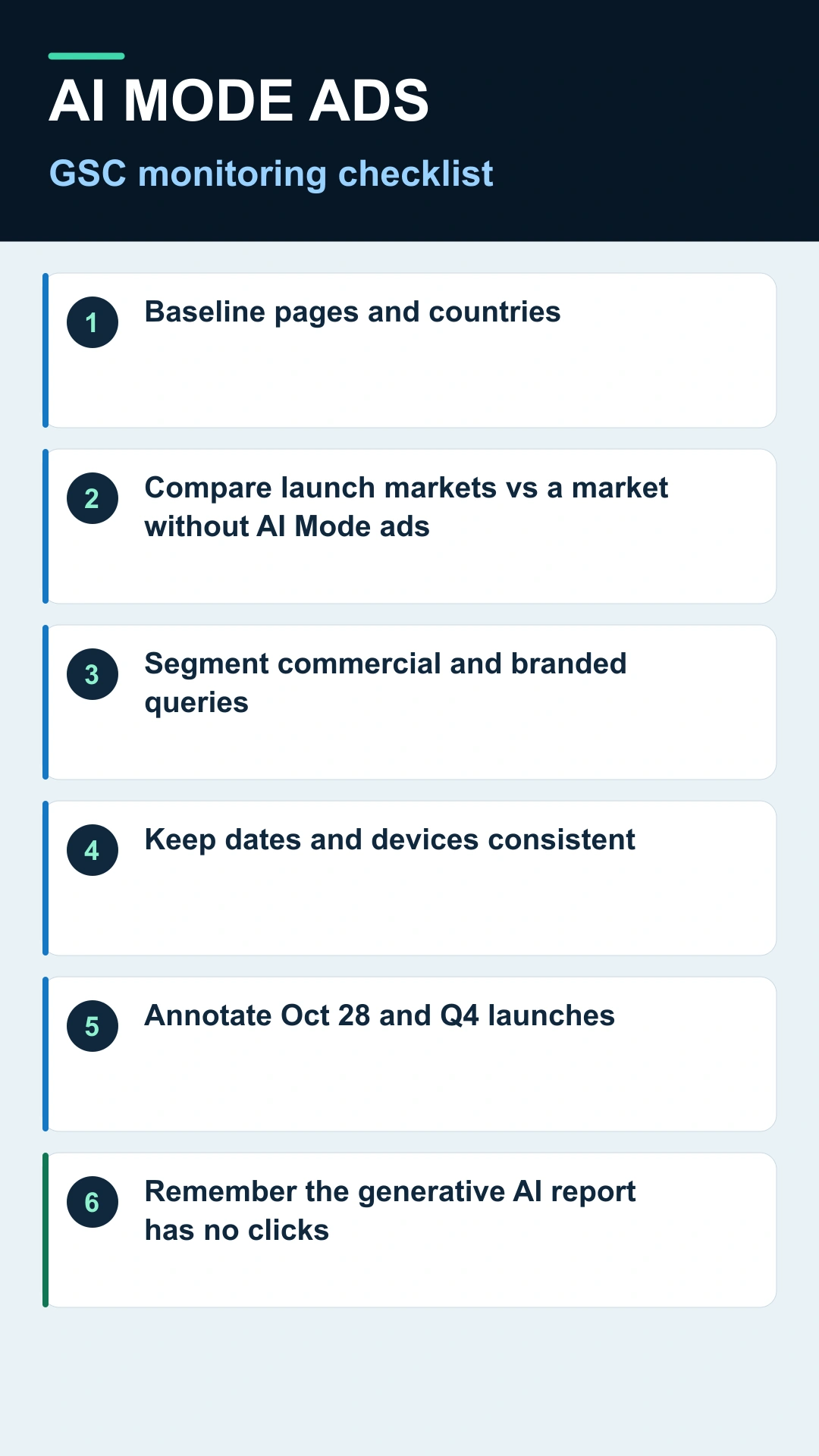
Start with the pages that matter to your business. Compare launch markets before and after October 28 against a market without ads within AI Mode. Keep device and date comparisons consistent, and record the English-only limitation.
In the main Performance report, segment commercial and branded query groups. Review their clicks and impressions alongside the country and page patterns in the generative report. Don't describe the resulting comparison as an AI Mode click report: the generative report contains no clicks, and Web includes more than AI Mode.
Annotate October 28 and the Q4 launches when they occur. If you run Google Ads, use your own paid data as context, remembering its aggregated reporting cannot isolate AI Mode. A before-and-after difference can flag something to investigate; it doesn't establish that ads caused it.
Expert Insight I'd expect the first useful signal to be a change in impressions relative to clicks on commercial queries in launch markets. That's a working hypothesis, not a measured result. One careful market comparison will likely tell you more about your business than an industry average.
What I'd do today without overreacting
- Skip panic rewrites. Read the announcement against your own data before changing useful pages.
- Protect snippet eligibility. Check indexing and review nosnippet, data-nosnippet, max-snippet and noindex controls before changing them.
- Strengthen commercial and product pages. Add details you can support and resolve unclear product information. This is a page-quality recommendation, not a promise of AI inclusion.
- Coordinate brand query defense with paid. Review branded query performance together, while keeping paid placement and organic response claims separate.
- Set baselines now. Save page, country, date and device comparisons so the next review has a documented starting point.
- Revisit after Q4 launches. Check actual availability before treating Brazil, Mexico or the UK as launched markets.
FAQ
Are there ads in Google AI Mode in my country?
The U.S. and the ten October expansion markets are listed above. Google plans Brazil, Mexico, the UK and other locales for Q4. Check placement and language too: Indonesia's documented inclusion covers AI Overviews only, and ads within AI Mode are English only for now.
Do ads in AI Mode or AI Overviews affect organic rankings?
Google says paid advertising does not influence organic responses. More advertising can change the context around your visibility, but this announcement doesn't demonstrate a change in your rankings or traffic.
Can I see AI Mode traffic in Search Console?
AI features contribute to Web in the main Performance report. The separate generative report shows AI Overviews and AI Mode link impressions by page, country, date and device, without clicks. It isn't a separate AI Mode traffic attribution report.
Is AI Mode ad CTR the same as organic CTR?
Google says CTRs are similar for sponsored and organic product list items within AI Mode. It did not publish numbers or a method. That claim doesn't cover text ads or organic web links generally.
Can advertisers opt out of AI Mode?
No, according to Google Ads Help. Eligible Search, Shopping and Performance Max campaigns participate automatically. Separate AI Mode targeting and reporting aren't available.
When will ads reach Spanish, the UK, Brazil or Mexico?
The UK, Brazil and Mexico are in the Q4 2026 plan, without a specific launch date here. Ads are English only for now. Spain isn't named in the lists, and Google has not given a date for Spanish.
More ads are documented. Their effect on your organic clicks still needs measuring.
Growing Search can help you establish that baseline and review the pages that matter through an SEO audit.
About the Author