YouTube Mentions Are the Strongest AI Visibility Signal in Ahrefs’ 75,000-Brand Study
Ahrefs analyzed 75,000 brands and found YouTube mentions had the strongest Spearman correlation with visibility in ChatGPT, Google AI Mode, and AI Overviews. Here is what the data means for GEO strategy.
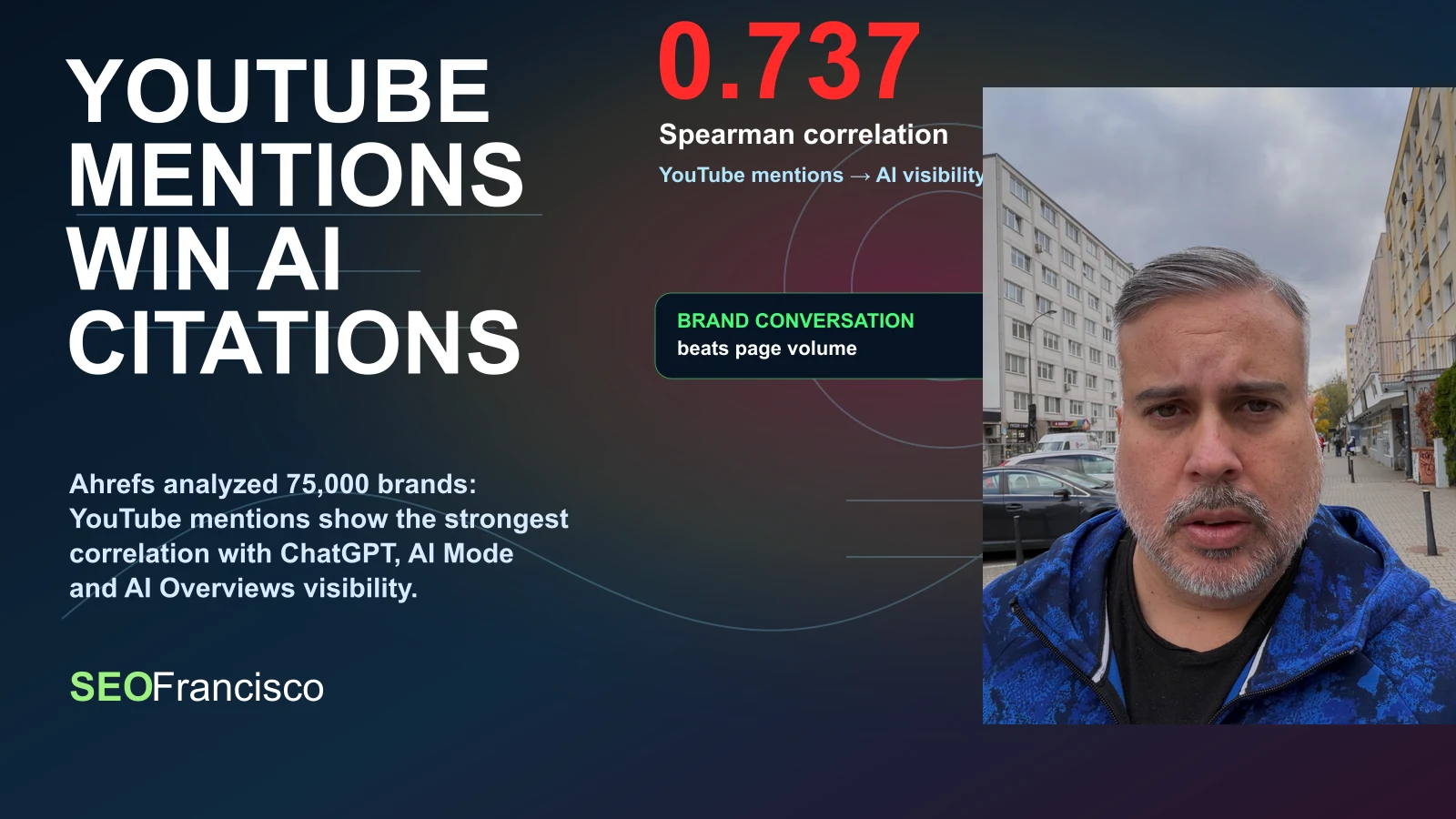
45-Second Recap
Why YouTube mentions now matter for AI visibility
A short briefing on Ahrefs' 75,000-brand study, the Spearman correlations, and what SEO teams should change first.
YouTube Mentions Are the Strongest AI Visibility Signal in Ahrefs' 75,000-Brand Study
TL;DR: Ahrefs analyzed 75,000 brands and found that YouTube mentions had the strongest correlation with brand visibility in ChatGPT, Google AI Mode, and Google AI Overviews. The signal is not proof of causation. It is still a major operating clue: AI visibility is being shaped by distributed brand conversation, not just owned-site publishing.
What you'll learn:
- Why YouTube mentions led Ahrefs' AI visibility correlation study with a Spearman score of 0.737
- Why branded web mentions appear to matter roughly twice as much as Domain Rating in this dataset
- How to turn the finding into a practical GEO workflow across video, transcripts, PR, and owned content
The latest Ahrefs Spanish study should make every SEO team uncomfortable in a useful way. For years, we treated video as a content distribution channel and backlinks as the authority layer. The AI search data points in a different direction: when Ahrefs compared brand signals against visibility across ChatGPT, Google AI Mode, and AI Overviews, YouTube mentions showed the strongest correlation in the entire dataset.
The study used Spearman correlation, which measures how strongly two ranked variables move together. It does not prove YouTube mentions cause AI citations. But when the top signal is YouTube mentions at 0.737, followed by YouTube mention impressions at 0.717, while Domain Rating sits around 0.27 to 0.33, the practical implication is hard to ignore. AI systems appear to reward brands that exist in the broader language layer of the web, especially in video transcripts and third-party conversation. (Source: Ahrefs Spanish study on AI brand visibility correlations.)
For a wider explanation of how this fits into generative search strategy, see our guide to AI SEO and search visibility. For the video-specific side, the connection with YouTube SEO is no longer just rankings inside YouTube. It is becoming an entity signal for the AI answer layer.
The Ranking of Signals Ahrefs Found
| Signal | Correlation With AI Visibility | What It Suggests |
|---|---|---|
| YouTube mentions | 0.737 | Brands mentioned in video titles, transcripts, and descriptions tend to appear more often in AI answers. |
| YouTube mention impressions | 0.717 | Reach matters, not just existence. Visibility of the mention appears tied to AI brand visibility. |
| Branded web mentions | 0.66-0.71 | Unlinked brand conversation across the web may be a stronger GEO signal than classic link metrics. |
| Branded anchors | 0.51-0.63 | Anchor text still matters, especially where traditional authority signals remain strong. |
| Branded search volume | 0.35-0.47 | Demand and recognition help, but they are not the top layer of the model. |
| Domain Rating | 0.27-0.33 | Authority still contributes, but the correlation is far below brand mention signals. |
| Number of pages | ~0.19 | Publishing more pages has only a marginal relationship with AI visibility in this dataset. |
Why YouTube May Be Such a Strong Signal
YouTube is not just a video platform. For language models, it is a massive corpus of speech turned into text. Every interview, product review, webinar, conference talk, podcast clip, tutorial, and brand comparison can become a transcript. That transcript is crawlable, indexable, embeddable in search systems, and usable as evidence of how the market talks about an entity.
This matters because AI systems do not only need links. They need entity context. They need repeated co-occurrence between brands, categories, problems, competitors, and use cases. A brand that appears in ten relevant YouTube transcripts about "enterprise SEO platforms" has a different language footprint than a brand with ten new blog posts that nobody else mentions.
The training-data angle adds another layer. A 2024 New York Times report, summarized by Gadgets360, said OpenAI transcribed more than one million hours of YouTube videos while building training data for GPT-4. That does not mean the current citation layer simply copies training data. It does mean YouTube has been part of the language environment major models learned from, and current AI search systems continue to interact with YouTube as a high-volume web source. (Source: Gadgets360 summary of The New York Times report.)
Key takeaway
YouTube gives AI systems entity-rich language at scale: brand names, categories, use cases, competitors, and user intent all compressed into transcripts. That is exactly the kind of context generative systems need when deciding which brands belong in an answer.
Domain Rating Did Not Disappear, It Got Demoted
The wrong conclusion is "DR does not matter." The better conclusion is that Domain Rating is no longer the dominant proxy for AI answer inclusion. In the Ahrefs dataset, DR sits around 0.27 to 0.33 while branded web mentions sit roughly around 0.66 to 0.71. That is not a small gap. It suggests that the AI visibility layer is less impressed by link equity alone and more responsive to whether the brand is part of the public conversation.
This makes sense technically. Links help search engines crawl, rank, and infer authority. But AI answers need language that can be extracted, summarized, and connected to an entity. A high-DR site with isolated owned content may be easier to crawl, but a brand that appears across YouTube, media, Reddit, podcasts, review pages, and niche publications gives the model more independent context to work with.
This is also where content marketing needs to evolve. The job is not only publishing pages on your own site. It is creating assets that other people quote, discuss, recap, interview, embed, and compare.
Platform Differences Change the Playbook
The Ahrefs study also found meaningful differences between platforms. Google AI Mode appears more tied to classic brand authority signals, with branded anchors around 0.628 and branded search volume around 0.466. That makes AI Mode harder for emerging brands because it leans more heavily on signals that usually require time, demand, and existing market presence.
ChatGPT shows weaker correlations with several traditional metrics. That does not make ChatGPT easy. It means the opportunity surface is different. A less-established brand can potentially earn visibility by becoming the best-cited, best-described, most clearly associated entity for a narrow problem, even before it has the same search demand profile as an incumbent.
| Platform | What Appears to Matter More | Implication for Brands |
|---|---|---|
| Google AI Mode | Branded anchors, branded search volume, classic authority signals | Harder for new brands; build search demand and third-party authority in parallel. |
| Google AI Overviews | Google-indexed content, trusted sources, video and publisher context | Owned content still matters, but it performs better when reinforced by external discussion. |
| ChatGPT | Weaker relationship with classic metrics, more room for entity clarity | Emerging brands can compete by owning specific questions and building distributed mentions. |
For technical teams, this connects directly with the mechanics we covered in how ChatGPT citations work. Retrieval access gets you considered. Entity confidence helps you get selected. External mentions help build that confidence.
The Operational Playbook
If YouTube is a critical GEO signal, the answer is not "start uploading random videos." The answer is to build a repeatable distribution system where your brand appears in the language layer of your category.
Do This Week
- Audit current YouTube mentions. Search YouTube for your brand, products, executives, and comparison keywords. Save every video where the brand appears in title, description, transcript, or spoken content.
- Export transcript coverage. Check whether your brand is spoken clearly in the transcript, not only shown visually. AI systems need text, not just logos on screen.
- Map competitor co-occurrence. Find where competitors are mentioned and you are absent. Those are the easiest topic gaps to close.
Do This Month
- Turn expert content into video-first assets. Record short explainers, product comparisons, customer interviews, and category briefings with transcript-quality language.
- Pitch third-party creators and podcasts. Prioritize credible niche channels over broad vanity reach. AI visibility rewards relevance and repeated entity context.
- Republish transcript-backed summaries. Embed videos on owned pages, publish structured recaps, and link them to your most important AI SEO pages.
Do This Quarter
- Create a brand mention KPI. Track YouTube mentions, YouTube impressions, web mentions, branded anchors, branded search, and AI answer inclusion together.
- Build a citation prompt set. Run category prompts weekly across ChatGPT, Perplexity, Gemini, and AI Overviews. Record when your brand appears, where sources come from, and which pages or videos are cited.
- Align PR, video, and SEO planning. Treat third-party conversation as an SEO input, not a separate awareness channel.
What Not to Do With This Data
Do not abandon owned content. AI still reads web pages, Wikipedia, Reddit, publishers, blogs, documentation, and product pages. The Ahrefs result does not mean your website stopped mattering. It means your website is no longer enough by itself.
Do not treat YouTube as a mechanical checkbox either. Ten low-quality videos with no views, no transcripts, no engagement, and no third-party reinforcement are unlikely to create the same signal as one credible creator explaining why your brand solves a real category problem. The study points toward brand salience, not content spam.
Finally, do not ignore the overlap in variables. Ahrefs notes that "branded web mentions" can include YouTube.com when the brand appears in the video title. That means the two leading variables are not perfectly independent. YouTube may dominate, but part of that dominance is intertwined with broader branded web mentions. The clean takeaway is not "YouTube alone wins." It is "distributed branded conversation wins, and YouTube is currently the strongest visible proxy."
Key takeaway
The next phase of GEO is not more pages. It is more credible surfaces where your brand is named, explained, compared, and repeated by people outside your own website.
Frequently Asked Questions
Did Ahrefs prove that YouTube mentions cause AI citations?
No. Ahrefs measured correlation, not causation. A high YouTube mention correlation could mean YouTube is a direct influence, or it could mean brands that appear often on YouTube are already stronger across other authority and demand signals. The result is still useful because it identifies where strong AI-visible brands tend to show up.
Why would YouTube matter for ChatGPT and AI Overviews?
YouTube creates a huge transcript layer where brands are connected to categories, products, use cases, and competitors. AI systems rely on language context to decide which entities belong in an answer. A brand repeatedly discussed in relevant videos gives the model more entity evidence than a brand that only appears on its own website.
Do backlinks still matter for AI search visibility?
Yes. Backlinks still support crawling, authority, and traditional SEO performance. But Ahrefs' correlation data suggests that branded mentions and YouTube visibility may have a stronger relationship with AI answer visibility than Domain Rating alone. The practical strategy is not links versus mentions. It is links plus brand conversation.
Should every SEO team invest in YouTube now?
Most teams should at least measure YouTube brand presence as a GEO signal. Whether to invest heavily depends on the category. If your buyers research through demos, reviews, podcasts, tutorials, or expert commentary, YouTube should be part of your AI visibility plan.
What is the first metric to track?
Start with YouTube brand mentions in titles, descriptions, and transcripts. Then add YouTube mention impressions, branded web mentions, branded anchors, branded search volume, and weekly AI answer inclusion across your most important category prompts.
About the Author