Google UCP SEO: Discovery vs. Checkout Readiness
Google UCP is not a ranking signal. Learn what Merchant Center requires and separate product discovery from checkout eligibility and execution.
TL;DR: Google's Universal Commerce Protocol is real, but it is not a new SEO tag, a documented ranking factor, or a switch that makes products visible to every AI agent.
In Google's implementation, UCP comes after product discovery. A participating merchant still needs eligible products, accurate Merchant Center data, a checkout integration, Google Pay setup, validation, and Google's approval.
The useful model is Discovery -> Eligibility -> Transaction. SEO has work to do at the first two layers. Engineering, payments, and commerce operations own most of the third.
Google UCP SEO Video Guide
Watch Google UCP SEO: Discovery vs Checkout Readiness
A practical walkthrough of Google's current UCP rollout, Merchant Center requirements, and the line between SEO work and checkout engineering.
Google updated its Merchant Center implementation guide for Universal Commerce Protocol on July 10, 2026. The guide confirms details ecommerce teams had been waiting for: native_commerce, merchant_item_id, a recommended supplemental data source, return and support requirements, product restrictions, and an approval process.
It also exposes the mistake I expect to see in plenty of UCP roadmaps: treating one feed field as if it completes the integration.
Search Engine Land's UCP analysis gives SEOs a useful starting point. Read beside Google's current documentation, though, it compresses three separate systems into one story: product discovery, checkout eligibility, and transaction execution. Those systems affect one another, but they do not have the same requirements or owners.
I led SEO at Shopify for seven years, and Shopify co-developed UCP with Google. That experience makes me cautious about announcements that make platform infrastructure sound like instant merchant availability. A protocol can be production-ready while a specific program remains selective, account-dependent, and difficult to integrate.
I covered the wider consumer story in Google Universal Cart and ecommerce SEO. This article has a narrower job: show what teams can act on now without inventing a UCP ranking factor.
What UCP Actually Is
The Universal Commerce Protocol is an open, vendor-neutral standard that lets a platform discover and invoke commerce capabilities a business chooses to expose. The UCP core concepts separate a Platform, which consumes capabilities, from a Business, which exposes them. In transactional contexts, the business typically remains Merchant of Record and owns the transaction.
Capabilities can include checkout, cart, catalog search and lookup, order lifecycle, and identity linking. They are not automatically enabled as a bundle. Google describes Cart, Catalog, and Identity Linking as optional capabilities, and businesses decide which ones to support.
UCP is also transport-flexible. Google's engineering explanation describes REST APIs, A2A, and MCP as possible bindings. It calls Google's checkout experience a reference implementation, not the definition of the protocol.
Google Search is one UCP consumer. UCP is not a Google Search markup format.
Seven Systems, Not One Agentic-Commerce Feature
Before assigning work, make sure everyone is using the same nouns.
| System | Its actual job | What it is not |
|---|---|---|
| UCP | Commerce capability and transaction protocol | A ranking factor, schema type, or Google-only feed |
| Universal Cart | Google's consumer-facing cart across supported merchants and surfaces | The protocol, or one legal cross-merchant order |
| AP2 | Payment authorization, authenticity, and accountability | A mandatory stage in every UCP purchase |
| Merchant Center | Google's merchant and product-data hub | A completed UCP integration |
| Product structured data | On-page product facts for understanding and documented search experiences | "UCP schema" or a checkout API |
| Shopify Catalog API | A discovery layer in Shopify's ecosystem | UCP transaction execution |
| OpenAI ACP | A separate protocol used for ChatGPT commerce | Another name for Google UCP |
This is a multi-protocol market. UCP can be compatible with AP2 without requiring AP2 in every transaction. Supporting UCP does not make a merchant purchasable in ChatGPT. Shopify can provide platform tooling without automatically enrolling every store in Google's checkout program. I made the same ecosystem distinction in my earlier look at the Google and OpenAI agentic-commerce race.
Discovery, Eligibility, Transaction
This three-layer model is the most practical way to audit readiness.
| Layer | What belongs here | Primary owners | Evidence of success |
|---|---|---|---|
| Discovery | Approved Merchant Center products; titles, IDs, variants, images, price and availability; crawlable PDPs; Product structured data | SEO, feed/PIM, web | Approved listings, consistent product facts, relevant visibility |
| Eligibility | Participating merchant and market; eligible category; policies and notices; native_commerce.checkout_eligibility; Google approval | Commerce operations, feed/PIM, legal; SEO as monitor | Eligible products and a supported Buy experience |
| Transaction | UCP profile; checkout APIs; totals and fulfillment; payment handler; order updates; failure recovery | Engineering, payments, security, commerce platform | Sandbox validation, correct totals, observable success and failure events |
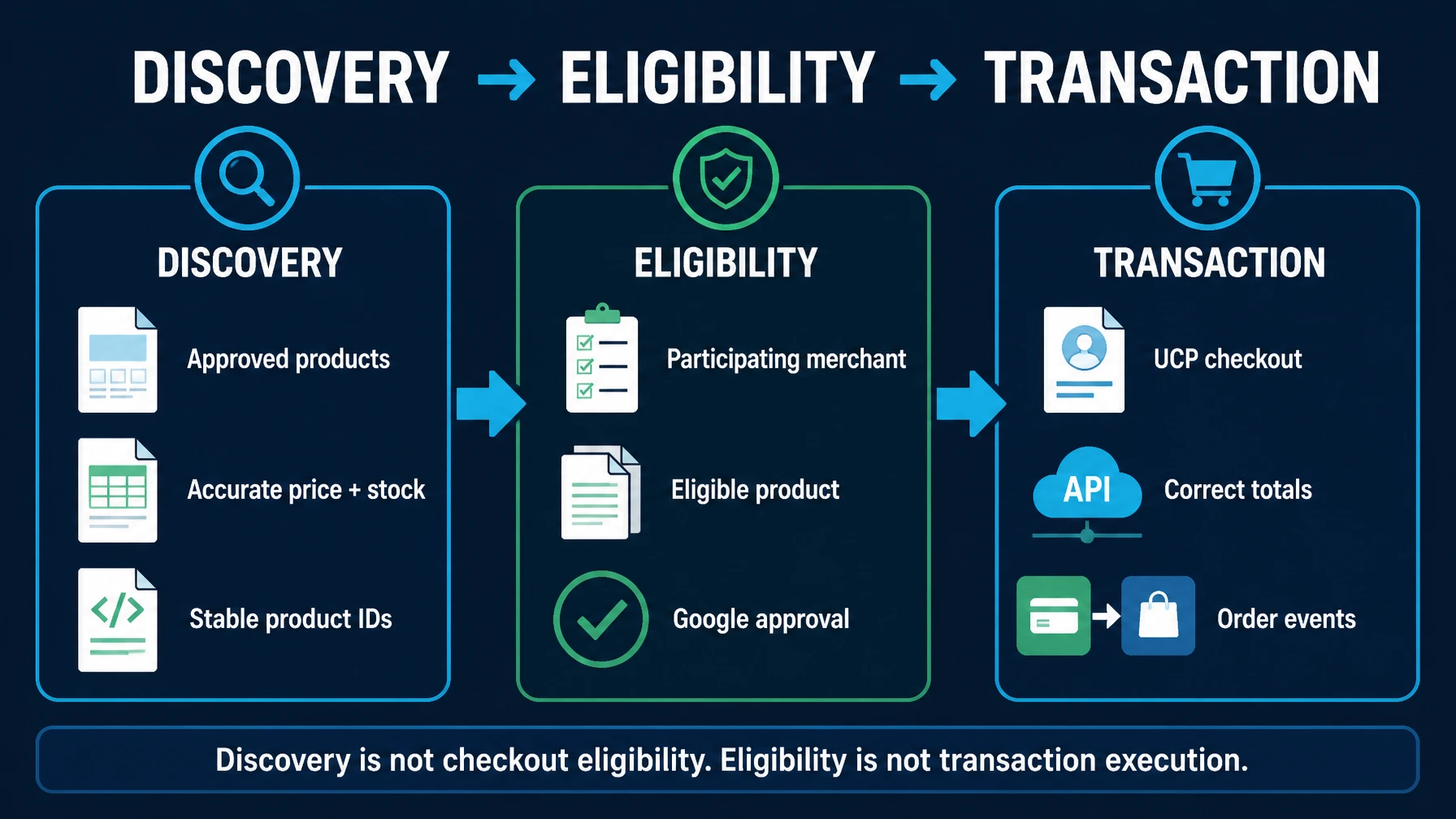
Discovery does not guarantee checkout eligibility. Eligibility does not prove the transaction works. A completed transaction does not prove UCP improved the product's organic ranking.
Google Search Central recommends Product structured data, a Merchant Center feed, or both. Using both can help Google understand and verify product facts and maximize eligibility for documented product experiences. Nothing in that guidance calls Product markup a UCP requirement or a ranking boost.
There is no special "UCP schema." Page markup and the Merchant Center feed support discovery. The checkout eligibility field supports Google's transaction program. The UCP profile and endpoints execute a purchase. Each has a different job.
What Is Live as of July 13, 2026
UCP is a living specification, and Google's rollout language has changed during 2026. Availability claims need a date and a source.
| Item | Status on July 13, 2026 | Primary source |
|---|---|---|
| UCP checkout in AI Mode and Gemini | Select or participating merchants; account-dependent | Merchant Center Help |
| U.S., Canada, and Australia | Documented for participating merchants and eligible products; onboarding remains gradual | Onboarding guide |
| Universal Cart in U.S. Search and Gemini | Announced to roll out in summer 2026 | Google announcement |
| YouTube and Gmail | Announced to follow; not evidence of uniform native checkout today | Google announcement |
| U.K. expansion | Announced for later | Google announcement |
| UCP as an organic ranking signal | Not documented | No primary source makes this claim |
Google's pages are not perfectly consistent about Gemini web, the Gemini app, and Gemini availability overall. Use the narrowest current wording, then verify the actual account, country, product, and surface. A working demonstration from one account does not establish general availability.
Google's current documentation also keeps the merchant as Merchant of Record and owner of the customer relationship. That matters, but it should not be stretched into "the merchant receives every piece of Google interaction data." Google's own privacy practices still apply on its surfaces.
What native_commerce and merchant_item_id Actually Do
Google's Merchant Center preparation guide, updated July 10, documents checkout eligibility inside the native_commerce group. The model is native_commerce.checkout_eligibility, not a flat SEO flag. If checkout eligibility is false or absent, Google says the product is not eligible for this checkout experience.
That is the documented effect. The guide does not connect the field to organic rankings, AI Mode visibility, or Shopping Graph inclusion.
The correct serialization depends on the data-source format. Follow Google's current XML, delimited-feed, or API guidance rather than copying native_commerce=true from a summary. Google recommends a supplemental data source for the new attributes and warns that malformed primary-feed data can interfere with normal ingestion. Keep experimental checkout fields away from the feed that already keeps products approved.
merchant_item_id solves a different problem. The Merchant Center id should match the item ID expected by the Checkout API. When it does not, Google documents merchant_item_id as the mapping field.
This looks like feed cleanup until the wrong variant reaches checkout. Audit Merchant Center IDs, SKU and internal IDs, GTIN/MPN, item groups, variant IDs, canonical PDPs, structured-data identifiers, and Checkout API IDs together. Test bundles, color and size variants, stock transitions, backorders, and discontinued products. Identifier drift is not an abstract SEO issue once it can change the item, price, or fulfillment promise in an order.
One correction to the Search Engine Land article is worth making plainly: its native_commerce link points to Vertex AI Search for commerce attribute documentation, not the UCP Merchant Center guide. Use Google's UCP-specific guide for implementation.
The Technical Implementation Sequence
Google's integration guide makes clear that feed preparation is only one part of the work. I would run the project in this order:
- Confirm access and scope. Record the country, selected-merchant status, eligible categories, Merchant Center standing, interest or waitlist status, and Google's current approval state.
- Reconcile product identity. Map every sellable variant from the page and feed to the commerce backend. Use
merchant_item_idonly when the Checkout API expects a different identifier. - Complete policies and notices. Configure returns, return costs and windows, customer support, cancellations, and required consumer notices. Recheck Google's current restricted-category list.
- Stage eligibility attributes. Add
native_commerce.checkout_eligibilitythrough a controlled supplemental source and test ingestion before scaling it. - Publish the UCP profile. Engineering declares the supported capabilities, endpoints, payment handlers, and verification material.
- Build the checkout APIs. Implement session creation, updates, completion, totals, fulfillment choices, and failure handling.
- Configure payments. Build against the handler in the current Google guide. The announced flow uses Google Pay and Wallet data; future payment announcements are not production requirements.
- Validate and wait for approval. Test in Google's sandbox. Technical completion alone does not make the merchant or products publicly available.
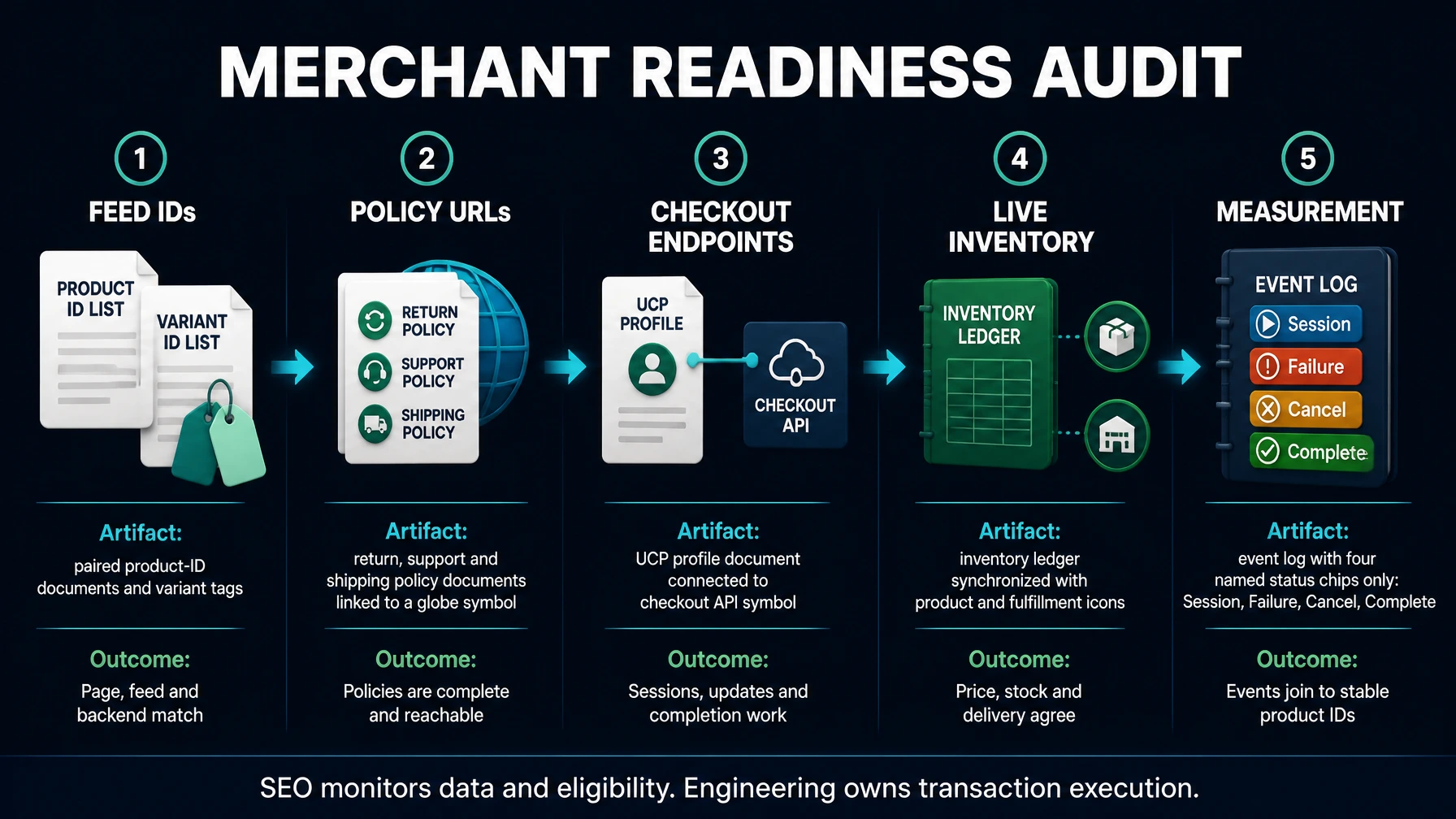
- Monitor by stable IDs. Log session creation, API errors, payment failures, cancellations, fulfillment failures, and completions against the same product identity used for discovery.
Test one price truth across the visible PDP, Merchant Center feed, Product structured data, and checkout total. Repeat for currency, availability, tax, shipping, and delivery promises. That is where SEO, feed operations, and engineering need a shared acceptance test.
Put a named owner and a dated sign-off beside each layer. SEO should not approve payment behavior, and engineering should not assume a successful API response means the product shown to the shopper was accurate. A short cross-functional release checklist is more valuable here than a single dashboard labeled "UCP ready." It forces the team to identify whether a failure began in discovery data, program eligibility, or transaction code.
Do Now, Prepare, and Do Not Assume
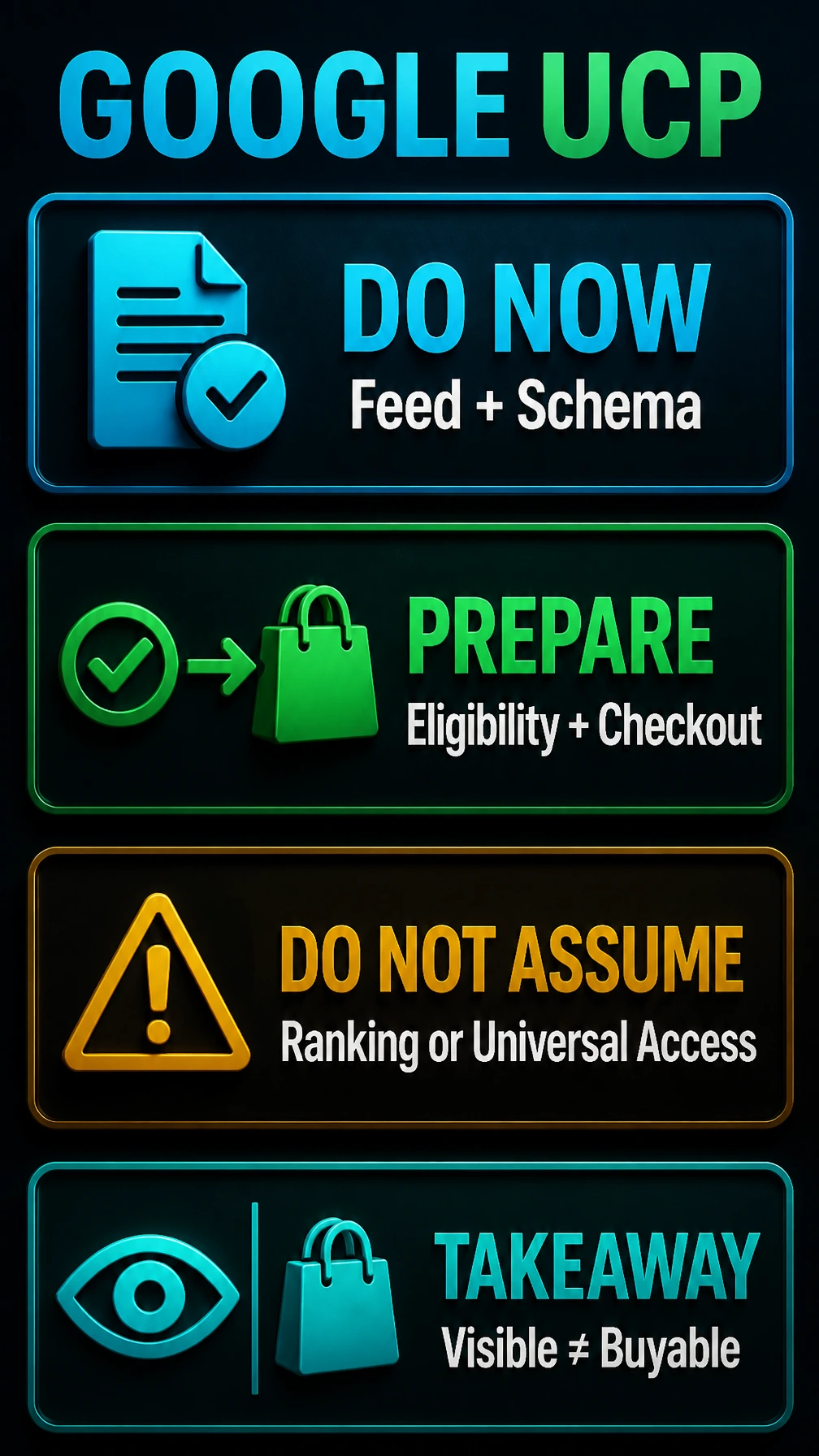
| Do now | Prepare | Do not assume |
|---|---|---|
| Resolve Merchant Center errors and stale product facts. | Record waitlist, country, product, surface, and approval status. | Every merchant or Shopify store has access. |
| Reconcile price, stock, IDs, variants, and canonical URLs. | Map feed IDs to Checkout API IDs and test edge cases. | native_commerce improves rankings. |
| Align visible PDP facts, the feed, and Product structured data. | Stage checkout fields in a supplemental data source. | Structured data makes a store UCP-ready. |
| Complete returns, support, shipping, and required notices. | Assign commerce, legal, engineering, payments, feed, and SEO owners. | Policy completeness creates an organic boost. |
| Model factual compatibility, sizing, materials, care, and delivery data. | Create checkout tests, monitoring, and rollback rules. | YouTube and Gmail checkout are uniformly live. |
| Annotate feed and product changes. | Define which joins and attribution reports are actually available. | A fall in website sessions proves on-Google sales. |
The first column improves today's discovery layer even if Google has not selected the merchant. The second reduces integration risk. The third keeps a limited checkout program from turning into ranking fiction.
Where Search Engine Land Is Right, and Where I Would Push Back
The article correctly centers Merchant Center, product identity, policy completeness, and the gap between product data and checkout systems. Its advice on native_commerce, merchant_item_id, and a supplemental data source is supported by Google's July guide.
Four claims need tighter boundaries:
- Surface availability needs future tense. Google put Search and Gemini first and said YouTube and Gmail would follow.
- Ecosystem scale is not program access. UCP is designed to work at scale, but Google's native checkout remains selective and approval-gated.
- AP2 is compatible, not universal. Its signed mandates address payment authorization and accountability. Google does not document it as a required stage in every UCP transaction.
- Policies are requirements, not rank juice. Returns, support, notices, and category restrictions affect readiness and compliance. No primary Google source says complete policies make agents rank a merchant higher.
The important SEO conclusion is not that the article is wrong. It is that a secondary interpretation should not outrank a newer implementation guide.
Measurement Without Ranking Fiction
No public primary source currently promises a complete report that joins an organic query, an AI response, product selection, checkout-session creation, and a completed order.
Build the evidence chain you can control: Merchant Center approvals and errors, feed-change annotations, the search visibility Google actually exposes, product-level checkout eligibility, checkout-session events, API and payment failures, cancellations, fulfillment outcomes, and completed orders. Join those records with stable product and order IDs where the platform permits it.
Keep discovery reporting separate from transaction reporting. A fall in website sessions could mean an on-Google purchase, a lost click, a ranking decline, or a reporting change. Sessions alone cannot distinguish them. Likewise, checkout eligibility is not evidence of additional visibility.
My review of Google's generative AI performance reporting follows the same rule: use the signals Google exposes, then state the missing joins instead of filling them with estimates.
Not Selected? Do This Now
For most merchants, preparation is the current opportunity.
Fix disapprovals, weak identifiers, thin variant data, and contradictions between product pages and the feed. Align Product structured data with visible facts. Complete return, support, shipping, and delivery information. Reconcile the ID architecture before an integration deadline makes the problem urgent.
Structure the factual answers buyers need: compatibility, sizing, materials, included accessories, care, availability, and fulfillment. Do not build thin pages that imitate long shopping prompts. Conversational search increases the value of complete product truth; it does not make prompt-shaped copy useful. My guide to query augmentation and agentic search explains the discovery side of that work.
If the store runs on Shopify, platform UCP support may shorten future engineering work. It still does not prove enrollment in Google's program. Record the account's actual status and recheck Google's live UCP overview before implementation because the rollout is changing.
The Takeaway
UCP expands the commercial path after discovery. It does not erase discovery.
Rankings, product pages, Merchant Center, structured data, brand demand, and product data still matter. For participating merchants, a second question follows: can this eligible product move through a trustworthy, observable checkout flow?
Make the product discoverable. Make the merchant and product eligible. Make the transaction executable. Keep the owners and measurements separate.
That is less exciting than claiming every AI agent can buy from every store. It is also a roadmap a team can implement.
FAQ
Is UCP a Google ranking factor?
No primary Google source documents UCP participation as an organic ranking signal for Search, AI Mode, or Gemini. Its documented job is commerce capability and checkout execution.
Do products need UCP to appear in AI Mode or Gemini?
Google does not document UCP as a discovery requirement. Merchant Center data, product pages, and structured data still support product discovery. UCP determines whether an eligible product from a participating merchant can enter a supported transaction flow.
Can I add native_commerce to the feed today?
Follow Google's onboarding status and current serialization. Google recommends a supplemental source, and the field controls checkout eligibility within its program. It does not create organic visibility.
Does Product structured data make a store UCP-ready?
No. Product markup supports understanding and documented search experiences. UCP readiness also requires merchant and product eligibility, policies, a UCP profile, checkout APIs, payment setup, validation, and approval.
Are Shopify merchants automatically live?
No. Shopify co-developed UCP and provides platform tooling, but Google's checkout program still has merchant selection, eligible-product, validation, and approval gates.
Does every UCP checkout use AP2?
No. Google describes AP2 as compatible payment infrastructure. UCP capabilities and payment handlers are negotiated, and AP2 is not documented as mandatory for every purchase.
Is native checkout live on YouTube and Gmail?
Google's dated rollout statement put Search and Gemini first and said YouTube and Gmail would follow. Verify the live documentation, account, country, and surface before claiming availability.
Who owns the customer and order?
Google says the participating merchant remains Merchant of Record and retains the customer relationship and data. Google's privacy practices still govern the interaction on Google surfaces.
About the Author