Duplicate Product Content and AI Citations: The 2.8% Problem
Shero found brand pages earned 2.8% of 1,851 AI citations. See what Shopify teams should test across duplicate copy and structured descriptions.

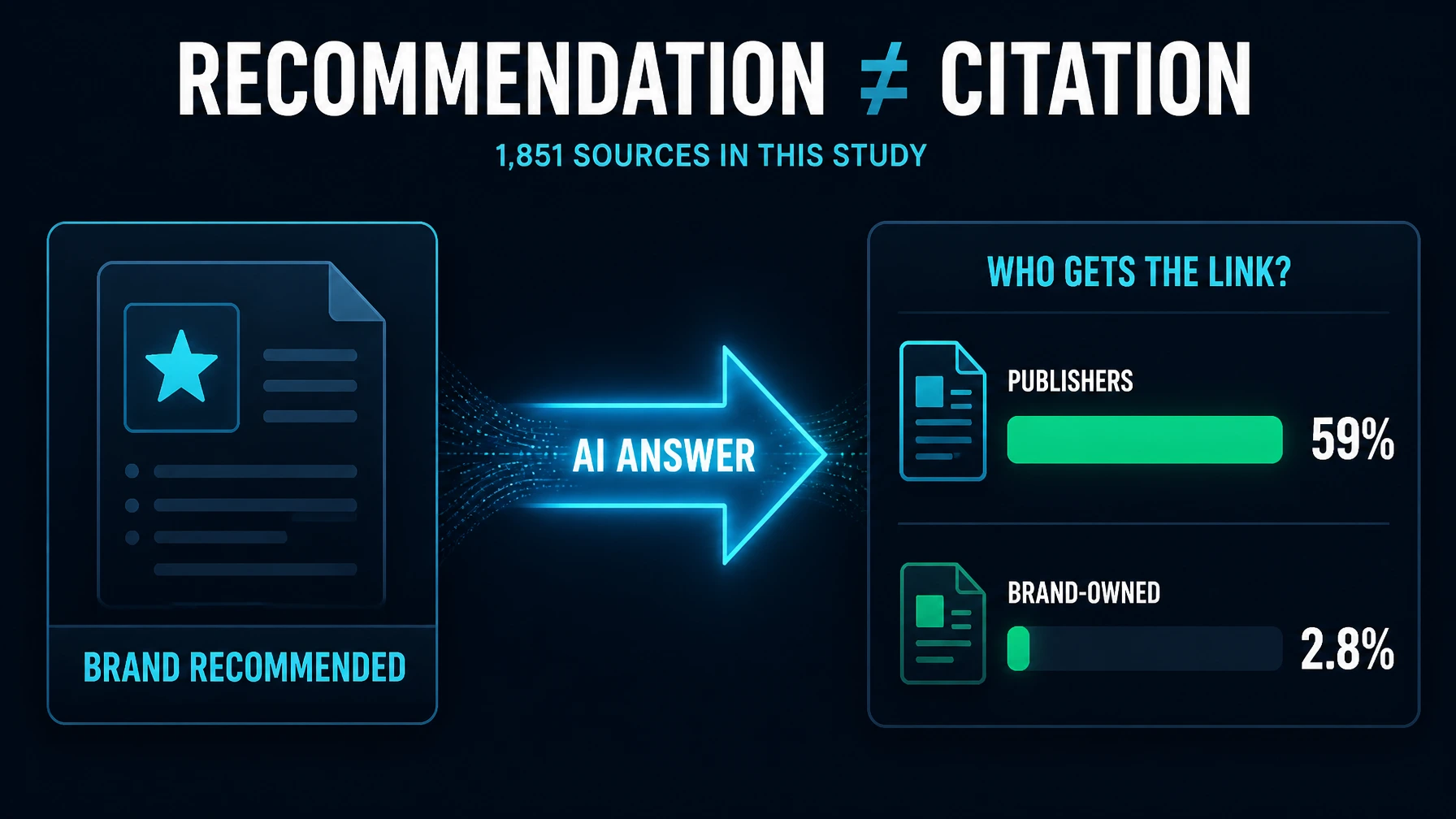
TL;DR: Shero Commerce logged 1,851 sources cited by Google AI Mode, ChatGPT, and Perplexity across 60 Shopify buying categories. Publishers supplied 1,100 of those sources, or 59.43%. The tested brand's own page supplied 51, or 2.76%.
The same research found substantial product-description duplication and sparse structured descriptions. Those patterns create a plausible attribution risk when several domains publish the same product language. The study does not show that duplication caused the citation gap, and unique copy cannot guarantee a citation. The defensible response is a controlled test on commercially important products.
6-Minute AI Citation Ownership Breakdown
Watch why an AI recommendation does not guarantee a brand-owned citation
A source-backed walkthrough of Shero's Shopify study, duplicated product copy, structured descriptions, and a controlled way to test citation ownership.
An AI answer can recommend your product while sending its citation, and the possible click, to a magazine or retailer. The brand gains a mention. The third party owns the path out of the answer and controls the evidence a buyer sees next.
Gentian Shero's July 2026 Shopify study makes that source-ownership gap measurable. Shero tested real buying questions and published the underlying workbook, which allowed me to recalculate the main figures and inspect where the public rows differ from the article. The most useful conclusion is narrower than a promise to rewrite every product description. Ecommerce teams need to measure owned citations separately from mentions and recommendations, then test whether product-specific evidence improves that outcome.
The Citation Ownership Gap Inside 1,851 Sources
The public Shero workbook records 1,851 cited sources. Only 51 rows point to the tested brand's own page, which equals 2.76% and rounds to the study's 2.8% headline. Publishers and media account for 1,100 rows, or 59.43%. Retailers account for another 356.
That distribution changes how an ecommerce team should define AI visibility. A mention can build awareness. A recommendation can place the product in a buyer's consideration set. An owned citation gives the merchant a chance to earn the visit, present current product facts, and lead the buyer toward a transaction. One blended visibility score hides those commercial differences.
The store-level log uses four statuses: cited, recommended, mentioned, and absent. Across 620 Google checks of established brands, 16 were cited, 37 recommended, 6 mentioned, and 561 absent. The study describes brands as cited or recommended 9.5% of the time, but 9.52% comes from including all 59 non-absent rows. Cited plus recommended alone equals 53 of 620, or 8.55%.
Favorable outcomes also separate brand presence from source ownership. The workbook contains 109 recommended rows and 50 cited rows. The brand's own page therefore received the link in 50 of 159 cited-or-recommended cases, or 31.45%. In roughly one third of the 60 Google category results, no sampled established brand received any non-absent status.
Publishers may deserve many of those citations. Comparison queries benefit from independent testing and multi-product evaluation. The operational concern appears when a brand supplies the underlying product language, several sellers repeat it, and the brand page still fails to become the linked source.
What Shero Measured and What the Study Cannot Prove
Shero targeted 1,000 Shopify stores and sampled up to 10 accessible products per store. The collected table totals 8,573 descriptions. The AI-search component covers 60 buying categories and 180 prompts divided among discovery, comparison, and validation questions. Google AI Mode, ChatGPT, and Perplexity all appear in the logs.
Two data seams matter. Shero reports that 883 stores returned live product data. The public Store Data tab contains 894 domains, and 882 rows have a positive product count. A later line in the methodology tab also works from 882. The one-store mismatch does not overturn a finding, but it should remain visible.
Engine coverage is uneven too. Google and Perplexity each have 620 established-brand checks. ChatGPT has 518, and 11 of the 60 category summaries have no ChatGPT result. The study used all three engines, although the public log does not support an even three-engine comparison across every category.
This is a cross-sectional snapshot from July 2026. Answer composition can change with prompt wording, model version, locale, account state, retrieval index, and date. Shero observed duplication, structured-description depth, brand status, and citation ownership in the same research program. The researchers did not randomly rewrite descriptions, preserve matched controls, and measure citation changes before and after the intervention.
Publisher authority, links, original reporting, user discussion, and historical prominence could explain part of the source distribution. The study supports an attribution hypothesis worth testing. It does not identify the cause of the 2.8% result.
Duplicate Product Copy Creates Attribution Ambiguity
Internal duplication is the cleanest description finding. Shero compared overlapping 8-word shingles and flagged product pairs above its similarity threshold. The workbook identifies 1,892 of 8,573 sampled descriptions as in-store duplicates, or 22.07%. Variant-heavy catalogs make that pattern familiar. Four colors of the same jacket can inherit four nearly identical descriptions.
External duplication needs firmer attribution. Shero reports that about 20% of descriptions appeared near-verbatim on another domain. That percentage cannot be reproduced from one defined denominator in the published tabs. The Syndication Receipts sheet contains 172 unique origin-product probes. Of those, 51 were marked found elsewhere and 30 had at least one confirmed match, which produces 29.65% or 17.44% under two available readings. The full Store Data table flags only 22 cross-site duplicate products.
The public rows support the distribution-channel pattern more clearly. Among 125 candidate-domain rows tied to a positive found-elsewhere probe, 101 were classified as retailers or marketplaces. Product copy commonly travels through retail feeds and marketplace listings, rather than being copied by a competing manufacturer.
These results do not establish a duplicate-content penalty. Google's duplicate URL documentation explains how redirects, rel="canonical", sitemaps, and internal links contribute to canonical selection. Shero did not test cross-domain canonicals or ranking demotions.
Copy uniqueness serves a more specific purpose here. A brand page should contain verified facts that a retailer feed does not carry. Materials, compatibility limits, sizing logic, care requirements, testing methods, buyer constraints, and original comparisons give the merchant page language with a direct relationship to its source.
The Structured Description Is the Weaker Content Layer
The standard Shopify description field makes the thin-content problem look larger than it appears on the page. In the full product sample, 2,560 of 8,573 standard description fields contain fewer than 50 words, or 29.86%. Shero then fetched two raw product pages per accessible store, removed shared boilerplate, and classified fewer than 50 product-specific words as thin.
The published Raw HTML Check tab contains 173 clean final classifications. Only 27 meet that thin definition, or 15.61%. This subset was shaped by storefront accessibility and bot protection, so 15.61% is not an estimate for every Shopify store. It is also a raw-response measure.
Google documents a crawl, render, and index process that executes JavaScript with Chromium. Raw HTML remains useful for crawlers with limited rendering, but it does not describe everything Google's rendered pipeline can see.
The structured description is weaker in the clean subset. A positive structured-description word count appears for 152 of 173 rows, or 87.86%. That figure is close to Shero's reported 88% Product schema adoption, although the workbook field is a proxy and not a separate yes-or-no schema audit. More revealingly, 102 of 173 structured descriptions are empty or under 50 words, which equals 58.96%.
A sparse JSON-LD description can expose machines to a generic summary even when the rendered page has richer details. No field-level experiment in this study shows that an LLM prefers or trusts the schema description. Keeping it accurate, product-specific, and consistent with visible content is sound implementation with a testable attribution hypothesis.
Crawler identity also needs precision. OpenAI's official crawler documentation identifies OAI-SearchBot for ChatGPT search visibility, GPTBot for potential model training, and ChatGPT-User for certain user-triggered visits. A robots audit that checks only GPTBot can miss the crawler connected to search discovery.
Product-Specific Evidence That a Retail Feed Cannot Carry
After more than seven years leading SEO at Shopify, I would treat this as a catalog systems problem before ordering a catalog-wide rewrite. The visible page, product feed, retail export, regional copy, and JSON-LD description can drift apart. Fresh prose in one field may never become the clearest source when the other layers continue publishing generic or conflicting language.
Start with evidence the brand can verify and a third-party seller is unlikely to create independently. Useful material includes measured specifications, compatibility constraints, sizing logic, care and expected wear, product-testing observations, support questions, return reasons, and buyer-fit guidance. A nearby implementation example appears in the beauty ecommerce product-page case study, where unique descriptions and Product schema formed part of a full product-page program.
Put the critical facts in accessible visible HTML, then synchronize the structured description with those facts. The Product Schema Generator can help produce valid field structure. Editorial ownership still determines whether the description says anything attributable.
Do not impose a universal minimum length. Shero used 50 words as an audit threshold. The study did not identify a word count that causes citations. A technical product with sizing and compatibility constraints needs more explanation than a simple replacement part.
A Controlled Attribution Test for a Shopify Catalog
A full-catalog rewrite changes too much at once and leaves no comparison group. A smaller test can show whether product-specific evidence is associated with better source ownership for your own catalog.
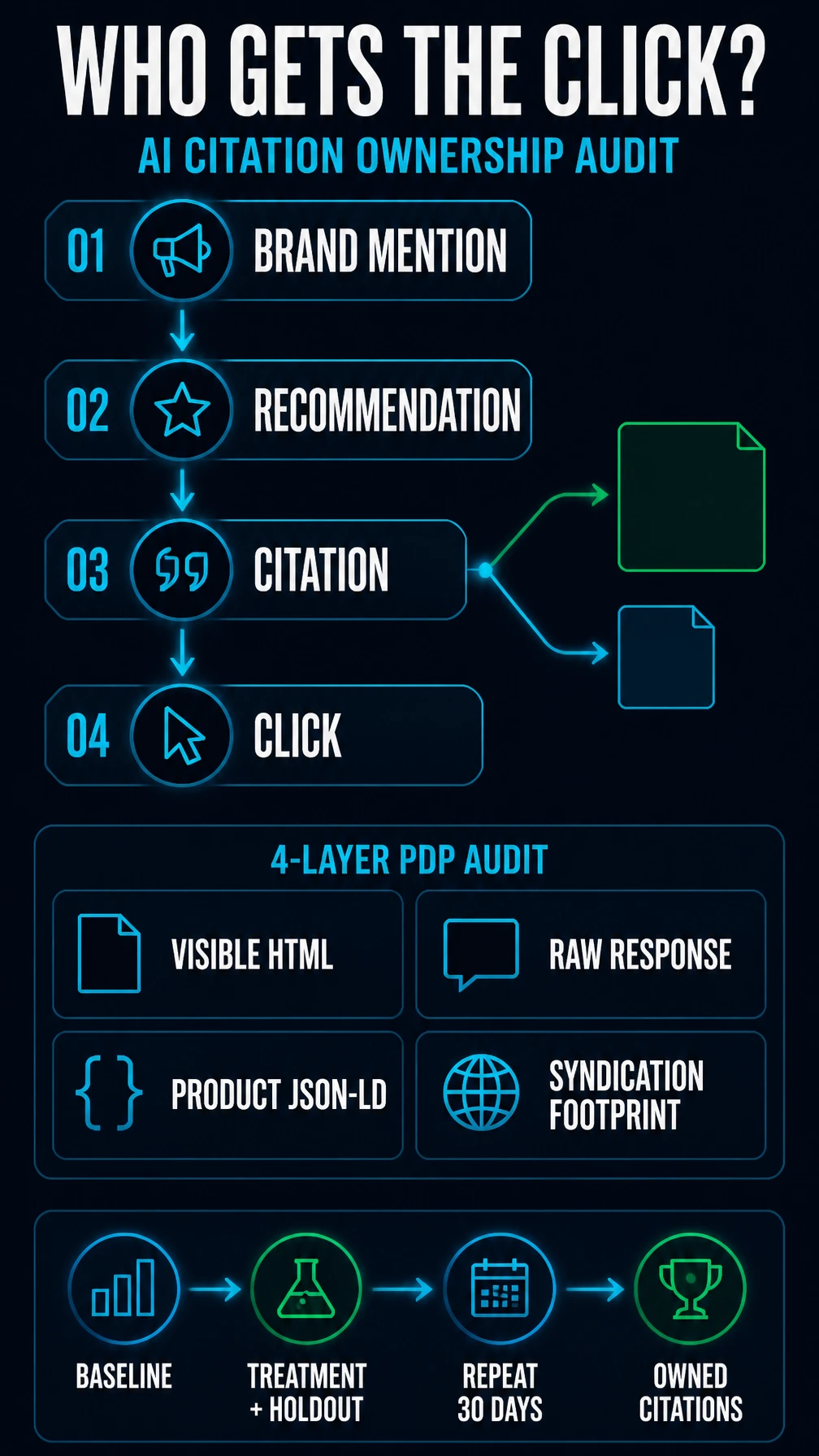
- Select 50 to 100 commercial SKUs. Favor stable products that already earn search impressions, appear on retailer sites, or feature in comparison questions.
- Create treatment and holdout groups. Match products by type, demand, price range, retailer exposure, and current organic visibility.
- Record a fixed baseline. Use the same engines, discovery, comparison, and validation prompts, locale, account state, and observation dates. Save whether the brand is absent, mentioned, recommended, or cited, plus the linked domain.
- Rewrite the treatment pages. Replace syndicated boilerplate with verified product evidence and align the visible copy, server response, product feed, and JSON-LD description.
- Keep major variables stable. Preserve price, availability, promotions, internal linking, and template changes where practical. Maintain a change log for the differences that remain.
- Repeat checks for at least 30 days. AI answers vary, so one observation per prompt is too fragile for a commercial decision.
- Report outcomes separately. Track mention rate, recommendation rate, brand-owned citation rate, publisher and retailer citation share, organic impressions, clicks, crawl activity, and indexing changes.
A lift in brand-owned citations would support another test. A null result can show that query intent, independent publisher evidence, authority, or retrieval coverage matters more than copy uniqueness for the selected prompts. Report either outcome as an observed change in one controlled sample.
This experiment belongs inside a full Shopify SEO program because product copy depends on feeds, templates, crawling, rendering, internal discovery, and catalog operations. A writing ticket by itself cannot control those layers.
Product Page Audit Priorities
- Map syndication before editing. Search a distinctive sentence in quotation marks and record retailer, marketplace, affiliate, regional, and publisher matches.
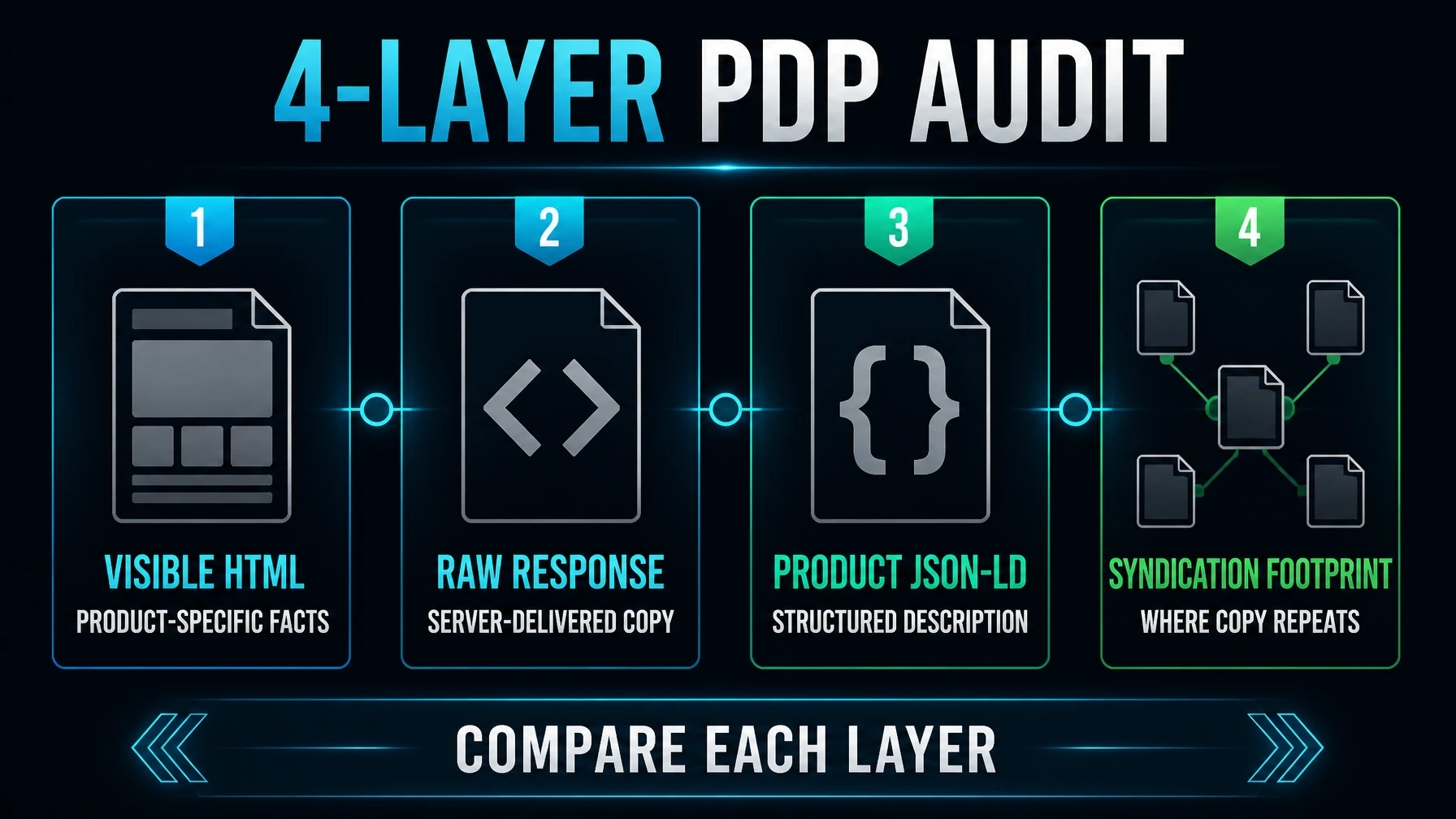
- Compare each content layer. Inspect the standard description field, raw response, rendered page, product feed, retail export, and Product JSON-LD separately.
- Prioritize high-intent products. Begin with products buyers compare, retailers syndicate, or AI systems already mention.
- Add attributable evidence. Publish brand-owned facts that can be checked. Rephrasing a generic manufacturer claim does not create new evidence.
- Measure ownership. Keep absent, mentioned, recommended, and cited states in separate columns. Record the exact domain that receives every link.
The audit should end with an assignable experiment. “Write unique descriptions” is too broad to measure. “Add verified compatibility and sizing evidence to 60 treatment products, align JSON-LD, and compare owned citations for 12 fixed prompts over 30 days” gives the team a decision point.
Shero's study offers a rare public ecommerce workbook and a strong reason to inspect source ownership. Its data does not turn product copy into a guaranteed AI-citation lever. Close the attribution gaps you control, preserve a holdout, and let results from your own store determine how far the work should expand.
Frequently Asked Questions
Does duplicate product content cause AI engines to cite publishers?
Shero's study cannot establish that. It observed duplication and publisher-dominated citations in the same July 2026 research program, with no randomized rewrite or matched before-and-after test. Treat duplication as a plausible attribution risk to measure.
Is duplicate product content a Google penalty?
The study measured no ranking penalty. Google's documentation treats duplicate URLs through canonical selection and signal consolidation. Shero did not test whether retailer canonicals change AI citation outcomes.
How much external duplication did the study find?
Shero reports about 20%, but that rate cannot be reproduced from one defined denominator in the public workbook. The strictest available receipt reading produces 30 confirmed probes among 172, or 17.44%. Cite 20% as author-reported.
Do Product schema descriptions help a page earn AI citations?
The study did not test that field as a citation factor. In the clean 173-row subset, 102 structured descriptions were empty or under 50 words. Filling the field with accurate product-specific facts is sensible implementation to test, without a promised citation result.
Will unique product descriptions make an AI system cite my store?
No one can guarantee that from this evidence. Independent reviews, authority, links, retrieval access, and query intent can still favor another source. Use a holdout and repeated checks, then expand only when your own results support it.
About the Author