Immigration Lawyer Toronto SEO: What Google Maps and AI Mode Actually Reward
A real SERP audit of “immigration lawyer Toronto” showing how Google Maps, Google Places, organic search, and AI Mode surface different law firms and different SEO signals.
60-Second Real SERP Audit
Watch the Toronto immigration lawyer audit before you read
A short walkthrough of what Google Maps and AI Mode surface for the same legal search.
Immigration Lawyer Toronto SEO: What Google Maps and AI Mode Actually Reward
TL;DR: A clean Chrome Canary incognito search for “immigration lawyer Toronto” showed a split between Google Maps and Google AI Mode. Maps rewarded strong Google Business Profile signals: reviews, proximity, categories, hours, appointment options, and local relevance. AI Mode leaned toward a different layer: established entities, specialist practitioners, directory validation, rich practice-area pages, and source support that helps an AI answer justify its recommendations.
What you’ll learn:
- Which real Toronto immigration law firms appeared in Maps, Places, organic search, and AI Mode.
- Why the Map Pack and AI Mode did not surface the exact same set of businesses.
- What an immigration law firm should improve to rank in both local search and AI-generated answers.
This is the kind of SEO audit I expect to become more important in 2026: not abstract ranking-factor commentary, but real searches in real verticals, with real businesses, real SERP modules, and real differences between Google’s answer surfaces.
The query is high intent: “immigration lawyer Toronto.” The user is not casually researching immigration policy. They may need a work permit, spousal sponsorship, permanent residence help, a refugee claim, an inadmissibility strategy, or an appeal. This is a local YMYL query where trust, authority, and conversion UX matter as much as ranking position.
I ran the search on May 2, 2026, at 4:30 PM EDT in Google Chrome Canary incognito, using English Canada parameters and personalization turned down as much as practical. Local results always carry location and timing sensitivity, so treat this as a point-in-time SERP audit, not a universal ranking report.
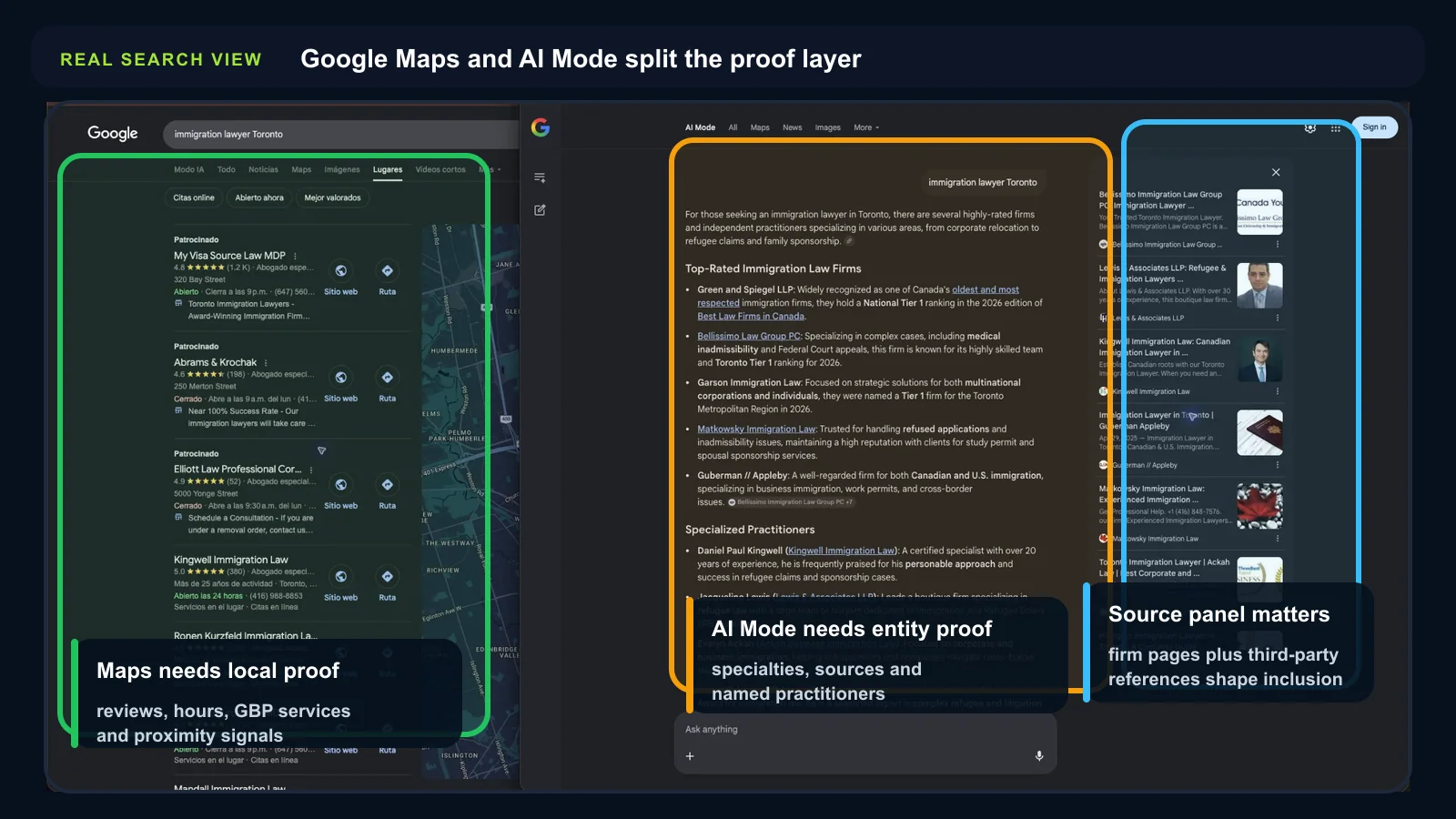
The Core Finding: Maps and AI Mode Reward Different Proof
Google’s official local ranking guidance still frames local results around three broad systems: relevance, distance, and prominence. Google also says complete and accurate Business Profile information helps the system understand what a business does, where it is, and when people can visit. That matched what showed up in the Places results.
The visible local winners had strong GBP signals: lots of reviews, explicit immigration-law categories, phone numbers, open hours, appointment options, and addresses that made sense for the Toronto search. But Google AI Mode did not simply repeat the Map Pack. It generated a more editorial answer, grouping firms and practitioners by perceived authority, specialty, and source support.
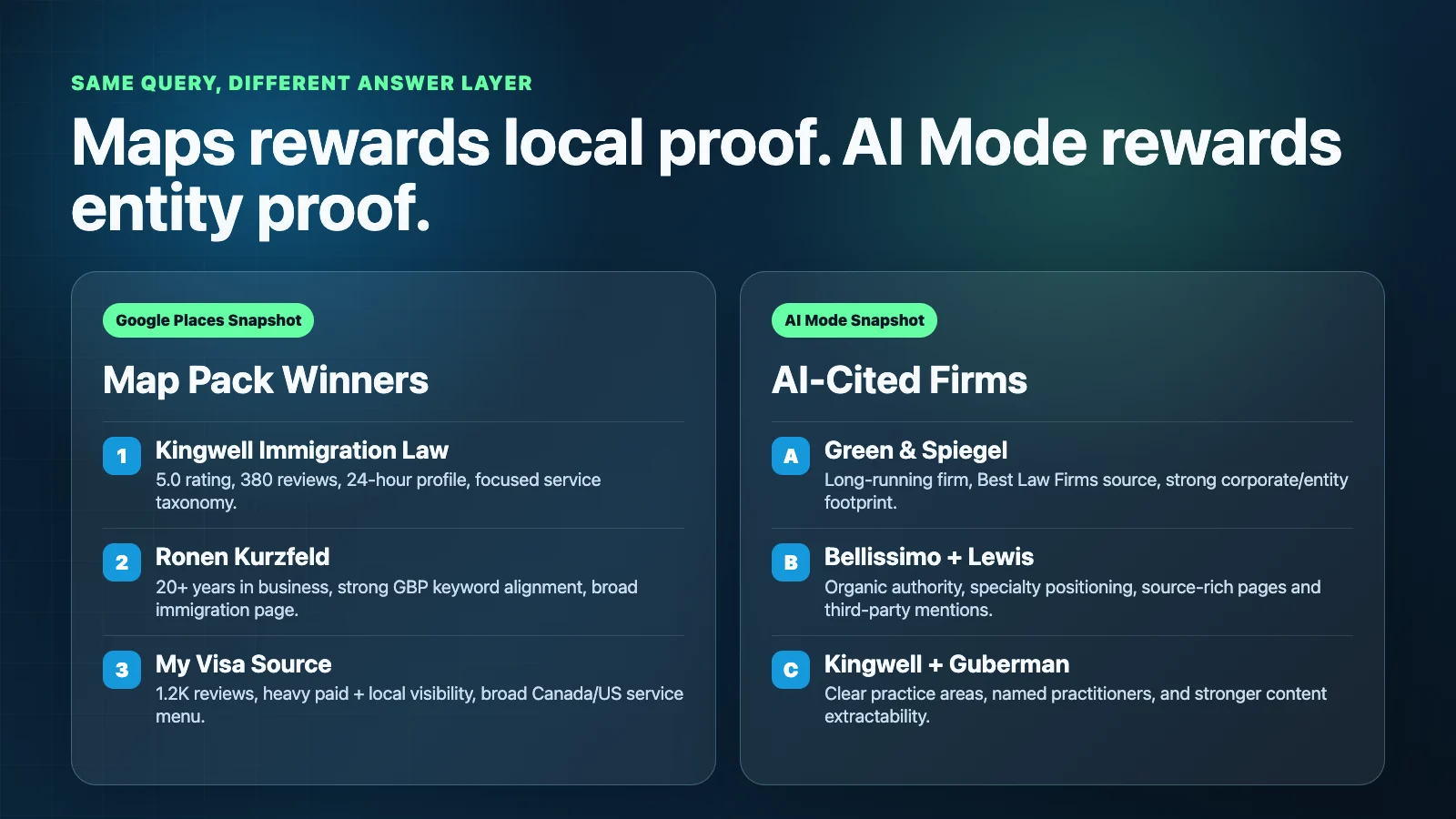
This is the practical lesson for legal SEO: you cannot chase only the Map Pack anymore. A law firm that wants to win modern search needs to look credible to three systems at once:
- Maps and Places, where the Business Profile is the strongest visible interface.
- Classic organic search, where pages, titles, internal links, schema, and authority still shape visibility.
- AI answers, where the system must have enough entity confidence and source range to include the brand in a synthesized recommendation.
That third layer is where many local businesses are still underbuilt. They have a GBP. They have reviews. They may even have a decent homepage. But they do not have the external, extractable, source-rich footprint that an AI answer can confidently cite.
What Google Maps and Places Showed
In the expanded Places view, the visible non-sponsored local results included a wide spread of firms: Kingwell Immigration Law, Ronen Kurzfeld Immigration Lawyer Toronto, My Visa Source Law MDP, Mandall Immigration Law, VisaPlace, Lewis & Associates LLP, Mamann Sandaluk LLP, Matkowsky Immigration Law, Ayodele Immigration Law, Bellissimo Immigration Law Group PC, Ackah Toronto Immigration Lawyer, Bright Immigration, Guberman Appleby Immigration Lawyers, Green and Spiegel LLP, AKM Law, Battista Migration Law Group, Chaudhary Law Office, and others.
The first cluster put three things in plain view.
| Visible local result | GBP signal observed | SEO interpretation |
|---|---|---|
| Kingwell Immigration Law | 5.0 rating, 380 reviews, 25+ years in business, open 24 hours, online appointments. | Strong trust density plus a focused site taxonomy around immigration services and Toronto intent. |
| Ronen Kurzfeld Immigration Lawyer Toronto | 4.8 rating, 268 reviews, 20+ years in business, open 24 hours, online appointments. | Business name, page topic, and service language closely match the query. |
| My Visa Source Law MDP | 4.8 rating, 1.2K reviews, 15+ years in business, visible paid and organic local presence. | High review volume and strong conversion funnel, with broad Canada and U.S. immigration coverage. |
| Lewis & Associates LLP | 4.9 rating, 1.7K reviews, 35+ years in business in the expanded Places list. | Very strong review volume and tenure, especially for refugee and immigration law positioning. |
| Green and Spiegel LLP | 4.8 rating, 1.2K reviews, 60+ years in business in the expanded Places list. | Prominence and institutional authority are strong, even when not the first visible Map Pack item. |
For local SEO, the takeaway is not simply “get more reviews.” Review volume helped, but the better pattern was review volume plus category relevance plus profile completeness plus content that reinforces the service promise. Google’s local documentation explicitly notes that more reviews and positive ratings can help local ranking as part of prominence, but reviews alone are not the whole system.
One subtle point: several results were open 24 hours. In legal services, that may not always mean a lawyer is personally available at 3 AM, but it does affect how the business presents in local search. If a firm can ethically and operationally support after-hours intake, that is a conversion and visibility advantage. If it cannot, fake availability is not the answer. Local SEO should never create a promise the business cannot keep.
What Organic Search Added
The organic results were not identical to the local list. Page-one web results included Bellissimo Immigration Law Group, Lewis & Associates LLP, Green & Spiegel, Kingwell Immigration Law, Guberman // Appleby, AKM Law, Best Lawyers, Battista Migration Law Group, and other legal directories or firm pages.
This matters because organic visibility is the bridge between Maps and AI Mode. The Map Pack can make a firm visible for immediate local intent, but AI Mode often needs pages it can read, classify, and use as evidence. A thin homepage with a phone number is not enough. The firms that looked stronger in organic had more extractable pages: immigration services, practitioner bios, locations, FAQs, awards, case areas, and third-party mentions.
For example, Kingwell Immigration Law presents a focused Toronto immigration lawyer page with service categories such as applications, permits, visas, citizenship, deportation, humanitarian applications, inadmissibility, permanent residence, refugees, sponsorships, urgent matters, and visitor visas. It also names Daniel Kingwell and describes his certified specialist status and litigation focus. That gives both users and AI systems more entity detail to work with.
Bellissimo Immigration Law Group positions itself around immigration, citizenship, refugee matters, medical inadmissibility, Federal Court appeals, deportation, visa appeals, misrepresentation, mandamus, and citizenship revocation. That kind of detailed specialty language is exactly what an AI answer needs when the user asks for a lawyer for a specific case type.
Lewis & Associates LLP states more than 30 years in immigration law, 10,000+ clients, and a refugee and immigration law focus. Green & Spiegel describes itself as a Canadian and U.S. immigration law firm with more than 60 years in practice. Guberman // Appleby emphasizes 70+ years of combined Canadian and U.S. immigration work. These claims become machine-readable entity attributes when placed in crawlable text.
Real Site Audit Notes: What These Firms Can Improve
The fastest way to understand this SERP is to look at the pages Google and AI Mode can read. The firms below already have useful signals. The opportunity is to make those signals easier for a search system, an AI answer, and a stressed legal client to understand in one pass.
Kingwell Immigration Law: Turn Service Breadth Into Extractable Proof
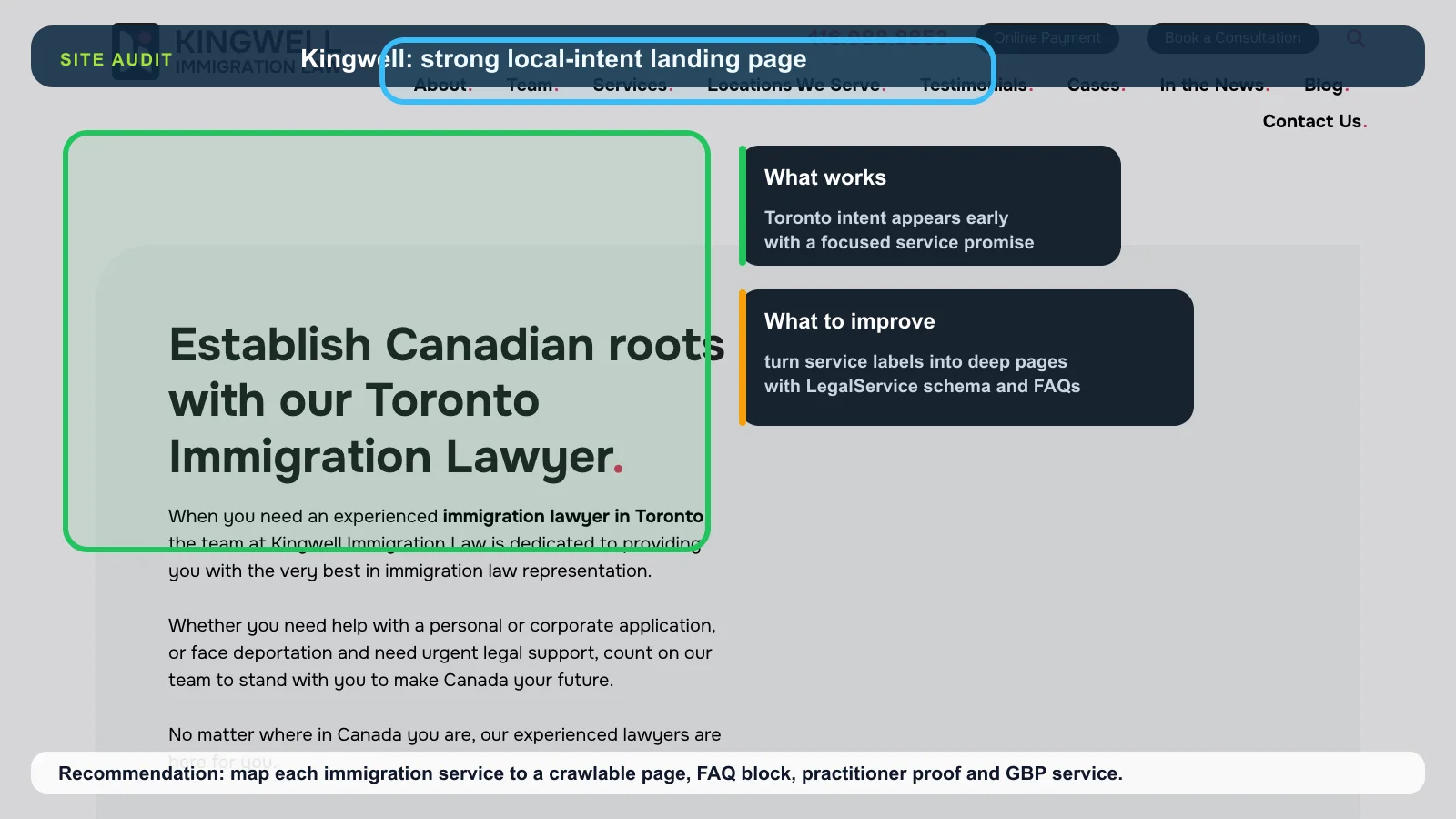
Kingwell does a good job matching the city and practice area in the first screen. That helps both users and Google understand the page quickly. The improvement is in the service architecture. Labels like work permits, sponsorships, refugee claims, inadmissibility, urgent matters, and visitor visas should each lead to a deep page with a direct answer, intake criteria, documents needed, lawyer proof, FAQs, and internal links back to the main Toronto page.
What to change: build service clusters around the highest-value case types, add LegalService and FAQ markup where accurate, and link those pages from the Google Business Profile services list when the profile supports it.
Bellissimo Law Group: Make Specialty Depth Easier to Quote
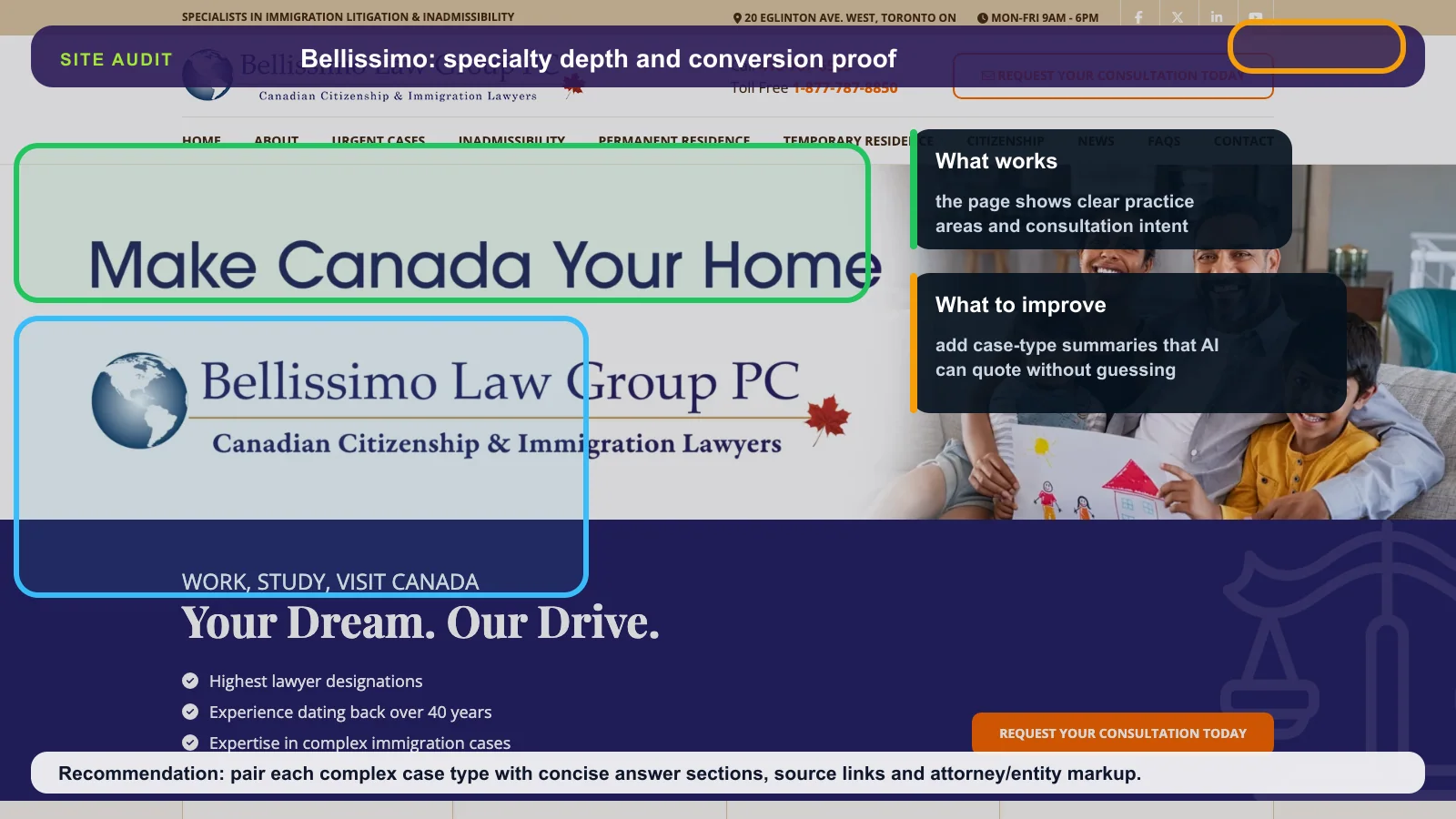
Bellissimo has the kind of specialty language AI Mode can use: immigration, citizenship, refugee matters, medical inadmissibility, Federal Court appeals, deportation, visa appeals, misrepresentation, mandamus, and citizenship revocation. The page already signals authority. The missing layer is compact answer material that an AI system can lift without flattening the nuance.
What to change: add short “who this is for,” “what we review,” “common risks,” and “next step” sections on each case-type page. Those blocks help AI answers describe the firm more accurately and help visitors decide if they have found the right legal team.
Guberman // Appleby: Split Cross-Border Intent Into Page Clusters
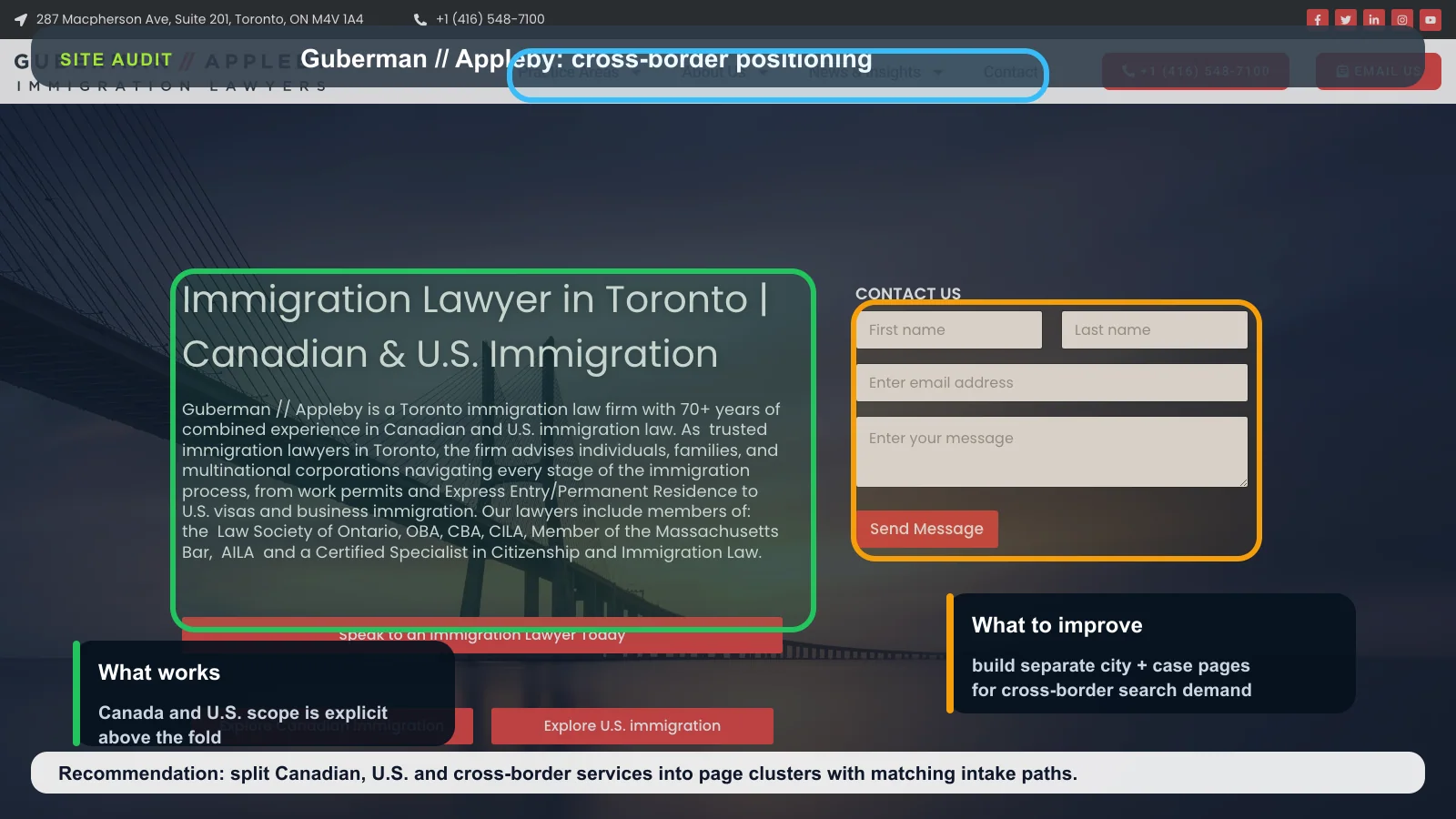
Guberman // Appleby is especially useful for this audit because the page is specific. It does not only say “immigration law.” It names Canadian and U.S. immigration, work permits, Express Entry, permanent residence, visas, business immigration, and cross-border matters. That gives the brand a sharper entity profile.
What to change: split the Canada, U.S., and cross-border offers into distinct page groups. Each group should connect a case type, a city modifier, attorney credentials, and a matching intake path. The contact form is visible, which is good, but the page should also make the best next action different for business immigration, family immigration, and urgent visa issues.
Green and Spiegel: Pair Institutional Authority With Local Proof
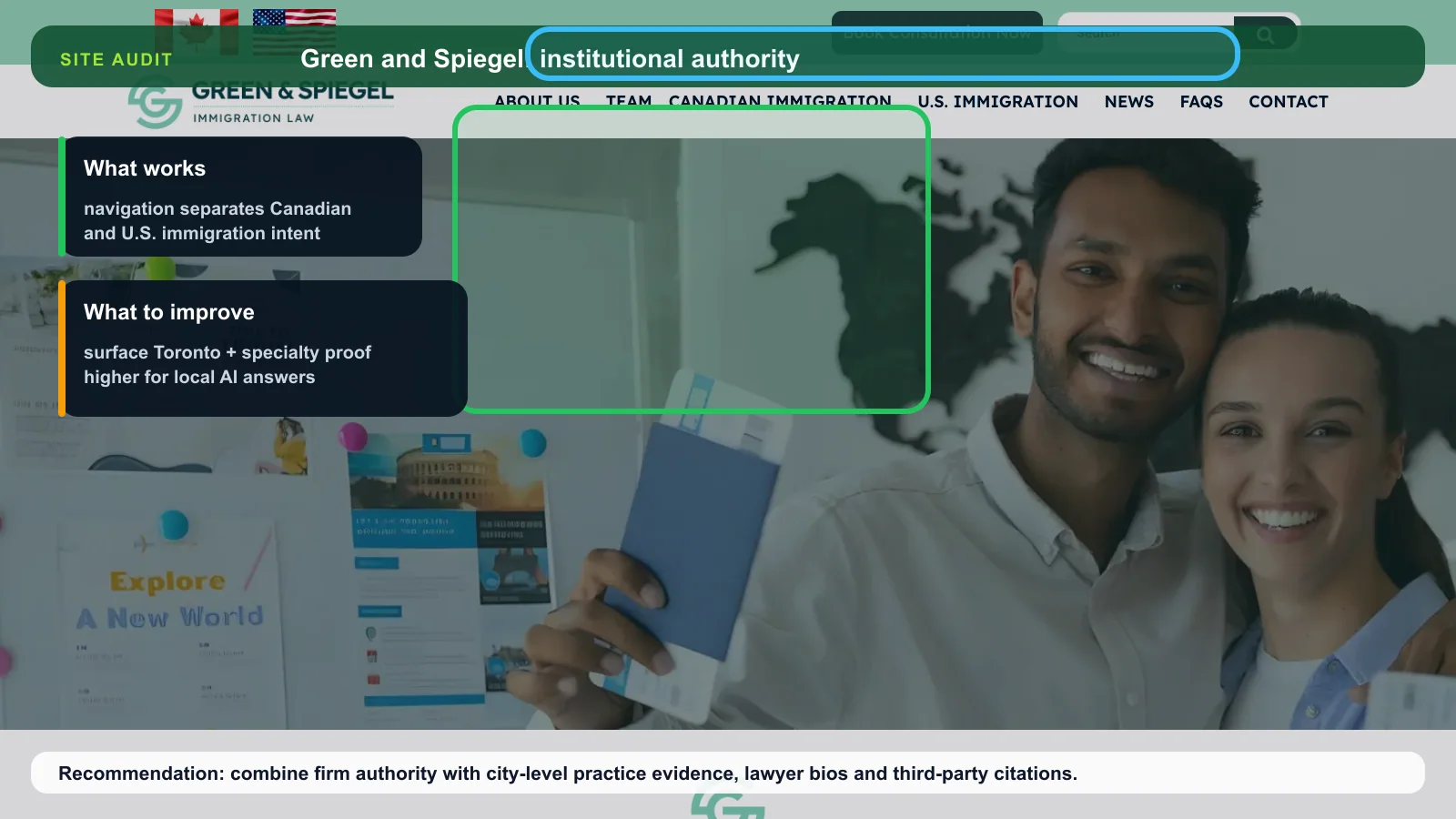
Green and Spiegel benefits from brand tenure and a broad immigration footprint. The navigation separates Canadian and U.S. immigration, which is helpful for search systems. For the Toronto query, the opportunity is to bring city-level and specialty-level evidence closer to the top of the page.
What to change: add more visible Toronto practice proof above the fold, connect lawyer bios to immigration specialties, and support the main pages with third-party citations, directories, videos, and interviews that repeat the same entity facts.
What Google AI Mode Did Differently
AI Mode generated a structured answer instead of a list. It grouped firms under “Top-Rated Immigration Law Firms,” “Specialized Practitioners,” and “Free Consultations and Legal Aid.” The answer named Green & Spiegel, Bellissimo Law Group PC, Garson Immigration Law, Matkowsky Immigration Law, and Guberman // Appleby in the top-rated section. It also named Daniel Paul Kingwell, Jacqueline Lewis, Evelyn Ackah, and Lorne Waldman as specialist practitioners.
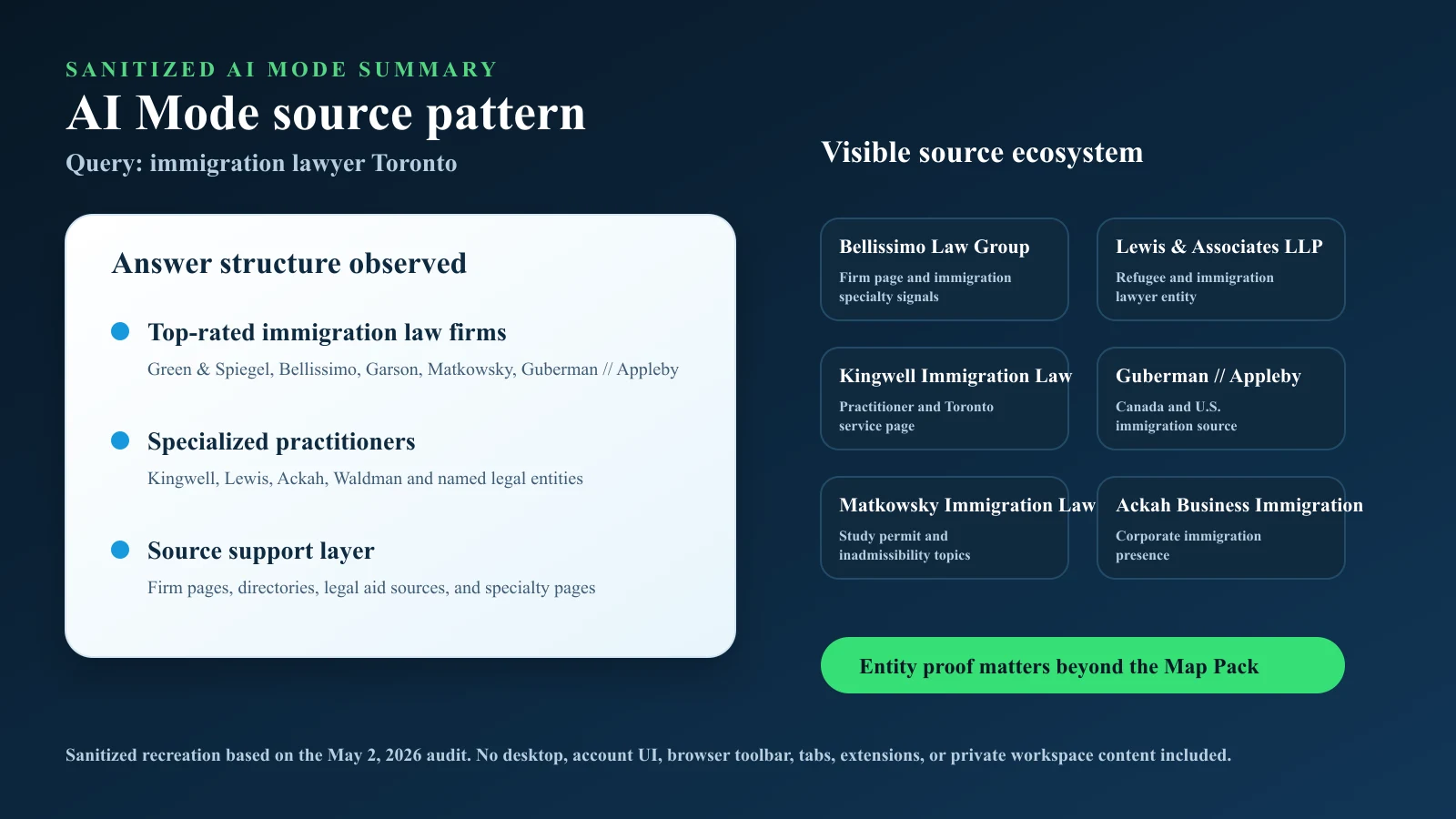
This is the most important part of the audit. AI Mode did not behave like a pure local ranking interface. It behaved like a recommendation engine trying to justify a synthesized answer. The answer surfaced firms and lawyers that were supported by source pages, legal directories, specialty descriptions, and recognizable authority signals.
The visible related-links panel showed sources from firm websites such as Bellissimo, Lewis, Kingwell, Guberman, Matkowsky, and Ackah, along with directory and legal-help sources such as Best Law Firms, CourseCompare, Legal Aid Ontario, and Steps to Justice. That reinforces a point we covered in the YouTube mentions and AI visibility study: generative search is not only reading your site. It is triangulating your brand through the wider web.
Why the Difference Exists
Maps is built around local decision-making. It has to answer: “Which nearby businesses match this query and are likely to be useful right now?” That pushes the system toward GBP completeness, category matching, distance, review strength, hours, phone availability, and the business’s local prominence.
AI Mode has a different job. It has to answer: “Which firms should I summarize as credible options, and what sources can support that answer?” That pushes the system toward crawlable content, entity recognition, third-party validation, and descriptive specificity. A firm page that says “we handle Canadian immigration” is weaker than a page that lays out work permits, Express Entry, spousal sponsorship, refugee claims, inadmissibility, appeals, Federal Court judicial reviews, and urgent removals.
This is why local legal SEO needs a dual architecture:
- Business Profile architecture for Google Maps and local conversion.
- Content architecture for organic rankings and AI extraction.
- Entity architecture for AI Mode, AI Overviews, ChatGPT, Perplexity, and other answer engines.
If you are building a full AI SEO program, local search is one of the best places to see the change. The business still needs NAP consistency and reviews, but it also needs to be legible as an entity across the web.
What an Immigration Law Firm Should Improve First
If I were advising an immigration law firm in Toronto after this audit, I would not start with a generic “write more blog posts” plan. I would start with the overlap between user intent, GBP relevance, and AI extractability.
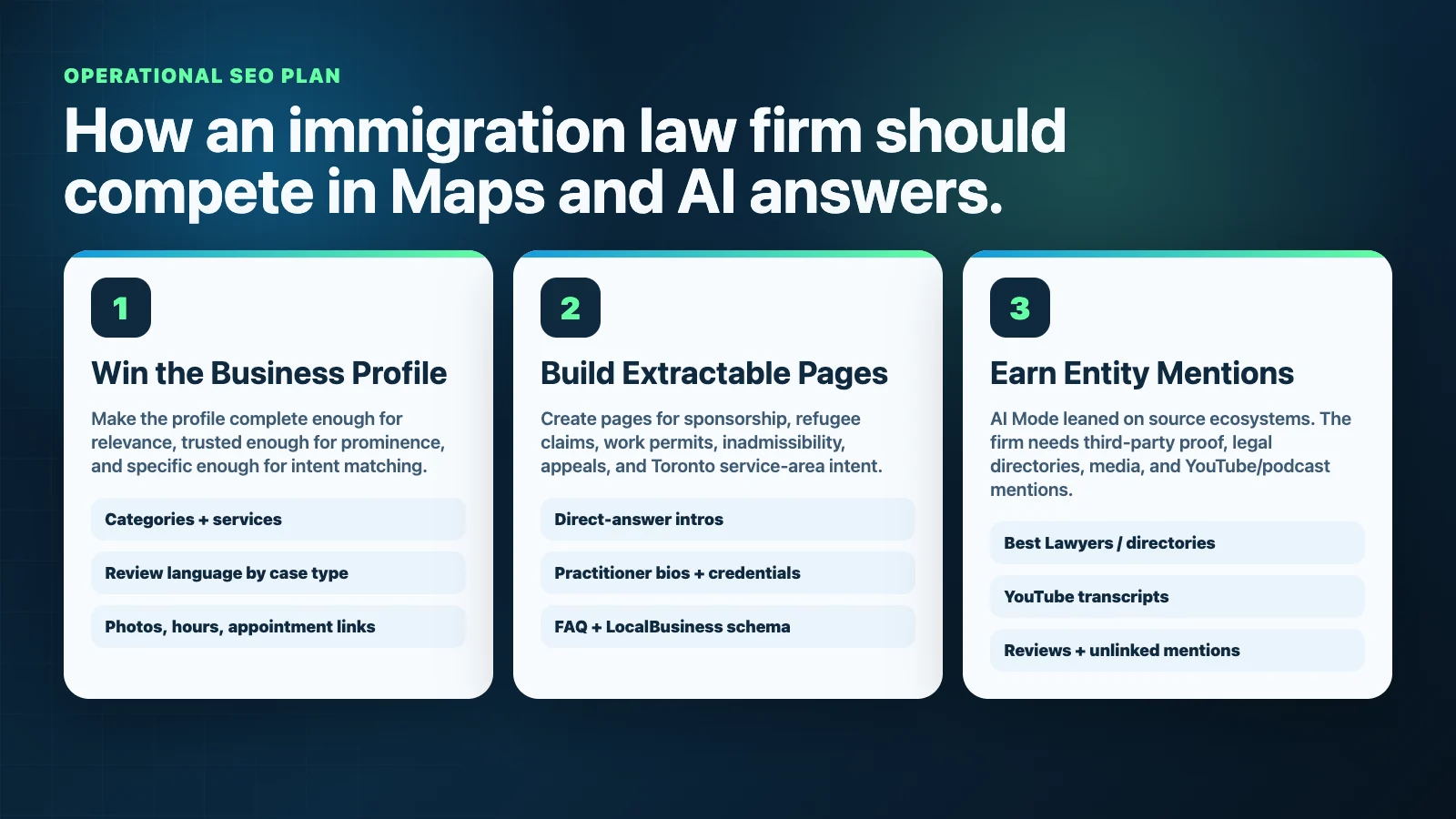
1. Make the Business Profile More Specific
The GBP should not merely say “law firm.” It should reinforce the exact services people search for: immigration attorney, immigration lawyer, spousal sponsorship, work permit, study permit, permanent residence, refugee claim, inadmissibility, deportation defense, appeals, and consultation availability. Categories, services, appointment links, photos, hours, and review response language all matter.
Review strategy should be especially careful in legal services. Do not script reviews. Do not pressure clients. But you can ethically ask satisfied clients to mention the type of help they received in their own words. “Helped with my spousal sponsorship” is more useful than “great service” because it gives Google and AI systems more intent-level language.
2. Build Dedicated Pages for Case Types
AI answers need specificity. A single “Immigration Services” page is rarely enough for a competitive city. The strongest site architecture should include dedicated pages for:
- Spousal sponsorship lawyer in Toronto.
- Work permit lawyer in Toronto.
- Study permit refusal lawyer.
- Express Entry and permanent residence support.
- Refugee claim lawyer in Toronto.
- Inadmissibility and removal order defense.
- Federal Court appeals and judicial review.
- Business immigration and cross-border work.
Each page should open with a direct answer, explain who the service is for, outline the process, show the documents or decision points involved, introduce the lawyer or team, answer FAQs, and link to the relevant consultation path. This is useful for users and much easier for AI systems to quote accurately.
3. Add LocalBusiness and LegalService Schema Carefully
Google’s LocalBusiness structured data documentation says structured data can tell Google about business hours, departments, reviews when appropriate, and other business details. For law firms, the goal is not to spam schema everywhere. The goal is to make the real-world entity easier to understand.
At minimum, the firm should review if its location page and key practice pages include accurate Organization, LocalBusiness or LegalService-style schema, consistent name/address/phone, sameAs links, opening hours, geo coordinates, area served, and links to practitioner profiles. If there are multiple offices, each office should have its own location data instead of one vague national blob.
SEO Francisco has a Local Business Schema Generator that can help teams draft the first version, but every legal implementation should be reviewed before publishing. Structured data must describe the page accurately.
4. Earn Third-Party Entity Mentions
AI Mode’s source list showed why owned content is not enough. Legal directories, awards pages, media mentions, podcast interviews, YouTube videos, and local business citations all help the model understand which entities are prominent in the market.
For immigration law firms, the highest-value third-party mentions are not random directories. They are context-rich mentions that connect the firm to a specialty: refugee law, spousal sponsorship, corporate immigration, inadmissibility, Federal Court litigation, U.S.-Canada cross-border matters, or urgent removals.
This is also where YouTube SEO enters the local SEO conversation. A short video explaining “What to do after a study permit refusal in Canada” can create a transcript that ties the lawyer’s name, firm, city, and specialty together. That transcript can become an entity signal, beyond a normal video-marketing asset.
5. Fix the Conversion Layer
Ranking is not enough for this query. The user is anxious, comparing options quickly, and often needs a consultation path immediately. Every ranking page should make the next step obvious without sounding aggressive:
- Consultation button above the fold.
- Phone number visible on desktop and mobile.
- Specific service match in the hero copy.
- Lawyer credentials near the call-to-action.
- Trust markers that are specific, not generic.
- FAQ answers for cost, timeline, eligibility, and what to bring to a consultation.
This matters for Maps too. When the GBP sends a visitor to the website, the landing page has to confirm the same promise the profile made. If the profile says “online appointments” but the site makes booking hard, you lose the conversion even if you win the click.
The New Local SEO Model: GBP + Pages + Entity Graph
The old local SEO playbook was mostly about citations, reviews, proximity, and a decent location page. Those still matter, but they are no longer enough for competitive professional services. The new model is bigger:
The most durable firms will not think of Maps, organic, and AI Mode as separate channels. They will build one entity system that all three can understand. The Business Profile says who the firm is locally. The website explains what the firm does. The rest of the web confirms that the firm is known for those services.
That is the real opportunity for local legal SEO. Not tricking Google. Not stuffing “immigration lawyer Toronto” into every heading. The opportunity is to make the firm’s real expertise easier to verify, easier to match to intent, and easier for both people and AI systems to trust.
Frequently Asked Questions
No. In this snapshot, Google Maps and Places emphasized local business signals such as reviews, categories, hours, proximity, and profile completeness. Google AI Mode generated a wider recommendation-style answer supported by firm websites, directories, and authority sources. The two layers overlap, but they are not identical.
Start with the Google Business Profile: categories, services, hours, appointment links, photos, and review response quality. Then build dedicated service pages for the case types clients actually search for, such as spousal sponsorship, work permits, refugee claims, inadmissibility, and appeals.
Structured data is not a magic ranking lever, but it helps clarify the business entity, location, services, opening hours, practitioner profiles, and sameAs links. It is especially useful when paired with accurate Google Business Profile data and specific service pages.
AI Mode appears to weigh source networks differently. It can surface firms with stronger directory validation, recognizable practitioners, specialty descriptions, and crawlable pages, even when those firms are not the first visible local result in the Map Pack.
Yes, if the videos are genuinely useful and connected to real client questions. YouTube transcripts can reinforce entity associations between the firm, lawyer, city, and specialty. For example, a video on study permit refusals or spousal sponsorship evidence can support both user trust and AI visibility.
About the Author