AI Citation Drift: What the Data Really Shows About LLM Source Stability
AI citation drift is real. Semrush tracked Reddit collapsing from 60% to 10% on ChatGPT in one month. Citation half-lives range 3.4–5.7 weeks by platform. Here's the full data breakdown and what SEO practitioners must do now.
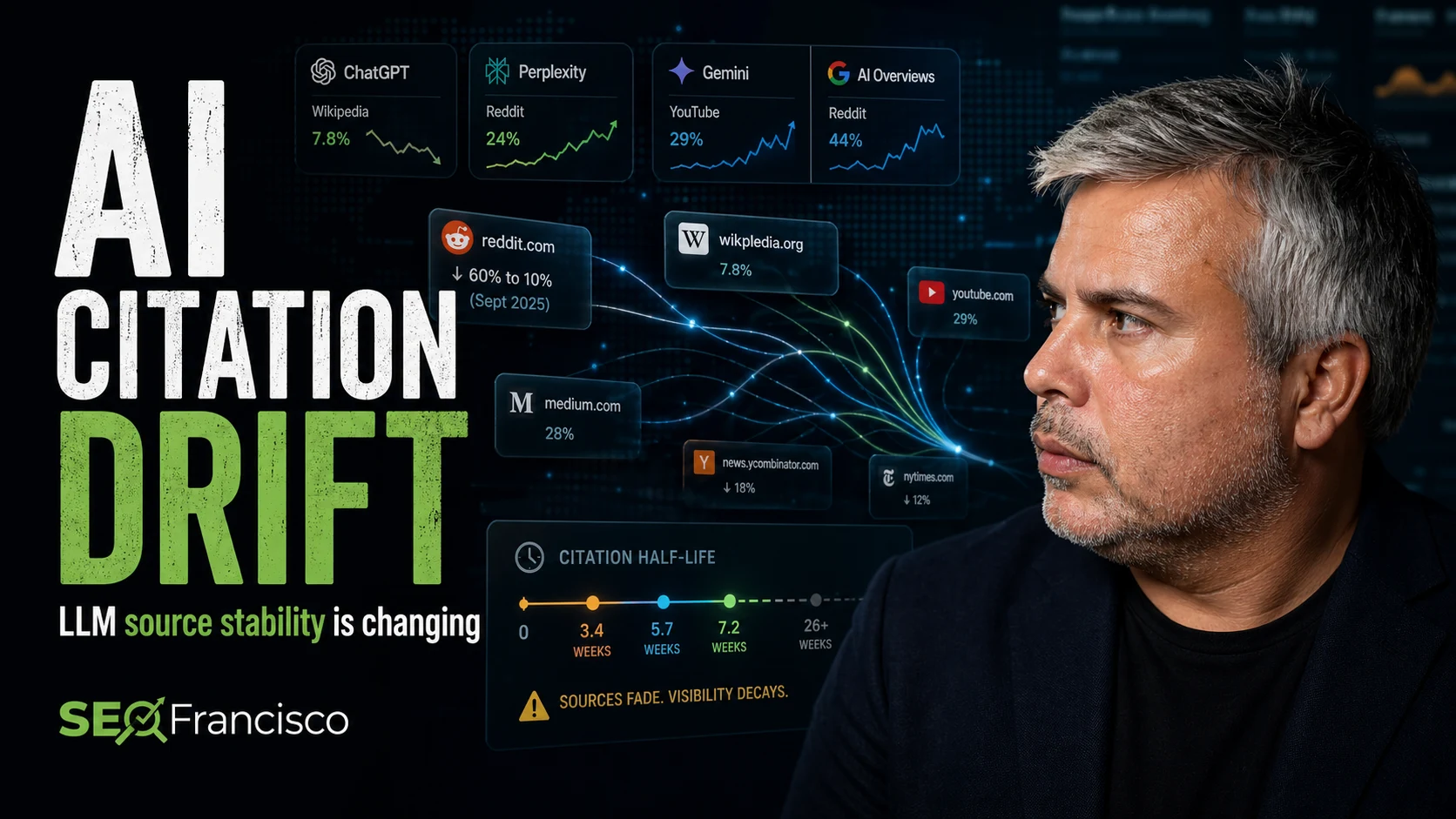
TL;DR: LLM citation sources don't hold still. Semrush documented Reddit collapsing from appearing in 60% of ChatGPT responses down to just 10% in a single month. SISTRIX tracked AI citation drift across 82,619 prompts over 17 weeks across three platforms. And Stacker/Scrunch's research shows your average citation lasts just 3.4 weeks on ChatGPT before decaying. If your GEO strategy is built on "get cited once and you're set," you're already losing ground.
What you'll learn:
- What AI citation drift is and why LLM source selection is far more volatile than anyone in the industry admits
- Platform-by-platform citation data: how ChatGPT, Perplexity, Gemini, and AI Overviews cite completely different sources
- A tiered action plan to build durable, multi-platform AI visibility, not just a one-time citation spike
AI citation drift is the inconvenient truth sitting underneath every GEO success story you see on LinkedIn. You ran a prompt, your brand appeared. Great. Come back in six weeks and see what happens. The evidence from multiple large-scale studies, Semrush's 230,000-prompt analysis, Stacker/Scrunch's 3-million-citation decay study, Previsible's month-over-month brand score tracking, consistently shows that LLMs are not stable citation engines. They change, they purge, they reprioritize. Understanding the mechanics of that drift is now a core SEO competency. If you want to go deeper on the technical crawl side of this, check our technical SEO advisory guide.
What AI Citation Drift Actually Is
Most people still think of AI search like a slightly smarter search engine. You appear in results, you stay in results. That's not how it works. LLMs are generative, they synthesize answers from a constantly shifting retrieval pool, filtered through a probabilistic model that recalculates relevance on every generation pass. Nothing is permanently indexed.
SISTRIX's Johannes Beus tracked this directly: 82,619 prompts run across 17 weeks, three platforms, and six languages. The core finding is that AI citation sources drift far more than the industry acknowledges, and that drift is platform-specific, not universal. (Source: SISTRIX)
Previsible calls the measurable version of this LLM perception drift: the month-over-month change in how AI models reference and position brands inside a category, even when nothing visible changed in the market. Using Evertune's tracking data on B2B software brands, they found brands swinging 5–8 points in a single month with zero corresponding change in their actual SEO or content output. The model shifted. The brand didn't. (Source: Search Engine Land)
Think of your brand's position in an LLM like a sand dune in the wind. The dune exists. It's real. But without ongoing deposition, the wind moves it somewhere else. The brands that hold position are the ones constantly adding new grains from multiple directions, not the ones who staked their flag once and walked away.
Key takeaway
AI citation drift is structural, not a bug. LLMs continuously recalculate source relevance. A citation today is not a citation guaranteed next month. Your GEO strategy needs a maintenance layer, not just an acquisition layer.
Platform-by-Platform: How ChatGPT, Perplexity, Gemini, and AI Overviews Cite Completely Differently

The single worst assumption in AI search optimization is treating "LLMs" as one unified channel. They're not. ChatGPT and Perplexity share an 11% domain overlap in their citation pools, meaning 89% of what one cites, the other doesn't. (Source: Profound, 680M citation analysis via ALM Corp) Optimizing for one doesn't automatically tune for the other.
Here's what the platform data actually shows:
| Platform | Top Cited Domain | Reddit Share | Key Citation Logic |
|---|---|---|---|
| ChatGPT | Wikipedia (7.8% of all citations) | ~10% post-Sept 2025 purge (was 60%) | Encyclopedic authority, credentialed media, Bing index dependency |
| Perplexity | Reddit (6.6% 3.5× ChatGPT's share) | 24% in Jan 2026 (Tinuiti data) | Community voice, independent 200B+ URL index, conversational authority |
| Google AI Overviews | Reddit (2.2%), YouTube (1.9%) | 44% of all social citations | Integrated with Google's index; social + expert content mix |
| Google Gemini | YouTube (29% of social), Medium (28%) | 5% of social citations (vs. 44% on AI Overviews) | Long-form editorial, video content, different from AI Overviews despite same parent company |
(Source: Profound 680M citation analysis; Tinuiti Q1 2026 AI Citation Trends Report; Semrush 230K prompt study; ALM Corp synthesis)
That Gemini row is the one that surprises people most consistently. Gemini and Google AI Overviews share a parent company but have a nine-times difference in how much they cite Reddit. If you built your strategy around AI Overviews and assumed Gemini would behave the same, you built on sand.
The 4–7% figure from Profound's analysis deserves emphasis. Traditional SEO ranking factors explain less than one in ten AI citation outcomes. The other 90%+ is driven by entity associations, content structure for extraction, distribution breadth, and recency. (Source: Profound via ALM Corp) That doesn't mean SEO doesn't matter, it's the prerequisite for getting crawled. But once retrieved, the citation decision is driven by entirely different signals.
Key takeaway
Platform-specific citation logic means platform-specific strategies. Reddit presence helps on Perplexity and AI Overviews. YouTube content matters disproportionately on Gemini. Encyclopedic authority drives ChatGPT. These are not the same optimization problem.
The September 2025 Reddit and Wikipedia Collapse on ChatGPT
In August 2025, Reddit was appearing in roughly 60% of ChatGPT prompt responses. Six weeks later, it was at 10%. That's not a gradual decline, that's a structural purge. Wikipedia dropped from ~55% to below 20% in the same window. (Source: Semrush, 230K prompt study)
The popular explanation at the time was Google removing its num=100 search parameter, theoretically limiting ChatGPT's access to deeper SERP pages. The data doesn't support it. Only 34% of Reddit's Google rankings sit between positions 21–100, mathematically insufficient to explain a 50-point citation collapse. (Source: Semrush)
"I believe the main reason for the drop is an attempt to avoid over-citing on certain websites, to be less biased toward them, while generating answers. As a result, ChatGPT has become more tough to manipulation attempts."
Sergei Rogulin, Head of Organic and AI Visibility at Semrush
Key takeaway
Single-platform citation concentration is an existential GEO risk. LLMs can cut a domain's citation share by 80%+ overnight with zero warning. Build presence across multiple high-authority editorial domains, not just one or two UGC platforms.
Citation Half-Life and Source Decay: How Long Do AI Citations Actually Last?

Stacker partnered with Scrunch to run the most methodologically rigorous citation decay study to date: 3 million+ citation events, 120,000+ non-network domains tracked as a baseline, 8 industries, 6 AI platforms, 26-week observation window from September 2025 through March 2026, with 200 bootstrap simulations for statistical validation. (Source: Stacker/Scrunch)
The headline: the average non-network domain has a citation half-life of roughly 4.5 weeks. Within about one month, half your ChatGPT citations will have disappeared. Traditional SEO built on decade-old link equity doesn't have this problem. AI citation does, and that structural difference changes how you need to think about content production cadence.
| AI Platform | Non-Network Half-Life (weeks) | Distributed Content Half-Life (weeks) | Durability Gain |
|---|---|---|---|
| OpenAI (ChatGPT) | 3.4 | 7.2 | +3.8 weeks |
| Google AI Mode | 4.3 | 8.2 | +4.0 weeks |
| Google AI Overview | 4.7 | 9.9 | +5.2 weeks |
| Gemini | 4.6 | 10.9 | +6.3 weeks |
| Perplexity | 5.7 | 10.4 | +4.6 weeks |
(Source: Stacker/Scrunch citation decay study, September 2025–March 2026)
ChatGPT cycles through sources fastest at 3.4 weeks. Perplexity is the stickiest at 5.7 weeks. The 2.1× durability advantage from distributed content held across all 8 industries tested. That consistency across completely different verticals tells you it's structural, not industry-specific. When your content lives across many editorial domains, even as individual sources cycle out, the underlying information persists above the citation threshold. (Source: Stacker/Scrunch)
dateModified schema markup and a visible "last updated" timestamp to your top pages. AI systems prefer content roughly 25.7% fresher than the median traditionally-ranked page. Make recency explicit and machine-readable, it directly affects citation likelihood.
Key takeaway
Distribution creates durability. Content on one domain has a half-life of 3–6 weeks. The same information distributed across a network of editorial sources holds citations for 10+ weeks. GEO needs a distribution layer, not just a content creation layer.
LLM Perception Drift as a New SEO KPI

Jordan Koene at Previsible coined the term that finally put numbers on what practitioners had been observing anecdotally: LLM perception drift. Using Evertune's brand score data, which tracks how likely an LLM is to recommend a brand without being prompted by name, they measured the project management software category from September to October 2025.
| Brand | AI Brand Score Change (Sep → Oct 2025) | Likely Driver |
|---|---|---|
| Slack | −8.10 | Single-function positioning, category boundary expansion |
| Trello | −5.59 | Standalone tool losing ground to system brands |
| Monday.com | −0.78 | Minor drag from category broadening |
| Atlassian | +5.50 | Multi-product system, rich documentation, deep integrations |
| Deloitte | +5.00 | Category expanding into "enterprise productivity" and IT consulting |
| +3.62 | System anchor brand for the newly broadened category | |
| Microsoft | +2.08 | Multi-context presence across productivity, cloud, collaboration |
(Source: Previsible / Evertune, via Search Engine Land, December 8, 2025)
None of these brands dramatically changed their content or SEO strategy between September and October. The model shifted. LLMs increasingly pull project management into wider conceptual neighborhoods, operations, digital transformation, workflow orchestration, enterprise productivity. When category boundaries blur, single-function tools get outcompeted by system brands that live across multiple contexts simultaneously. This is entity-based SEO on steroids, same principle, playing out in weeks not years, with no rank tracking dashboard to catch it early.
"By 2026, AI brand signal stability will sit next to share of voice and keyword rankings as a core visibility metric."
Jordan Koene, CEO, Previsible, Search Engine Land, December 8, 2025
Key takeaway
LLM perception drift is measurable and already moving B2B brand discovery numbers. Multi-product system brands gain. Single-function tools lose. Build contextual density across adjacent topics, not just your core category page.
What Actually Drives Durable AI Citations

Traditional ranking factors explain 4–7% of AI citation outcomes. The remaining 93–96% comes from three primary drivers:
1. Distribution breadth, the strongest signal. Ahrefs analyzed 75,000 brands and found brand web mentions correlate with AI citation rates at 0.664. That's roughly three times stronger than the correlation for backlinks (0.218). (Source: Ahrefs via ALM Corp) LLMs synthesize text, they understand brand importance from how often and where a brand is mentioned across the web, not from link graph topology. If your brand appears on four or more platforms, you're 2.8× more likely to get a ChatGPT citation than a brand concentrated on one channel. (Source: Ekamoira)
2. Content structure for RAG extraction. AI systems chunk your text into roughly 200-word segments and vectorize each independently. If a chunk can't stand alone, relies on prior context, or starts with "It" pointing to something three sentences back, the vector it produces is semantically weak. Every paragraph must pass the Island Test: intelligible in isolation. The Information Density formula: ID = (Unique Entities + Factual Claims) / Total Word Count. Higher density means more usable context per token, which increases extraction probability. (Source: Ekamoira)
3. System signal strength. Atlassian's +5.50 brand score gain in one month happened because they have strong documentation, cross-product integrations, community presence, and coverage across adjacent verticals. Multi-product system brands gain AI visibility more reliably than single-function tools because they surface across more query types and provide richer model associations.
Key takeaway
Stop chasing backlinks as your primary GEO lever. Brand web mention breadth beats backlink volume 3-to-1 for AI visibility. Redirect budget toward earning editorial mentions across authoritative sources and restructuring content for clean RAG extraction.
The GEO vs. SEO Debate: Where I Land
The industry keeps asking whether Generative Engine Optimization is a separate discipline or just rebranded SEO. Here's my position after looking at the data:
They share infrastructure. They enforce different scoring rules.
ChatGPT doesn't crawl the web independently, it executes queries against Bing's index for real-time answers. Gemini sits on Google's search infrastructure. If your site has crawl errors, blocks AI bots in robots.txt or has poor organic visibility, the AI never retrieves you in the first place. SEO is the prerequisite.
But getting retrieved is not the same as getting cited. In traditional SEO, ranking high enough earns a click. In GEO, success means your text gets extracted and reproduced inside the AI's answer. You can hold the #1 organic ranking and generate zero AI citations if your paragraphs are unstructured prose. Princeton's GEO research showed specific generative optimization strategies boost citation likelihood by 40%. (Source: Princeton GEO study)
The people saying "GEO is just SEO" are right about the foundation but wrong about implementation. The people saying "GEO is a completely different discipline" are right about the output format but wrong about the infrastructure. Treat GEO as a 15-point extension to your existing technical SEO plan, not a separate practice.
Key takeaway
SEO gets you retrieved. GEO gets you cited. You need both. Don't split into "SEO" and "GEO" silos, extend your existing technical process to cover extraction-readiness, AI crawl hygiene, and distribution breadth.
The Practitioner Action Plan
Critical (do this week)
- Audit
robots.txtfor AI crawlers. Explicitly allowGPTBotOAI-SearchBotClaudeBotandPerplexityBot. Over 35% of top websites accidentally block AI bots. BlockingOAI-SearchBotopts you out of ChatGPT search entirely. - Apply the Island Test to your top 10 pages. Every paragraph must make sense in isolation. Replace pronouns with explicit nouns. Kill sentences starting "It" or "This" without a clear noun referent. Highest-use structural change you can make for GEO extraction.
- Submit sitemap to Bing Webmaster Tools. ChatGPT's search uses Bing's index as a primary source. Most SEO teams ignore Bing Webmaster Tools entirely. Ten-minute task, real citation upside.
Important (this month)
- Build a multi-platform brand mention program. Target editorial coverage across 4+ authoritative domains relevant to your category. Unlinked mentions count, the 0.664 brand mention correlation with citations doesn't require a followed backlink. (Source: Ahrefs via ALM Corp)
- Add
dateModifiedschema and visible "last updated" timestamps. AI systems prefer content ~25.7% fresher than the median traditionally-ranked page. Make recency explicit and machine-readable. - Convert comparison and feature pages into tables. ChatGPT natively prefers tables because they map cleanly to its output structure. If you're presenting feature comparisons as paragraphs, convert them now.
- Implement FAQ Schema on top content pages. FAQ Schema gives AI systems a structured question-answer pair to cite directly, improving extraction probability and enabling rich-snippet eligibility.
Strategic (next quarter)
- Set a quarterly content refresh cycle. Citation half-life is 3.4–5.7 weeks per platform. A systematic quarterly update of statistics, dates, and examples resets the decay clock on your top pages.
- Add LLM perception drift tracking to monthly reporting. Tools: Evertune, Waikay, Peec AI, SE Ranking AI Visibility. Track your AI brand score month-over-month alongside traditional rankings.
- Build platform-specific GEO strategies for your top 2 platforms. Pick the two AI platforms most relevant to your audience. Map their specific citation logic, then build dedicated content or distribution plays for each.
Frequently Asked Questions
What is AI citation drift and why does it matter for SEO?
AI citation drift is the month-over-month volatility in which sources LLMs choose to cite in their answers. Unlike a Google ranking, which changes gradually and shows up in Search Console, AI citation patterns can change dramatically in weeks with no corresponding change in your site's content or authority. It matters because 73% of B2B buyers now use AI tools in their research process (Source: PR Newswire, March 2026), and a brand that disappears from AI citations loses discovery surface it can't track through traditional SEO tools.
Why did Reddit citations drop so sharply on ChatGPT in September 2025?
Semrush's 230,000-prompt study documented Reddit dropping from ~60% to ~10% of ChatGPT responses in about six weeks. The popular explanation, Google removing the num=100 parameter, doesn't hold up mathematically. Only 34% of Reddit's rankings sit in positions 21–100, insufficient to explain a 50-point drop. Semrush's Sergei Rogulin assessed it as an intentional retrieval weight adjustment by OpenAI to reduce manipulation-susceptibility. Perplexity and AI Mode showed no corresponding drop, confirming it was a ChatGPT-specific model decision.
How long does a typical AI citation last before it decays?
The Stacker/Scrunch citation decay study (3M+ events, 26-week window, September 2025–March 2026) found the average non-network domain has a citation half-life of 3.4 weeks on ChatGPT and up to 5.7 weeks on Perplexity. Within about one month, half your ChatGPT citations will have disappeared unless you refresh content and maintain distribution breadth. Distributed content across editorial networks holds citations roughly twice as long, averaging 7.2–10.9 weeks of half-life depending on platform.
Is GEO (Generative Engine Optimization) actually different from SEO?
They share infrastructure but enforce different scoring rules. ChatGPT's real-time search uses Bing's index; Gemini uses Google's. If your site isn't crawlable or has poor organic visibility, AI systems won't retrieve you, so SEO is the prerequisite. But once retrieved, the citation decision is driven by different signals: content structure for RAG extraction, entity density, brand mention breadth, and recency. Getting retrieved is an SEO problem. Getting cited is a GEO problem. You need both, solved in the same technical plan.
How do I tune for AI citations on ChatGPT?
ChatGPT favors encyclopedic authority (Wikipedia was 7.8% of all citations before September 2025), credentialed media coverage, and content that passes the Island Test, every paragraph intelligible in isolation, no pronoun-dependent chunks. Submit your sitemap to Bing Webmaster Tools since ChatGPT's search uses Bing's index. Explicitly allow OAI-SearchBot in robots.txt. Update content frequently, ChatGPT has the shortest citation half-life (3.4 weeks) of any major platform.
What tools can I use to track my AI search citation presence?
Several platforms now offer AI visibility tracking: Evertune and Waikay for AI brand score and share-of-voice; Peec AI for citation monitoring across ChatGPT, Perplexity, and Gemini; SE Ranking's AI Visibility module; and Meteoria. Semrush and Ahrefs are adding AI visibility features. For budget-constrained teams: run 20–30 representative category prompts weekly and track citation presence in a spreadsheet. Imperfect but better than nothing while the tooling matures.
Do backlinks still matter for AI search visibility?
Yes, but their power is significantly diminished relative to brand web mentions. Ahrefs found brand mention breadth correlates with AI citation rates at 0.664, versus 0.218 for backlinks, roughly three times the signal strength. (Source: ALM Corp) Backlinks still matter for traditional SEO, which is the prerequisite for AI retrieval. But if you're prioritizing link acquisition over building genuine editorial brand mentions, your GEO budget allocation is wrong.
How is Perplexity different from ChatGPT for citation optimization?
Perplexity maintains its own independent index of 200+ billion URLs, indexes in real time, and has different citation logic: Reddit accounts for 24% of Perplexity's citations in January 2026 (Tinuiti data), versus ~10% on ChatGPT post-September 2025 collapse. Perplexity also has the longest citation half-life (5.7 weeks non-network, 10.4 weeks for distributed content) of any platform studied. Community voice and UGC platforms carry more weight on Perplexity. Tune for both platforms with different content and distribution tactics.
About the Author