Why the Top 3 Immigration Lawyer Toronto Results Rank: Onpage, Offpage, and Local SEO Gap Analysis
A real Google incognito SERP audit comparing the top 3 organic results for “immigration lawyer Toronto” against positions 11-14, with Ahrefs offpage data, onpage screenshots, and practical SEO recommendations.
TL;DR: For the live Google query “immigration lawyer Toronto”, the top 3 organic results are not winning because of one simple factor. They win because Google can understand them as credible immigration-law entities with enough topical relevance, local trust, and external proof. Positions 11-14 are not weak businesses. Several have authority, history, and real legal credibility. Their gap is mostly packaging: weaker query-to-page alignment, less extractable proof, less useful SERP snippets, and fewer clear signals that tie the exact service, city, lawyers, and entity together.
What you'll learn:
- Which sites ranked top 3 versus positions 11-14 in a clean Chrome Canary incognito search.
- What Ahrefs showed about DR, referring domains, backlinks, and estimated organic traffic.
- How onpage relevance, entity clarity, local proof, and offpage authority combine in a legal SERP.
- What a firm outside the top 10 should change first to compete for page-one visibility.
This audit uses the same kind of evidence I would use in a client SEO review: a real Google result, real ranking URLs, real Ahrefs data, and real screenshots from the sites involved. It is not a generic ranking-factor list. The query is commercial, local, and YMYL: someone searching “immigration lawyer Toronto” may need help with a work permit, spousal sponsorship, permanent residence, refugee claim, inadmissibility issue, mandamus, or an appeal. That means Google has to balance relevance, local usefulness, trust, and risk.
I ran the Google search on May 3, 2026 in Google Chrome Canary incognito, using English Canada parameters and reduced personalization. Local SERPs can shift by time, device, location, ads, and testing, so treat this as a point-in-time competitive audit, not a universal ranking guarantee.
Methodology: What Was Compared
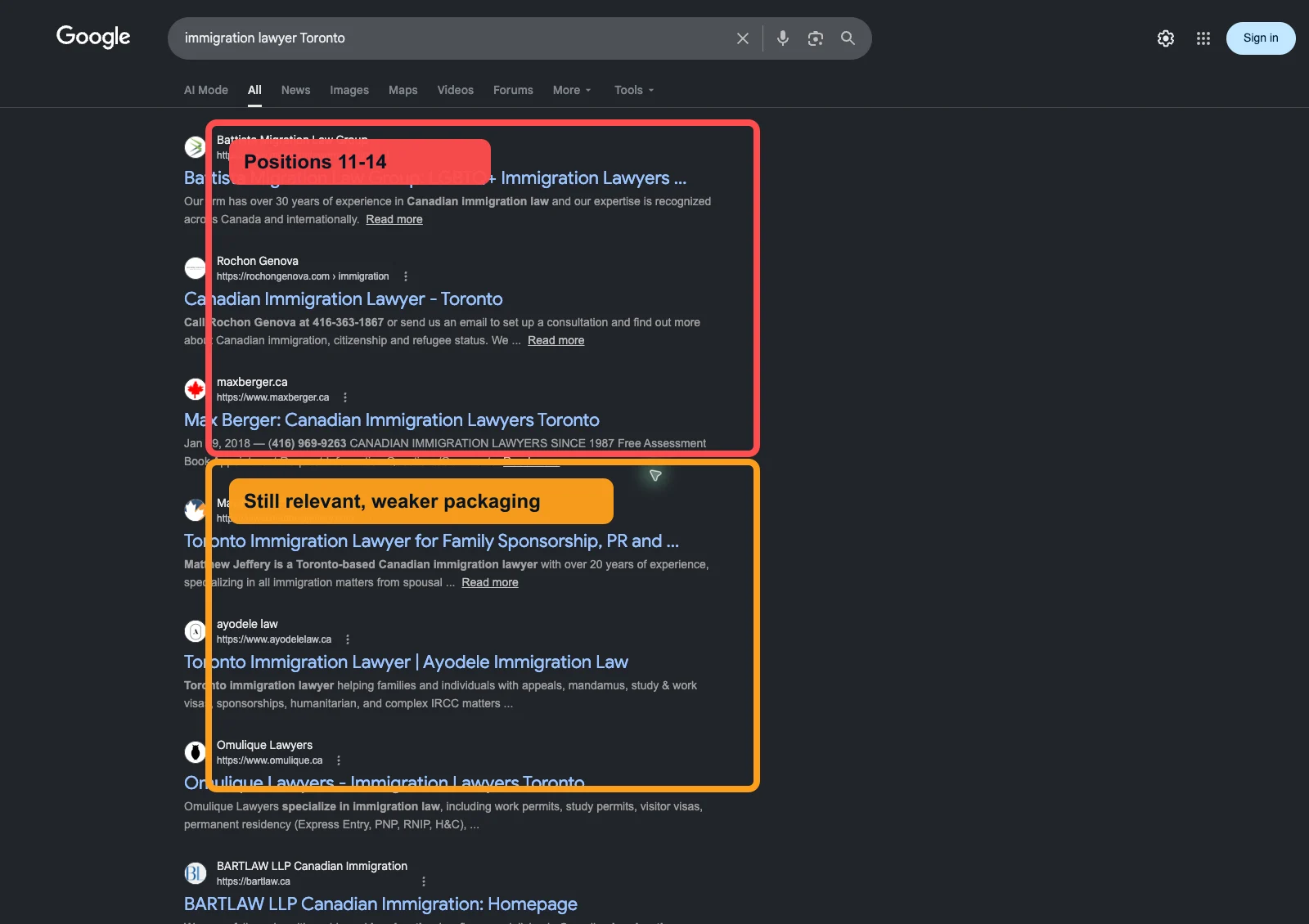
The audit compares the first three organic results against the first four results on page two. I excluded paid results, local pack listings, People Also Ask, forum modules, and directory results from the core organic comparison. Those modules still matter strategically, but the question here is narrower: why do the top organic law-firm domains outrank law-firm domains sitting around positions 11-14?
| Organic Position | Result | Ranking Domain | Observed Page Type |
|---|---|---|---|
| #1 | Bellissimo Immigration Law Group PC | bellissimolawgroup.com | Homepage / firm entity page |
| #2 | Lewis & Associates LLP | lewislegal.ca | Homepage with exact immigration lawyer framing |
| #3 | Green & Spiegel | gands.com | Homepage / established firm entity page |
| #11 | Battista Migration Law Group | migrationlawgroup.com | Homepage / specialist firm page |
| #12 | Rochon Genova | rochongenova.com/immigration/ | Immigration practice page |
| #13 | Max Berger | maxberger.ca | Homepage with older snippet signals |
| #14 | Matthew Jeffery Law Firm | matthewjeffery.com | Homepage / immigration service page |
For evaluation, I used three reference layers. Google's own SEO Starter Guide is the baseline for crawlable, helpful, well-structured pages. Backlinko's ranking factors guide is useful for a broad SEO checklist around links, content, UX, and search intent. AIOSEO's ranking factors glossary is a practical way to frame concepts such as backlinks, keyword relevance, internal links, site structure, and user experience. The actual conclusions below come from applying those ideas to this specific SERP.
The 200+ Factor Lens: How I Scored the SERP Without Turning It Into Noise
Backlinko's ranking-factor framework is useful because it reminds us that Google is not evaluating one signal. But a real audit should not become a 200-line checklist where every item gets the same weight. For “immigration lawyer Toronto”, the useful move is to group those factors into systems that Google can observe: can the page be crawled, can the entity be trusted, can the service be understood, can the location be verified, can the authority be corroborated, and can the page satisfy a high-stakes legal query better than competing pages?
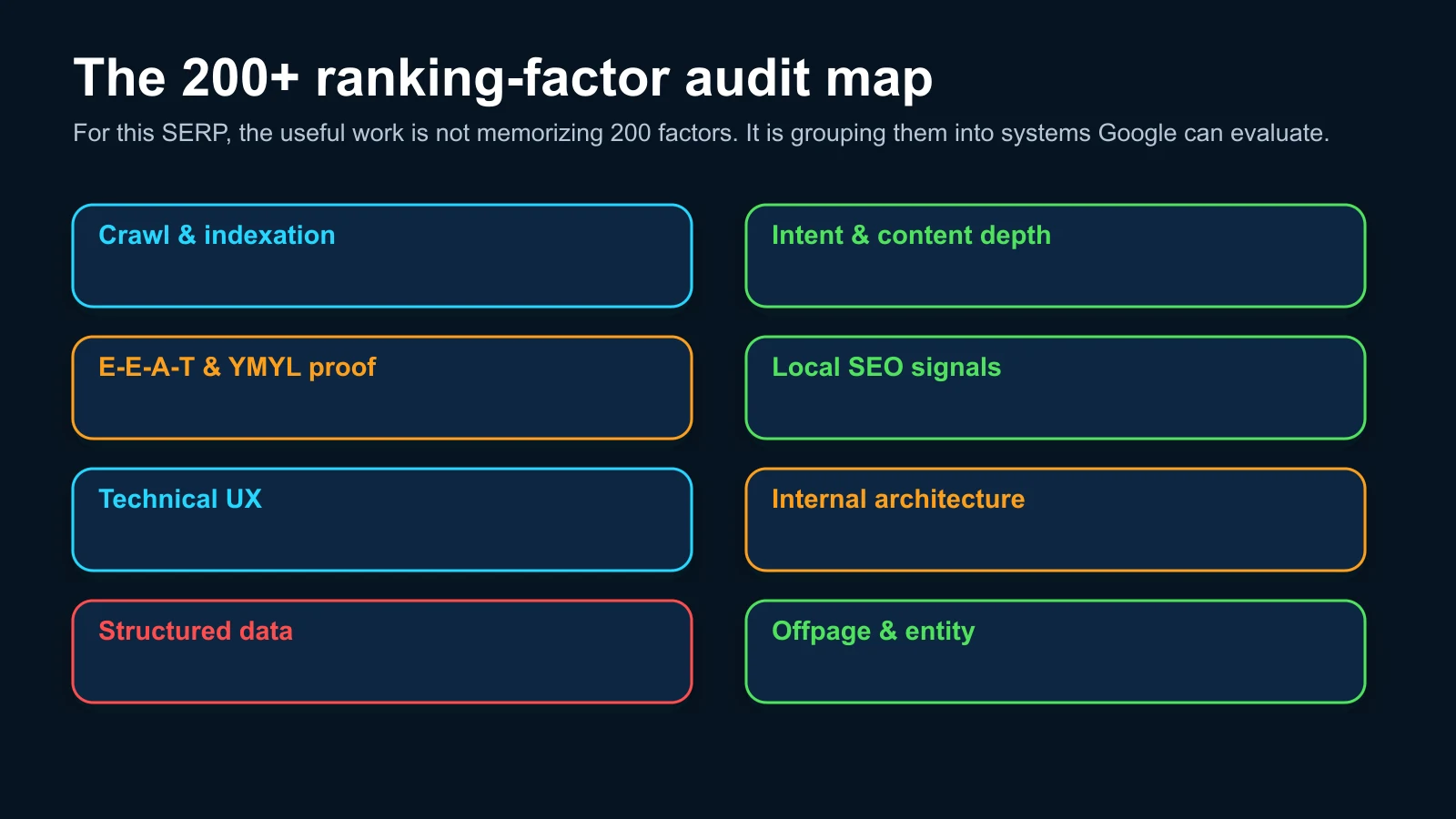
| Factor System | What I Checked | Why It Matters for This SERP |
|---|---|---|
| Crawl and indexation | Canonical, source HTML, rendered page, crawlable navigation, obvious page type | If Google cannot cleanly understand the ranking URL, authority leaks into the wrong page or a generic snippet. |
| Search intent match | Title, H1, first screen, service wording, Toronto language, commercial CTA | The query is not “Canadian immigration law history.” It is a local hiring query for a lawyer. |
| Content depth | Case-type coverage, FAQs, process explanation, current immigration topics, helpful specificity | A firm needs enough content to satisfy refugee, sponsorship, PR, work permit, inadmissibility, and appeal intents. |
| E-E-A-T and YMYL trust | Lawyer names, credentials, bar/professional proof, years of experience, reviews, media, policies | Immigration law is high-stakes. Google needs stronger proof than it would need for a low-risk local service. |
| Local SEO/entity proof | Toronto office signals, NAP consistency, local citations, GBP alignment, map/entity corroboration | The page has to be both an immigration-law entity and a Toronto-serving entity. |
| Internal architecture | Practice-area hubs, service clusters, breadcrumbs, anchor text, related pages, orphan risk | Internal links tell Google which page should rank for the broad commercial query versus specific case types. |
| Structured data | Organization, LocalBusiness, LegalService, Person, FAQ, Breadcrumb, Article schema | Schema is not a ranking button, but it reduces ambiguity around entity, service, location, and author/practitioner proof. |
| Offpage/entity authority | DR, referring domains, topical citations, legal directories, branded mentions, expert mentions | Links still matter, but for this SERP the best links are corroborating legal and local entity facts. |
Source-Code Evidence: What the HTML Says Before a User Reads the Page
Visual screenshots explain the user experience. Source code explains how easily search systems can classify the page. I checked the live HTML for the ranking pages and found several signals that change the diagnosis. Lewis does not have the strongest DR, but its title and H1 are highly aligned with the query. Green & Spiegel has the strongest authority profile, but its homepage title is generic. Rochon Genova has strong links and organic footprint, but I did not detect JSON-LD in the scraped source for the ranking page.
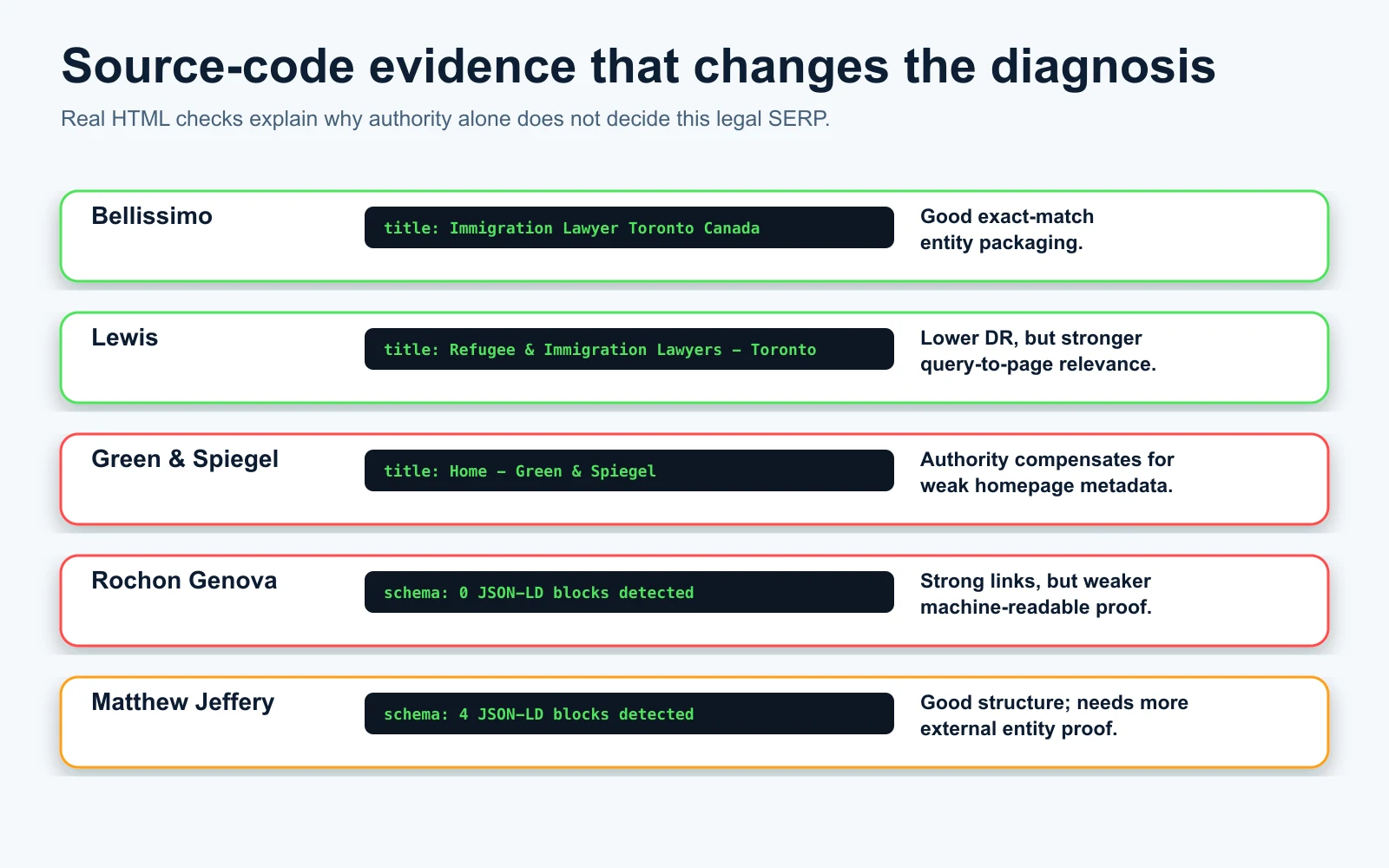
| Site | Source Signal | SEO Meaning |
|---|---|---|
| Bellissimo | title: Immigration Lawyer Toronto Canada |
Strong exact-query packaging for the head term. |
| Lewis and Associates | title: Refugee and Immigration Lawyers - Toronto |
Lower DR, but cleaner query-to-page relevance. |
| Green and Spiegel | title: Home - Green and Spiegel |
Authority is compensating for weak homepage metadata. |
| Rochon Genova | schema: 0 JSON-LD blocks detected |
Strong links, but weaker machine-readable entity proof. |
| Matthew Jeffery | schema: 4 JSON-LD blocks detected |
Good structured baseline, but needs stronger external entity proof. |
This is exactly where many SEO audits go wrong. They see a DR number and stop. But a ranking system has to connect the domain authority to a specific entity, page, service, and user need. If the HTML says “Home,” if the H1 is broad, if structured data is missing, or if internal links do not reinforce the right hub, the page can have authority without fully converting that authority into exact-query strength.
Source-Code Fixes I Would Actually Ship
The point of reviewing source code is not to find trivia. It is to decide what should change in the CMS, template, schema layer, and internal-link architecture. Below are concrete examples of the kind of source-level improvements I would recommend for the pages that are under-converting their authority.
Green and Spiegel: Rewrite Generic Homepage Metadata
Green and Spiegel is ranking because the entity is strong, not because the homepage metadata is doing enough work. A title like “Home - Green and Spiegel” makes Google rely more heavily on external understanding. I would replace it with metadata that connects brand, service, city, and legal category.
currentTitle = "Home - Green and Spiegel"

recommendedTitle = "Toronto Immigration Lawyers | Green and Spiegel"

recommendedMetaDescription =
  "Speak with Green and Spiegel's Toronto immigration lawyers for work permits, permanent residence, citizenship, inadmissibility, appeals, and business immigration matters."

recommendedH1 =
  "Toronto Immigration Lawyers for Individuals, Families, and Employers"
That single change does not guarantee movement, but it removes ambiguity. It tells Google and AI systems that the homepage is not just a brand page. It is a Toronto immigration-law entity page.
Rochon Genova: Add LegalService and Practitioner Schema
Rochon Genova has enough authority to compete, but the ranking page needs better machine-readable proof. I did not detect JSON-LD in the scraped source for the immigration page. The page should describe the firm, the legal service, the location served, and the practitioners visible on the page.
{
  "@context": "https://schema.org",
  "@type": "LegalService",
  "name": "Rochon Genova Immigration Lawyers",
  "url": "https://rochongenova.com/immigration/",
  "areaServed": {
    "@type": "City",
    "name": "Toronto"
  },
  "serviceType": [
    "Canadian immigration law",
    "Permanent residence",
    "Work permits",
    "Family sponsorship",
    "Immigration appeals"
  ],
  "provider": {
    "@type": "Organization",
    "name": "Rochon Genova LLP"
  }
}
The schema must match visible page content. If the page does not show the lawyers, services, address, FAQs, or consultation process, those should be added first. Schema should clarify evidence, not invent it.
Battista: Separate the Broad Head Term From the Specialty Page
Battista's specialty positioning is valuable, but the broad query needs a broader hub. I would avoid weakening the LGBTQ+ immigration positioning. Instead, I would create a parent page for the head term and use the specialty page as one of the strongest child pages.
recommendedParentPage =
  "/toronto-immigration-lawyers/"

parentTitle =
  "Toronto Immigration Lawyers | Battista Migration Law Group"

childPage =
  "/lgbtq-immigration-lawyers-toronto/"

internalLinksFromParent = [
  "LGBTQ+ immigration lawyers in Toronto",
  "refugee claims and appeals",
  "inadmissibility and removal orders",
  "family sponsorship",
  "work permits and study permits"
]
This lets the firm compete for the broad commercial keyword without losing the differentiated specialty page that may win more specific, higher-trust searches.
Max Berger: Fix Snippet Freshness and Trust Extraction
Max Berger already has relevant title and H1 signals, but the SERP snippet surfaced dated information. That usually means Google is not finding a better summary or stronger fresh content block. The fix is not just a new meta description; the visible page copy needs to support the snippet.
recommendedMetaDescription =
  "Toronto immigration lawyers helping with permanent residence, sponsorship, work permits, citizenship, inadmissibility, and appeals. Book a consultation with Max Berger Law."

recommendedAboveFoldBlock =
  "Immigration help in Toronto for PR, sponsorship, work permits, citizenship, and appeals. Our team explains your options, documents, timelines, and next steps before you apply."
Because the authority profile is weaker, the page has less tolerance for vague copy. It needs a precise service summary, current content, lawyer proof, review proof, and direct internal links into the highest-value immigration categories.
Internal Linking: The Missing Architecture Most Firms Need
The most common pattern in this SERP is not “no content.” It is weak hub architecture. The broad page should link to the service pages with descriptive anchors, and those pages should link back to the broad Toronto immigration lawyer hub. That helps Google understand which page owns the head term and which pages answer specific legal needs.
hubPage = "/toronto-immigration-lawyers/"

recommendedInternalLinks = [
  { anchor: "spousal sponsorship lawyer in Toronto", target: "/spousal-sponsorship-lawyer-toronto/" },
  { anchor: "work permit lawyer in Toronto", target: "/work-permit-lawyer-toronto/" },
  { anchor: "refugee claim lawyer in Toronto", target: "/refugee-lawyer-toronto/" },
  { anchor: "inadmissibility lawyer in Toronto", target: "/inadmissibility-lawyer-toronto/" },
  { anchor: "immigration appeal lawyer in Toronto", target: "/immigration-appeal-lawyer-toronto/" }
]
This is where many page-two firms can gain ground. They do not need a random blog calendar first. They need a better legal-service architecture that turns existing authority into clearer topical coverage.
The Ahrefs Offpage Snapshot
The offpage data is where the SERP gets interesting. If this were a pure DR contest, Green & Spiegel and Bellissimo would be easy winners, Lewis would look vulnerable, and Rochon Genova would probably be higher. But Google is not sorting this query by Domain Rating alone.
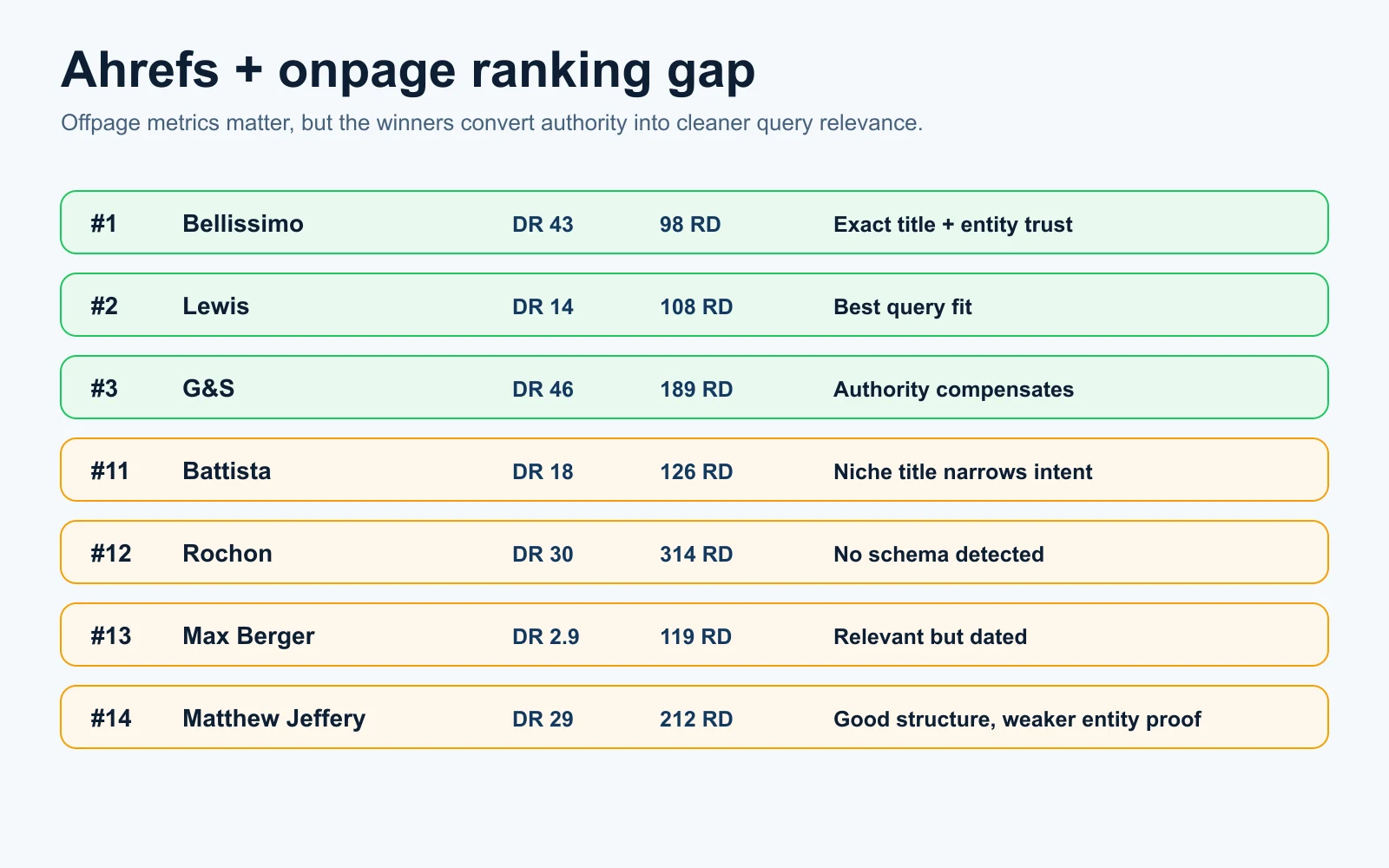
Three observations stand out.
First, authority helps but does not finish the job. Green & Spiegel had the highest DR in this set at 46, and Bellissimo followed closely at 43. Both rank in the top three. That supports the basic idea that established authority and external recognition matter. But Lewis & Associates ranked #2 with a much lower DR of 14, which means something else is compensating.
Second, estimated organic traffic is not the same thing as exact-query strength. Lewis had the strongest Ahrefs estimated organic traffic among the top three, while Bellissimo and Green & Spiegel showed zero estimated traffic in this snapshot. That does not mean those brands get no traffic in reality; it means Ahrefs' modeled keyword database did not assign measurable traffic to them in the sampled view. Still, Lewis' visibility suggests a stronger match between page wording, query intent, and pages Ahrefs can detect.
Third, some page-two results have serious offpage strength. Rochon Genova had DR 30, 314 referring domains, and about 1.6K estimated organic traffic. Matthew Jeffery had DR 29 and 212 referring domains. Battista had 126 referring domains. These are not invisible domains. Their issue is not simply “get links.” The problem is that authority is not being converted into enough query-specific relevance for this exact search.
Why the Top Three Win
#1 Bellissimo: Strong Entity Trust and Clear Immigration Scope
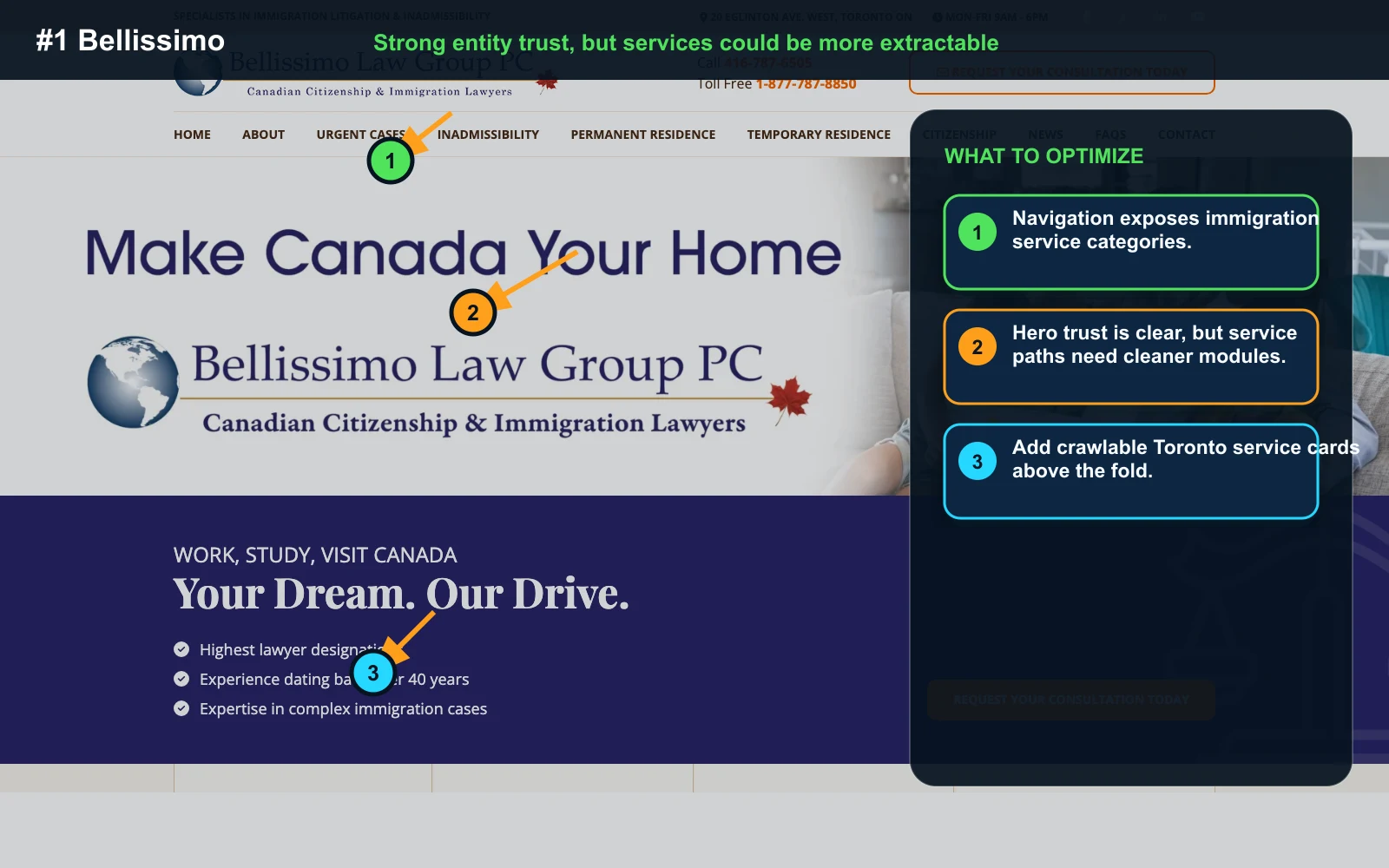
Bellissimo ranks first because Google can confidently classify the firm as a specialized Canadian immigration-law entity serving Toronto. The title tag is unusually strong for the exact query, the visible navigation reinforces immigration subtopics, and the above-the-fold trust language supports the YMYL requirement. This is a good example of how page-level relevance and entity confidence work together.
The offpage profile supports that interpretation. Ahrefs showed DR 43, 98 current referring domains, and 133 current backlinks. Those numbers are not massive compared with national publishers, but for a specialized local legal vertical they are enough to support a trust signal, especially when the brand is also represented across legal directories, citations, and search-result snippets.
| Factor Cluster | Bellissimo Read | Optimization Priority |
|---|---|---|
| Intent match | Very strong title and clear immigration-law positioning. | Keep exact-query alignment, but avoid relying only on the homepage. |
| Content architecture | Navigation exposes urgent cases, inadmissibility, PR, temporary residence, citizenship, news, and FAQs. | Create a compact crawlable “Toronto immigration lawyer services” module above the fold. |
| E-E-A-T | Experience and complex-case expertise are visible in the hero area. | Make lawyer credentials, recognitions, and review proof more extractable with schema and internal links. |
| AI visibility | The entity is easy to summarize, but service-specific answers could be cleaner. | Add answer blocks for sponsorship, work permits, refugee claims, appeals, and inadmissibility. |
The key improvement is not “write more content.” It is extractability. Bellissimo should make each major immigration pathway readable as a discrete entity-service pair: Toronto immigration lawyer for spousal sponsorship, Toronto immigration lawyer for inadmissibility, Toronto immigration lawyer for refugee claims, and so on. That helps Google, AI Overviews, and LLM-style answer systems cite the firm for narrower intents instead of only understanding the homepage as a broad brand page.
#2 Lewis & Associates: Lower DR, Better Query Fit
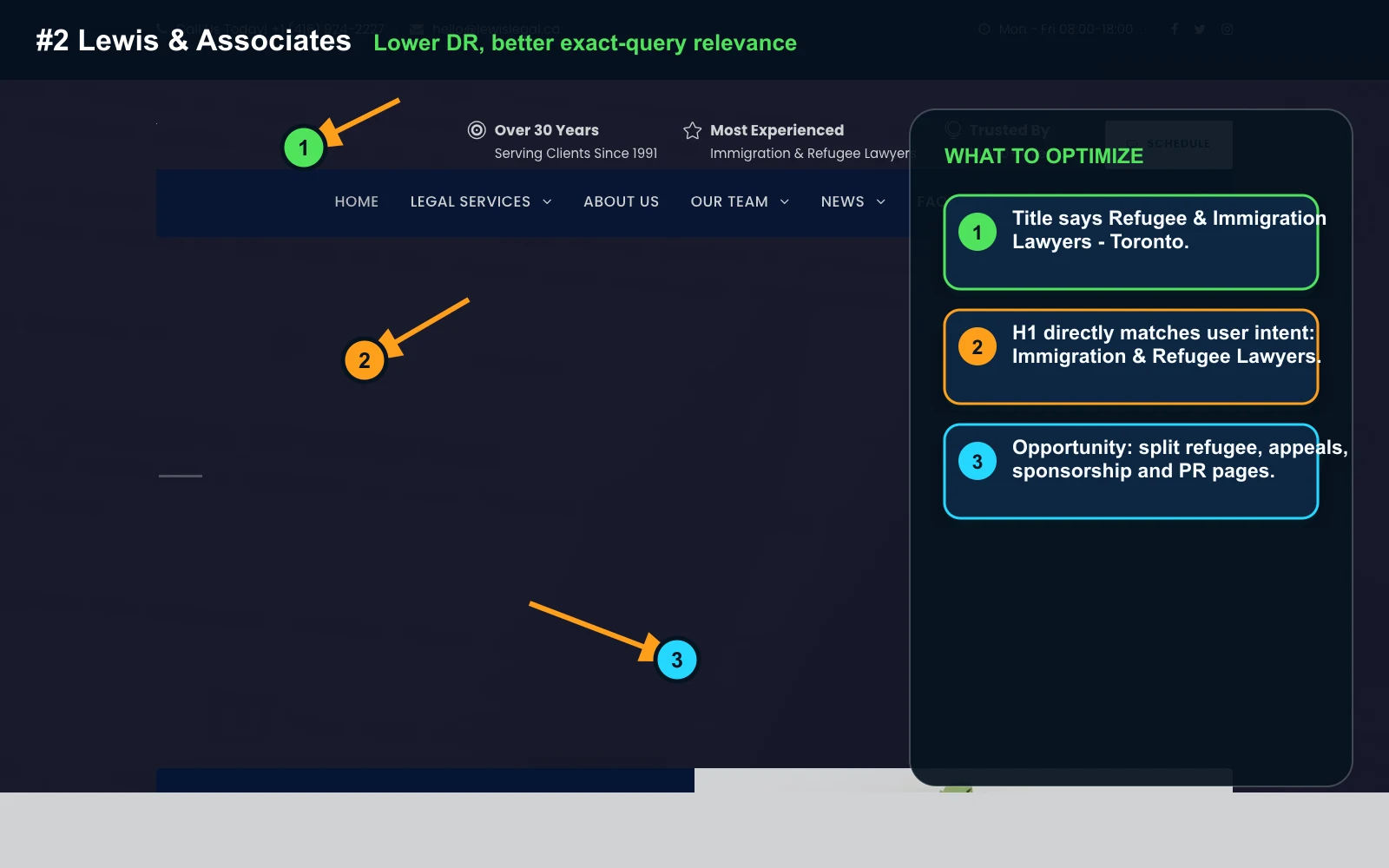
Lewis is the best example in the dataset because it breaks the simplistic offpage narrative. Ahrefs showed DR 14, 108 referring domains, 403 organic keywords, and about 2.4K estimated organic traffic. That is a much stronger organic footprint than the DR alone would imply, and the source HTML helps explain why: the title tag and H1 directly reinforce refugee and immigration lawyers in Toronto.
The page does not win by having the most authority. It wins by reducing ambiguity. A search system can quickly connect the page to the user need: immigration/refugee lawyer, Toronto, professional legal help. That is a major advantage in a SERP where some stronger domains have broader homepage metadata or weaker exact-query framing.
| Factor Cluster | Lewis Read | Optimization Priority |
|---|---|---|
| Intent match | Excellent. Title and H1 are close to the exact commercial query. | Protect this alignment and extend it into sub-service pages. |
| Offpage | Lower DR than top competitors, but enough referring domains to support local trust. | Prioritize topical legal citations over generic backlink volume. |
| Content depth | Strong broad relevance, but immigration law has multiple case-specific intents. | Create stronger hubs for refugee appeals, sponsorship, PR, work permits, and Federal Court matters. |
| Internal links | The homepage has ranking power that should be distributed into intent pages. | Use descriptive internal anchors from the homepage to each case-type page. |
Lewis should not chase Green & Spiegel's authority profile as the first move. The highest ROI is to multiply the page's existing relevance advantage. Build case-type pages that sound like real user problems, then support them with attorney proof, FAQs, and internal links. That turns one strong homepage into a broader legal SEO cluster.
#3 Green & Spiegel: Brand Authority and Institutional Prominence
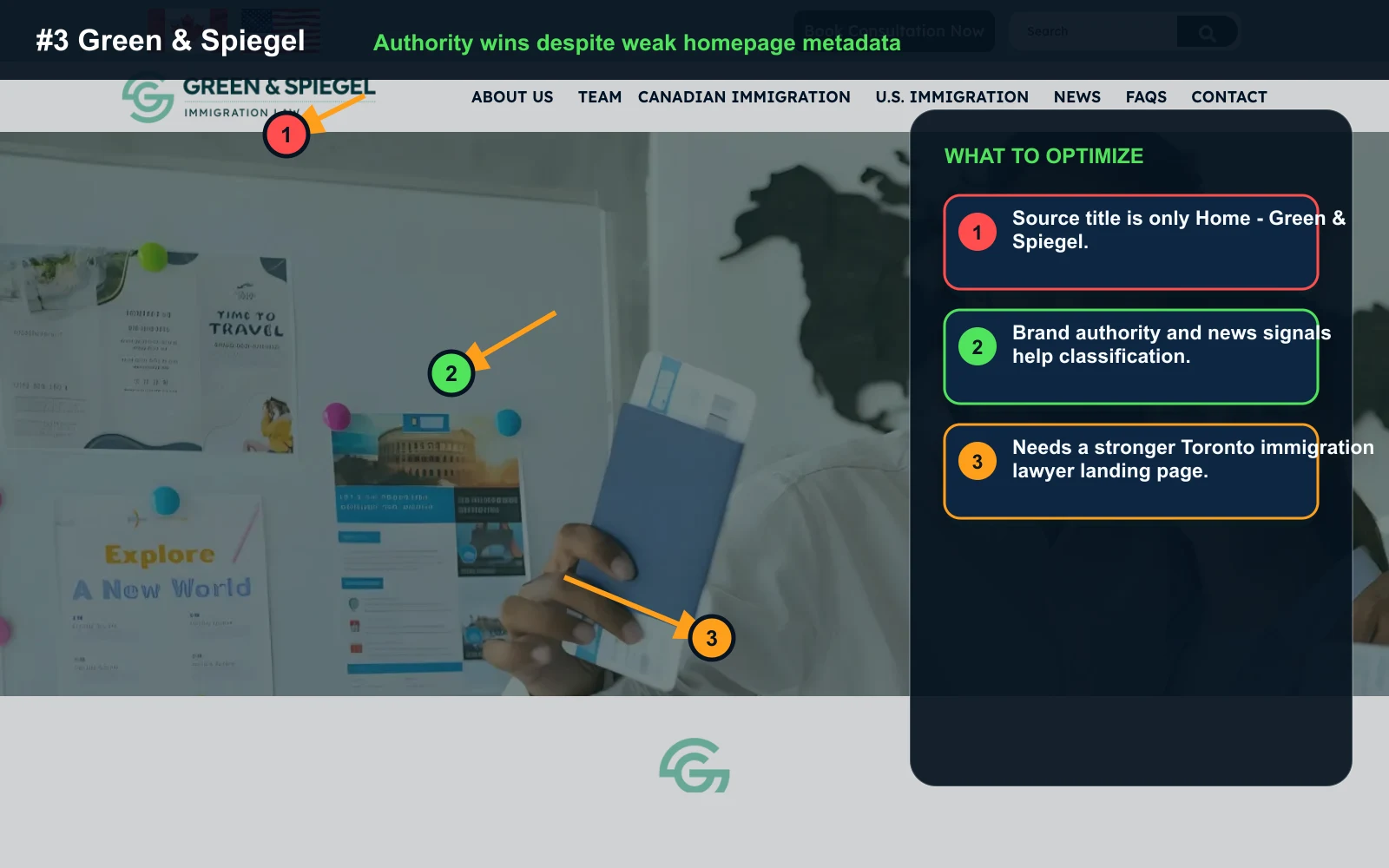
Green & Spiegel had the strongest authority profile in this comparison: DR 46, 189 referring domains, and 401 current backlinks. That is the type of entity profile Google can trust in a YMYL vertical. The ranking makes sense even though the homepage source title is only “Home - Green & Spiegel” and the scraped meta description was not detected.
This is the clearest example of authority compensating for imperfect onpage packaging. Google likely has enough external evidence to understand the brand, but the page itself is leaving relevance on the table. A user searching “immigration lawyer Toronto” wants the fastest path to: who can help me, with what case type, in what jurisdiction, and how do I contact them?
| Factor Cluster | Green & Spiegel Read | Optimization Priority |
|---|---|---|
| Offpage/entity | Strongest authority profile in the comparison. | Use that authority to support a sharper Toronto immigration landing page. |
| Metadata | Homepage title is generic and does not describe the query. | Rewrite title/meta to connect brand, Toronto, immigration lawyers, and service intent. |
| Content hierarchy | News and institutional content create authority but can blur the immediate commercial answer. | Place service entry points, lawyer teams, and Toronto office proof earlier in the experience. |
| Competitive risk | Lower-authority competitors can attack with cleaner query alignment. | Defend the ranking with stronger H1, service modules, schema, and internal linking. |
The best next move would be stronger above-the-fold local and service architecture: Toronto office proof, immigration lawyer team links, practice-area cards, and a short section that explains what cases the firm handles in Toronto specifically. The brand authority is already there. The page should make that authority easier to convert into exact-query relevance.
Why Positions 11-14 Lag
#11 Battista: Strong Niche Positioning, Weaker Exact-Query Packaging
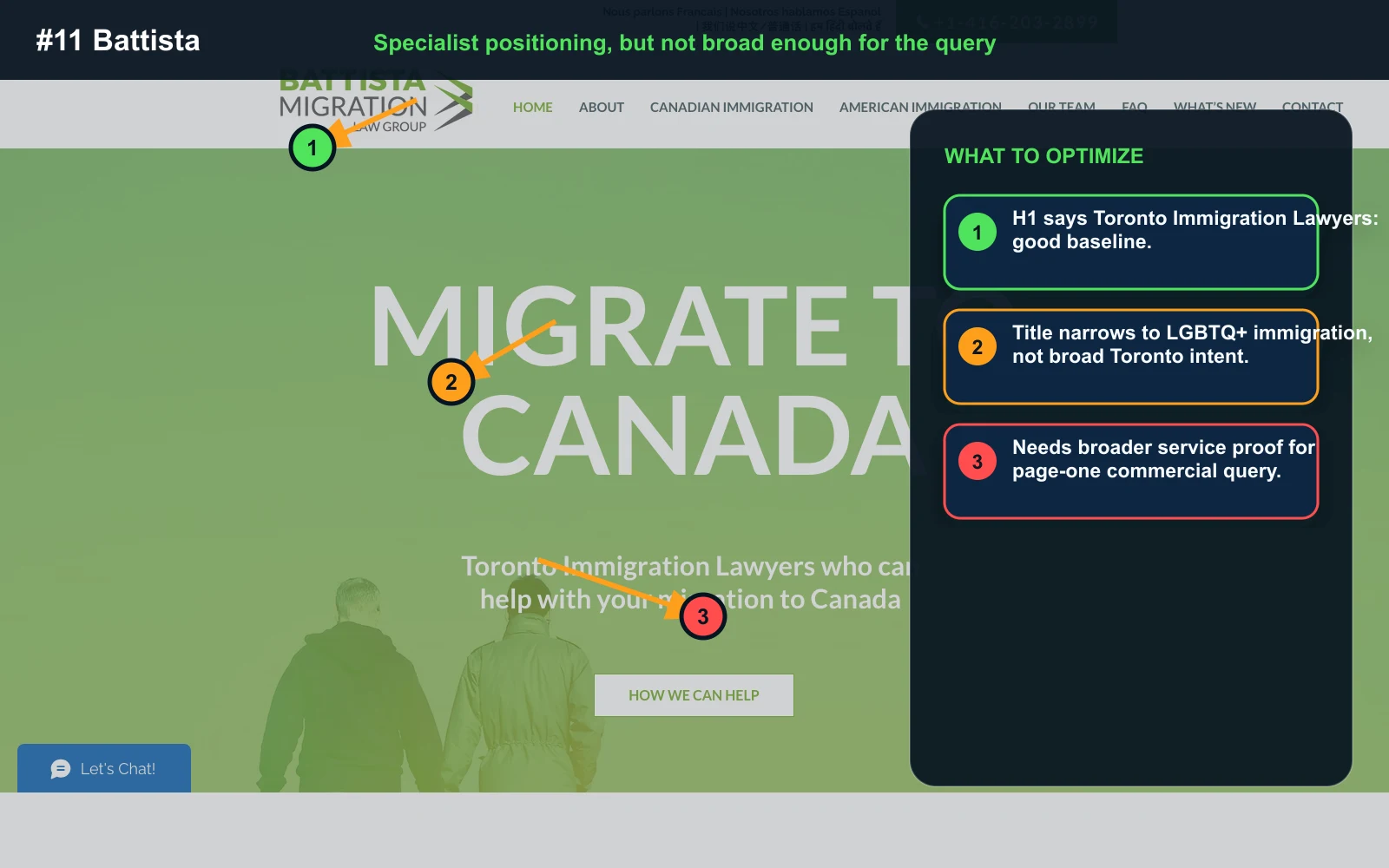
Battista has a credible and differentiated story. The SERP snippet highlights 30+ years of Canadian immigration law experience and recognized expertise. Ahrefs showed DR 18 and 126 referring domains. That is not a bad offpage base.
The source-level issue is intent breadth. The title tag I pulled says “LGBTQ+ Immigration Lawyers Toronto”. That is excellent for a specific audience and probably helpful for trust, but the core search being audited is broader. Google may understand Battista as highly relevant to a sub-segment while still preferring broader “immigration lawyer Toronto” pages for the head term.
| Factor Cluster | Battista Read | Optimization Priority |
|---|---|---|
| Intent match | Strong Toronto immigration H1, but title narrows the page to LGBTQ+ immigration. | Keep the specialized page, but create or strengthen a broader Toronto immigration lawyer hub. |
| Positioning | Differentiation is real and valuable. | Use specialty proof as a subsection, not the only head-term framing. |
| Local proof | Toronto relevance is present. | Make address, service area, reviews, and consultation path more structured and crawlable. |
| Content expansion | Needs broader case-type support to compete with top-three entity pages. | Add hub links for refugee claims, appeals, inadmissibility, PR, sponsorship, and work permits. |
The likely gap is not authority in isolation. It is how directly the page satisfies the broad query. “Migration law” is semantically close, but users and Google are comparing pages for “immigration lawyer Toronto.” The page should make the exact relationship obvious: immigration lawyers in Toronto, case types handled, consultations, lawyer credentials, and local proof.
#12 Rochon Genova: Strong Metrics, But the Page Needs Legal-SEO Focus
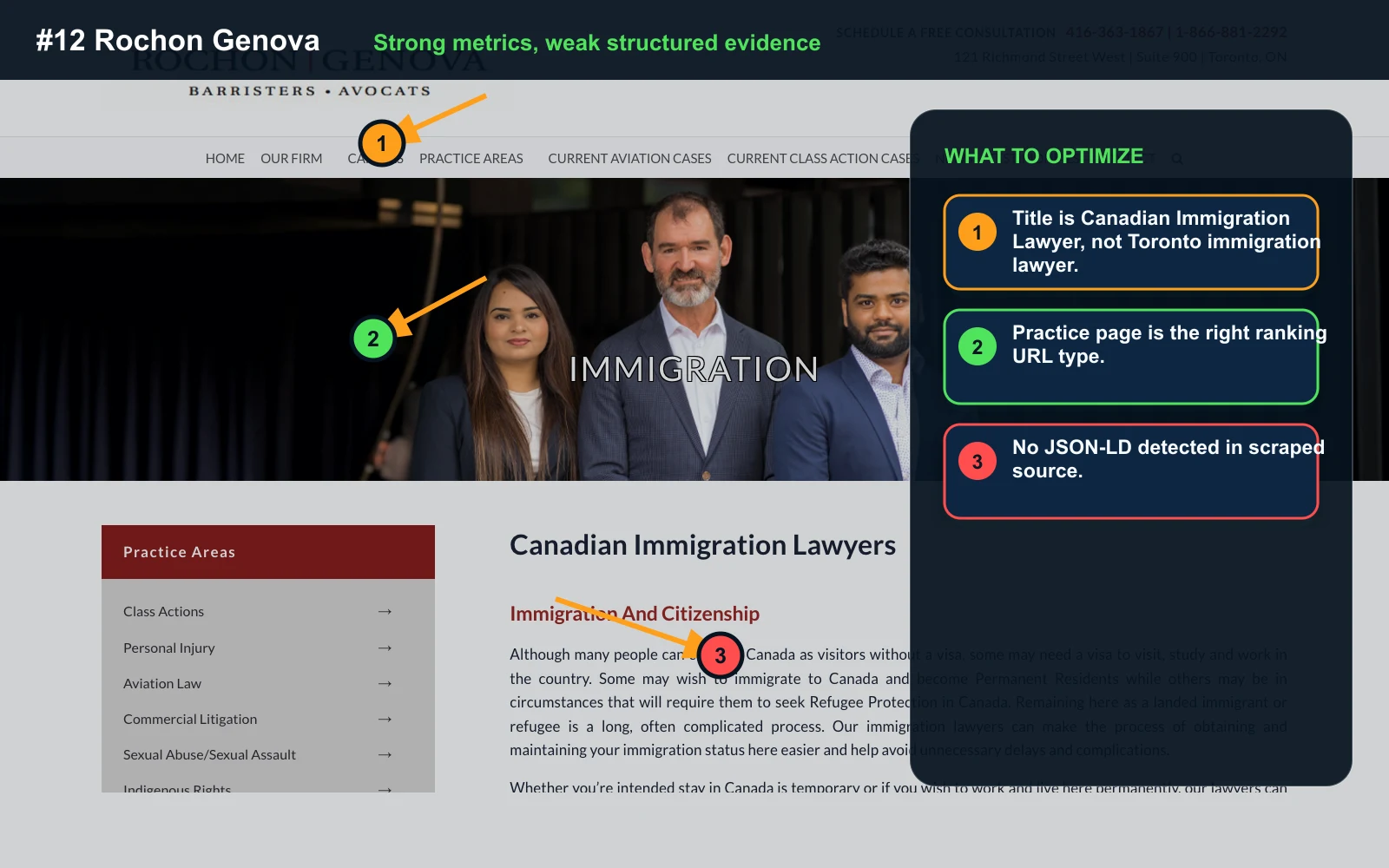
Rochon Genova is the most important page-two lesson. It had DR 30, 314 referring domains, 2.6K current backlinks, 217 organic keywords, and about 1.6K estimated organic traffic. That is stronger than several competitors. Yet it sat around position 12 for this query.
The likely issue is precision. The ranking URL is an immigration practice page, which is the right idea. But a practice page can still underperform if it reads as a general legal-service page rather than the best answer for “immigration lawyer Toronto.” The title says “Canadian Immigration Lawyer,” which is relevant, but less exact than “Toronto immigration lawyer.” I also did not detect JSON-LD blocks in the scraped source for this page.
| Factor Cluster | Rochon Genova Read | Optimization Priority |
|---|---|---|
| Offpage | Strong page-two authority: DR 30 and 314 referring domains. | Do not start with generic link building; fix page-level conversion of authority first. |
| Structured data | No JSON-LD detected in the scraped source. | Add LegalService, Organization, Person, Breadcrumb, and FAQ schema mapped to visible content. |
| Practitioner proof | The page needs clearer lawyer/entity proof for YMYL evaluation. | Add lawyer bios, credentials, experience, case categories, and consultation process. |
| Internal architecture | The practice page should be the hub for immigration-law subtopics. | Link from related legal pages and create child pages for high-value case types. |
If I were prioritizing work here, I would rebuild the page as a Toronto immigration-law hub: short answer intro, service modules, lawyer bios, trust proof, FAQs, LocalBusiness/LegalService schema, internal links, and citations from relevant legal directories. The offpage base is already strong enough to justify that investment.
#13 Max Berger: Legacy Trust, Dated Snippet Signals
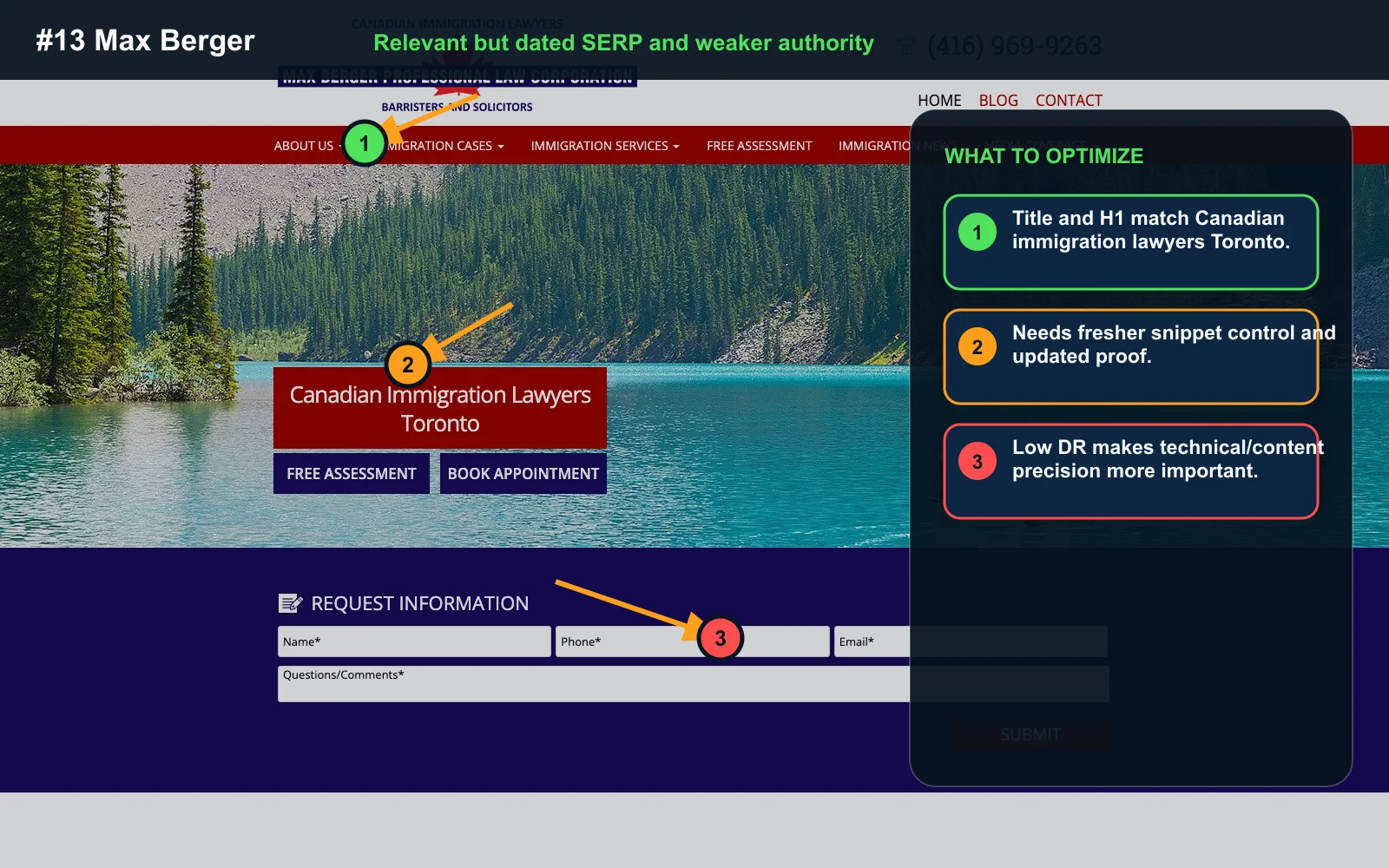
Max Berger's result has one obvious SERP issue: the snippet surfaced a date from 2018, a phone number, and generic conversion text. That does not mean the firm is not credible. It means Google did not find a stronger, fresher, more useful summary to display for this query.
The source HTML is not the main weakness. The title and H1 both align with Canadian immigration lawyers in Toronto. The bigger problem is that the offpage and freshness signals are weaker than the competitors above it. Ahrefs showed DR 2.9, 119 referring domains, and zero estimated organic traffic in the snapshot. With lower authority, the page has less room for fuzzy messaging, dated snippets, or thin proof.
| Factor Cluster | Max Berger Read | Optimization Priority |
|---|---|---|
| Metadata | Relevant title and H1 are already present. | Rewrite meta description and visible intro to generate a fresher, stronger snippet. |
| Authority | DR 2.9 is the weakest in the comparison. | Build entity citations from legal directories, local profiles, and topical publications. |
| Freshness | SERP snippet showed dated signals. | Add current immigration updates, refreshed service copy, and recent proof. |
| UX/content | The page must earn trust quickly because offpage strength is limited. | Improve above-the-fold trust proof, FAQs, case-type navigation, and mobile scanning. |
The highest-impact work is likely onpage first: update the opening copy, service structure, attorney proof, FAQ schema, local trust elements, and internal links. Then support those pages with better local citations and legal-directory mentions.
#14 Matthew Jeffery: Strong Relevance, Still Needs More Entity Depth
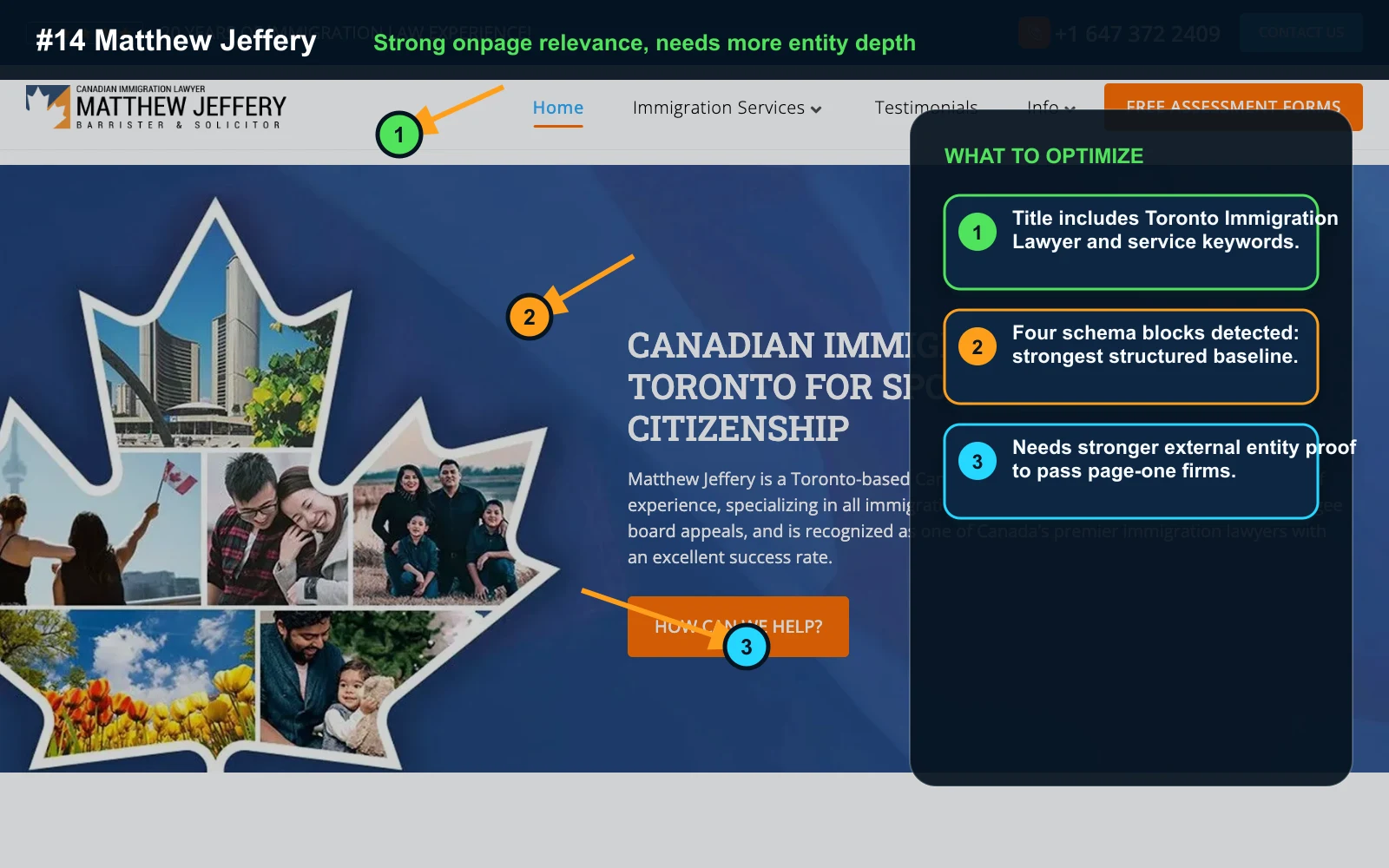
Matthew Jeffery is close to the intent. The SERP title mentions Toronto immigration lawyer and the snippet references family sponsorship and PR. The source title and H1 are both strong, and I detected four JSON-LD blocks in the scraped source. Ahrefs showed DR 29 and 212 referring domains, which is a healthy offpage base. Yet the result still sits below the top-ten threshold.
That makes this the best “almost there” case. The page has many of the technical/onpage pieces that weaker pages lack. The gap is competitive depth: the top three combine relevance with stronger entity signals, more visible trust, or cleaner external validation.
| Factor Cluster | Matthew Jeffery Read | Optimization Priority |
|---|---|---|
| Metadata and H1 | Strong: title and H1 directly map to Toronto immigration-law demand. | Keep this alignment and test a title variant that includes “law firm” or high-value services. |
| Structured data | Four JSON-LD blocks detected, strongest structured baseline among page-two examples. | Audit schema accuracy and ensure it describes visible lawyer, service, and FAQ content. |
| Entity proof | Relevant, but still needs stronger third-party corroboration. | Earn more legal-directory, media, YouTube, podcast, and expert citations around the named lawyer and firm. |
| Content depth | Good service relevance, but page-one competitors have broader trust patterns. | Build a stronger content cluster around sponsorship, PR, citizenship, inadmissibility, and appeals. |
Matthew Jeffery should expand the page from “we do immigration law” into a stronger evidence page: who the lawyer is, what case types are handled, what makes the firm credible, which Toronto users are best served, what the process looks like, and which related pages explain each immigration path.
What Positions 11-14 Should Change First
The pattern across page two is consistent: the firms are legitimate, but Google needs a clearer reason to select them over firms that are easier to classify. Here is the order I would use.
1. Rewrite the Ranking Page Around Exact Intent
The page needs to answer the query in the first screen: immigration lawyer in Toronto, not just Canadian immigration law, migration law, or legal services. That does not mean spam the keyword. It means the title, H1, first paragraph, service links, and calls-to-action should make the exact offer unmistakable.
2. Segment the Legal Demand
Build or improve pages for spousal sponsorship, work permits, study permits, permanent residence, refugee claims, inadmissibility, appeals, mandamus, and citizenship. Then link those pages from the main Toronto immigration lawyer page. This helps users choose the right path and gives Google a clearer topical map.
3. Make Trust Proof Extractable
Legal SEO is not only copy. It is proof. Add lawyer names, credentials, years of experience, memberships, office details, case categories, review themes, publications, media mentions, directory listings, and FAQs. Search systems need structured and visible evidence, especially in YMYL topics.
4. Use Schema Carefully
Use organization, local business, legal service, breadcrumb, article, and FAQ schema only where it matches visible content. Google's guidance is clear that structured data should describe real page content. For law firms, schema should clarify entity facts, not invent them.
5. Build Better Entity Citations, Not Random Links
The offpage objective is not “more backlinks.” It is more useful corroboration. Legal directories, local business citations, bar-related profiles, podcasts, expert quotes, legal explainers, YouTube transcripts, news mentions, and partner pages can all reinforce the same entity facts: firm name, lawyers, city, practice area, and specialties.
Final Takeaway
The top three results for “immigration lawyer Toronto” win because they give Google a stronger combination of entity confidence, local relevance, topical clarity, and external proof. The page-two firms are not far away in business quality. Several have enough authority to compete. But authority that is not packaged around the exact query becomes inefficient.
The practical plan is simple: make the ranking page the clearest Toronto immigration-law answer in the market, support it with case-type pages, reinforce it with real lawyer and firm proof, and build citations that validate the same story offsite. That is how a result moves from “relevant enough for page two” to “trusted enough for page one.”
About the Author