Google's "Bounce Click" Defense Crumbles: Independent Data Shows AI Overviews Cut Organic CTR Up to 79% — Plus 7 New Task-Based Features That Replace the Click Entirely
Liz Reid claims AI Overviews only eliminate "bounce clicks" — but five independent studies show organic CTR dropping 26–79%. Plus 7 new Google features that replace the click entirely.
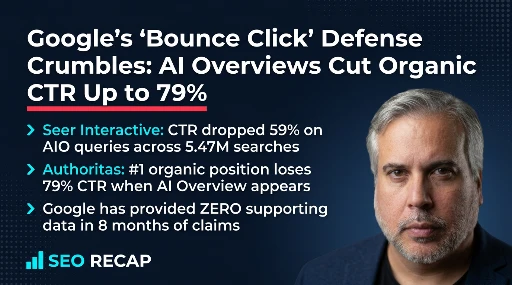
Google's "Bounce Click" Defense Crumbles: Independent Data Shows AI Overviews Cut Organic CTR Up to 79%
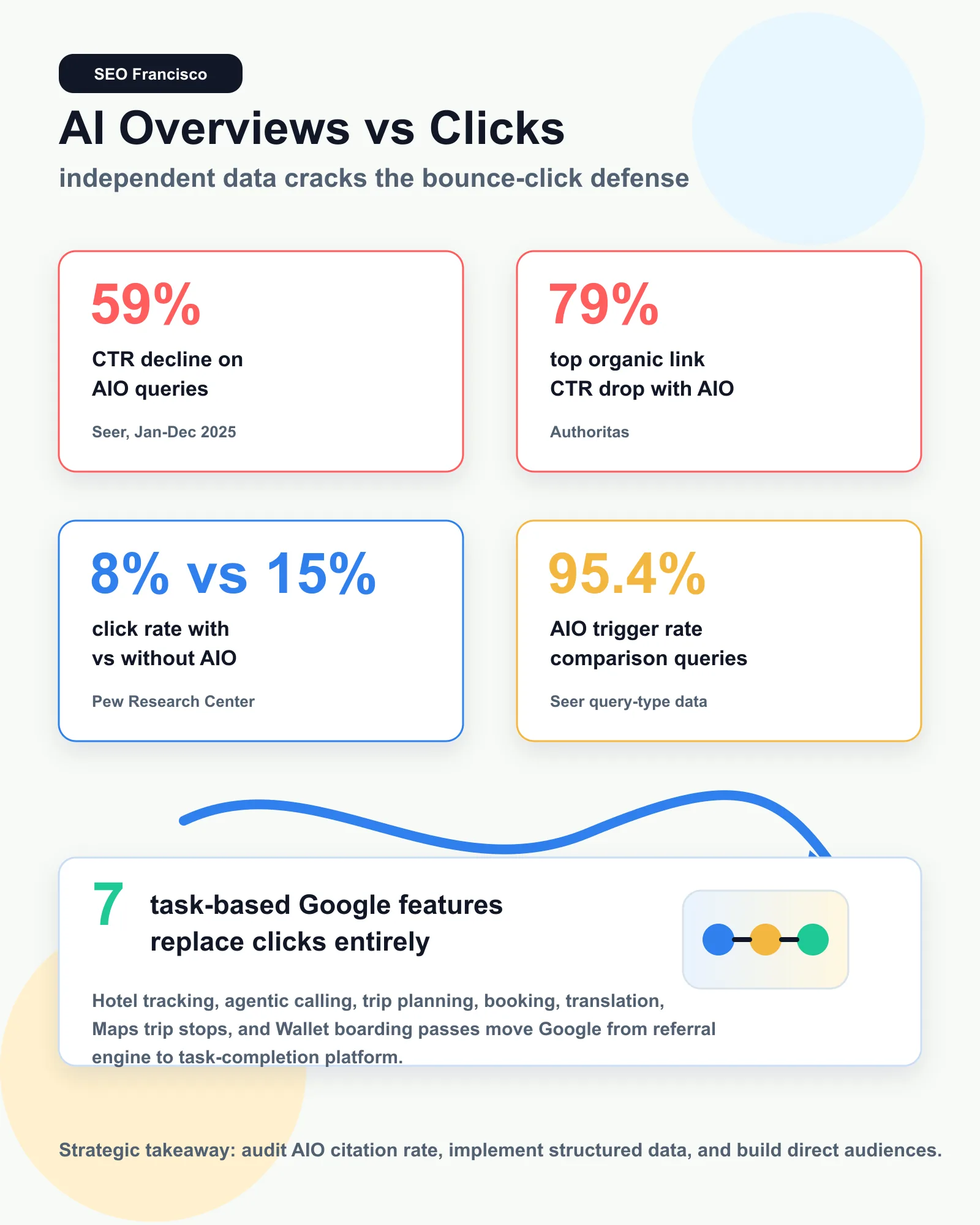
TL;DR: Google's Head of Search claims AI Overviews only eliminate low-value "bounce clicks" — but five independent studies tracking tens of millions of queries show organic CTR has plunged 26–79%, concentrated precisely on the commercial queries that fund publisher operations. Meanwhile, Google just launched seven task-completion features that make the click even more obsolete, while the EU moves to force open Google's behavioral data to competitors.
Google Head of Search Liz Reid now claims AI Overviews only eliminate "bounce clicks" — low-value visits where users immediately returned to the SERP. Convenient story: the traffic publishers lost was never worth having. But five independent studies , from Seer Interactive, Pew Research Center, Chartbeat, Digital Content Next, and Authoritas , paint a sharply different picture. Google also just launched seven task-based features that make the click even more obsolete. Here's what the numbers actually say, who's saying what, and what publishers should do about it.
1. The "Bounce Click" Story: What Google Is Actually Saying

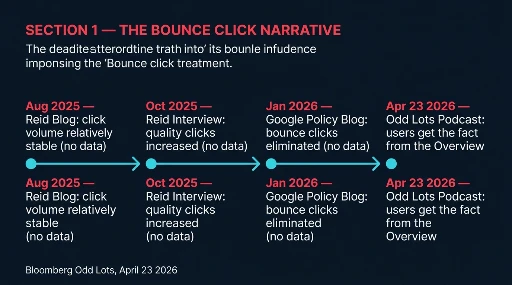
On April 23, 2026, Liz Reid appeared on Bloomberg's Odd Lots podcast and delivered Google's clearest articulation yet of the "bounce click" defense. Her argument: users who "quickly click and return to search no longer need to visit the page because they get the fact from the Overview."
This wasn't a spontaneous remark. Reid has been building this story over eight months:
Key takeaway
Google's "bounce click" defense is a story built without a single data point. It's been repeated across three venues over eight months, getting more detailed each time , and it remains entirely unverified.
2. Five Independent Studies That Contradict the "Bounce Click" Theory
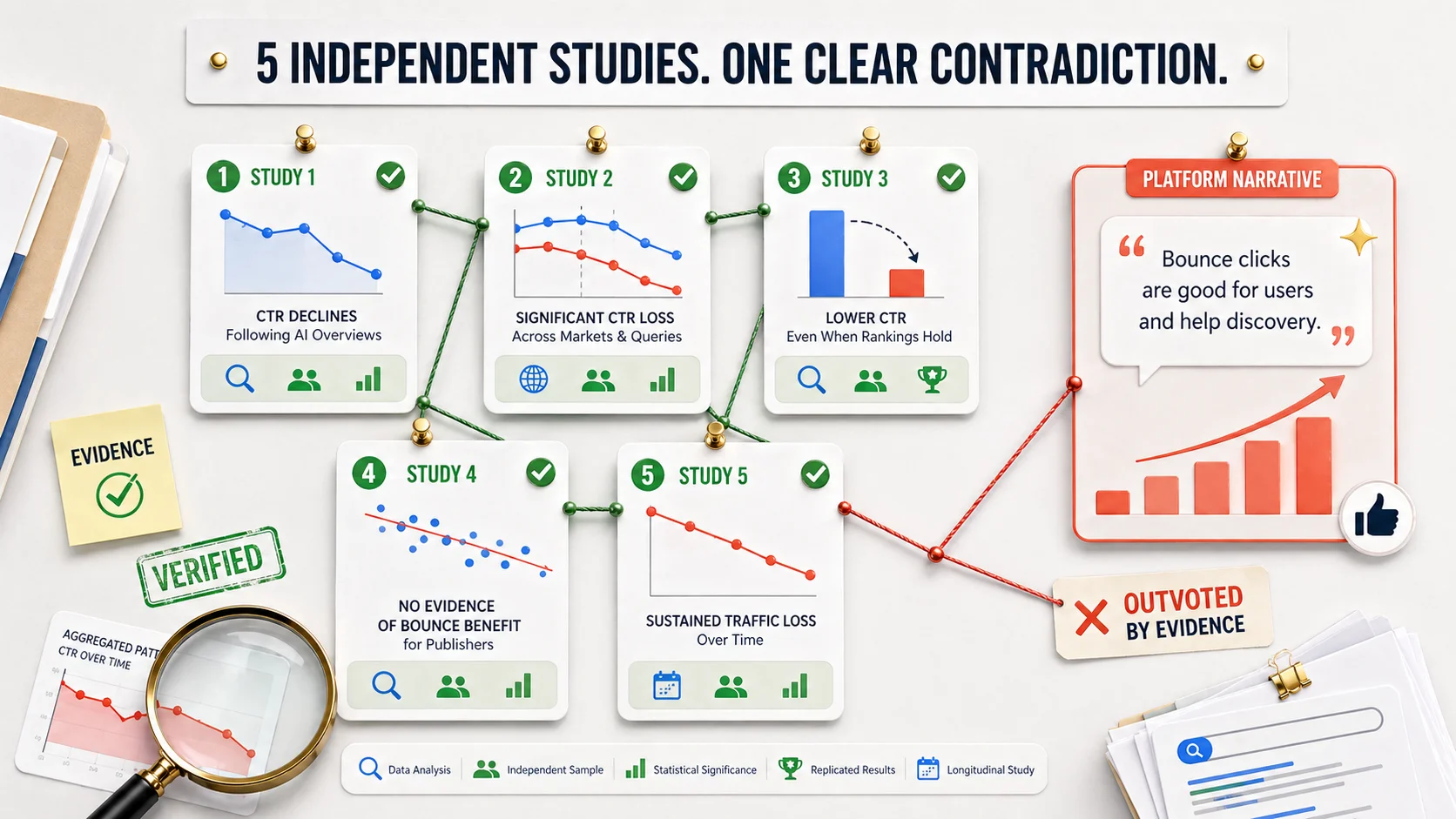
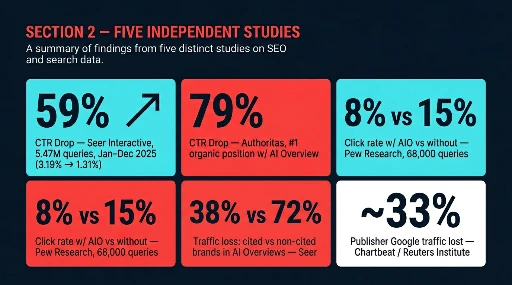
Google offers assertions. Independent researchers publish actual numbers. And the data is consistent across all five studies: AI Overviews are cutting organic CTR far beyond what any "bounce click" theory can explain.
Study 1: Seer Interactive , 5.47 Million Queries, 53 Brands
Seer Interactive's 2026 update is the most granular dataset available. Tracking 53 brands across 5.47 million queries and 2.43 billion impressions from January 2025 to February 2026, the study documents a clear trajectory:
| Period | Organic CTR on AIO Queries | Change from Jan 2025 |
|---|---|---|
| January 2025 (baseline) | 3.19% | , |
| June 2025 | ~2.10% | -34% |
| December 2025 (floor) | 1.31% | -59% |
| February 2026 (recovery) | 2.36% | -26% |
The partial recovery from 1.31% to 2.36% between December 2025 and February 2026 is notable , an 80% bounce from the floor , but organic CTR is still 26% below where it started. This isn't a story of "bounce clicks" being filtered out. It's a story of real traffic loss with incomplete recovery.
Study 2: Seer's Citation Impact Analysis
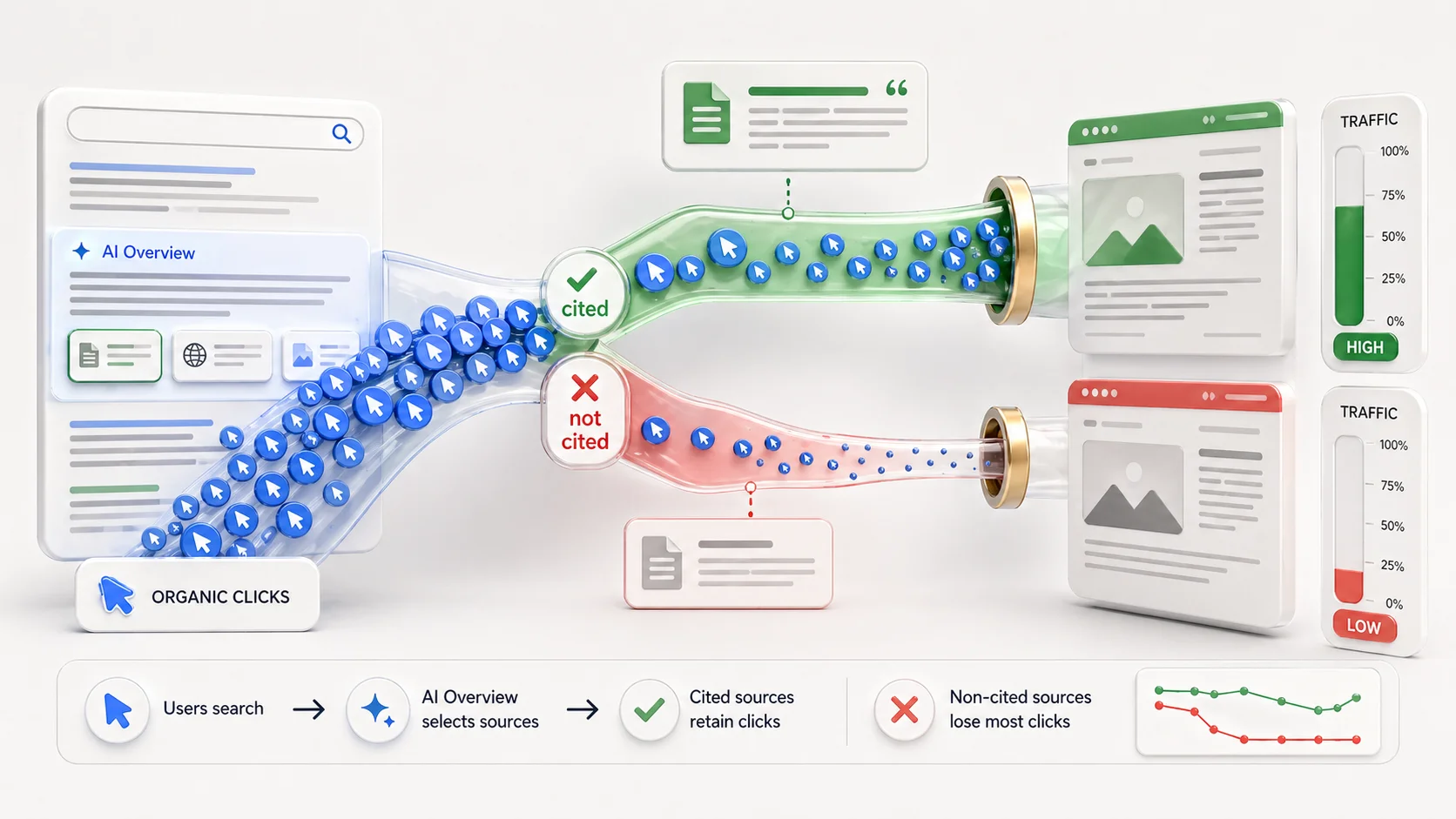
Seer's per-million-impressions data shows how citation status determines survival:
Study 3: Pew Research Center , 68,000 Real Queries
Pew's controlled study of 68,000 real queries found users clicked results 8% of the time with AI Overviews versus 15% without. That's a 47% reduction in click propensity , measured at the user-behavior level, not the query level. When AI Overviews appear, users are almost half as likely to click anything at all.
Study 4: Chartbeat / Reuters Institute , 2,500+ Publisher Sites
The Chartbeat/Reuters Institute 2026 report documents the aggregate publisher impact:
| Metric | Finding |
|---|---|
| Global publisher Google search traffic | Down ~one-third |
| Google Discover referrals YoY (2,500+ sites) | -21% year-over-year |
Study 5: Digital Content Next , 19 Major Publishers
Digital Content Next surveyed 19 publishers including the New York Times, Conde Nast, and Vox between May and June 2025 and found a median 10% year-over-year Google referral decline. CEO Jason Kint called the member data "ground truth" , these are publishers with direct analytics access, not third-party estimates.
"Ground truth , these are publishers with direct analytics access, not third-party estimates."
Jason Kint, CEO, Digital Content Next
Study 6: Authoritas , Position-Level Impact
Authoritas measured impact on the most valuable SERP real estate: the #1 organic position. When AI Overviews appear, the top organic link's CTR drops by approximately 79%. That's the clearest rebuttal to the "bounce click" argument , the #1 result typically earns the highest-engagement clicks, not bounce traffic. Full stop.
Key takeaway
Across six independent datasets , spanning 5.47 million queries, 68,000 user sessions, and 2,500+ publisher sites , the evidence isn't ambiguous: AI Overviews are wrecking organic CTR at every level, on every query type, for every publisher size. The "bounce click" framing can't account for a 79% loss at position #1.
3. Which Queries Trigger AI Overviews , and Why It Matters
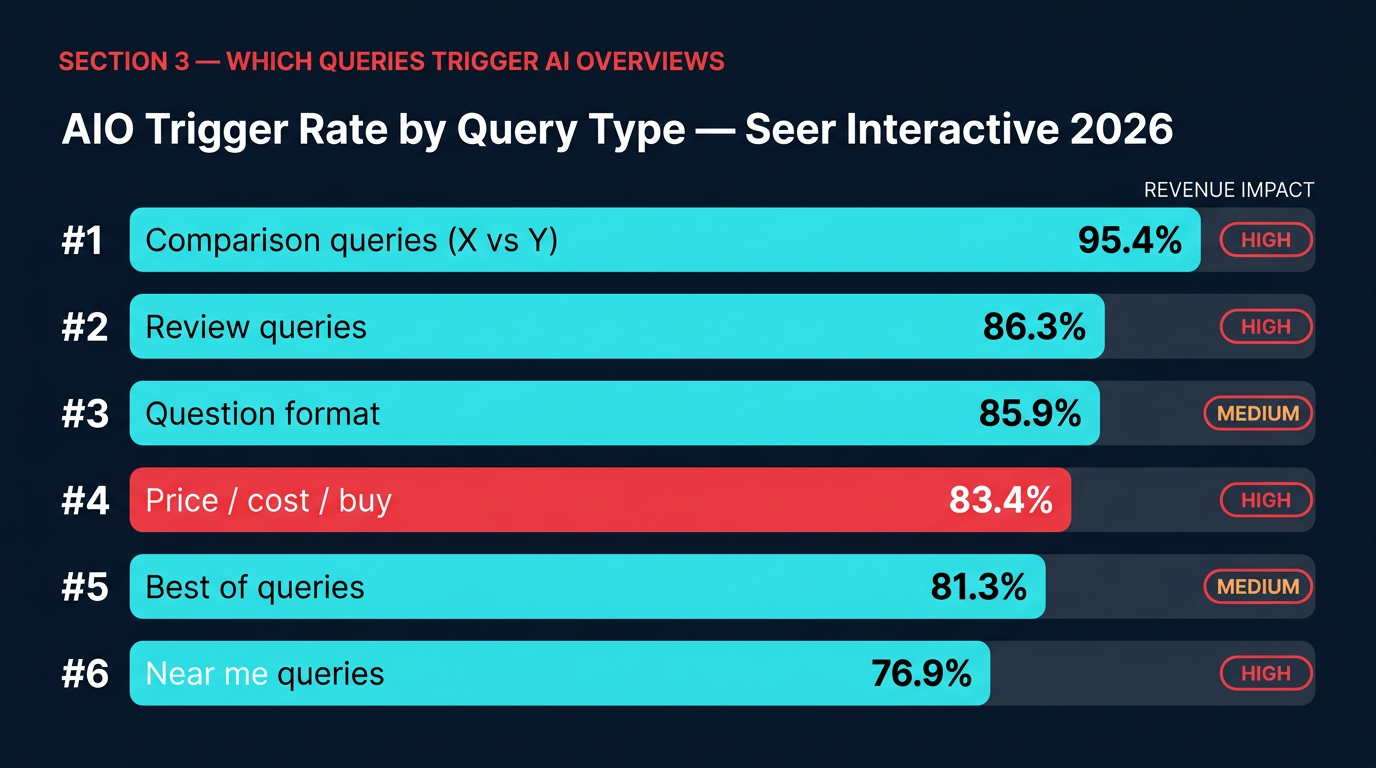
The scale of CTR loss depends on how often AI Overviews appear. Seer's data breaks down AIO trigger rates by query type, and the pattern is striking: commercial-intent queries , where publisher traffic is most monetizable , trigger AIOs at the highest rates.
| Query Type | AIO Trigger Rate | Revenue Impact |
|---|---|---|
| Comparison (X vs Y) | 95.4% | High , affiliate, review revenue |
| Review queries | 86.3% | High , affiliate commissions |
| Question format | 85.9% | Medium , informational content |
| Price / cost / buy | 83.4% | High , direct purchase intent |
| "Best of" queries | 81.3% | High , listicle, affiliate |
| "Near me" queries | 76.9% | High , local business, maps |
Key takeaway
The queries most devastated by AI Overviews are the same queries that generate the most publisher revenue. Not coincidence , it's the structural reality of where Google's interests and publishers' interests most sharply diverge.
4. Google's Claims vs. Independent Data , Side by Side
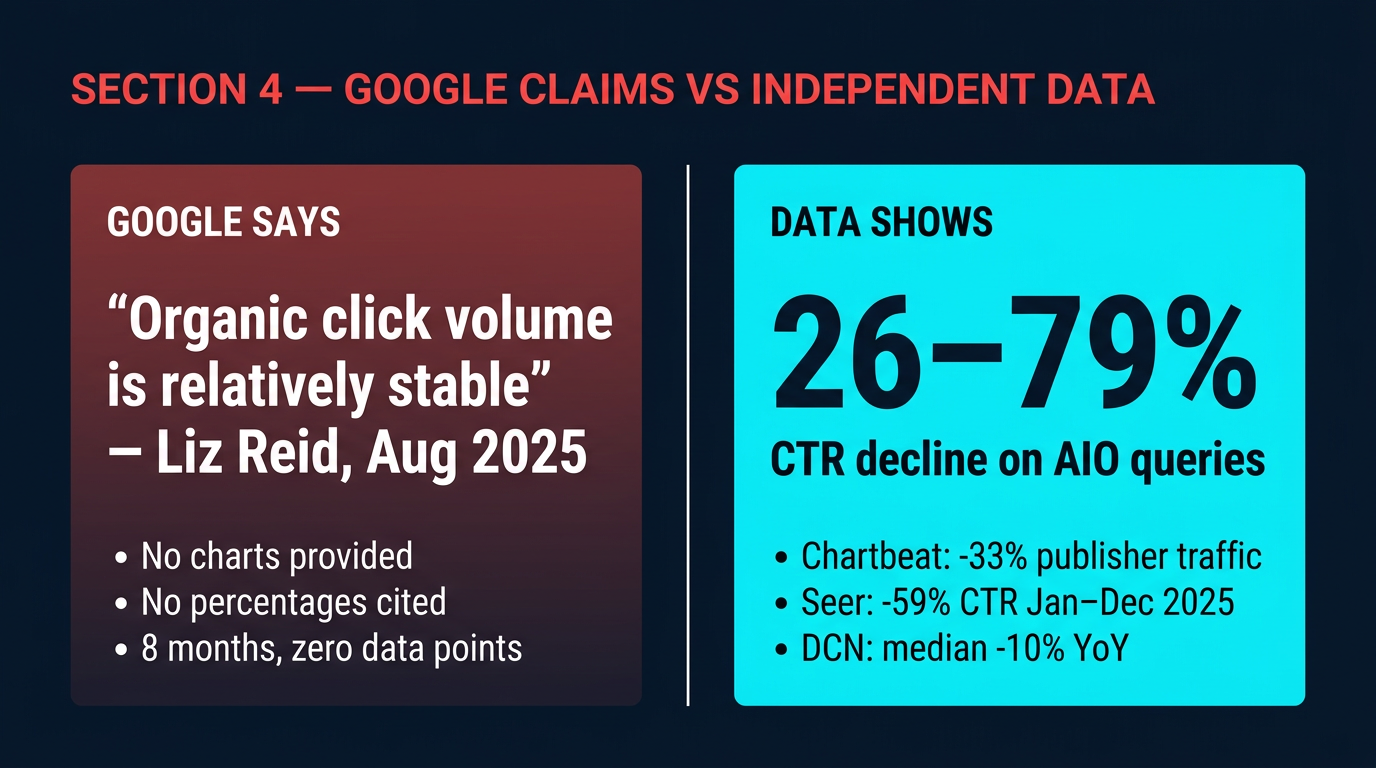
Put Google's public statements next to the available evidence and a consistent pattern emerges: Google makes qualitative claims; independent researchers produce quantitative data. Every time.
| Google's Claim | Source | Independent Evidence |
|---|---|---|
| "Organic click volume is relatively stable" | Reid, August 2025 | Chartbeat: ~33% drop. DCN: median -10% YoY. Seer: 26–59% CTR decline on AIO queries. |
| "Quality clicks have increased" | Reid, August 2025 | No independent study has confirmed a "quality click" increase. Google has not defined "quality click" or published methodology. |
| "Users who bounced no longer need to visit" | Reid, April 2026 | Authoritas: 79% CTR loss on #1 organic position , the highest-engagement slot, not a bounce-traffic source. Pew: 47% fewer clicks across all result types. |
| "Increased query volume balances reduced clicks" | Reid, April 2026 | More queries × lower CTR = traffic that flows to Google, not publishers. Volume without clicks does not benefit the open web. |
Key takeaway
In every case where Google has made a qualitative claim, independent quantitative research contradicts it. The gap between Google's story and measured reality is counted in tens of percentage points. That's not subtle.
5. Meanwhile, Google Launches 7 Features That Replace the Click Entirely
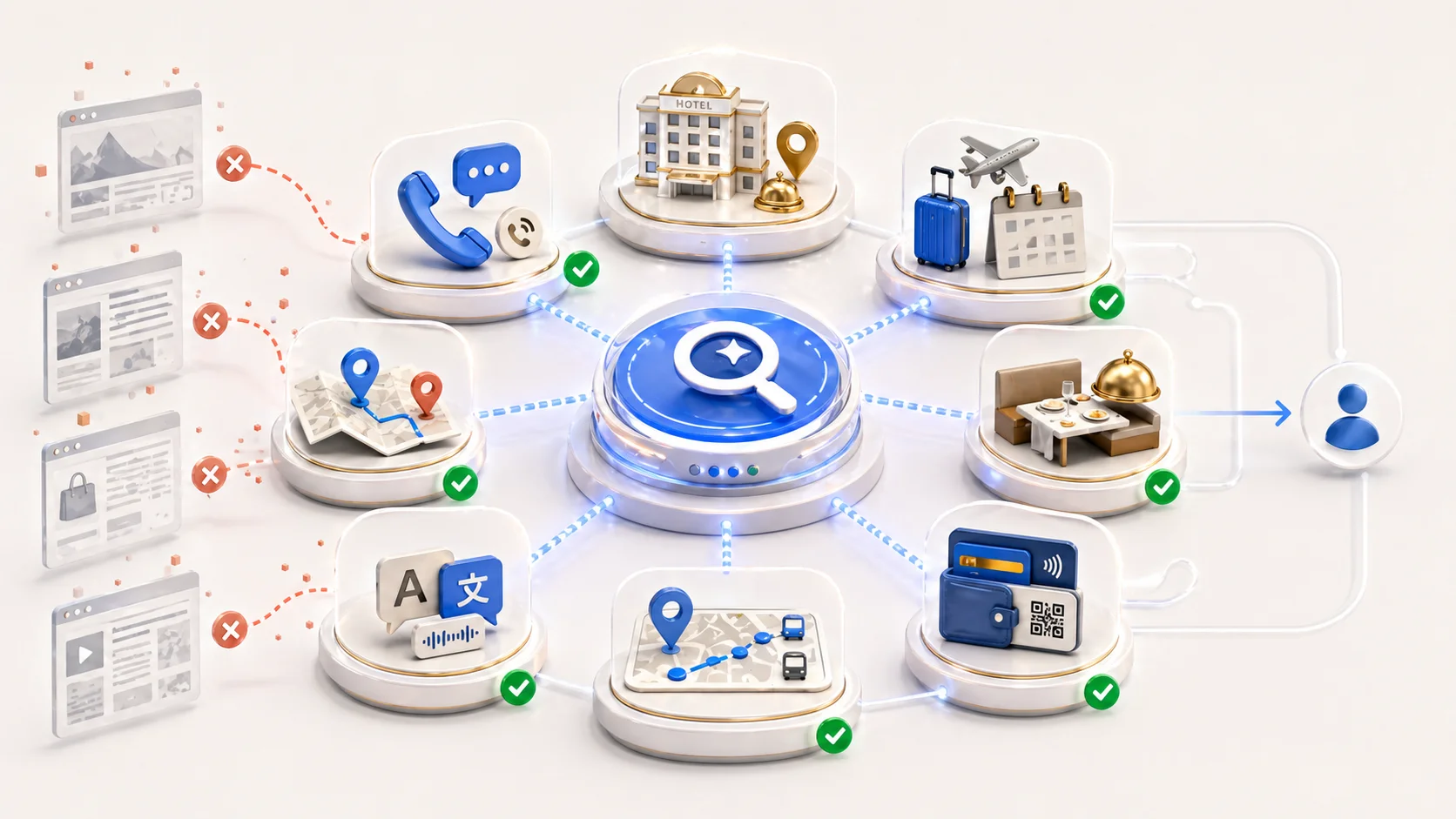
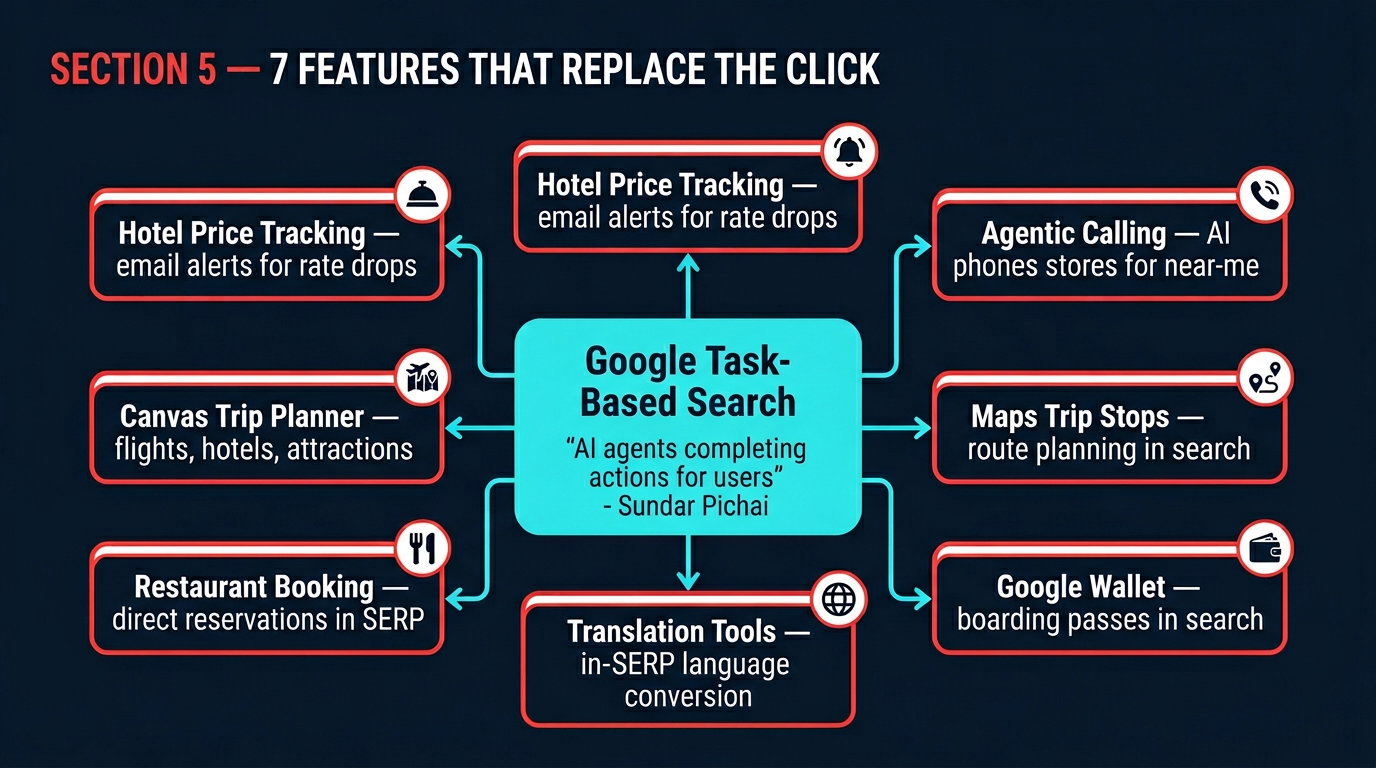
The timing of the "bounce click" story gets more revealing when you pair it with Google's simultaneous product launches. On April 25, 2026, Google Search Product Leader Rose Yao announced a suite of task-based features , and CEO Sundar Pichai framed the strategic vision: the future of search is "task-based" with AI agents completing actions for users.
These seven features collectively move Google from a referral engine to a task-completion platform:
| Feature | What It Does | What It Replaces |
|---|---|---|
| Hotel price tracking | Email alerts when hotel rates drop (global) | Travel comparison sites, hotel booking pages |
| Agentic calling | AI calls local stores to check stock for "near me" queries | Calling the store yourself, local business websites |
| Canvas trip planner | Structured itineraries with flights, hotels, attractions on a map (US) | Travel blogs, itinerary sites, guidebook publishers |
| Restaurant booking | AI assists with restaurant reservations directly in search | OpenTable, Resy, restaurant websites |
| Translation tools | Built-in translation within search results | Translation sites, language resource pages |
| Maps trip stops | Route planning with stops integrated into search | Travel planning sites, road trip blogs |
| Wallet boarding passes | Save boarding passes to Google Wallet from search | Airline apps, booking confirmation emails |
Google's stated direction vs. Google's actual product roadmap: still two different conversations, just happening faster now.
What This Means for SEO Strategy
The task-based pivot changes what "optimization" means. Websites shift from ranking targets to service endpoints. The winners in this model need:
1Structured HTML & Schema.org Markup
Google's agentic features consume structured data. If your pricing, availability, hours, and inventory aren't machine-readable, your data doesn't exist to these systems.
2Accurate, Real-Time Product Data
The agentic calling feature and hotel price tracker depend on current, correct data. Stale inventory or outdated pricing means exclusion from these features.
3Consistent Local Listings
The "near me" agentic features pull from Google Business Profiles and structured local data. Inconsistencies between your website, GBP, and third-party listings will cost visibility.
4Direct Audience Relationships
Email lists, apps, communities, and subscription models that don't depend on Google referral traffic. The publishers who survive the task-based era are those who own their audience.
Key takeaway
Google's seven new task features aren't incremental improvements , they're a shift in what search is for. Publishers who adapt their data architecture now will be integrated into these systems. Those who don't will become invisible inputs with no visible output.
6. The EU Factor: Search Data Sharing Could Reshape the Scene
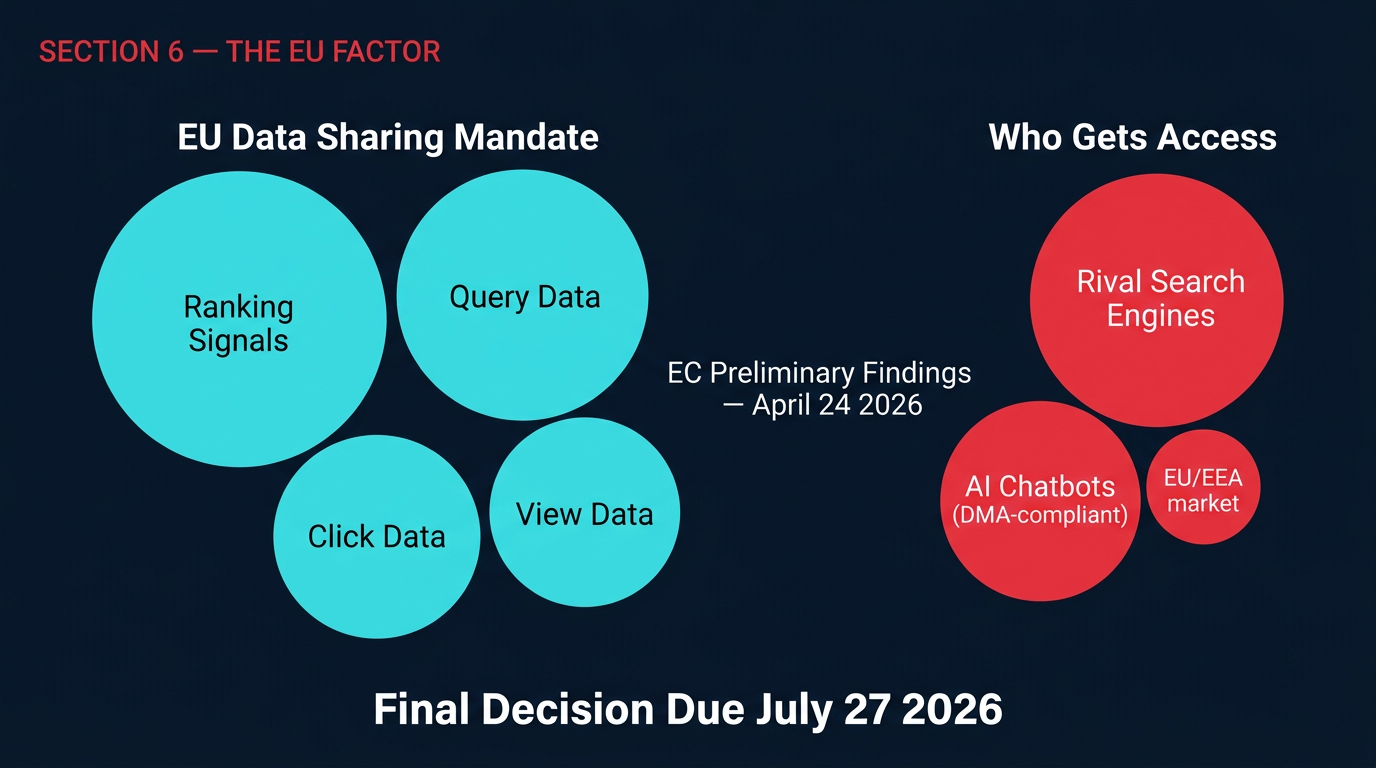
While Google builds its task-completion moat, the European Commission is moving in the opposite direction. On April 24, 2026, the EC sent preliminary findings proposing that Google share search data with rival search engines in the EU/EEA on "fair, reasonable, and non-discriminatory terms."
The proposed data categories are sweeping:
| Data Category | Description |
|---|---|
| Ranking signals | The factors Google uses to order results |
| Query data | What users are searching for |
| Click data | What users click after searching |
| View data | What users see and how long they engage |
Key takeaway
The EU DMA proceedings are the single biggest structural wildcard in AI search right now. A July 2026 ruling forcing Google to share ranking, click, and view data with competitors could rapidly level a playing field that's tilted toward Google for two decades.
7. What Publishers Should Do Right Now
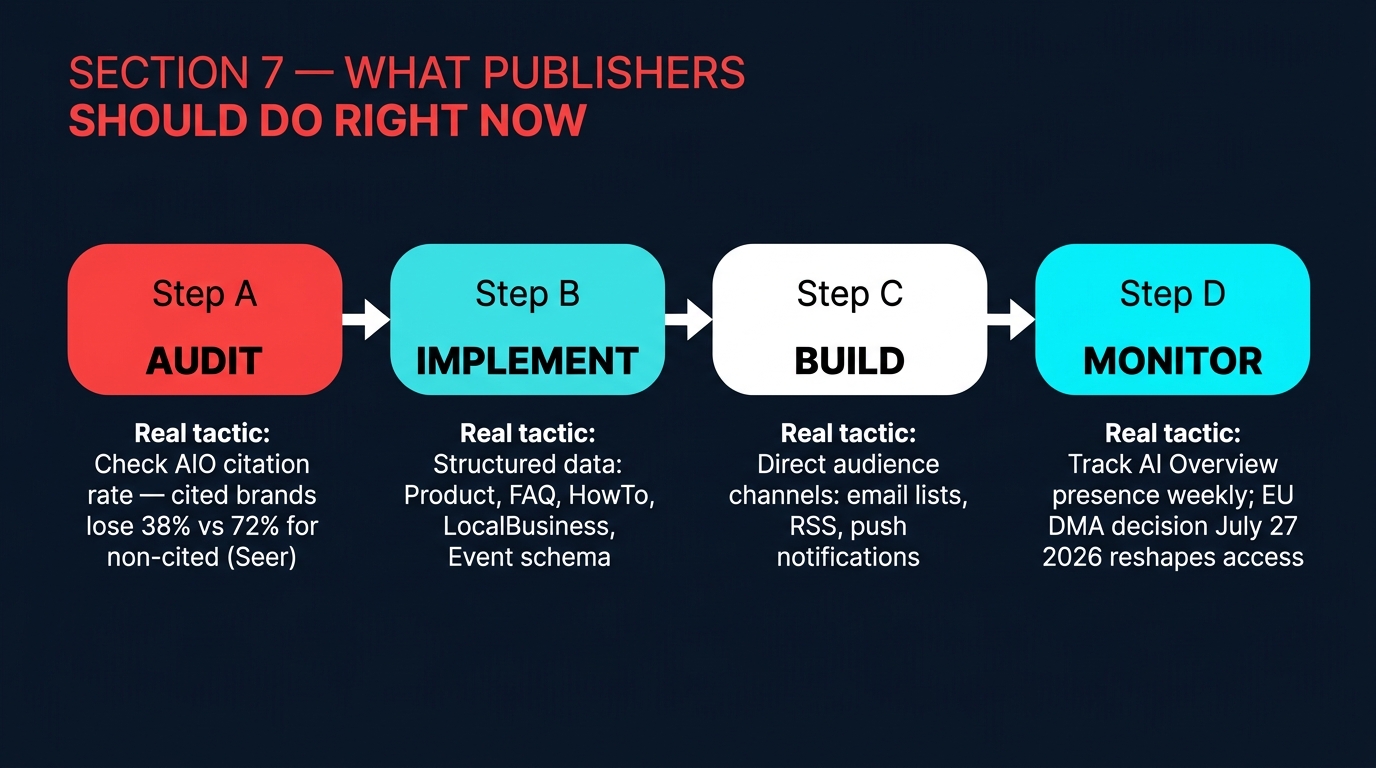
CTR erosion, task-based feature expansion, and the "bounce click" story together create a clear strategic vital for publishers. Here's the action plan:
Critical (This Month)
- Audit your AIO citation rate. Use Seer's methodology , check which of your top queries trigger AI Overviews and whether you're cited. The 38% vs. 72% traffic loss gap between cited and non-cited makes this the single highest-use diagnostic.
- Implement structured data aggressively. Product, FAQ, HowTo, LocalBusiness, and Event schema. Google's task-based features consume structured data; unstructured content is invisible to them.
- Check your AIO trigger rate by query type. If your traffic concentrates in comparison, review, or "best of" queries (80%+ AIO trigger rates), your exposure is severe. Diversify into query types with lower AIO penetration.
Important (Next Quarter)
- Build citation-worthy content. AI Overviews cite sources with clear, authoritative factual statements. Dense, well-sourced, expertise-first content gets cited. Thin content gets summarized without attribution.
- Develop direct audience channels. Email newsletters, mobile apps, membership programs. Every reader you acquire through a non-Google channel is insulated from AIO-driven CTR decline.
- Monitor the EU DMA proceedings. If Google is forced to share ranking and click data, the competitive scene for search , including AI search , changes. Public consultation closes May 1.
Strategic (Next 12 Months)
- Prepare for the "data source" role. In a task-completion search model, publishers that provide machine-readable, real-time, authoritative data get integrated into Google's agentic features. Publishers that don't become invisible.
- Negotiate directly with AI platforms. Google, OpenAI, Anthropic, and Perplexity all need publisher content for training and retrieval. The licensing and partnership window is open now , it won't stay open indefinitely.
Frequently Asked Questions
What are Google's "bounce clicks" and why is the term controversial?
Google Head of Search Liz Reid defines "bounce clicks" as low-value visits where users click a search result, immediately return to the SERP, and never meaningfully engage with the page. Reid argues AI Overviews simply eliminate these wasted clicks. The term is controversial because Google has provided zero supporting data , no charts, percentages, or year-over-year comparisons , while independent studies from Seer Interactive, Pew Research, and Authoritas show organic CTR declines of 26–79% that extend well beyond what could be classified as bounce traffic.
How much has organic CTR dropped because of AI Overviews?
Independent studies show significant CTR declines when AI Overviews appear. Seer Interactive tracked 53 brands across 5.47 million queries and found organic CTR on AIO queries dropped from 3.19% (January 2025) to 1.31% (December 2025) , a 59% decline. It partially recovered to 2.36% by February 2026, still 26% below starting levels. Authoritas found that the top organic link's CTR drops approximately 79% when AI Overviews appear. Pew Research Center found users clicked results 8% of the time with AI Overviews versus 15% without.
What are Google's new task-based search features in 2026?
In April 2026, Google launched seven task-completion features: hotel price tracking with email alerts (global), agentic calling where AI phones local stores to check stock for "near me" queries, a Canvas trip planner that builds structured itineraries with flights/hotels/attractions (US only), restaurant booking assistance, built-in translation tools, Maps integration for trip stops, and Google Wallet boarding pass saving. These features shift Google from a referral engine to a task-completion platform.
How do AI Overviews affect cited versus non-cited brands?
Seer Interactive's data per 1 million informational impressions shows a clear hierarchy: with no AI Overview present, brands receive approximately 33,500 organic clicks. When an AI Overview appears and the brand IS cited, clicks drop to approximately 20,743 , a 38% decline. When the brand is NOT cited, clicks collapse to approximately 9,445 , a 72% decline from the no-AIO baseline. Being cited preserves roughly 62% of organic click volume; not being cited destroys nearly three-quarters of it.
Which types of queries trigger AI Overviews most frequently?
According to Seer Interactive's 2026 data, comparison queries (X vs Y) trigger AI Overviews 95.4% of the time. Review queries trigger at 86.3%, question-format queries at 85.9%, price/cost/buy queries at 83.4%, "best of" queries at 81.3%, and "near me" queries at 76.9%. The high trigger rates on commercial-intent queries mean CTR impact is concentrated where publisher traffic is most valuable.
What should publishers do to maintain traffic in the AI Overview era?
Publishers should tune for AI Overview citations using structured HTML and Schema.org markup , being cited preserves 62% of clicks versus a 72% loss when not cited. Invest in structured data for Google's task-based features (accurate pricing, availability, hours, inventory). Build direct audience relationships through email, apps, and communities. Monitor the EU DMA proceedings, which could force Google to share ranking and click data with competitors by July 2026.
How has global publisher traffic from Google changed in 2025–2026?
The Chartbeat/Reuters Institute 2026 report found global publisher Google search traffic dropped by roughly one-third. Google Discover referrals fell 21% year-over-year across 2,500+ publisher sites. Digital Content Next's study of 19 major publishers including NYT, Conde Nast, and Vox found a median 10% year-over-year Google referral decline. These figures cover all query types, not just those with AI Overviews.
Sources
- Search Engine Journal , Google Pushes "Bounce Clicks" Explanation for AI Overview Traffic Loss (April 25, 2026)
- Search Engine Journal , Google Adds New Task-Based Search Features (April 25, 2026)
- Seer Interactive , AIO Impact on Google CTR: 2026 Update (2026)
- Pew Research Center , AI Overviews Click Behavior Study (68,000 queries, 2025–2026)
- Chartbeat / Reuters Institute , Publisher Google Traffic Report (2026)
- Digital Content Next , Publisher Google Referral Decline Study (May–June 2025)
- Authoritas , AI Overview CTR Impact on Organic Position #1 (2026)
- Bloomberg Odd Lots Podcast , Liz Reid Interview (April 23, 2026)
- Search Engine Journal , Google's Robots.txt Docs Expand, Deep Links Get Rules, EU Steps In (April 24, 2026)
About the Author