SEO Pulse: Googlebot's 2MB Cutoff, the Agentic Commerce Arms Race, and Who Won the March Core Update
Deep analysis: Googlebot's newly enforced 2MB crawl limit silently truncates pages, Google and OpenAI race to own AI checkout, and winners emerge from the March 2026 core update aftermath. Data-driven insights for SEO professionals.

Three seismic shifts are reshaping how search engines crawl, rank, and monetize the web this week. Googlebot has a newly enforced page size cutoff that's silently killing large pages, Google and OpenAI are racing to own AI-powered checkout, and the March 2026 core update's real winners and losers are finally becoming clear. Here's the data and the action plan.
1. Googlebot's 2MB Crawl Limit: The Silent Page Killer
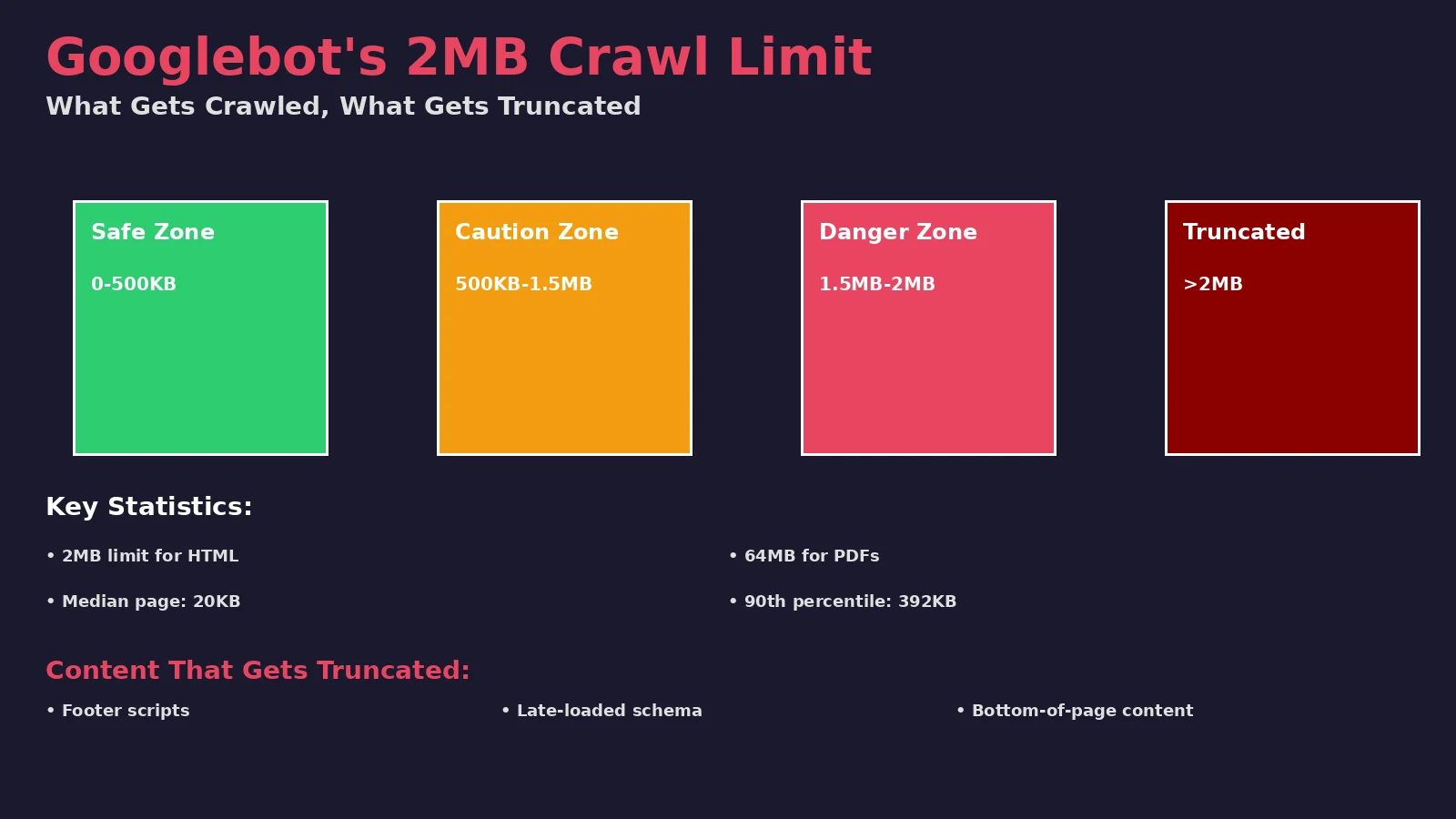
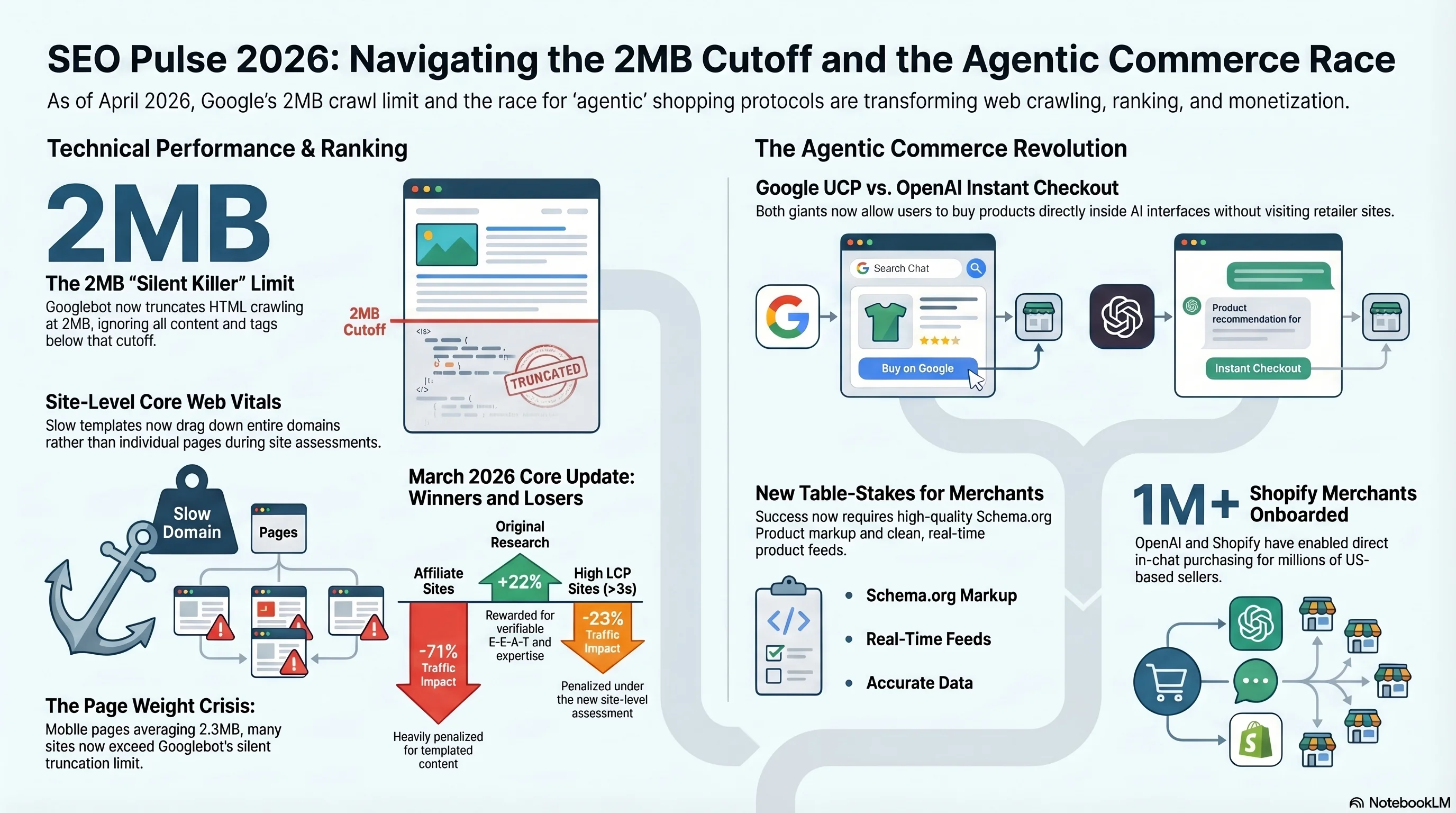
Google quietly updated its Googlebot documentation in March 2026, dropping the stated crawl limit from 15MB to just 2MB per URL. The change went largely unnoticed until independent testing confirmed something alarming: when your page exceeds 2MB, Googlebot silently stops fetching at the cutoff — with zero warning in Search Console.
The revelation came from Google's own Search Off the Record podcast (episode 105, released April 1, 2026), where Martin Splitt and Gary Illyes discussed the growing page weight problem and how it interacts with Googlebot's fetching architecture.
Why This Matters More Than the Numbers Suggest
At first glance, the 2MB limit seems generous — the median HTML file is only 20KB and even the 90th percentile is 392KB. But the danger is concentrated in specific page types that many enterprises rely on for organic traffic: product aggregation pages with extensive reviews, large category pages with filtering markup, and pages with heavy inline JavaScript or CSS.
Independent testing by Spotibo found that well-known platforms are already over the limit. German e-commerce site Zalando had pages reaching 2.6MB, while OMR Reviews hit approximately 3.4MB. These are not edge cases — they represent major traffic-driving page types for large organizations.
Critical: When Googlebot truncates at 2MB, it passes the incomplete content to indexing as if it were the complete file. If your canonical tags, structured data, or key content sit below the cutoff, they are effectively invisible to Google. There is no warning in Search Console.
What Gets Truncated First
Googlebot reads the HTML stream sequentially. Content at the bottom of the document gets cut first. This makes placement strategy critical: your meta tags, canonical URLs, schema markup, and above-the-fold content must live in the first portion of your HTML. Heavy footer scripts, inline SVGs, and bloated third-party widget code are the usual culprits that push essential elements past the boundary.
Action Required
Audit your largest pages immediately. Move CSS and JavaScript to external files. Ensure canonicals, structured data, and meta tags appear in the first 500KB of your HTML document. Use Chrome DevTools or the Fetch as Google tool to check your actual rendered page size.
2. The Agentic Commerce Arms Race: Google UCP vs. OpenAI's Instant Checkout
The biggest structural shift in search monetization since the invention of Shopping Ads is unfolding right now: both Google and OpenAI are building open protocols that let AI agents complete purchases inside conversational interfaces, without the user ever visiting a retailer's website.
The implications for SEO and organic traffic are profound. If a user can ask an AI assistant about a product and buy it in the same conversation, the traditional funnel of search, click, browse, cart, and checkout collapses into a single step. Website visits become optional.
Google's Universal Commerce Protocol (UCP)
Announced in January 2026 and developed with Shopify, Etsy, Wayfair, Target, and Walmart, UCP is an open standard that enables direct purchases across AI surfaces like AI Mode in Search and the Gemini app. It allows shoppers to check out from eligible US retailers while researching on Google, with payment processed through Google Pay and PayPal.
Key March 2026 updates added Cart capability (multi-item purchases from one store) and Catalog capability (real-time inventory, variants, and pricing retrieval by AI agents). Over 20 global partners across the retail ecosystem have endorsed UCP.
OpenAI's Agentic Commerce Protocol + Instant Checkout
OpenAI launched Instant Checkout inside ChatGPT, powered by its Agentic Commerce Protocol built with Stripe. Since March 24, 2026, every eligible Shopify merchant's products became discoverable inside ChatGPT through Shopify's Agentic Storefronts. US ChatGPT Plus, Pro, and Free users can now buy directly from US Etsy sellers in-chat, with over a million Shopify merchants also onboarded.
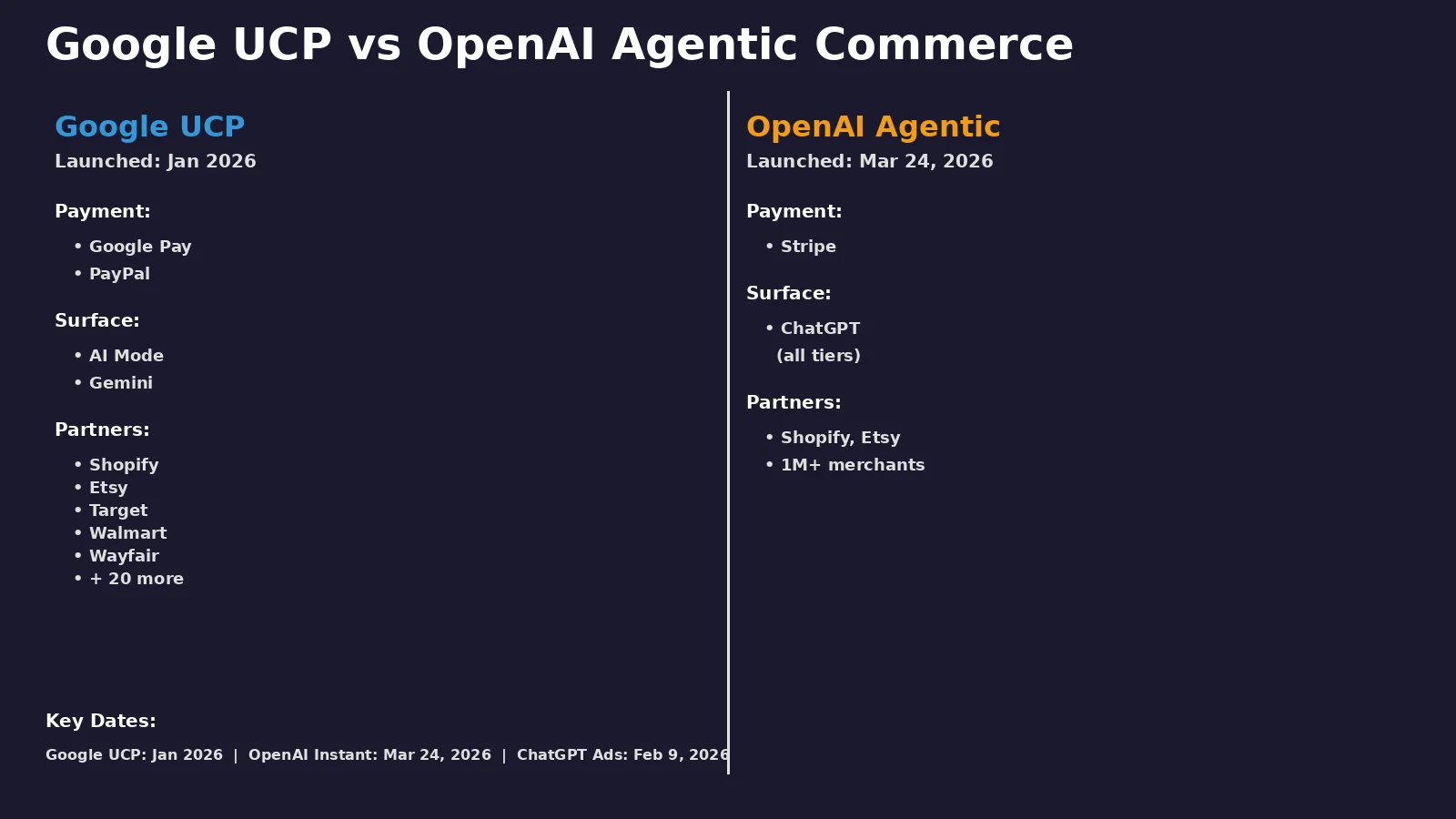
| Feature | Google UCP | OpenAI Agentic Commerce |
|---|---|---|
| Payment Rails | Google Pay, PayPal | Stripe |
| AI Surface | AI Mode, Gemini App | ChatGPT (all tiers) |
| Merchant Partners | Shopify, Etsy, Target, Walmart, Wayfair + 20 | Shopify, Etsy (1M+ merchants) |
| Cart Support | Multi-item (March 2026) | Single checkout flow |
| Ads Integration | Google Ads Shopping | Testing (Feb 2026, $60 CPM) |
| Protocol Status | Open standard | Open standard |
What This Means for SEO
The convergence point is clear: both protocols aim to make product discovery and purchase happen inside AI conversations, bypassing traditional website visits entirely. For SEO professionals managing e-commerce sites, the strategic question shifts from "how do I rank higher" to "how do I ensure my products are discoverable by AI agents."
Structured product data (schema.org Product markup), clean product feeds, and merchant verification become table-stakes requirements rather than optional enhancements. Sites without robust structured data will not surface in either protocol's product discovery layer.
The ChatGPT ads angle: OpenAI launched advertising in ChatGPT on February 9, 2026, starting with contextual ads for Free and Go tier users in the US at a $60 CPM premium. There is no self-serve ad platform yet — current inventory is limited to enterprise partnerships. But the trajectory is unmistakable: AI assistants are becoming ad-supported commerce platforms.
3. March 2026 Core Update: Winners, Losers, and the Site-Level CWV Shift
Google's March 2026 broad core update completed rolling out on April 8, ending a 12-day rollout that began March 27. With five full days of post-rollout data now available, clear patterns are emerging in the winners and losers — and one technical change is catching many SEO teams off guard.
The Holistic Core Web Vitals Shift
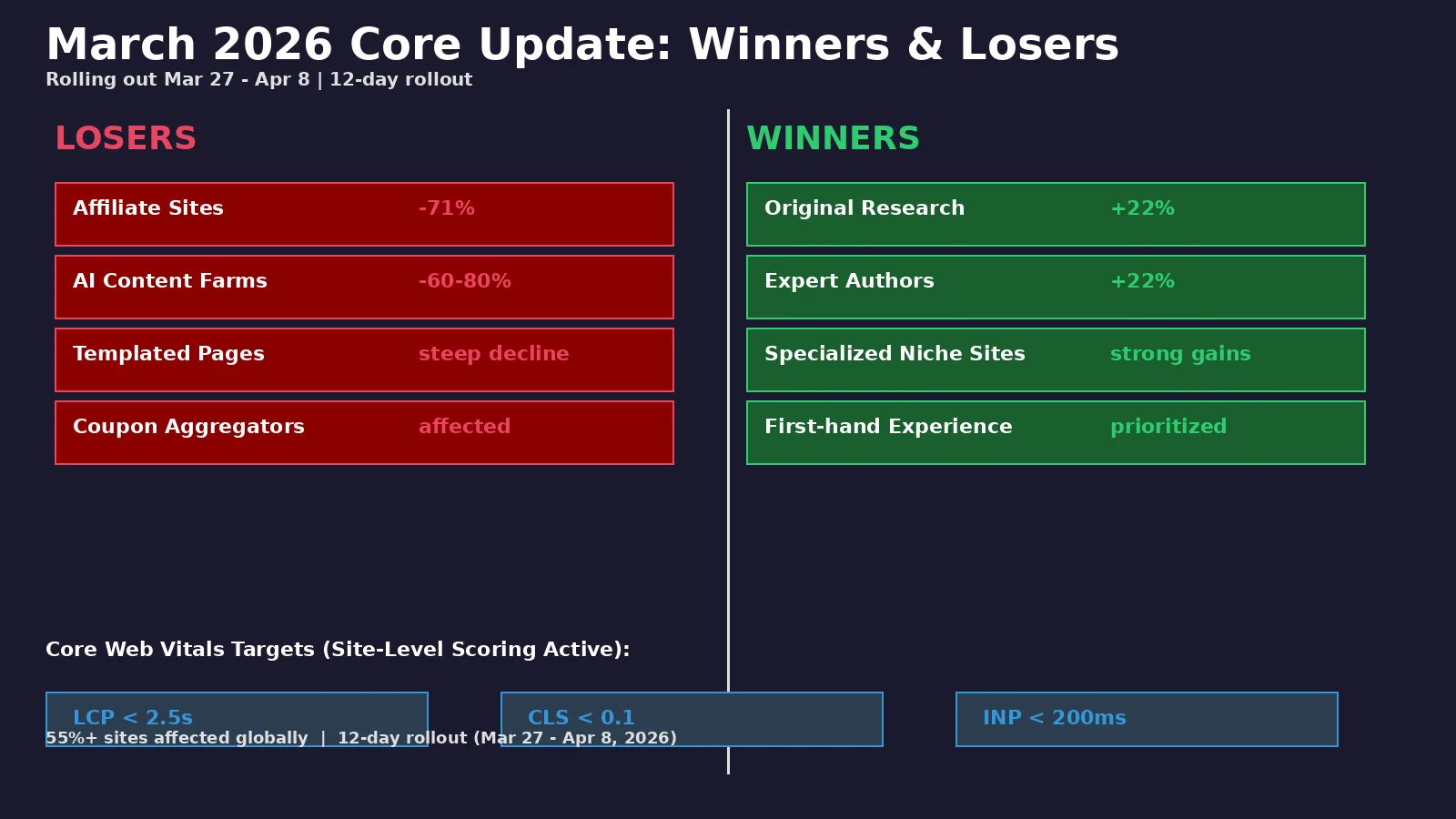
The most consequential technical change in this update is the shift from per-page Core Web Vitals scoring to site-level assessment. Previously, a slow product page would only hurt that page's rankings. Now, slow templates drag down the entire domain. Analysis shows sites with Largest Contentful Paint (LCP) above 3 seconds lost 23% more traffic than faster competitors — and this penalty applied domain-wide, not page-by-page.
Winners and Losers
The update hit hardest in sectors that proliferated low-value content at scale. Affiliate sites experienced the highest negative impact rate at 71%, AI content farms lost between 60% and 80% of their traffic, and templated comparison pages saw steep declines. Some webmasters reported top pages dropping from position 1 to position 30 or beyond.
On the other side, domains publishing original analysis, proprietary data, and content with verifiable author expertise gained approximately 22% in average visibility. The update explicitly rewards first-hand experience and transparent authorship — the E-E-A-T framework is now more measurably consequential than ever.
Key insight: Google described this as "a regular update designed to better surface relevant, satisfying content." But the data tells a more targeted story: specialization beats generalization, and sites that expanded into loosely related topics during the content boom years lost the most ground.
Webmaster Observations from the Trenches
Forum reports reveal volatile and sometimes confusing results. Some webmasters reported that cheap stock-listing websites with English reviews suddenly ranked first in non-English markets. Others saw very small local newspapers appear at the top for topics they barely cover. These anomalies suggest the update's quality signals may still be calibrating in certain verticals and languages.
Google recommends waiting at least one full week after completion (April 15) before drawing definitive conclusions from Search Console data. Your baseline comparison period should be pre-March 27 versus post-April 8.
4. GSC Impressions Bug: The 11-Month Fix Rolling Out Now
The Google Search Console impressions bug story continues to develop. Google officially confirmed on April 3, 2026 that a logging error had been inflating impression counts since May 13, 2025 — nearly 11 months of inaccurate data that webmasters relied on for decision-making.
Logging error begins silently inflating impression counts in Search Console Performance reports.
Google publicly confirms the bug and announces the fix is rolling out over several weeks.
March 2026 core update completes — compounding confusion for webmasters trying to isolate performance changes.
Expected completion of impression correction rollout across all Search Console reporting.
The critical detail many are missing: Google has not disclosed specific numbers, percentages, or multipliers for how much impressions were inflated. This means webmasters cannot reliably backfill corrected data for the May 2025 to April 2026 window.
Practical impact: If you reported CTR declines to stakeholders between May 2025 and April 2026, those reports were based on a denominator that was too large. Your actual CTR during that period was likely higher than what Search Console showed. Consider re-framing historical analysis for this window using click-based metrics instead.
5. Page Weight Crisis: Average Mobile Homepage Now 2.3MB
The Googlebot 2MB limit discussion takes on additional urgency when you examine the trajectory of page weight across the web. According to the Web Almanac, the average mobile homepage grew from 845KB in 2015 to 2.3MB in July 2025 — that average now exceeds Googlebot's crawl limit for HTML files.
To be clear, the 2MB limit applies to the raw HTML file, not the total page weight (which includes images, scripts, and stylesheets loaded separately). But the trend line is concerning: as frameworks get heavier, as inline styles and scripts proliferate, and as server-side rendering embeds more data in the initial HTML payload, more pages are approaching the boundary.
The strategic implication is straightforward: externalizing heavy resources reduces the risk of your HTML being truncated while also improving Core Web Vitals performance — a double benefit given the site-level CWV assessment introduced in the March core update.
6. Google Shopping Ads Political Content Policy — April 16 Deadline
Google will enforce updated political content restrictions on Shopping Ads beginning April 16, 2026. The policy change affects merchants in nine countries: Argentina, Australia, Chile, Israel, Mexico, New Zealand, South Africa, the United Kingdom, and the United States.
Shopping ads featuring political content in these markets will now require merchants to verify their Google Ads account as an election advertiser. Google will also prohibit certain political Shopping Ads in India outright.
The scope of "political content" is broader than many merchants expect. Products featuring a candidate's name, referendum support messaging, donation-related product pages, campaign buttons, satirical political slogans, and even publications featuring elected officeholders all fall under the new restrictions.
Deadline: April 16, 2026. Merchants who have not completed election advertiser verification by this date will see affected Shopping Ads campaigns paused. Apply through Google Ads now if any of your products could be classified as political content.
7. Your Action Items for This Week
Priority Actions — April 13-19, 2026
- Audit page sizes against the 2MB limit. Run a crawl of your highest-traffic pages and check raw HTML file sizes. Prioritize pages with inline scripts, embedded SVGs, or extensive review/comment sections. Move heavy CSS and JS to external files.
- Prepare for agentic commerce. If you sell products, ensure your schema.org Product markup is complete, your merchant feeds are accurate, and you're registered with Google Merchant Center. Investigate Shopify Agentic Storefronts if applicable.
- Assess core update impact — but wait until April 15. Google recommends one full week post-completion before comparing data. Set your baseline as pre-March 27 vs. post-April 8. Focus on click-based metrics given the ongoing GSC impressions correction.
- Fix site-level CWV issues. The holistic scoring change means your slowest templates are now a domain-wide liability. Identify pages with LCP above 2.5 seconds and prioritize them as site-health issues, not individual page problems.
- Recalibrate historical CTR reporting. If you reported CTR declines between May 2025 and April 2026, those numbers were based on inflated impression data. Flag this in any active dashboards or stakeholder reports.
- Check Google Shopping Ads compliance. If you sell any products that could be classified as political content, complete election advertiser verification before April 16.
8. Frequently Asked Questions
What is Googlebot's 2MB crawl limit?
Googlebot now fetches only the first 2MB of any URL (excluding PDFs, which have a 64MB limit). Content beyond the 2MB cutoff is silently truncated — Google does not warn you when this happens. The median HTML page is only 20KB, so most sites are unaffected, but large product pages, review aggregators, and sites with heavy inline CSS/JS may be at risk.
How did the March 2026 core update change Core Web Vitals scoring?
The update shifted from per-page CWV scoring to holistic site-level assessment. Slow templates now drag down the entire domain's rankings, not just individual pages. Sites with LCP above 3 seconds lost 23% more traffic than faster competitors. Target thresholds are LCP under 2.5s, CLS under 0.1, and INP under 200ms.
What is Google's Universal Commerce Protocol (UCP)?
UCP is an open standard launched by Google that enables direct, instant purchases across AI surfaces like AI Mode in Search and the Gemini app. Developed with Shopify, Etsy, Wayfair, Target, and Walmart, it allows shoppers to check out from eligible US retailers while researching on Google, using Google Pay or PayPal.
What is the Agentic Commerce Protocol from OpenAI?
The Agentic Commerce Protocol, built by OpenAI with Stripe, is an open standard for AI commerce that powers Instant Checkout inside ChatGPT. It enables AI agents to complete purchases on behalf of users. Over a million Shopify merchants and US Etsy sellers are now accessible through ChatGPT conversations.
Is the Google Search Console impressions bug fixed?
Google confirmed the bug on April 3, 2026, and the fix is rolling out over several weeks. The logging error inflated impressions starting May 13, 2025 — nearly 11 months of inaccurate data. Clicks and other metrics were not affected. You will see decreased impressions as the correction propagates, but your actual search visibility has not changed.
Which sites won and lost in the March 2026 core update?
Losers: Affiliate sites (71% saw drops), AI content farms (60-80% traffic loss), templated comparison pages, and coupon aggregators. Winners: Sites publishing original research, proprietary data, and content with verifiable author expertise saw average visibility gains of approximately 22%. The update explicitly rewards first-hand experience (E-E-A-T).
Watch the 60-Second Recap
The 2MB crawl limit, agentic commerce wars, and core update winners — all in under a minute.
About the Author