SEO News: June and July 2020
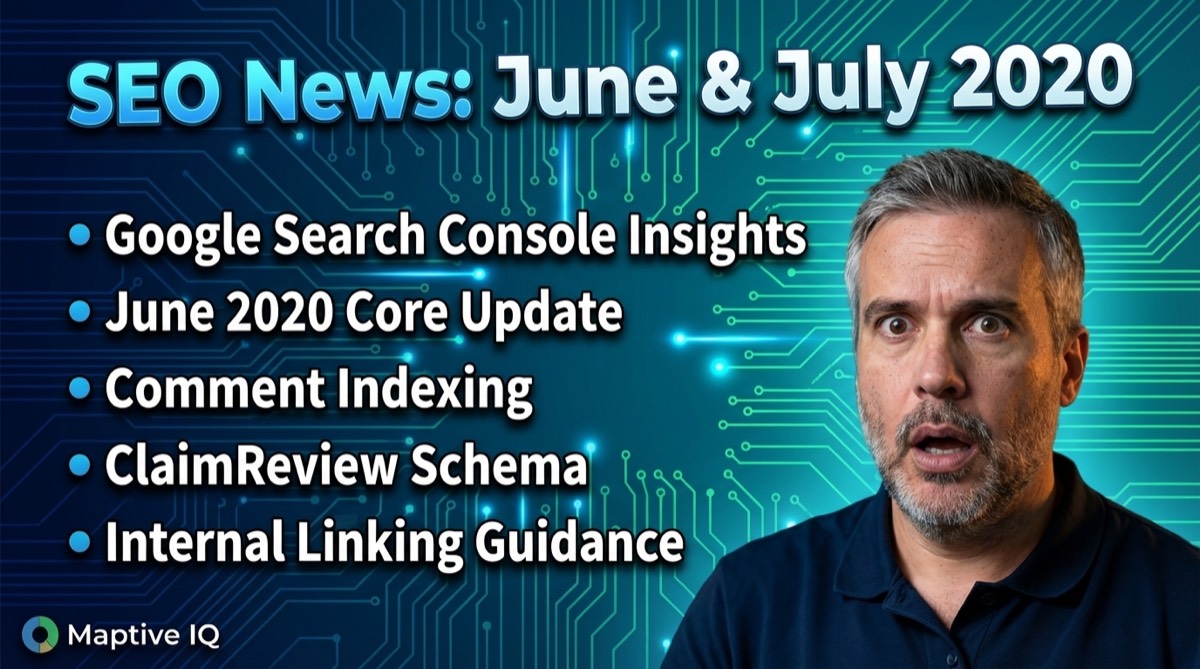
A structured recap of Google Search Console Insights, the June 2020 core update, comment indexing, ClaimReview schema, and internal linking guidance.

The mid-2020 period brought several meaningful changes to Google Search, from a new analytics layer to algorithm shifts that appeared to help smaller publishers. This article restructures the original update into a clearer reference guide, with practical takeaways for SEO teams who still want the strategic lessons from that period.
Google Search Console Insights Beta
A deeper integration with Analytics
Google launched the beta of Search Console Insights as a bridge between Search Console and Google Analytics data. The update mattered because it gave content creators a clearer view of what was happening across discovery channels instead of leaving search and engagement data in separate tools.
What Search Console Insights showed
- Page-view history: a quick visual read on traffic growth or decline over time.
- New content tracking: visibility into when Google first discovered a page and how many views it had earned since publication.
- Session-duration metrics: page views paired with engagement data over time.
- Traffic-channel breakdown: clearer separation of organic, social, referral, and direct traffic.
- Most popular content: a practical way to see which pages and topics were resonating most.
- Referring-link analysis: external sites sending traffic, plus view and duration context for those visitors.
- Social-platform detail: platform-level traffic breakdowns for Facebook, Instagram, and Twitter.
Why this mattered for SEO
The most interesting signal here was not just more reporting. It was the implication that Google was paying closer attention to traffic quality and engagement, not simply the existence of links. If a link sent visitors who immediately bounced, that was very different from a link that sent engaged readers into the site.
Takeaway: Prioritize links from active sites with real readership, and treat social distribution as a way to earn engaged visits rather than empty clicks.
Google Core Update on June 23, 2020
Correction window on June 27-28
Google rolled out a core update on June 23, 2020, followed by a correction window on June 27 and 28. The update created visible ranking movement across several sectors, and one of the most discussed patterns at the time was that smaller, more focused sites appeared to gain visibility.
Key observations from the update
- Smaller sites gained traffic: niche-focused publishers seemed to benefit in some cases, suggesting a recalibration around relevance and specificity.
- Google My Business messaging expanded: local businesses could enable a direct
Messagebutton inside their listing, opening a faster communication path from search.
The broader lesson was that Google continued rewarding pages that were clearer, more relevant, and more useful to a specific query set, rather than simply reinforcing the biggest domains by default.
Comment Indexing and Disqus Visibility
Starting around June 20, 2020, Google began indexing Disqus comments more consistently. That was important for publishers using Disqus because their comment sections were no longer just community layers. They could now affect how much topical relevance a page appeared to have.
In practice, this changed how comment sections should be managed:
- thoughtful comments could add useful context and depth
- spam comments could dilute the page with noise
- moderation became part of SEO hygiene, not just community management
If a site used Disqus, the quality of the discussion below the article became materially more important.
Structured Data and E-E-A-T
Google clarified during this period that structured data alone was not used to decide whether an author was an authority in a niche. Adding Person, Author, or related schema would not automatically improve E-E-A-T by itself.
That nuance matters:
- schema helps Google understand who created the content
- schema can help connect a person to their broader web presence
- authority still has to come from real-world signals such as credentials, publications, recognition, and experience
So the lesson was not that schema was unimportant. It was that schema supports authority verification; it does not replace genuine expertise.
ClaimReview Schema for Fact-Checking Images
Google introduced support around ClaimReview, including ways publishers could connect factual reviews to visual content. This was especially relevant to fact-checking publishers, research-heavy content, and image-led reporting.
The practical use case was straightforward:
- associate a claim with a review of that claim
- provide a verdict such as true, false, or misleading
- help search engines understand how the image or visual should be interpreted
For brands publishing research, case studies, or data visualizations, the opportunity was to make visual assets more trustworthy and more understandable in search.
Googlebot Crawling Geography
John Mueller also addressed a common concern about crawl traffic coming from unexpected countries. He confirmed that while Googlebot requests might appear from different global locations, the majority still came from the United States.
That meant server logs showing Googlebot activity from outside the US were not automatically a problem. The real takeaway was operational:
- do not block Googlebot traffic just because it appears to come from another country
- verify crawler legitimacy correctly before acting
- avoid server-level rules that accidentally interfere with normal crawling
Internal Linking Guidance from John Mueller
One of the most actionable points from this period was Mueller's confirmation that internal linking helps Google in two important ways:
- Discovery: internal links help Google find pages that might not be obvious through navigation alone.
- Context: anchor text helps Google understand what the linked page is about.
That reinforced a point experienced SEOs already knew: internal linking is not optional polish. It is a core part of how a site communicates structure and topical relationships.
Internal linking best practices
- Use descriptive anchor text instead of vague phrases like
click here. - Link from strong pages to important pages you want to rank.
- Build topic clusters that support pillar pages and related supporting content.
- Audit for orphan pages regularly and repair weak internal-link paths.
If Google cannot find or interpret a page through the site's own internal architecture, it is much harder for that page to perform well.
Summary Table
| Update | Why it mattered | Action for SEO teams |
|---|---|---|
| Search Console Insights Beta | Better visibility into content performance across search, referral, and social. | Monitor referral quality and engaged traffic, not just visits. |
| June 23 Core Update | Smaller, more focused sites appeared to gain visibility in some cases. | Double down on topical depth and niche expertise. |
| Google My Business Messaging | Created a faster direct communication path from local search. | Enable messaging where fast lead response matters. |
| Disqus Comment Indexing | User comments became more relevant to page content quality. | Moderate actively and treat comments as part of SEO quality control. |
| Structured Data and E-E-A-T | Schema helped understanding, but did not create authority by itself. | Use schema to support real expertise signals, not substitute for them. |
| ClaimReview Schema | Made fact-checking and visual credibility easier to surface in search. | Consider it for research, case-study, and verification-led content. |
| Googlebot Geography | Confirmed that crawl traffic can legitimately appear from different regions. | Do not block valid Googlebot requests based on country alone. |
| Internal Linking Guidance | Reinforced discovery and anchor-text context as real ranking inputs. | Audit internal-link architecture and fix orphan or weakly connected pages. |
Final Takeaway
June and July 2020 were not just a collection of small updates. Together, they pointed toward a more mature version of SEO: better measurement, cleaner site architecture, stronger content quality, and a clearer relationship between user experience and search performance.
For current-day teams, the most durable lessons from this period still hold:
- measure traffic quality, not just traffic volume
- treat internal linking as strategy, not cleanup
- use schema to support clarity, not to fake authority
- keep technical implementation tied to business outcomes
About the Author